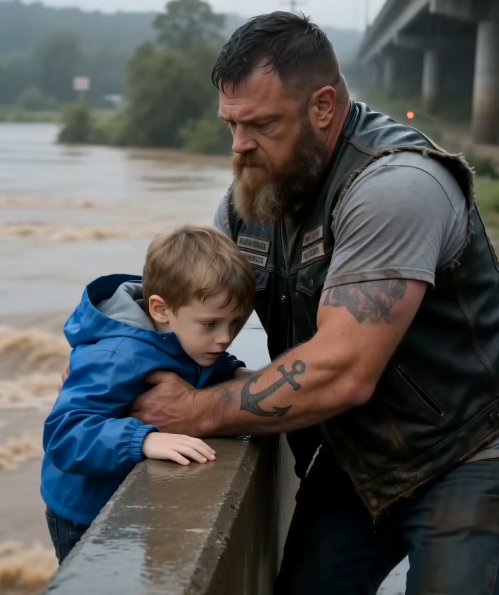
Part 2: A Biker Yanked an Autistic Boy Off a Flooded Bridge Railing, Shoved Him Into a Stranger’s Arms and Jumped the Police Tape Into the River—Then the Boy Who Had Never Spoken Said His Name
Part 2 — The Tape
“Uncle Jake?”
The word hung in the wet air under the Sycamore Street bridge.
My nephew Wyatt was eight. He’d been diagnosed with autism at three and had only ever said a handful of words. After the crash, he’d stopped talking altogether. I knew that much from what people whispered at the Elkins Walmart, the way people whisper about families that have been through something.
And he’d just said my name.
His mother, Amy, stood frozen on the riverbank with her hand over her mouth.
Then the black Cadillac Escalade pulled up at the end of the bridge, and my father got out.
Leland Cross was sixty-six, silver-haired and broad-shouldered, in a tan Carhartt jacket over a pressed shirt. He’s the Randolph County Commissioner. He owns Cross Motors on Harrison Avenue, the biggest car dealership between Elkins and Clarksburg. His face is on billboards all along Route 33. Leland Cross for State Senate.
He saw me, soaking wet, with his grandson standing behind my legs.
“Deputy,” he said, loud enough for every phone on the bridge, “that man killed my son. Get him away from my grandson. Now.”
The deputy, a young guy named Kyle Shreve, put me in handcuffs on the riverbank. Moose barked and barked. Wyatt made a high, thin sound and covered his ears.
Amy picked him up and turned away from me.
By nine p.m., the video had two million views. It wasn’t the part with the dog. It was the first eleven seconds, a giant soaked biker grabbing an autistic eight-year-old off a bridge railing while a woman screamed. Biker Grabs Autistic Child at Flooded Bridge. A Clarksburg news station used my old booking photo from three years ago, from when the State Police arrested me for vehicular homicide.
I sat in the Randolph County Jail on a charge of child endangerment and obstruction of emergency operations, and I made myself go back to that night.
March 14th, three years ago. Ryan had just been promoted to shift supervisor at the Tygart Valley sawmill. Dad threw him a dinner at the Elkins Country Club. I didn’t go. Dad and I hadn’t spoken in a year. I spent the night drinking at the Rusty Spur, then went home to my trailer on Isner Creek Road and passed out.
Here’s what I’ve never told anybody.
I don’t remember getting home.
My truck was parked at Dad’s house that week. Ryan had borrowed it to haul lumber. The keys were in the cupholder. The State Police said I took it. They said I drove Ryan home drunk, crashed into the guardrail on Route 33 near Beverly, and ran. My father swore to it. He said he watched me pull out of his driveway with Ryan in the passenger seat.
The jury hung. The charges were dropped. But in Randolph County, I’m still the man who killed his brother and left him to die.
And sitting in that cell, I made myself ask the question I’ve been running from for three years.
What if Dad was right?
What if I didn’t remember because I didn’t want to?
At midnight, a guard brought me a note. It was folded small, in pencil, written in the careful block letters of a child who’d never said a word.
UNCLE JAKE. MOOSE IS OK. GRANDPA WAS DRIVING.
Part 3 — Mama Tried
Ten summers ago, my brother’s backyard on Diamond Street in Elkins smelled like charcoal and fresh-cut grass.
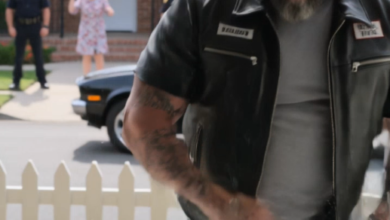
Ryan was twenty-six, with my same face, only kinder. We had matching tattoos on our left forearms, an old Navy anchor with an R and a J. Our granddad served on the USS Missouri. We got them the summer I turned eighteen.
That afternoon I’d just given him a yellow Lab puppy from a farm in Mill Creek. The puppy fell asleep on Ryan’s chest in a lawn chair.
“Moose,” Ryan said. “His name’s Moose.”
I taught that puppy one thing. A two-note whistle, high then low. Every time Moose heard it, he came running, no matter what.
“That’s your uncle’s whistle,” Ryan told the dog. “You hear that, you go.”
My old blue F-150 sat in his driveway. The cassette deck had been broken since 1998. One tape was stuck in it, and it was all it would ever play: Merle Haggard, Mama Tried, the original cassette. It started playing the second you turned the key, at full volume. There was no off switch and no volume knob that worked.
“That truck’s a jukebox with wheels,” Ryan laughed.
Dad hated that tape. He made me pull the fuse every time he rode in it. “I’m not listening to that hillbilly garbage,” he’d say.
When Amy brought baby Wyatt home a year later, Ryan put a booster seat in the back of my truck so we could take him fishing. Wyatt would sit back there and bounce to Mama Tried with his little hands over his ears, grinning.
That’s the truck my brother died in.
Nobody ever asked who pulled the fuse that night.
Part 4 — The Bartender
My father came to see me at the Randolph County Jail himself, the next morning, with his lawyer and his campaign manager.
“I asked the prosecutor to drop the child endangerment charge,” Leland said, sitting down across the glass. “Amy asked me to. She says you saved the dog. I’m not a monster, Jake.”
His lawyer slid a folder under the slot.
It was the West Virginia State Police crash report from March 14th, three years ago, the original one. Vehicle: 1997 Ford F-150, registered owner Jacob Cross. Driver: fled scene. Passenger: Ryan Cross, deceased. Rear passenger: minor child, Wyatt Cross, age 5, minor injuries.
Then there was a sworn statement from Leland Cross. I observed my son Jacob take the keys from the cupholder and drive away from my residence at approximately 11:50 p.m. with my son Ryan and my grandson in the vehicle. Jacob was visibly intoxicated.
Then there was a statement from the Rusty Spur’s bartender, a woman named Darla Hinkle. Jake Cross left the bar at approximately 11:40 p.m., highly intoxicated. He said he was going to “get his truck back from his daddy.”
“That’s ten minutes, Jake,” my father said quietly. “The Rusty Spur is eight minutes from my house.” He shook his head. “You said it yourself to the State Police. You don’t remember.”
The last page was a note in a child’s handwriting, my nephew’s note from the night before. GRANDPA WAS DRIVING.
“Amy found this in your jail property bag this morning,” Leland said. “The deputy showed her.” He sighed heavily. “Jake, Wyatt is autistic. He can’t tell the difference between what he saw and what he’s been told. He’s eight. He was five that night. Since the crash, he’s drawn me in every picture. Me holding his hand. Me pushing him on the swing. Me in the truck.” He wiped his eyes. “I’m the only grandfather he has. Of course he puts me in everything.”
His campaign manager leaned forward.
“Mr. Cross, your father is running for state senate. That video of you grabbing Wyatt is everywhere. If you try to use a confused autistic child to smear him, it’s going to look very, very bad for you.”
My father stood up.
“Ryan loved you,” he said. “God knows why. Stay away from his boy.”
I sat in that room after they left, staring at Darla Hinkle’s statement.
He said he was going to get his truck back from his daddy.
I didn’t remember saying that.
But I didn’t remember anything after eleven o’clock that night.
Maybe I did get my truck back. Maybe Dad was telling the truth, and a five-year-old with autism had mixed it all up.
But one thing in the State Police report didn’t fit.
Rear passenger: minor child, Wyatt Cross, age 5.
My father had just told me Wyatt drew him in the truck.
If Wyatt was sitting in the back seat, he’d have seen exactly who was behind the wheel.
Part 5 — The Fuse
I made bond that afternoon. The child endangerment charge was dropped, but the obstruction charge stuck. My club brother Earl Lanham picked me up in his pickup with Moose in the back seat.
“Amy dropped him off at the clubhouse an hour ago,” Earl said. “She said Wyatt wanted you to have him for a few days. She wouldn’t say anything else.”
Moose climbed into my lap and wouldn’t get off.
That night I called a lawyer named Ruth Ann Mabry. She handles appeals out of Morgantown. She’d read about my case three years ago and always thought the State Police rushed it.
“Jake,” she said, “let’s start with the truck.”
My old F-150 was still sitting in Earl Lanham’s salvage yard on Route 250, where the State Police released it after the trial. Nobody wanted it.
Ruth Ann drove down from Morgantown with a retired State Police accident reconstructionist named Sergeant Dale Pritt. Dale crawled into the cab with a flashlight while Ruth Ann took pictures.
“Driver’s seat is locked about four inches forward of where a man your size would sit,” Dale said. “Jake, you’re six-four. You couldn’t have driven this truck without your knees in the steering column.” He pointed. “That seat position fits a man about five-nine or five-ten.”
My father is five-nine.
Then Dale pulled open the fuse panel under the dash.
The fuse for the radio was missing.
“Somebody pulled it,” he said. “Before the crash. There’s dust on the empty slot, no impact damage.”
Dad always made me pull that fuse. Nobody else cared about that tape.
Then Ruth Ann found the hospital record.
Leland Cross had gone to Davis Medical Center in Elkins the morning after the crash, at 7:15 a.m. He said he’d “slipped on the ice on his porch.” The ER nurse documented a diagonal contusion across left shoulder and chest consistent with seatbelt restraint.
A driver’s seatbelt crosses the left shoulder.
There was also an insurance claim. Three weeks after the crash, Leland Cross filed a claim with Nationwide on his own Cadillac Escalade for a dented front bumper. Then he quietly withdrew it the next month.
The last piece was the money.
After Ryan died, his employer’s life insurance paid $600,000 into a trust for Wyatt. A wrongful-death settlement from the state, over a defective guardrail on Route 33, added another $480,000. Leland Cross was named trustee. Ruth Ann filed for an accounting.
Over three years, $390,000 had moved out of Wyatt’s trust as “loans” to Cross Motors and to a political action committee called Randolph County Forward.
That committee was paying for my father’s state senate billboards.
“He used his dead son’s money to run for office,” Ruth Ann said quietly. “And his grandson’s autism therapy is being paid for out of the same trust. If anyone looks too closely at the crash, the trust gets frozen, the campaign dies, and he goes to prison.”
I sat in my kitchen with Moose’s head on my knee, staring at the seatbelt photo.
My father had driven my brother and my nephew home drunk. He put my truck in a guardrail. He pulled himself out, left his son dying in the passenger seat, and walked home a mile in the dark. In the morning, he told the State Police I did it.
Then he raised Ryan’s boy on Ryan’s money.
“We take this to the State Police,” Ruth Ann said.
That’s when my phone buzzed. It was a text from an unknown number.
Leave it alone, son. You don’t want to find out what Amy did.
Part 6 — The Petition
On Monday, my father filed a petition in Randolph County Circuit Court for emergency guardianship of his grandson.
The petition said Amy Cross was “unable to protect the child from a dangerous relative.” It said Amy had “allowed Jacob Cross, a man previously charged in her husband’s death, unsupervised contact with the minor and his emotional support animal.” It attached the bridge video.
The judge, a man my father had played golf with for twenty years, scheduled a hearing for Thursday.
Ruth Ann took everything to the West Virginia State Police barracks in Elkins: the seat position, the fuse, the hospital record and the trust accounting. A sergeant said he’d “forward it to Charleston.”
“That could take months, Jake,” Ruth Ann said in the parking lot. “And there’s a problem. The DA says a three-year-old crash with a hung jury is a ‘low priority.’ The only living witness is an autistic child who doesn’t talk.”
“He talked to me.”
“Two words.” She looked tired. “A defense lawyer will say you coached him.”
By Tuesday, Randolph County had turned on me again. Somebody spray-painted BROTHER KILLER on the door of my motorcycle repair shop on Randolph Avenue. My father’s campaign posted a statement on Facebook: Our family is once again being targeted by a troubled relative. We ask for prayers and privacy.
The State Police came Wednesday morning with an order signed by a magistrate. They took Moose from me. Emotional support animal belonging to the minor, held pending guardianship proceedings.
Moose barked all the way down the driveway in the back of a county animal control truck.
Thursday morning, at the guardianship hearing, Amy sat in the back row of the courtroom with her head down. She didn’t look at me once.
The judge granted my father temporary guardianship of Wyatt.
My father walked out of the courthouse with his grandson’s hand in his. Wyatt kept looking back at me over his shoulder with those big gray eyes, covering his ears with his free hand.
That night I sat alone in my shop on Randolph Avenue with BROTHER KILLER dripping red paint on the door.
At eleven p.m., someone knocked.
It was Amy.
She was holding a thick manila folder and shaking.
“Jake,” she said, “he’s right. There’s something I did. And you need to hear it from me.”
Part 7 — The Drawings
Amy sat on an overturned paint bucket in my shop and opened the folder.
Inside were drawings. Dozens of them, in crayon and marker, on printer paper, construction paper and the backs of envelopes.
They all showed the same thing.
A blue truck. A big stick figure with gray hair behind the steering wheel. A smaller figure in the passenger seat. A tiny figure in the back, with his hands over his ears.
And above the gray-haired driver, every single time, Wyatt had drawn a little musical note with a big red X through it.
“He started drawing these two weeks after the crash,” Amy whispered. “He drew one every day for a year. His therapist asked me what the X meant. I said I didn’t know.”
She pressed her hands over her face.
“I knew, Jake. I knew the second I saw the first one. Your dad always pulled that radio fuse because he hated Ryan’s tape. Wyatt loved that tape. He’d cry if you turned it off.” Her voice broke. “And there was no music that night.”
“Why didn’t you tell anyone?”
“Because Leland came to my house the day after the funeral,” she said. “He sat at my kitchen table and told me he’d pay for everything. Wyatt’s ABA therapy is sixty thousand dollars a year, Jake. His speech therapist. His special school in Buckhannon. I’m a dental hygienist. I couldn’t pay for any of it.” She looked at me with red eyes. “He never said it out loud. He didn’t have to. If I said anything about the drawings, the money stopped. And Wyatt would lose everything.”
She pulled one more thing out of the folder. It was the photo from under her sweaters, of Ryan and me at nineteen and twenty-one, laughing on the tailgate of my blue F-150.
“I kept this because Ryan loved you,” she said. “I showed it to Wyatt once, the day he turned seven. I told him, ‘This is your Uncle Jake. Daddy’s brother. Someday, maybe.'” She swallowed. “I didn’t think he remembered. He never looked at anything for more than a second.”
“And then you let a courtroom believe I killed my brother.”
“Yes.” Amy didn’t look away. “I let you carry it for three years. So my son could have therapy. I’m not going to pretend that’s okay.”
I looked at the drawings spread across the floor of my shop. A little boy who couldn’t speak had told the truth the only way he could, over and over, every day for a year. Every grown-up around him had looked the other way, me included. I’d stayed drunk and angry instead of fighting for him.
“I let it happen too,” I said. “I let everybody believe it because I couldn’t remember. I figured I deserved it.”
Amy wiped her eyes.
“Leland’s holding a campaign rally Saturday,” she said. “At the riverfront park, right by the Sycamore Street bridge. Wyatt’s supposed to be on stage. Leland wants the photo. The grieving grandfather and the autistic grandson the ‘violent biker’ tried to hurt.” She hesitated. “It’s livestreamed. Channel 12 will be there.”
“And Moose?”
“Leland’s bringing him too,” Amy said quietly. “For the cameras.”
Could a little boy who’d only ever said two words tell four hundred people the truth?
Part 8 — The Whistle
The Elkins riverfront park sits on the bank of the Tygart Valley River, a hundred yards upstream from the Sycamore Street bridge. The flood had gone down by Saturday. The water ran brown and slow, and the grass was still muddy.
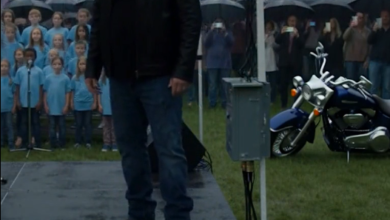
Four hundred people stood in front of a flatbed-trailer stage hung with LELAND CROSS FOR STATE SENATE banners. A Channel 12 news camera from Clarksburg sat on a tripod. The campaign was livestreaming on Facebook.
My father stood at the podium in a navy blazer with Wyatt beside him in a little button-down shirt. Moose sat at the boy’s feet on a short leash.
Amy stood at the edge of the stage with Ruth Ann Mabry and Sergeant Dale Pritt.
Along the bridge railing a hundred yards away, thirty-one bikers stood in a quiet line in their leather vests, arms crossed.
I stood at the end of the bridge, exactly where I’d grabbed Wyatt off the railing a week before.
“Three years ago,” my father said into the microphone, his voice breaking, “my son Ryan died on Route 33 because of a drunk driver. My own son.” He put his hand on Wyatt’s shoulder. “And last week, that same man grabbed my grandson on this very bridge. I’m running for the state senate to make sure no family in West Virginia has to live in fear like we do.”
The crowd applauded.
Ruth Ann stepped up to the edge of the stage with a microphone the campaign hadn’t given her.
“Mr. Cross,” she said, “the night of the crash, you told the State Police you watched Jake pull out of your driveway in his truck. Did you hear anything as he drove off?”
My father smiled patiently, the smile on all the billboards.
“I heard that engine roar out of my driveway, ma’am. That’s all.”
“No music?”
“No.”
“Jake’s truck had a cassette player that came on automatically at full volume,” Ruth Ann said. “Merle Haggard. Everybody in Elkins knew that truck. You could hear it from a block away.”
My father laughed into the microphone, easy.
“Lord, that tape. Mama Tried. No, ma’am. There wasn’t any music that night. I’d pulled the fuse myself so I wouldn’t have to listen to that garbage all the way down 33 with Ryan and—”
He stopped.
The riverfront went silent.
Sergeant Dale Pritt stepped up beside Ruth Ann.
“Mr. Cross,” he said, “you just told four hundred people you pulled the radio fuse yourself before driving down Route 33 with Ryan. The radio fuse was missing from that truck. The driver’s seat was set for a man your height. And Davis Medical Center documented a driver’s seatbelt bruise across your left shoulder the next morning.”
Amy stepped onto the stage and held up a sheaf of crayon drawings for the Channel 12 camera. There was a blue truck and a gray-haired man at the wheel. A little boy in the back had his hands over his ears, and over the driver was a musical note with a big red X.
“Your grandson drew this every day for a year, Leland,” she said, her voice shaking. “No music. You.”
Four hundred people turned to look at the man at the podium.
My father’s face went gray.
He reached down and grabbed Wyatt’s hand hard and started pulling him toward the back of the stage.
Wyatt planted his feet. His hands flew to his ears.
I put two fingers in my mouth, the way I did ten summers ago in a backyard on Diamond Street.
Two notes. High, then low.
Moose’s head snapped up. He tore his leash right out of my father’s hand and bolted off the stage, across the muddy grass, straight toward the bridge.
Wyatt ran after him.
He pulled free of his grandfather and ran past four hundred people and the Channel 12 camera, after his dog, toward the man standing at the end of the bridge.
Moose reached me first.
Wyatt reached me second.
He stopped two feet away, out of breath, with his hands still over his ears. He looked up at my face.
Then he lowered his hands.
What was he going to say?
Part 9 — The Railing
“Grandpa drove,” Wyatt said.
His voice was small and hoarse from three years of silence, but it carried clearly across the riverfront and through the Channel 12 microphone.
“Grandpa drove. No music. Daddy said, ‘Slow down, Dad.'”
He looked down at Moose.
“Then the truck went boom.”
Behind him, on the stage, Sergeant Dale Pritt took my father by the arm.
Leland Cross was indicted by a Randolph County grand jury that fall. The charges were vehicular homicide, leaving the scene of a fatal crash, perjury, obstruction, and misappropriation of trust funds. The State Police reopened everything. Darla Hinkle, the bartender, admitted my father had paid her $2,000 three years earlier to change the time on her statement. I’d actually left the Rusty Spur at 10:15.
Leland pleaded guilty in the spring. He was sentenced to fifteen years. He withdrew from the state senate race. Cross Motors was sold to pay back every dollar he’d taken from Wyatt’s trust.
My vehicular homicide case was formally dismissed with prejudice. The Randolph County prosecutor said it out loud at the courthouse, on Channel 12. Jacob Cross did not cause his brother’s death.
Amy told the court everything about the drawings and the money. She wasn’t charged. She sees a counselor every Tuesday in Buckhannon. She asked me to sit in on one session. I did. We both cried. We didn’t fix everything, but we started.
Wyatt’s trust was moved to a court-appointed trustee. His therapy never stopped for a single day.
Wyatt talks now. Not a lot. Mostly about Moose, trucks, and Merle Haggard. His speech therapist says that’s exactly how it starts.
Last week, on a clear evening in June, Amy, Wyatt, Moose and I walked down to the Sycamore Street bridge.
The Tygart Valley River was low and green and quiet, sparkling in the last of the sun.
Wyatt walked to the railing, the same spot where I’d grabbed him a year earlier with fifty people screaming at me.
He looked up at me.
“Lift me,” he said. “I want to see.”
So I did. I put my hands under his arms and lifted him, slowly and gently, until he could see over the railing to the calm water below.
Moose put his paws up on the railing beside him and wagged his whole body.
Wyatt looked down at the river for a long time. Then he reached over and touched the anchor tattoo on my forearm, the R and the J.
“Daddy had this,” he said.
“He did, buddy.”
He traced the R with one finger, very carefully.
Then he looked at me, and for the first time, I saw my brother’s grin on his face.
“Uncle Jake,” he said. “Can you whistle for Moose?”
I put two fingers in my mouth and whistled. Two notes, high, then low.
Moose barked and spun in a circle on the bridge.
Wyatt laughed out loud, a real laugh, bright and clear, out over the Tygart Valley River where everyone could hear it.
“Again,” he said.
So I whistled again.
If Jake and Wyatt’s story stayed with you, follow our page. We’ve got a lot more biker stories coming, and some of them hit even harder than this one.