Part 2: A Biker Was Caught Giving Money to a 10-Year-Old Boy — Then Police Saw the Drawings Hidden Behind His Back
Part 2
My name is Officer Daniel Reed, and I have learned that parking lots tell stories faster than people do.
A man leaning into a car window becomes a threat before you know he is asking for directions. A teenager running becomes guilty before you know his little brother fell. A biker handing money to a child becomes the kind of call that makes every officer’s pulse change before the door even opens.
That afternoon, I saw the vest first.
That is the truth.
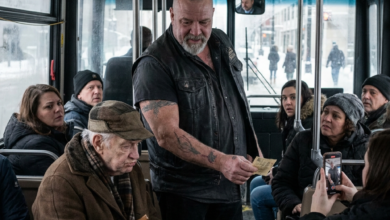
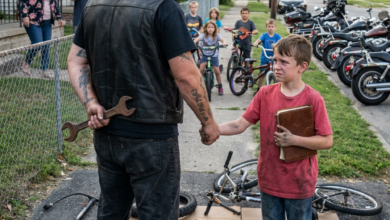
Wade Mercer was not doing anything aggressive. He was standing still, hands low, body turned slightly sideways so he would not crowd the boy. But he was big, rough-looking, and close to a child who looked terrified, which meant my mind moved through every bad possibility before it reached a decent one.
Jonah Brooks saw my uniform and froze harder than Wade did.
That bothered me.
Children who are safe often look relieved when police arrive. Jonah looked like my presence had put the last thing he owned at risk.
“Is this man bothering you?” I asked him.
Jonah shook his head too quickly.
“No, sir.”
“Do you know him?”
“No, sir.”
I looked at Wade.
He nodded once.
“That’s true.”
The woman by the SUV came closer, still holding a grocery bag against her hip.
“I saw him give the boy money,” she said. “A lot of money.”
Wade kept his eyes on me.
“I did.”
“For what?” I asked.
Jonah pressed the drawings to his chest.
Wade answered before the boy had to.
“For these.”
He held up a wrinkled drawing of a brown dog with one eye bigger than the other, standing under a yellow sun that looked more like a fried egg. It was not good in the technical sense. The lines shook. The colors ran outside the shapes. The paper had been folded and unfolded too many times.
But Jonah watched that drawing like it was a paycheck.
Not a school project.
Not a joke.
A paycheck.
I turned to him more gently.
“Jonah, why are you selling drawings in a parking lot?”
He looked toward the grocery store doors, then down at his shoes.
“My mom needs medicine.”
The woman by the SUV stopped breathing for a second.
Wade looked away.
And I understood, all at once, that we had walked into the middle of a child doing the only adult thing he knew how to do.
Part 3
Jonah had been in the parking lot for almost two hours.
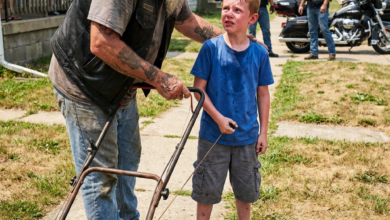
He had not set up a table because he was afraid the store would make him leave. He had not made a sign because he thought a sign would look too much like begging. Instead, he stood near the cart return with a folder tucked under one arm, waiting for adults to slow down long enough for him to say one sentence.
“Do you want to buy a drawing?”
Most people did not hear him.
Some pretended not to.
One man laughed and said, “Kid, nobody buys crayon pictures.”
Jonah kept standing there anyway.
That detail hurt me more after I knew it.
He had drawn thirty-two pictures on notebook paper because that was what he had. Dogs, cars, houses, birds, flowers, superheroes, one motorcycle he had copied from a magazine cover, and several pictures of his mother before she got sick, standing in front of their apartment with a red scarf around her hair.
His mother’s name was Marlene Brooks.
She was thirty-four, Black American, a home health aide who had missed work after a severe infection turned into a hospital visit, then turned into bills, then turned into a prescription she could not afford until Monday. Jonah did not understand insurance gaps, clinic paperwork, pharmacy delays, or why adults kept telling his mother to wait.
He only understood that she had been shivering under a blanket that morning.
So he drew.
Then he walked to Carter’s Market because more people came there than anywhere near their apartment.
Wade had found him after buying a pack of coffee, motor oil, and a cheap sandwich he never ate.
At first, Wade walked past like everyone else.
Then he heard the boy say, almost too softly, “Drawings for sale.”
Wade stopped.
Jonah lifted the folder with both hands.
“They’re one dollar.”
Wade looked at the stack.
“All of them?”
Jonah blinked.
“No, sir. One dollar each.”
Wade crouched slightly, not close enough to scare him.
“How much for the whole gallery?”
Jonah’s mouth opened, then closed.
He did not know if the biker was making fun of him.
“Thirty-two dollars,” he whispered.
Wade pulled out three hundred and twenty dollars.
That was the moment the woman saw.
That was the moment the call became a fear.
And that was the moment Jonah believed the money might be taken away before his mother ever saw help.
Part 4
I asked Wade why he paid ten times the price.
He did not answer immediately.
Some men give kindness loudly because they want witnesses. Wade gave his like he was embarrassed anyone had noticed. He folded his hands in front of him, tattooed fingers locked together, and looked at the drawings instead of at me.
“Because he asked a fair price,” he said.
“That doesn’t explain ten times.”
“No.”
The woman by the SUV shifted awkwardly.
Jonah looked from Wade to me, still waiting for the world to decide whether his small business was allowed to exist.
I softened my voice.
“Jonah, did he ask you to go anywhere with him?”
“No, sir.”
“Did he touch you?”
“No, sir.”
“Did he say anything that scared you?”
Jonah looked at Wade.
Then he shook his head.
“He said my dog drawing had honest ears.”
Wade cleared his throat.
“It does.”
I almost smiled, but the situation was too fragile for that.
The store manager came out then, a white American woman in her late forties named Paula Greene, worried and already apologizing because someone had told her a biker was paying a child in the parking lot. She looked at Jonah’s folder, the bills, and the circle of adults who had all arrived too late to see the truth first.
“I didn’t know he was out here,” she said.
Jonah’s shoulders tightened.
“I wasn’t bothering anybody.”
Paula’s face changed.
It was not guilt exactly.
It was recognition.
The kind adults feel when a child says something small enough to reveal how many times he has been moved along.
Wade took the drawings from Jonah carefully, as if they were worth what he had paid.
Then he handed the money back to the boy, folded and neat.
“Your work’s paid for,” he said. “Now we make sure your mom gets help.”
Jonah looked afraid again.
“No hospital. She said hospitals cost too much.”
That sentence landed in the parking lot heavier than any accusation against Wade had.
I looked at the boy.
“Is your mom alone right now?”
Jonah nodded.
That changed everything.
A child selling drawings was not just a sad story anymore.
It was a medical welfare check waiting to happen.
Part 5
We did not put Jonah in the back of a patrol car like he had done something wrong.
I told him that first.
“You’re not in trouble,” I said. “Your mom isn’t in trouble for being sick either.”
He studied my face, deciding whether adults could be trusted when they used gentle voices. Wade stood nearby holding the folder of drawings under one arm, his motorcycle forgotten behind him. The woman who had called looked like she wanted to disappear into her SUV.
To her credit, she did not.
“I’m sorry,” she said to Jonah.
Jonah did not answer.
Children do not owe adults comfort after being misjudged.
Paula, the store manager, asked for five minutes and came back with a paper bag filled with soup cups, bottled water, crackers, fruit, and a small box of colored pencils. She gave the bag to Jonah, but not in a way that made him feel like a charity case.
“For your next collection,” she said, tapping the pencils.
Jonah held the box like he was not sure whether he was allowed to keep something new.
Wade saw that too.
I called for a paramedic unit to meet us at Jonah’s apartment for a non-emergency medical check. Then I asked Jonah if he wanted Wade to come with us or stay behind.
That might sound like a strange question.
But sometimes a child knows who made him feel seen before any official process began.
Jonah looked at Wade.
“Can he bring the pictures?”
Wade nodded.
“Yes, sir.”
So we went.
I drove behind Paula’s assistant manager, who took Jonah in her car because he already knew her from the store. Wade followed on his motorcycle at a respectful distance, and the woman who had made the call drove behind him with groceries she had suddenly decided Jonah and his mother might need.
Their apartment building was three blocks away.
Old brick.
Bad stairs.
A hallway light that flickered like it was tired too.
Marlene Brooks was inside on the couch, wrapped in a blanket, feverish, embarrassed, and terrified when she saw a police officer at her door.
Jonah ran to her first.
“I sold them,” he said, holding up the money. “All of them.”
Marlene looked at the bills.
Then at Wade standing in the hallway with the drawings pressed to his chest.
And she began to cry in a way that sounded like apology and relief breaking at the same time.
Part 6
The paramedics checked Marlene while everyone else waited in the hallway.
That hallway became one of the strangest rooms I have ever stood in. A biker with a folder of children’s drawings. A grocery store manager holding soup. A woman who had called police holding two bags of food like penance. A ten-year-old boy sitting on the floor, hugging his knees, trying to listen through the apartment door without looking scared.
Wade sat down beside him.
Not too close.
Just close enough.
Jonah looked at the folder.
“Are you really keeping them?”
Wade nodded.
“Bought them, didn’t I?”
“They’re not that good.”
Wade’s face changed, not dramatically, but enough that I noticed.
“Who told you that?”
Jonah shrugged.
“Kids.”
Wade looked down the hallway for a long second.
Then he removed one drawing from the folder. It was the motorcycle, drawn in black crayon with wheels too big and handlebars too high.
“This one’s my favorite,” he said.
Jonah looked skeptical.
“It doesn’t look real.”
“Neither did my first one.”
“You draw?”
“Used to.”
That surprised me too.
Wade pulled out his wallet and removed a folded, yellowed piece of paper from behind his license. He opened it carefully. Inside was a child’s drawing of a motorcycle, worse than Jonah’s by far, with square wheels and a rider shaped like a potato.
Jonah stared.
“You kept that?”
“Forty-three years.”
“Why?”
Wade smiled faintly.
“Because I was a kid who thought his ugly drawings weren’t worth anything either.”
That was when the real reason came out.
Wade had grown up poor in Toledo, raised by a grandmother who cleaned offices at night. He used to draw motorcycles because he wanted one more than anything. One day, a mechanic bought his drawing for five dollars, then taped it to the shop wall. Not because it was good, but because the boy who made it needed to believe something from his hands could have value.
“That five dollars didn’t fix my life,” Wade said. “But it changed what I thought I was allowed to become.”
Jonah listened without blinking.
Inside the apartment, the paramedic opened the door.
Marlene needed treatment, but not panic. Transport was recommended. Assistance programs could help with the prescription. A clinic social worker would meet them at the hospital.
Jonah looked at his mother.
Then at Wade.
“Can I bring my pencils?”
Wade handed him the new box.
“Artists travel with tools.”
For the first time all day, Jonah smiled.
Part 7
The drawings did not disappear into a folder.
Wade framed them.
Not all in fancy frames, because he said that would make them look like they belonged to someone else. He bought simple black frames from a discount store and hung them on one wall of his motorcycle repair shop, right above the waiting bench where customers drank bad coffee and argued about weather.
At the top, he placed a small handwritten sign.
Jonah Brooks — First Collection. Sold Out.
When Jonah saw it two weeks later, he stood in front of that wall for almost ten minutes without speaking.
Marlene stood behind him, healthier now, still tired, but upright. The hospital had connected her with a clinic, medication assistance, and a caseworker who knew which forms mattered before a crisis became a disaster. Paula from Carter’s Market had helped her apply for a part-time cashier position once she recovered. The woman who had called police dropped off groceries twice, then finally asked Marlene if she could apologize properly.
Marlene let her.
Not because she had to.
Because she chose peace over carrying one more heavy thing.
Officer Reed visited the shop a month later and bought a new drawing from Jonah, who had started making them on thicker paper with colored pencils. This one showed a police cruiser, a motorcycle, a grocery store, and a boy standing between them with a folder in his hands.
“How much?” Officer Reed asked.
Jonah looked at Wade.
Wade said nothing.
That mattered.
Jonah stood taller.
“Five dollars.”
Officer Reed paid ten.
Jonah started to hand back change.
The officer shook his head.
“Gallery tax.”
Jonah laughed.
That laugh felt like a repaired thing beginning to move again.
Years from now, maybe Jonah will become an artist. Maybe he will not. Maybe he will draw motorcycles forever, or maybe he will forget about colored pencils once life gives him other tools. That is not the point of this story.
The point is that one afternoon, in a grocery store parking lot, a biker handed money to a frightened boy and the world almost mistook kindness for danger.
But the truth was simpler.
A child had put a price on something he made.
A grown man believed him.
And sometimes that is the first rescue.
Follow the page for more stories about the people we almost judged before we finally saw them.