Part 2: A Biker Snatched a Loaf From a Hungry Boy and Smashed It on the Street—Then a Shard of Glass Fell Out and Closed His Own Bakery
Part 2 — The Biker Who Learned Dough in Prison
Before Ray Dawson opened a bakery, he broke a man’s jaw.
The fight happened outside a Tulsa bar when Ray was twenty-four. Alcohol, pride, and years of untreated anger turned an argument into violence that left another man hospitalized.
Ray served time.
He did not emerge transformed by a single lesson or grateful speech. He entered prison furious and spent his first months searching for someone else to blame.
Then he was assigned to the kitchen.
The head baker was an older incarcerated man named Ezekiel Price, who had worked in commercial bakeries before addiction and theft dismantled his life.
Ezekiel did not care that Ray rode motorcycles.
He cared whether Ray weighed flour correctly.
The first loaf Ray made collapsed.
Ezekiel placed it before him.
“What went wrong?”
“Oven.”
“No.”
“Yeast.”
“No.”
“Then tell me.”
Ezekiel pushed the dense loaf closer.
“You rushed what you couldn’t punch.”
That sentence stayed.
Bread required pressure but not violence, heat but not rage, time without control. Ray could shape dough, but he could not force fermentation to obey fear.
He learned patience through repetition.
After release, Ray returned to motorcycle repair because engines were what he understood. He stayed sober, paid restitution, and opened Dawson Iron Works inside a former transmission shop along old Route 66.
He baked at night.
At first, bread went only to club brothers. The Iron Lanterns complained that Ray’s early loaves could be used as wheel chocks.
Tiny Ruiz ate them anyway.
As Ray improved, he supplied a church breakfast, then a veterans’ shelter, then families waiting outside a free clinic.
Ezekiel died before release.
Ray received one final recipe through the prison chaplain: a basic wheat loaf with instructions written in block letters.
At the bottom, Ezekiel added:
FEED SOMEBODY WHO CAN’T PAY YOU BACK.
Ray opened Dawson Bread & Iron beside the garage seven years later.
The front half smelled of yeast, coffee, and toasted grain. The rear wall shared brick with the motorcycle shop, where V-twin engines, tools, leather, gasoline, and chain grease created an entirely different language.
Ray moved between both worlds.
At three in the morning, he wore an apron.
By eight, the leather vest returned.
The bakery’s business model barely worked. Paying customers covered wages and ingredients, while day-old bread supported neighborhood food tables.
Ray refused publicity built around charity.
“Bread ain’t charity if the photographer eats first,” he said.
Luis’s neighborhood relied on those loaves.
Marisol worked as a school cafeteria assistant and cleaned offices at night. Her rent rose twice in one year, while groceries became a calculation of days rather than meals.
Luis never called his family poor.
He said Mondays were cereal days and Fridays were creative dinner.
His little sister Camila was six.
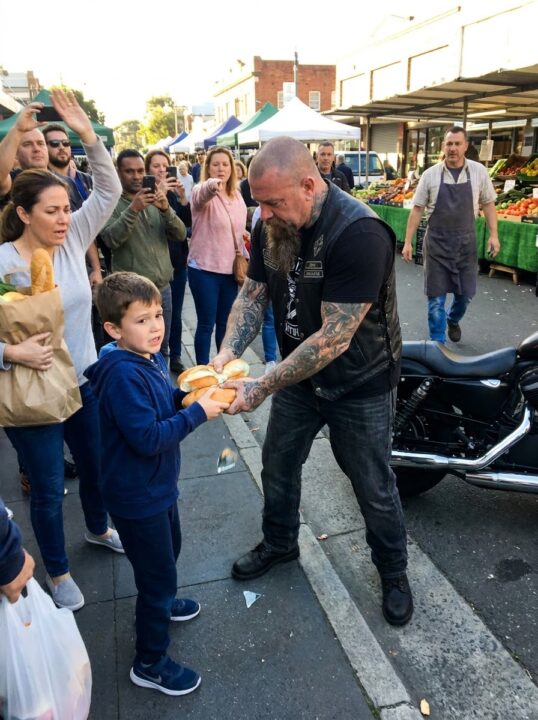
The loaf Ray knocked from his hands had been intended for both children. Luis planned to eat one end at the market and carry the rest home.
That truth reached Ray later.
It made the broken loaf heavier.
The contamination began at 3:52 Saturday morning.
A large glass flour-storage jar slipped from a shelf near cooling rack four. It shattered across the floor several feet from uncovered bread.
The bakery manager stopped production in that section.
Workers discarded exposed ingredients, isolated nearby loaves, cleaned according to procedure, and marked rack four with a blue line while awaiting inspection.
The response should have worked.
It failed because the marking system was unclear.
A seventeen-year-old assistant named Owen believed the blue line indicated bread designated for donation. He moved one crate to the delivery staging area before another worker stopped him.
The staff believed every loaf had been returned.
One had already left with a volunteer driver.
No single villain existed.
There was a broken jar, a confusing mark, a tired teenager, a hurried supervisor, and a system without a final two-person count.
Ray’s name remained on every bag.
That was why he refused to sacrifice Owen.
Brotherhood was about to be tested by the easiest solution available:
Blame the smallest person in the room.
Part 3 — The Crowd Around the Broken Loaf
When the glass struck the pavement, three reactions occurred at once.
Marisol pulled Luis behind her.
The produce vendor demanded someone call police.
Ray ordered every Dawson loaf removed from the market.
The second reaction mattered most.
People began checking bread already purchased. Bags opened across the square. Parents pulled pieces from children’s hands, and fear spread faster than facts.
Ray climbed onto the edge of the market platform.
He did not have a microphone.
He did not need one.
“Don’t eat any bread carrying my blue band,” he said. “Put it back in the bag. Do not search through it with bare hands. Riders will collect it.”
A woman shouted, “How much glass is inside?”
“Don’t know.”
“Is all your bread contaminated?”
“Don’t know.”
“Then why sell it?”
“Didn’t know.”
The answers sounded inadequate because they were honest.
Ray could have claimed only one loaf was affected. He refused certainty he did not possess.
The Iron Lanterns divided into teams.
Tiny collected market bread. Clay Maddox contacted shelters and churches. Cole Mercer’s son, who managed deliveries, retrieved the route sheet from the bakery.
The motorcycles remained parked where they stood.
Riders used trucks and sealed containers for collection rather than stuffing potentially contaminated food into saddlebags.
Police arrived because several witnesses initially reported a biker attacking a child.
Luis told them Ray saved him.
Marisol said the same.
The officers documented the incident and focused on keeping the area controlled while health officials responded.
The bakery manager arrived carrying the rack-four production log.
His face looked hollow.
“We found the blue crate.”
“Empty?” Ray asked.
“One loaf missing.”
Ray pointed toward the pavement.
“Found it.”
“That means the rest never left.”
“Prove it.”
“We counted.”
“Count again.”
The manager lowered his voice.
“If we recall everything, we’re done.”
Ray looked toward the growing stack of returned bread.
“Maybe.”
“Forty-two employees depend on this place.”
“Kid depended on us first.”
The manager turned toward Marisol.
She flinched.
Ray noticed.
“Don’t look at her.”
“I’m not blaming—”
“You’re looking for a cost smaller than ours.”
The bakery closed voluntarily before inspectors ordered it.
Every customer with a receipt received a refund. Families who obtained free loaves were offered replacement food vouchers through partnering organizations while the recall proceeded.
Ray wrote no inspirational statement.
He posted a direct notice through every available neighborhood channel, providing affected product information, return instructions, and contact details for health authorities.
The viral video complicated everything.
Online viewers saw Ray grabbing Luis and throwing the bread before glass became visible. Some shared the first eight seconds without the reveal.
Comments accused him of hating children, targeting a Latino family, and staging the shard after the crowd reacted.
A second clip showed the glass.
Public opinion reversed too quickly.
Now people called Ray a hero and praised his instincts.
He rejected that version.
“A hero wouldn’t bake the glass in,” he told a reporter.
The inspector corrected him.
Nobody had intentionally baked glass into anything; the exact contamination point remained under investigation.
Ray did not soften.
“My shop made the loaf.”
Health officials collected samples, reviewed procedures, and closed the production area for professional cleaning and inspection.
The bakery could not reopen immediately.
That afternoon, a veterans’ center called about its order of three hundred loaves.
The contract carried a penalty for cancellation.
Ray canceled.
Tiny objected.
“That order covers payroll.”
“Can’t fill it safely.”
“Another bakery can.”
“Then call one.”
“With what money?”
Ray removed the title to a restored custom Harley from his office safe.
Tiny recognized it.
The motorcycle had taken Ray three years to build.
“You sell that bike, it’s gone.”
“Bread’s already gone.”
“That machine was for the memorial ride.”
Ray placed the title on the desk.
“People before chrome.”
Tiny struck the wall.
Leather creaked as riders crowded the office.
The club had tolerated recalls, lost revenue, and public anger. Selling the custom Harley felt like punishment beyond responsibility.
Clay suggested blaming Owen publicly to protect the business.
“He moved the crate.”
Ray turned slowly.
“He followed a bad mark.”
“He still made the mistake.”
“So did the manager.”
Clay looked toward the floor.
“So did I,” Ray added. “Approved the system.”
He called Owen into the office.
The teenager expected termination.
Ray handed him the blue grease pencil.
“Design a mark nobody can misunderstand.”
Owen stared.
“You’re not firing me?”
“Not today.”
“Why?”
“Because scared people hide mistakes.”
Ray pointed toward the collected loaves.
“I need you brave enough to report the next one.”
The false climax arrived when a second glass fragment was found.
Not inside another loaf.
Inside the bakery’s delivery crate.
That suggested contamination had occurred after baking, during staging—not throughout the entire production batch.
The financial damage might have been smaller than feared.
Ray did not reduce the recall.
Safety did not become less important because the explanation became cheaper.
Part 4 — The Bread He Could Not Bake in His Own Oven
The health department’s preliminary investigation confirmed the flour jar as the likely source.
Fragments had entered one donation crate during movement near the isolated rack. There was no evidence that glass reached dough, mixers, or ovens.
That distinction protected future production.
It did not make the loaf safe.
The bakery underwent professional cleaning. Exposed materials were discarded, storage practices changed, and glass containers were removed from production areas.
Inspectors required verification before reopening.
Ray asked whether he could bake free replacement loaves during closure.
The answer was no.
Not inside that kitchen.
He accepted it.
Then he called Reverend Elaine Brooks, whose church operated an inspected commercial kitchen for meal programs. The facility was available Sunday because a planned event had been canceled.
Ray rented it.
He closed Dawson Iron Works for twenty-four hours and rescheduled every motorcycle repair. Several customers complained. One threatened to take his Road Glide elsewhere.
Ray gave him directions to another shop.
The Iron Lanterns arrived at the church kitchen before dawn.
Most had never baked.
Ray divided them into teams: measuring, mixing, shaping, cleaning, cooling, packaging, and delivery. Every task followed the kitchen’s approved procedures under supervision from experienced staff.
No leather vests entered food-preparation areas.
Hair and beards were covered.
Hands were washed so often Tiny claimed his fingerprints disappeared.
Clay spilled enough flour to whiten his boots.
Owen introduced a new quarantine system using clear barriers, written logs, and two-person verification rather than colored marks alone.
The blue grease pencil went into a display box.
Not as a joke.
As evidence of a system that failed.
Ray sold the custom Harley to cover ingredients, lost contract costs, cleaning expenses, and wages during closure. An Iron Lantern offered to buy it cheaply so Ray could reclaim it later.
Ray refused.
“That’s hiding a sale inside brotherhood.”
The bike went to a legitimate buyer in Arizona.
When its V-twin engine disappeared down Central Avenue, Ray stood outside the church kitchen holding a tray of dough.
Tiny joined him.
“Hurts?”
“Yes.”
“Worth it?”
“Ask me after inspection.”
By noon, the first safe loaves cooled on metal racks.
Ray did not place his bakery’s branding on them. The church kitchen had produced them, and the packaging listed appropriate information for distribution.
The first delivery went to Marisol’s apartment.
Ray carried the loaf himself.
Luis opened the door.
The boy looked behind him.
“Where’s your bike?”
“Sold one.”
“Because of me?”
“No.”
“Because of the glass?”
“Partly.”
Luis lowered his eyes.
Ray crouched.
The giant biker did not touch him.
“You didn’t break my shop.”
“I took the bread.”
“Supposed to.”
“If you didn’t see it—”
“I did.”
Luis looked at the new loaf.
“Is this one safe?”
Ray answered carefully.
“It came from a cleared kitchen with a different process. Your mom decides whether you eat it.”
Marisol examined the packaging and accepted.
Ray offered no money.
No staged photograph.
He prepared to leave.
Luis stopped him.
“Why did you throw it?”
“Fastest way to stop you reaching.”
“You could’ve said glass.”
“Didn’t know yet.”
“You just saw a shine?”
“Yes.”
Luis considered the answer.
“My sister says shiny bread sounds expensive.”
Ray smiled beneath his beard.
Camila appeared from the kitchen.
She asked whether the biker wanted a slice.
Ray looked toward Marisol.
She nodded.
They ate at the small table.
The loaf tasted ordinary.
That was the point.
Outside, Iron Lanterns riders delivered free bread across the neighborhood using trucks and motorcycles with clean, separated carrying containers.
By sunset, 612 loaves had reached families, shelters, and food programs.
The bakery had recalled eighty-seven.
Ray replaced every one and added hundreds more.
A reporter asked why.
Ray wiped flour from his tattooed forearm.
“Fear spreads farther than a recall.”
“What does that mean?”
“Means the neighborhood needs to trust breakfast again.”
Part 5 — The Employee Ray Refused to Sacrifice
Dawson Bread & Iron reopened four days later after inspection and clearance.
The first paying customer was Marisol.
She bought one small roll.
Ray tried to refuse the dollar.
She placed it on the counter.
“Free bread fixed Sunday. This is Tuesday.”
He accepted.
Owen returned to work under supervision. The teenager expected customers to recognize him from rumors identifying a “careless volunteer.”
Ray posted no name.
When a local radio host demanded accountability, Ray appeared alone.
“Someone moved a loaf from quarantine,” the host said.
“Yes.”
“Who?”
“My bakery.”
“That’s not a person.”
“It’s the answer customers need.”
“Are you protecting an employee?”
“I’m protecting reporting.”
Ray explained that employees should be accountable through training, supervision, and appropriate workplace processes, but public scapegoating could encourage the next frightened worker to hide a safety mistake.
The bakery introduced anonymous incident reporting, two-person release checks, and physical separation for quarantined products.
Owen helped design every change.
His first proposal failed inspection.
He revised it.
No one called that redemption.
It was work.
Brotherhood changed too.
Clay apologized to Owen for offering his name to protect the club’s reputation. Owen did not accept immediately.
“You thought I was cheaper than the bakery,” he said.
Clay nodded.
“Yes.”
“Would you have said it if I was a member?”
Clay took longer to answer.
That was answer enough.
The Iron Lanterns began inviting bakery employees to safety meetings held without club hierarchy. A dishwasher could stop production. A teenager could question a road captain.
Ray placed Luis’s broken paper band in the display box beside the blue grease pencil.
A cleaned replica—not the contaminated original—showed the mark that nearly became invisible through familiarity.
Luis visited after school.
Ray taught him to shape dough, but Marisol required written permission, clean clothing, supervision, and no work during school hours.
The boy loved the heavy mixer.
Ray refused to let him operate it.
“Old enough to spot glass,” Luis argued.
“Not old enough to lose a finger.”
“You grabbed me without asking.”
“Emergency.”
“So this could be an emergency.”
Ray unplugged the machine.
“Now it ain’t.”
Luis rolled dough by hand.
Years earlier, Ezekiel had taught Ray that bread exposed the difference between force and patience. Now Ray passed the lesson to a boy whose breakfast he once destroyed.
Luis asked about prison.
Ray told the truth in age-appropriate pieces.
He admitted hurting someone.
He did not turn incarceration into a heroic origin.
“Did baking make you good?” Luis asked.
“No.”
“What did?”
Ray shaped the dough.
“Still working.”
The bakery’s reputation recovered slowly.
Some customers never returned.
Ray did not call them unforgiving.
They had the right to choose another loaf.
The veterans’ center found a replacement supplier and did not renew the contract. That loss hurt more than the custom Harley.
Ray continued sending bread when asked, but never used donation to pressure the center back into business.
Trust could be offered.
It could not be invoiced.
One year after the recall, the health inspector conducted an unannounced visit. Owen noticed a cracked plastic container lid and stopped production before being asked.
The container held no hazardous material.
The pause cost money.
Ray praised him only after the issue was documented and corrected.
Owen laughed.
“You’re making me paranoid.”
Ray shook his head.
“Paranoid hides. Careful reports.”
Part 6 — The Day the Bakery Closed for Everyone
Every year on the Saturday nearest the incident, Dawson Bread & Iron closes to retail customers.
The sign does not call it an anniversary.
The bakery uses the day for safety training, maintenance, neighborhood bread distribution, and a full review of its recall plan.
The motorcycle garage closes too.
Iron Lanterns riders work beside bakery staff in the inspected kitchen. Some mix dough. Others deliver. Clay remains banned from measuring flour after confusing pounds and kilograms during the second year.
Luis eventually became tall enough to see across the workbench.
At fourteen, he worked limited after-school hours under proper rules. At sixteen, he earned a food-safety certification.
His first independent loaf came out crooked.
Ray placed it in the front display.
Luis objected.
“It looks terrible.”
“Safe?”
“Yes.”
“Tastes good?”
“Yes.”
“Then it’s bread.”
Camila received the first slice.
Marisol watched from the counter where she once tried striking Ray with a grocery bag.
The custom Harley remained in Arizona, but its buyer sent Ray a photograph each year. Ray kept the photographs inside his office drawer rather than displaying them.
The motorcycle represented a cost.
Not a medal.
Ezekiel’s handwritten recipe hung near the staff room, protected behind glass and outside production space.
Beneath it sat the wooden box containing the blue pencil and replica bread band.
New employees heard the story during training.
Ray told it without making himself the hero.
He began with the sentence that mattered:
“A child almost ate what we failed to control.”
Then everyone reviewed how to prevent another failure.
At closing time, Ray baked one final loaf alone.
He carried it to the curb where the contaminated bread once broke.
Luis joined him.
They tore the loaf by hand.
No glass.
Only steam.
Part 7 — Breakfast on Central Avenue
Ten years after Ray threw Luis’s loaf onto the pavement, Dawson Bread & Iron opened a second location.
Luis managed it.
He was nineteen, attending community college, and still forbidden to call Ray before four in the morning unless the building was burning or dough had developed legal representation.
Marisol attended the opening with Camila.
Tiny arrived on a quieter Harley. Clay brought flowers and claimed they were for the ovens.
Ray came last.
His beard had turned mostly gray, and arthritis slowed the scarred hand that once snatched bread from a child before the first bite.
Luis placed a warm loaf before him.
Ray rotated it, inspected the crust, checked the label, and looked beneath the cooling tray.
Luis folded his arms.
“You trust me?”
“Yes.”
“Then stop checking.”
Ray examined the loaf again.
“Trust checks.”
Luis smiled.
Outside, families gathered along Central Avenue. Some knew the old story. Others saw only a huge tattooed biker sharing bread with the young baker beside him.
A child reached toward the sample table.
Ray noticed sunlight flashing across the crust.
His body stiffened.
Then he saw the reflection came from a clean steel tray.
Luis saw the reaction.
Neither mentioned it.
Ray stepped back and allowed the child to take the bread.
The motorcycles outside started one by one. V-twin engines rumbled beneath the smell of wheat, coffee, leather, and warm pavement.
Luis carried the first free loaf to his mother.
The second went to Camila.
The third remained on the counter for anyone who entered without enough money.
Ray watched from the doorway.
Nothing shattered.
Nobody shouted.
Breakfast continued.
Follow our page for more unforgettable biker stories about misunderstood actions, hard accountability, and rough-handed men who rebuild trust one quiet promise at a time.