A Biker Shoved a Homeless Man Outside a Diner as Police Ran Toward Him—Then an Officer Saw What Was Waiting Behind the Falling Man
I shoved the homeless man hard enough to knock him sideways outside the diner, and when two police officers came running, the waitress screamed that I had attacked someone who had only asked for a place to sit.
The paper bag hit the sidewalk first.
Then his shoulder.
Then mine.
I heard coffee cups clatter behind the restaurant window and somebody shout, “Get off him!” But I wasn’t on him. I was on one knee beside him, trying to pull my jacket loose without dragging it across his face.
His body had begun jerking.
The older officer reached us with one hand raised. His partner moved toward my shoulder.
“Back away.”
“Look behind him.”
“Sir. Back away.”
I raised both hands and shifted aside. The officer knelt where I had been. His partner caught my wrist, and a woman under the diner awning started recording.
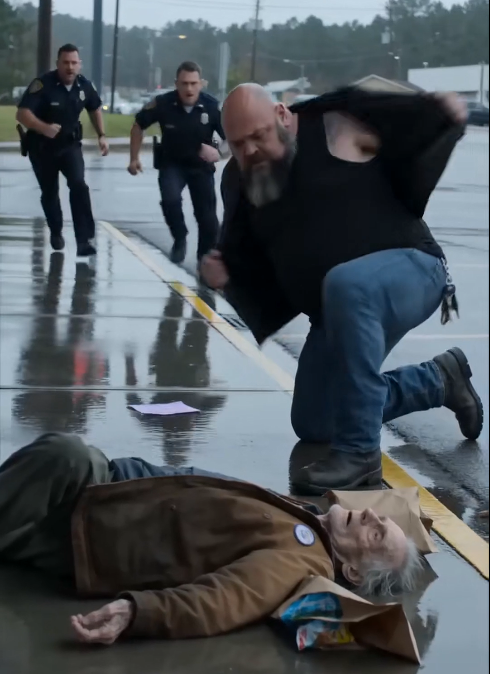
Everybody had seen the shove.
My name is Ray Dawson. I was fifty-six that spring, six-foot-four, and close to two hundred eighty-five pounds, with tattooed forearms, a shaved head, and a beard that had gone gray faster than the rest of me wanted to admit.
I owned a diesel repair shop outside Knoxville. The men I rode with called me Hammer. That morning, my black Harley was parked between a delivery van and a pickup with a broken taillight.
I had come for eggs.
The man on the pavement wore a brown coat with one sleeve repaired in darker fabric. His shoes were tied with different laces. Before he fell, he had been carrying a grocery bag folded carefully at the top, as though whatever was inside deserved better weather than he did.
Now the bag lay open beside the curb.
A purple paper placemat was sliding toward a puddle.
“Don’t let that go,” I said.
The officer holding my wrist looked at me.
“The paper.”
“Stay where you are.”
A waitress stepped forward and put her shoe on the edge before it reached the water. She bent, picked it up, and stared at the crooked flowers drawn around its border.
The man’s coat had opened at his wrist. There was a narrow metal bracelet beneath the cuff. The kneeling officer noticed it, then spoke into his radio.
His voice changed.
Behind us, the diner manager kept saying the same thing.
“I told him he couldn’t stay by the door.”
Nobody answered him.
The morning smelled of frying bacon, wet pavement, and the sharp dust left by something broken. A loose strip of yellow tape tapped against the wall in the breeze.
The officer beside me finally looked past my shoulder.
He went still.
I watched his eyes travel from the place where the man had been standing to the place where he was lying now.
For the first time, he loosened his grip.
“Was he coming this way?”
“Yes.”
The waitress pressed the purple paper against her apron.
“Oh, God.”
I didn’t want her to say that. I didn’t want anybody to decide the next minute belonged to me. The man was still on the ground, and there were too many faces above him.
“Give him some room,” the kneeling officer told the crowd.
People moved back reluctantly, as though distance might cost them the ending.
I stayed nearby until the officer asked what I had seen. I told him the man had stopped answering, that his hand had tightened around the bag, and that everything after that had happened faster than I could explain cleanly.
Then the jerking stopped.
The officer kept speaking to him quietly while we waited for the ambulance.
When the man finally opened his eyes, he looked frightened by all of us.
“Your name, sir?” the officer asked.
His mouth moved before any sound came.
Then he whispered, “Did I miss her?”
The waitress lowered her eyes to the placemat.
On its dry underside, beneath the flowers, someone had written a name and a time—and suddenly the man on the pavement had somewhere he was supposed to be.
Part 2 — The Space Between Him and the Glass
Ten minutes before the shove, I had been arguing with Boone about toast.
He believed white toast was a food group. I believed a man who had recently been told to improve his diet ought to stop putting jelly on things before tasting them.
Across the booth, Luis was reading an invoice and refusing to participate.
The diner was called the Copper Kettle. It sat beside a service road outside Knoxville, close enough to the highway that trucks rattled the sugar dispensers when they passed.
There was a problem at the entrance that morning.
A delivery cart had struck the old fixed sidelight beside the door. The lower portion of its glass pane had broken, leaving an irregular section still held in the frame. The manager had called someone to repair it and stretched yellow tape around two orange cones.
One cone had been moved to let a delivery through.
Nobody had put it back.
An opening had appeared where a barrier should have been.
From our booth, I could see the entrance at an angle. The jagged glass caught the light when the door swung inward. It wasn’t a pile on the floor anymore. Someone had swept most of that away.
What remained was worse to look at: a sharp, broken edge projecting from a fixed frame at roughly the height of a falling person’s neck.
The man in the brown coat arrived carrying his paper bag.
He didn’t shake a cup. He didn’t knock on the windows. He stood beneath the awning, checked the door, and smoothed the folded top of his bag with one palm.
A waitress named Abby opened the door.
I heard him ask whether he could sit inside.
The manager answered from behind her.
“We’re serving customers.”
“I understand.”
“You buying something?”
The man looked down at his hand. There were coins in it, but not many.
“Someone’s meeting me.”
The manager glanced toward the nearly empty counter.
“You can wait out here.”
Abby started to say something. He interrupted her with a request for clean menus.
She went to get them.
I knew that movement. Employees learn a hundred ways to postpone their own judgment because the person signing their check has spoken.
The man stepped away from the doorway. Unfortunately, away from the doorway put him beside the damaged panel.
I slid out of the booth.
Boone looked up. “Where you going?”
“Outside.”
I meant to ask the man whether he wanted breakfast. I meant to do it without making him stand there while a room decided what kind of charity he deserved.
I was three steps from him when his expression changed.
He had been looking at the road. Then his eyes stopped tracking anything. The fingers holding the bag tightened, and his shoulders drew up.
“Hey,” I said.
He didn’t answer.
His balance went forward.
I had seen that change before, though not often enough to become casual about it. My younger brother, Danny, had seizures when we were young. One moment he would be speaking; the next, the room would have a different set of priorities.
That memory didn’t give me a diagnosis.
It made me notice that something was happening to him.
I moved toward him just as his body stiffened and began tipping toward the broken sidelight.
There was no room to get between him and the frame.
I caught his upper body from the side and drove him away from it. Too hard to look gentle. Hard enough that we both went down on the open stretch of pavement beside the doorway.
I tried to take some of his weight. My shoulder struck the ground, and the paper bag flew from his hand.
That was what everybody saw.
A big man in leather putting both hands on a man in a worn coat.
The officer across the street had every reason to come running.
I wouldn’t ask him to apologize for that.
Once the man was clear of the immediate danger, I stopped trying to move him. I pulled my jacket into a fold near his head, and the officers took over as they reached us.
The shove was over. The emergency wasn’t.
Nobody held his limbs down. Nobody put anything in his mouth. One officer cleared the people back while the other stayed with him and called for medical help.
I answered questions when asked.
When the ambulance arrived, the manager pointed at the broken pane and said the repair company was already coming. He said it twice, louder the second time.
The younger officer looked at the moved cone.
“Keep this entrance clear.”
The manager began explaining.
“Now,” the officer said.
Boone emerged from the diner carrying my helmet. Luis had found the man’s bag and was gathering what had fallen out without opening anything further.
There were socks, a small plastic container, and the purple placemat Abby had saved.
No wallet that I could see.
No bottle.
I caught myself noticing that last absence and felt ashamed. A person shouldn’t have to empty his pockets correctly before strangers believe he is ill.
The paramedics spoke with him as he became more aware. They asked about his name, his medications, and whether he remembered what happened.
“Samuel,” he said.
Then, after a pause, “Bell.”
He tried to sit forward too quickly. One of the paramedics asked him to wait.
“My bag.”
Luis lifted it where he could see.
“We’ve got it.”
Samuel watched it as though we were holding something alive.
“Please don’t throw it away.”
Nobody said they had planned to.
The fact that he needed to ask told us plenty.
Part 3 — The Purple Flowers on the Paper
The first thing Samuel wanted to know was whether the woman had come.
Not whether his coat was torn. Not whether the man standing nearby had knocked him down. He kept looking toward the diner parking lot, trying to place the morning around the gap in his memory.
“Grace,” he said.
Abby stood near the ambulance with the placemat folded carefully along its existing crease.
“Is that who you’re meeting?”
He nodded.
“Your daughter?”
Another nod.
“Do you have her number?”
Samuel looked at his paper bag. Luis handed it to him, and he touched the folded top before letting the paramedic help him find what he needed.
Inside a small envelope was a telephone number written twice, once in black ink and once in blue. Below it was the name of a church outreach worker.
Samuel pointed at Grace’s number.
“You can call her.”
Abby glanced at me, perhaps expecting I would take over. I shook my head slightly.
He had answered her.
She could make the call.
I stood a few feet away while she explained who she was and what had happened. I couldn’t hear the other end, but I saw her expression change.
“She’s already on her way,” Abby told Samuel. “She was running late.”
Samuel closed his eyes.
For a second, I thought it was exhaustion.
Then he said, “I didn’t leave.”
The words sounded like an answer to a question nobody in the parking lot had asked.
The paramedics prepared to take him for further evaluation. I gave the officers my details and described the shove again, this time without adrenaline chewing the edges off every sentence.
The younger officer walked me through where I had been standing and where Samuel had started to fall. He looked at the broken pane from both positions.
Luis offered the diner’s camera location, which he had noticed above the register. The manager said it recorded the entrance.
That would help establish what happened.
The officer didn’t announce a verdict to the crowd. He told me they would follow up if needed.
It was enough.
My shoulder had begun to ache in a deep, spreading way.
Boone noticed.
“You need that looked at.”
“Later.”
He gave me the expression he usually reserved for customers who wanted to drive another thousand miles on a failing part.
I sighed.
“All right.”
A few minutes later, a small gray car turned into the lot so quickly it missed the first open space.
A woman climbed out wearing a navy cardigan over work clothes. She was perhaps thirty-five, with hair coming loose from a clip and an expression built from worry trying to remain anger.
Abby met her.
The woman looked toward the ambulance.
“Dad?”
Samuel tried to lift a hand.
She stopped beside him and touched his sleeve, not his face. It was a careful touch, as if more affection than that might say something she wasn’t ready to promise.
“I got stuck behind a wreck,” she said.
“I waited.”
“I know.”
“I didn’t go.”
Grace pressed her lips together.
There was a whole history inside that parking space.
The paramedic explained where they were taking him. Grace nodded, asked a few practical questions, and then noticed me.
Abby told her I was the man who had moved him away from the glass.
Grace looked at the frame.
Her face went pale.
“Thank you.”
I nodded.
“He asked for you.”
She looked back at her father.
“I’m here.”
The ambulance doors closed.
Grace stood still after they did, holding the purple placemat Abby had given her. She ran a finger along the crooked flowers.
“My daughter made this,” she said.
“How old?” Abby asked.
“Seven.”
Abby smiled a little.
Grace didn’t.
“She sent it last year.”
There was something about the way she said last year that made me look away. Samuel had carried a child’s piece of paper through weather that had ruined better things.
Grace folded it and tucked it safely into her bag.
Then she asked Abby whether her father had been inside.
Abby hesitated.
The manager had come out behind us. His name was Martin Hale. He was in his early forties, wearing a clean apron over a polo shirt.
“He was waiting by the entrance,” Martin said.
Grace looked at Abby instead.
“Did he ask for a table?”
Abby nodded.
Martin shifted.
“We didn’t know if he was actually meeting anybody.”
Grace stared at him.
“I told him to meet me here.”
Nobody answered.
She looked through the front window at the counter, the booths, the framed photographs near the kitchen.
Then she said something that made Martin stop adjusting his apron.
“My father picked this place because he thought he would know where to sit.”
Martin frowned.
Grace’s hand tightened around her car keys.
“He built those booths.”
For a moment, the traffic noise seemed farther away.
I looked inside.
The booths were old oak, worn smooth along the edges where generations of elbows had rested. Boone and I had eaten there for years without ever wondering who had measured the wood.
Martin turned toward the diner.
“What?”
Grace was already moving toward her car.
“Samuel Bell,” she said. “Ask your father.”
Then she drove after the ambulance, leaving us beside a restaurant that suddenly looked different without anything having moved.
Part 4 — The Man in the Photograph
I went to the hospital because Boone wouldn’t stop looking at my shoulder.
Luis drove my Harley back to the shop. Boone brought me in his truck, complained about the parking garage, and waited while someone examined me.
Nothing was broken. I had bruising, a strained shoulder, and instructions that would interfere with several things I had planned to lift.
Boone looked pleased enough to be irritating.
“Now maybe you’ll listen.”
“I listened.”
“Under protest.”
“That’s still listening.”
While we waited for the paperwork, Grace found us.
Samuel had agreed to see me if I was still there. He wanted to ask what happened, she said, and she preferred he hear it from someone who had actually been beside him.
I followed her.
He was sitting upright when I entered, looking older without the coat. His hair was flattened on one side. There were clean dressings over a scrape on his elbow.
His paper bag sat on a chair where he could see it.
I stopped near the door.
“Ray.”
“Sam.”
He looked at my shoulder.
“They said you hit the ground, too.”
“Wasn’t much room.”
“No.”
I pulled up a chair after he gestured toward it.
He asked about the glass. I told him where it was, how he had been falling, and what I had done. I didn’t make the movement sound better than it was.
“You knocked me down.”
“Yes.”
He considered that.
“Good direction, though.”
A small smile reached one side of his mouth.
He was allowed to find humor in his own morning.
I laughed before I expected to.
Grace stood beside the window, listening. There was tenderness in the way she watched him, but also caution. I knew better than to mistake one difficult day for the repair of a family.
Sam saw my glance toward the bag.
“They didn’t throw anything out.”
“No.”
“Good.”
He rested his hands on the blanket. They were long-fingered, with old scars near the knuckles and the thickened joints of someone who had worked with them for years.
“Your daughter said you built the booths.”
“Some of them.”
“You own the diner once?”
“Long time ago.”
Grace turned from the window.
“With Mom.”
He nodded.
Samuel and Elaine Bell had run the Copper Kettle for twenty-three years. He cooked breakfast, baked pies, repaired whatever broke, and built the booths when they expanded into the space next door.
Elaine kept the books and remembered everyone’s grandchildren.
They sold the restaurant when her health changed and keeping both the business and their home life going became too much. The buyer was Martin’s father.
Sam made it sound ordinary.
A sale. A change. People making the best decision available at the time.
It was only later that I understood how many things had vanished in sequence.
Elaine died.
Sam tried maintenance work. His seizures, which had been manageable at some points and more disruptive at others, complicated the jobs he could safely do. Losing steady work did not make the bills smaller.
Housing became temporary.
Then temporary housing ended.
He didn’t describe every night between those sentences.
He didn’t owe me a tour of his worst years.
Grace had helped before. More than once.
Sam said that before she did.
“She let me stay.”
Grace folded her arms loosely.
“We don’t have to do this right now.”
“I know.”
He looked at me.
“I told her I was taking care of things when I wasn’t. Missed appointments. Said I had somewhere to go.”
I waited.
“I wasn’t drinking,” he added.
“You don’t have to give me the easy version.”
His eyes lifted.
I meant that he didn’t need a clean explanation in which all the trouble belonged to illness and circumstance. I had been sober long enough to know people could hurt each other without any bottle in the room.
Sam understood.
“I didn’t like her seeing me need things,” he said.
Grace’s face changed.
“So you let me not know if you were alive.”
He looked down.
“That’s what I did.”
No one rushed to soften it.
The monitor made its ordinary sounds. A cart passed in the hallway.
Then Grace said, “Today was supposed to be a beginning.”
Sam nodded.
She had arranged to meet him at the diner with information from an outreach worker about a housing option and help reconnecting with regular care. A first meeting in a familiar public place, with no promises made on behalf of her daughter.
Sam had arrived early.
He had saved enough for coffee but worried that buying it before she arrived would make him need another. So he asked for a place to sit.
Outside.
Beside the broken pane.
He had been trying not to cost anybody too much.
My phone vibrated.
It was Luis.
He had gone back to the diner to collect my gloves, and Martin had called his father. There was a photograph near the kitchen, Luis said, one he had walked past a hundred times.
Three people stood beside a newly installed counter.
A much younger Martin.
Martin’s father.
And Samuel Bell in a white apron, smiling with a hand resting on a wooden booth.
I looked at Sam.
He was asking Grace whether the purple paper had gotten wet.
She took it out and showed him.
“Abby saved it.”
He touched the edge.
“Your girl draws a nice flower.”
Grace swallowed.
“She draws better ones now.”
Sam smiled faintly.
“I suppose she does.”
That was the thing about a year. It wasn’t only the time someone had survived. Somewhere else, a child had learned to draw differently, and a grandfather still carried the old flowers.
Part 5 — A Seat Wasn’t Enough
By that afternoon, somebody had posted a clip.
It showed the shove, the fall, and police running toward us. The caption supplied a motive the camera had never seen.
Boone found it first.
He held his phone out while we sat in the hospital parking garage.
“You’re famous.”
“I’d rather have lunch.”
“Yeah. This kind doesn’t pay.”
A man in our club named Travis wanted to answer immediately. He called three times before I picked up.
“We’ve got witnesses.”
“I know.”
“The window’s right there.”
“I know.”
“Then say something.”
I leaned against Boone’s truck, careful of my shoulder.
“Sam’s still in the hospital.”
“That doesn’t mean people get to call you a bully.”
He was right.
It also didn’t mean Sam’s medical emergency had become material we were entitled to distribute because my reputation needed help.
I told Travis we could make a brief statement about the immediate danger and cooperate with the people reviewing the incident. Any identifiable footage of Sam or details about his health needed his say.
Travis went quiet.
Then he said, “All right. Ask him.”
“I will.”
He accepted the boundary better than I expected.
The harder argument came from someone older.
Deke had been riding with us for years. He called that evening and said we were getting involved in something we didn’t understand.
“Helping in an emergency is one thing.”
“What’s the other thing?”
“Taking on a man who’s been outside for years. You don’t know what comes with that.”
“No,” I said. “I don’t.”
“I’m serious.”
“So am I.”
Deke had let a relative live with him once, and the arrangement had ended with stolen money and a broken bedroom door. His caution came from somewhere real.
I wasn’t going to insult it to make myself sound generous.
“We’re not moving him into your house,” I said.
“That’s how these things start.”
“Then we decide what we can actually do.”
There was silence.
Finally, he asked, “What does he need?”
I didn’t know yet.
That was the point.
The following day, with Sam’s permission, Grace brought an outreach worker named Nadine into the conversation. Nadine already knew him. She had been trying to help him secure a stable place and replace missing documents.
She wasn’t impressed by leather vests or the possibility of an inspiring story.
She asked who could provide transport on specific days.
Luis could do Tuesdays.
Marlene could help with paperwork on Thursday mornings.
I could store Sam’s belongings at the shop temporarily if he wanted, in a locked space he could access by arrangement.
Deke could repair a donated bicycle later, if that became useful.
Nobody promised a new life by Friday.
Sam listened while we discussed these things, then raised a hand slightly.
Nadine stopped.
“What am I agreeing to?”
She turned her notes toward him.
“Let’s go through it.”
That was when I began trusting her.
Not because she had all the answers. Because she didn’t let help become something adults discussed over the head of the person receiving it.
Sam agreed to some things.
He declined others.
He wanted regular medical follow-up arranged through the people caring for him, and help with practical barriers that had made keeping appointments and medications organized difficult. He wanted a place where his bag wouldn’t disappear while he showered.
He did not want strangers buying him clothes without asking his size.
He did not want a camera.
He wanted Grace told where he was, but he asked that she not be expected to handle every problem.
Grace looked down at her hands when he said that.
It was the first useful promise he had made her that week.
Martin called while we were discussing transport.
He asked if he could visit.
Sam thought about it before answering.
“Not today.”
I told Martin.
He sounded disappointed, then said he understood.
The next morning, he sent a message asking whether Sam would accept a meal when he was ready. No photograph. No announcement. He also confirmed the damaged sidelight had been properly secured and replaced.
That mattered.
So did what he said afterward.
“My dad remembered him right away.”
I waited.
“I didn’t.”
“He looks different.”
“That’s not an excuse.”
“No.”
Martin breathed into the phone.
“I would’ve given him a table if I knew.”
I looked toward Sam, who was sitting beside Grace, arguing gently about whether a cardigan was worth mending.
“Then that’s probably the part you need to think about.”
Martin didn’t answer immediately.
When he did, his voice was quieter.
“Yeah.”
Later, Sam agreed to a short public clarification about the incident. He did not want his diagnosis explained to strangers or his personal history used to turn him into somebody important enough to deserve intervention.
“Just tell them about the glass,” he said.
So we did.
The diner preserved the relevant camera recording for the officers. The brief statement corrected the immediate misunderstanding without turning Sam’s life into evidence.
Some people changed their minds.
Some kept the version they liked.
The officers completed their follow-up. I answered what they asked. Eventually, the calls stopped.
My shoulder improved.
Sam’s problems did not disappear at the same pace.
The available housing arrangement took coordination. There were forms to replace, appointments to keep, and days when he withdrew because being helped felt too much like being inspected.
Once, he missed a planned pickup.
Luis drove to the shop angry and frightened.
“He said he’d be there.”
We found Sam later at the place Nadine suggested checking. He had misunderstood the time, then been too ashamed to call after realizing.
Luis stood in front of him with both hands on his hips.
“You can call when you’re late.”
Sam nodded.
“You can call when you’re embarrassed.”
Another nod.
“You can’t make us guess.”
Sam looked at him.
“All right.”
Kindness had acquired rules.
That made it more likely to last.
Part 6 — The Things a Grandfather Could Promise
Grace did not bring her daughter to see Sam right away.
Nobody asked her to change that.
I appreciated it when Boone said so at the shop one evening. Some of the men had begun talking about a reunion as though the only obstacle was getting everybody into the same room.
Boone set down his coffee.
“The kid isn’t the reward.”
The room went quiet.
He was right.
Grace’s daughter, Sophie, had already experienced promised visits that never happened. She had watched her mother stand by a window with her phone in her hand. A grandfather’s bad circumstances did not make a child responsible for repairing them.
Sam knew that better than we did.
At first, he wrote short notes.
Not pages explaining why he had been absent. Small, truthful things Grace could choose to share.
He liked Sophie’s flowers.
He remembered the cake she had once requested that looked like a purple cat.
He was working with people who were helping him stay in one place.
He did not promise next Saturday until next Saturday was something he could manage.
He practiced making smaller promises.
I saw him twice a week for a while. Sometimes I drove him. Sometimes we drank coffee outside the shop while he told me that mechanics had become lazy because everything required a computer.
I told him bakers had been replaced by boxes.
He looked offended.
“Not good bakers.”
“Not good mechanics.”
That settled it.
One afternoon, I found him studying the loose hinge on our office cabinet.
“Don’t,” I said.
He looked over his shoulder.
“What?”
“You don’t have to fix something every time you come here.”
“It’s annoying me.”
“Then fix it because it’s annoying you.”
He smiled.
There was a difference, and we both knew it.
His housing arrangement began in a modest room through a local program. It wasn’t permanent at first. It wasn’t an apartment with sunlight pouring over a fresh start.
It had a bed, a secure door, and a place where his belongings stayed while he was gone.
For him, those were substantial improvements.
Nadine kept working with him. His care team handled his medical needs. The club handled the things we had actually agreed to do.
There were difficult weeks.
Once, he called to cancel coffee because he was tired and didn’t want company. I said all right. He sounded suspicious of how easily I accepted it.
“You’re not mad?”
“No.”
“I just don’t feel like talking.”
“You don’t owe me conversation.”
After we hung up, I sat with that sentence for a while.
I wondered how many times a person had to be grateful before silence began to feel like something he couldn’t afford.
At the diner, Martin asked Sam again if he would come by when ready.
This time, Sam said yes.
He asked me to join him.
We went on a Tuesday afternoon when the place was quiet. Abby met us near the door, and I watched Sam’s eyes move toward the repaired sidelight.
Clear glass.
No tape.
No exposed edge.
He looked away before I could ask.
Martin came from the kitchen carrying two menus, though I doubted Sam needed one.
“I owe you an apology,” he said.
Sam pulled out a chair.
“Then sit down.”
Martin sat.
He did not mention his father first. He did not tell Sam how much the old restaurant photographs meant to him. He apologized for refusing him a place to wait and for the unsafe area outside.
Sam listened.
Then he said, “You didn’t know I used to own it.”
“No.”
“You know that shouldn’t matter.”
“Yes.”
Sam nodded.
There was no handshake photograph.
We ordered lunch.
Halfway through, Abby brought a piece of apple pie and looked nervous. Sam tasted it, considered, and said it needed a little less sugar.
Martin laughed once.
Abby looked relieved.
Sam took another bite.
Forgiveness did not require him to compliment the pie.
Later, Grace arranged a short meeting with Sophie at a park. She told Sam exactly what she was comfortable with. He agreed.
I drove him and waited in the parking lot.
When he returned, his face looked worn out in a completely different way.
“How’d it go?”
“She’s taller.”
“They do that.”
“She asked why I missed her birthday.”
I kept my eyes on him.
“What’d you say?”
“That I wasn’t doing well, and I should’ve let her mother know. That it wasn’t because I didn’t want to see her.”
He rubbed his thumb against the seam of his coat.
“She said okay.”
“Okay can be a lot.”
He nodded.
Then he reached into his pocket and took out a new drawing.
The flowers were better.
He had noticed.
Part 7 — Where He Chose to Sit
Sophie’s next birthday fell on a Sunday.
Grace planned a small lunch at the Copper Kettle. She asked Sam whether he would like to come and made it clear he didn’t need to bring anything.
He asked whether he could make a cake.
Grace took a moment.
“Only if you want to.”
“I want to.”
Martin offered the kitchen for a short, arranged visit the day before, with someone there to help. Sam discussed what would work for him and chose a simple plan.
No one turned it into a comeback.
He made a round cake with purple frosting and a cat whose ears leaned in different directions. Sophie had requested the same design she remembered from years earlier.
When I saw it, I asked whether the cat needed a mechanic.
Sam handed me a dish towel.
“Make yourself useful.”
I dried bowls.
He worked slowly, resting when he needed to. At one point, the frosting bag slipped and left an extra purple stripe across the cat’s forehead.
He stared at it.
Then he added two more.
“Tabby,” he said.
Some mistakes could become a pattern.
The next day, I arrived early and found Sam outside the diner.
For a second, every muscle in my shoulder remembered the pavement.
Then I saw he was standing well away from the doorway, looking down the road with the cake box safe on a table beside him. He wore the same brown coat, cleaned and repaired, because he liked the weight of it.
“You can go in,” I said.
“I know.”
He smiled.
“I’m waiting because I want to.”
So I stood beside him.
A truck passed, making the glass tremble faintly in its new frame. Inside, Abby moved chairs around a table. Boone was already there pretending he hadn’t come mainly for cake.
Grace pulled into the lot.
Sophie climbed out carrying something behind her back. She walked toward Sam with the solemn concentration children bring to important deliveries.
He bent slightly so he could hear her.
“Mom said I could make you another one.”
She held out a purple placemat.
This one had cats around the edge.
Sam took it with both hands.
“Those are good cats.”
“I know.”
Grace laughed.
Sophie pointed toward the diner.
“You sit next to me.”
Sam looked at Grace.
She nodded.
Then he picked up the cake.
I reached to help, but he shifted it comfortably against his chest.
“I’ve got this part.”
We went inside.
Martin held the door. Abby asked Sophie where she wanted everyone. Boone moved twice before being told he had been in the right chair the first time.
Sam sat beside his granddaughter.
The table was one he had helped build years earlier. I could see a shallow nick in its edge where the finish had worn pale. He noticed it, too, and ran a finger along the mark.
Sophie asked what he was doing.
“Remembering.”
“Remembering what?”
He looked around the table.
“Where things go.”
Grace’s eyes filled briefly. She reached for a napkin and then used it to wipe frosting from Sophie’s thumb, giving herself something ordinary to do.
Nobody made a speech.
When the cake came out, the cat’s uneven ears drew exactly the reaction Sam had hoped for. Sophie laughed and insisted on the piece with the crooked ear.
He cut it for her.
Later, when the dishes were cleared, I saw him take the older placemat from his bag. He unfolded it beside the new one, smoothing the flowers with his palm.
Two drawings.
A year between them.
Neither erased what happened in that year.
There was room for both on the table.
As we left, Sam stopped beside the repaired window. He looked at the clear pane, then at me.
“I’m glad you were hungry that morning.”
I didn’t know what to say.
He spared me the effort.
“Next time, use the door like everybody else.”
I laughed, and my shoulder gave a small, distant ache.
Outside, my Harley waited in the sun. I heard Grace ask her father whether he wanted a ride back, and I heard him say yes without first trying to make it sound unnecessary.
Sophie took his hand.
He gave her the empty cake box to carry.
This time, nothing fell.
Follow our page for more biker stories about second chances, complicated families, and the quiet people who stay after the crowd moves on.