A Biker Missing Half His Face Taught a Blind Boy to “See” a Harley With His Hands—Then One Familiar Sound Revealed the Wound Connecting Them
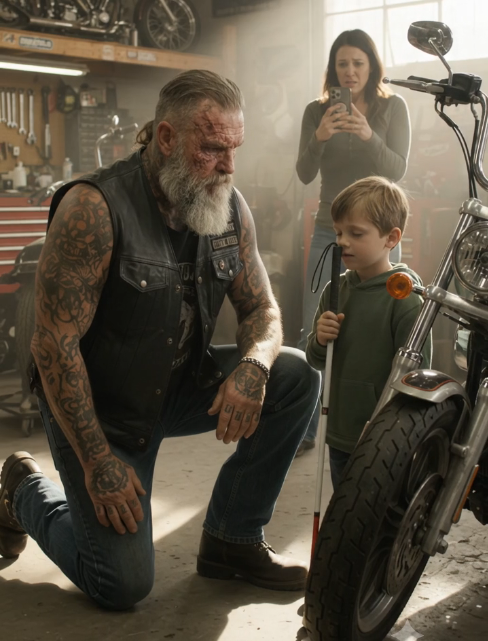
The first time eight-year-old Eli touched my Harley, his mother filmed from the garage doorway because she thought a man missing half his face was teaching her blind son something no therapist had managed to explain.
My name is Jack Mercer, although the riders in my club have called me Rook since before my beard turned gray. I am sixty-one years old, six-foot-three in my boots, and built like a man who spent four decades lifting engines instead of learning when to ask for help. My left eye is gone. Part of my cheekbone and jaw were rebuilt after a blast overseas, leaving one side of my face crossed by thick, uneven scars that no beard can entirely hide.
Children usually stare.
Adults usually pretend not to.
Eli did neither.
He stood beside my 1998 Heritage Softail with a white cane folded beneath one arm and both hands held close to his chest. He had been blind for eighteen months, but he still turned his face toward objects as though some stubborn part of him expected sight to return if he concentrated hard enough.
His mother, Sarah, remained by the open garage door with her phone raised. She was thirty-five, exhausted, protective, and doing her best not to look terrified by the arrangement she had approved.
A scarred veteran.
A blind child.
A five-hundred-pound motorcycle.
From the street, it probably looked like three bad ideas sharing one patch of concrete.
“Is it running?” Eli asked.
“No.”
“Is it hot?”
“No.”
“Can it fall?”
“Not while I’m here.”
That answer made Sarah lower the phone slightly. I had spent two hours securing the motorcycle in a service stand, disconnecting the battery, checking every sharp edge, and cleaning the parts Eli might touch. My club brothers had laughed when they saw me covering the exhaust clamps with soft workshop tape.
They stopped laughing when I told them why.
I did not take Eli’s hands and place them on the motorcycle. Children with no sight already had enough people moving them without warning. Instead, I offered him the back of my right hand and let him decide whether to follow.
He touched two fingers to my knuckles.
“Your skin is rough.”
“So is the bike.”
That earned the smallest smile.
I guided his hand toward the front tire but stopped an inch away. “Cold rubber in front of you. Move when you’re ready.”
His fingertips found the tread.
The smile vanished as concentration took over. He traced one groove, then another, following the curve until his wrist turned. His mother’s camera remained trained on us, recording the moment for his orientation specialist at the Desert Light Center for Blind Children.
“Why does it have lines?” he asked.
“To push water away from the tire.”
“Like shoes?”
“Exactly like shoes.”
He tapped the sidewall with one fingernail and listened.
Then he tapped again.
The boy wasn’t merely touching the Harley. He was asking it questions in a language made of vibration.
I moved him slowly from the tire to the fender, from the fender to the fork, then along the fuel tank. He noticed temperature before shape, texture before size. Chrome felt colder than painted steel. Rubber absorbed his tap. The empty fuel tank returned a deeper sound near its center.
“What color is this part?” he asked.
“Black.”
“What does black feel like?”
I opened my mouth, then closed it.
People had spent eighteen months telling Eli that green felt like grass, blue felt like water, and yellow felt like sunshine. Those comparisons meant something only because he had once seen those colors. He remembered blue. He remembered red. He remembered the silver sparkles above his neighbor’s yard on the last Fourth of July he had watched with both eyes.
I was not there to turn darkness into a poetry lesson.
“Black doesn’t feel like anything,” I said. “This tank feels smooth, cool, and curved. That’s more useful.”
Sarah lowered the phone completely.
“Thank you,” she whispered.
“For what?”
“Not pretending blindness is magic.”
Eli heard her. “Mom says people make videos about blind kids doing normal things and call them inspiring.”
“What do you call it?”
“Annoying.”
“I call it Tuesday.”
This time he laughed.
The sound bounced from the tool cabinets and the corrugated garage door. I had forgotten that a child’s laughter could change the dimensions of a room.
We reached the engine casing. I explained the cylinders, cooling fins, spark plugs, and the route fuel and air traveled before becoming motion. I kept the descriptions plain. Eli stopped me whenever words depended too much on sight.
“What does V-shaped mean?”
I held his forearms apart, then brought his hands together at the wrists.
“Two rows leaning away from each other.”
“Like a bird opening?”
“Close enough.”
He mapped the cylinders with both palms. His fingers moved across the cold fins, counting each ridge. When he found a bolt, he asked what it held. When he located a cable, he followed it until I told him to stop.
Sarah raised the phone again.
She filmed his hands.
She filmed mine hovering near them without taking control.
She filmed the moment Eli placed his ear several inches from the fuel tank and tapped it with one finger, listening to the hollow metal answer him.
Then he asked the first question that made my throat tighten.
“How do you know what I need before I ask?”
I turned away under the excuse of checking the service stand.
“Practice.”
“With blind kids?”
“No.”
“With blind grown-ups?”
“No.”
He waited.
Children recognize evasion faster than adults.
“Then who taught you?”
The garage seemed to shrink around me. The smell of motor oil disappeared beneath another odor that had no place in Tucson—burned fabric, hot sand, and the metallic dust that remained after the world changed shape.
I heard a sound inside my memory.
One sharp crack.
Then nothing on the left side.
Eli reached toward my voice and found the sleeve of my T-shirt. His hand traveled upward until his fingertips brushed the edge of the scar below my ear. Sarah gasped, but I did not pull away.
He traced only an inch before stopping.
“Did this hurt?”
“Yes.”
“Did you lose your eye at the same time?”
“Yes.”
His hand returned to the motorcycle, but his face had changed. He placed one palm over the V-twin casing and the other against the scarred side of my jaw, comparing two maps no one else in that garage could understand.
Then he whispered, “Did the sky explode for you too?”
Sarah’s phone shook.
I had never told either of them how I was injured.
Eli had never told me the sound he heard before darkness arrived.
Yet somehow, beside a silent Harley, an eight-year-old boy had found the exact door I had kept locked for twenty-three years.
What I told him next made Sarah stop recording—but the unfinished video later revealed why the same explosion had left one of us afraid of engines and the other unable to live without them.
Part 2 — The Half of My Face People Could See
Before the blast, I had a face nobody remembered.
That sounds bitter. It isn’t. Ordinary faces are a privilege most people never realize they possess. Mine had two eyes, an unbroken jaw, and a nose that had been punched crooked during a bar fight near Fort Hood. Nothing about it made strangers turn their children away in grocery-store aisles.
I joined the Army at nineteen and became a combat engineer. My job was roads, obstacles, damaged vehicles, and the dangerous objects buried beneath places other people needed to cross. I learned to trust patterns: disturbed soil, wires that did not belong, shadows beneath culverts, silence in villages that should have contained dogs and children.
Patterns kept people alive.
Until one didn’t.
The blast happened during my third deployment, on a road outside Kandahar. I was thirty-eight. Our vehicle had stopped near a damaged transport truck, and I remember stepping down into heat that seemed to rise from both the ground and sky.
Then the afternoon became white.
There was no heroic memory. I did not lift a truck, save a platoon, or deliver a final speech before losing consciousness. I remember pressure, dust, and a ringing tone that never entirely left my skull.
I woke six days later in Germany.
My left eye was gone. Bone beneath it had shattered. Part of my cheek and upper jaw required reconstruction. Shrapnel had damaged the ear on the same side, leaving me with reduced hearing and a strange sensitivity to sudden high-frequency cracks.
The surgeon explained everything carefully.
I heard only one sentence.
“We could not preserve the eye.”
People say losing sight in one eye is not the same as becoming blind. They are right. I retained the entire world through my right eye. I could read, drive after rehabilitation, and eventually ride again.
But depth disappeared before I understood how much life depended on it.
Stairs shifted beneath me. Coffee cups sat farther away than expected. Doorframes struck my shoulder. I poured oil beside funnels and reached past tools lying directly in front of my hand.
Rehabilitation taught me new methods. Turn my head more. Use shadows differently. Touch the edge of a table before setting something down. Listen for where footsteps originated. Let the right hand verify what the right eye believed.
I hated every lesson.
The therapist assigned to me was a patient woman named Denise who refused to be impressed by anger. Whenever I said I already knew how to do something, she let me fail safely and then asked whether I wanted to learn again.
“I’m not blind,” I snapped one afternoon.
“No,” she replied. “You’re a man with changed vision who thinks adaptation is surrender.”
That shut me up.
I returned home after thirteen surgeries with a face my own reflection could not immediately organize. The first time a child cried after seeing me at a pharmacy, I left my prescription on the counter and drove away.
For nearly a year, I covered the damaged side with gauze even after the wounds had closed.
Then my brother-in-law gave me an old Harley to repair.
It had been sitting beneath a tarp in an Arizona shed for nine years. The fuel had turned sour. Mice had chewed the wiring. Rust held several bolts tighter than any mechanic would have chosen.
It was perfect.
I could work without looking at anyone.
At first, the missing depth made even simple repairs exhausting. I dropped sockets. Misjudged distances. Banged my knuckles against steel. Eventually, I began closing my right eye while searching for familiar parts.
My hands learned faster that way.
Thread shape identified bolts. Temperature separated rubber from metal. Vibration exposed loose fittings. Sound revealed compression, timing, and imbalance.
The motorcycle became a machine I could understand without trusting sight alone.
When I finally started it, the V-twin filled the shed with a low uneven rhythm. It was nothing like the high crack that lived inside my memory. The engine note was deeper, slower, predictable.
I could feel it through the soles of my boots.
That mattered.
The blast had been chaos. The Harley produced noise with a pattern.
I rebuilt more motorcycles. Then I opened a small garage in Tucson with two veterans from my unit. We named it Second Mile Motorworks because none of us believed our first version of life had gone according to plan.
The club came later.
So did the volunteering.
A woman named Maribel from the Desert Light Center brought her van to our garage after it began overheating. She transported children with visual impairments to mobility training and medical appointments. I repaired the cooling system, then refused payment.
She studied my face longer than most adults dared.
“You understand adaptation,” she said.
“I understand engines.”
“Children are not engines.”
“Good. Engines are easier.”
She returned the following week with volunteer paperwork.
For a month, I left it unopened.
Then I attended an orientation session. I learned how to introduce myself before approaching, how to offer an elbow instead of pulling a person’s arm, how to describe space without saying useless things like “over there,” and why help given without consent is merely interference wearing polite clothes.
I began repairing white canes, audio devices, and mobility equipment. I taught teenagers how to identify basic tools by shape and balance. I never worked alone with a child, never photographed anyone, and never presented myself as a therapist.
Then Sarah called the center.
Her son had stopped responding to nearly every activity offered since losing his sight. He disliked canes, refused audio games, and panicked around loud mechanical sounds. Before the accident, however, he had loved motorcycles.
Maribel thought of me.
When she asked whether I would meet him, I almost said no.
The boy had been injured by an explosion.
So had I.
That did not make me uniquely qualified. It made me uniquely capable of getting it wrong for personal reasons.
But Maribel said Eli did not need a speech about courage. He needed an adult who would let him be angry, curious, and unimpressed.
That sounded familiar.
I signed the paperwork.
Part 3 — The Last Firework Eli Ever Saw
Eli remembered colors.
That complicated everything.
Children born without sight build the world using the information available to them. Eli had spent six years seeing his mother’s face, the red front door of their house, cartoons on Saturday mornings, and motorcycles passing the neighborhood.
Then, at a Fourth of July gathering, a commercial firework tipped after ignition.
The adults had followed what they believed were safe distances. One unstable base and several seconds changed that belief forever. A burst traveled sideways toward the patio before anyone could move the children.
Sarah never described the injuries to me in detail.
She did not need to.
Eli survived after multiple surgeries, but the damage to both eyes could not be repaired. He also developed a severe reaction to sudden cracks, whistles, and crowds cheering after loud sounds.
The last image he remembered was a silver spark rising crookedly instead of straight.
Afterward came smoke.
Then darkness.
Adults tried to comfort him by promising that blind people could still do almost anything. The intention was kind. The timing was not.
Eli did not want to know what blind people could achieve someday. He wanted to know why morning no longer arrived when he opened his eyes.
He stopped sleeping alone.
He refused to enter the backyard.
When a delivery truck backfired near the house, he crawled beneath the kitchen table and remained there for forty minutes.
His father, Daniel, loved him but did not know how to share the grief. He threw away every photograph from that Fourth of July and removed the outdoor grill because it smelled faintly of smoke. Then he volunteered for extra shifts at work until he was rarely home before Eli went to sleep.
Sarah did the opposite.
She documented everything.
Appointments.
Cane lessons.
New routes through the house.
The first time Eli poured water without spilling.
The first time he walked from his bedroom to the mailbox using sound and memory.
Some relatives accused her of filming too much. They assumed she wanted attention online. In reality, most recordings never left her phone. She filmed because Eli’s progress changed in increments too small to notice from one exhausted day to the next.
On hard nights, she showed him the videos and described what had improved.
“You used to need my hand on the stairs,” she would say. “Now you touch the rail.”
The camera was a record against hopelessness.
Before our first session, Sarah warned me that Eli might refuse to enter the garage. I rolled the Harley outside and let him decide. Instead, he stood at the threshold and asked what the building smelled like.
“Oil, rubber, dust, and coffee I should have thrown away yesterday.”
“That sounds gross.”
“It is.”
He entered.
For the first four visits, we never started an engine. Eli learned the garage while everything remained silent. He counted steps from the doorway to the workbench. He found textured tape marking safe paths. He learned that red tool handles had two raised bands and blue handles had one, allowing him to organize equipment without needing color.
He disliked praise.
Whenever Sarah said, “That’s wonderful,” he withdrew his hands.
So I replaced praise with information.
“You identified the correct wrench.”
“You found the edge before moving.”
“You remembered where the stand begins.”
Facts respected his effort without turning every movement into a performance.
During the fifth visit, Eli asked to hear the Harley.
His voice sounded confident.
His fingers did not.
I positioned him fifteen feet away with Sarah beside him, gave him hearing protection that reduced volume without eliminating the low vibration, and explained every step before touching the ignition.
“First, a click.”
He nodded.
“Then the starter turns.”
Another nod.
“Then the engine catches. It will be loud, but I’ll shut it off when you raise your hand.”
“What if I don’t raise it fast enough?”
“Your mother can.”
“What if she doesn’t?”
“I can see your face.”
He considered that.
“Okay.”
I turned the key.
The starter clicked.
Eli flinched.
I waited.
He did not raise his hand.
The engine caught, filling the garage with the deep, uneven pulse unique to an older V-twin. Eli’s shoulders rose to his ears. Sarah reached toward him, but he stepped away from her hand.
“Don’t,” he said.
He placed one palm against the garage wall.
The vibration traveled through the studs and drywall.
His expression changed.
“That’s the motorcycle?”
“That’s the motorcycle.”
“It feels slower than it sounds.”
“Good catch.”
He moved one step closer.
Then another.
I kept the engine at idle. No revving. No surprise. No performance for the camera.
At ten feet, Eli stopped.
“There are two beats.”
“Two cylinders.”
“Not together?”
“Not exactly.”
He listened for almost a minute, then raised his hand.
I shut the motorcycle off.
The sudden silence made him sway.
“What happened?” Sarah asked.
“I can still feel it.”
The engine had stopped, but the sensation remained in his palms and chest. I knew that echo. After the blast, I had continued hearing the explosion long after doctors told me the room was quiet.
I crouched several feet away.
“Sometimes the body keeps a sound after the sound leaves.”
Eli turned toward me.
“Does yours?”
The question landed harder than I expected.
“Yes.”
“Which sound?”
“Not today.”
He accepted the boundary.
On the drive home, Sarah asked him whether he wanted to return.
He said no.
The next morning, he changed his answer.
By the end of the first month, he could identify the tires, fenders, tank, seat, footboards, engine casing, and exhaust while the motorcycle remained cold. He developed his own names before learning mine. The cylinders were “the leaning towers.” The drive belt was “the quiet loop.” The spokes became “metal sunbeams,” although he immediately complained that the phrase sounded too poetic.
For the first time since the accident, a machine connected to an explosion was becoming predictable.
Then, during the seventh week, a bike in the adjacent service bay backfired.
One crack.
Sharp.
Unexpected.
Eli dropped to the floor.
And before I could reach him, the garage disappeared for me too.
Part 4 — When the Teacher Needed the Lesson
Dust filled my mouth.
Not Tucson dust.
Kandahar dust.
I knew where I was, yet another part of me did not. The tool cabinet became the damaged transport truck. Sunlight under the garage door turned white. My right hand searched for equipment I had not carried in twenty-three years.
Someone shut down the other motorcycle.
Boots moved.
A wrench struck the floor.
Too much sound.
I pressed my back against the workbench and fixed my right eye on a yellow line painted across the concrete, but the line kept changing into a road half a world away.
Then a small hand found my wrist.
“Jack.”
Eli.
His voice was shaking.
So was mine.
“Four in,” he said. “Six out.”
Sarah had taught him that breathing pattern after the accident. I had heard them practice it during early sessions and assumed I was the adult in the room least likely to need it.
I was wrong.
Eli counted.
“One, two, three, four.”
I breathed in.
“One, two, three, four, five, six.”
I breathed out.
He continued until the garage returned piece by piece: cold concrete beneath my boots, motor oil in the air, ceiling fan clicking overhead, Sarah crying quietly near the door.
The boy who had fallen first was now guiding me back by sound.
When my breathing steadied, I asked whether he was hurt.
“No.”
“Are you sure?”
“No.”
Fair answer.
We sat on the floor with several feet between us. Neither of us pretended the backfire had been harmless. Nobody said it was “just a sound.” Our bodies had reacted before language could correct them.
Sarah stopped recording the moment Eli fell. She remained uncertain whether to help him, help me, or call Maribel. Eventually she sat between us without touching either one.
“I’m sorry,” I said.
Eli frowned. “You didn’t make the noise.”
“I was supposed to keep the session safe.”
“You didn’t make the noise,” he repeated.
The mechanic responsible for the adjacent motorcycle entered from the alley. His name was Clay, a club brother who had worked beside me for twelve years. He looked sick with guilt.
“I should’ve warned you before starting it.”
The backfire resulted from an ignition issue he had been diagnosing. It was not planned, and he had believed the wall would absorb most of the sound.
“It’s on me,” he said.
Eli tilted his head. “Why does everybody want it to belong to them?”
None of us had an answer.
Clay wanted to suspend the garage sessions. Sarah considered moving them back to the center. Maribel suggested we pause and let Eli decide after speaking with his therapist.
I agreed.
For three weeks, Eli did not return.
I kept his textured tool markers in a drawer and told myself the project had ended. The truth was uglier. I was relieved.
Teaching Eli had opened places I had sealed beneath work, highway miles, and the steady noise of motorcycle engines. His questions moved straight through defenses adults politely avoided.
How did darkness sound?
Why did I know where his hands needed to go?
What noise did my body keep after the noise ended?
I could teach engine parts.
I did not know how to explain the wreckage beneath the lesson.
Sarah continued sending brief updates through Maribel. Eli had resumed cane training. He was sleeping poorly. He asked about the Harley but refused to discuss the backfire.
I began sleeping poorly too.
One night, I watched the videos Sarah had shared privately with permission. In the first, Eli tapped the fuel tank and waited for the sound to return. In another, his fingers counted cooling fins. The last recording ended before the backfire, capturing him smiling as he correctly identified the primary cover.
Watching the boy learn forced me to notice something I had ignored.
He never rushed his hands.
I always did.
Even after decades working on motorcycles, part of me approached every uncertain surface as though speed could prevent pain. Eli allowed objects to reveal themselves gradually.
The student understood patience better than the teacher.
I returned to the Desert Light Center, not to ask Eli back but to speak with Maribel. She listened while I explained that my reaction could make me unsafe as a volunteer.
“Did you strike anyone?”
“No.”
“Did you leave the child alone?”
“No.”
“Did you ignore the emergency plan?”
“No.”
“I’m not asking whether you were frightened, Jack. I’m asking what you did with it.”
I told her Eli had guided my breathing.
Maribel nodded. “Then perhaps he learned that needing help does not cancel someone’s ability to give it.”
That sentence irritated me because it sounded correct.
She required me to complete additional trauma-informed training before any session could resume. The garage adopted stricter controls: no engines started anywhere on the property during Eli’s visits unless scheduled, warning lights at both service bays, and a check system requiring every mechanic to acknowledge the quiet period.
Clay installed the lights himself.
Our club brothers accepted the rule, but several questioned whether returning to the motorcycle was wise. They cared about Eli. They also knew my history and had seen what sudden noise could do.
The disagreement tested us.
One rider said, “Maybe the kid needs something safer than a garage.”
Dani Ruiz, our road medic, answered, “Safer doesn’t mean smaller.”
We left the decision to Eli.
At the end of the third week, Sarah called.
“He wants to come Saturday.”
“What changed?”
“He heard a motorcycle pass the house. He identified it as a V-twin.”
I waited.
“He said he doesn’t want the backfire to be the last engine sound he remembers.”
On Saturday, Eli entered the garage carrying his white cane. He found the textured path without assistance and stopped beside the Harley.
“Are we starting it today?” I asked.
“No.”
“All right.”
“I want you to tell me about your explosion.”
Sarah inhaled sharply.
I had expected the question.
I still wasn’t ready.
Eli placed one hand against the cold fuel tank. “You said the body keeps sounds. Mine keeps the firework. Yours keeps something else.”
I sat on the mechanic’s stool.
Then I told him about the road.
Not every detail. Children do not need to carry an adult’s worst memories merely because they ask honest questions. I explained that an explosive device damaged our vehicle during the war, that I lost my left eye, and that doctors rebuilt part of my face.
Eli listened without interrupting.
When I finished, he asked, “Was it like mine?”
“Not the same place. Not the same weapon.”
“But the same kind of hurt?”
“Yes.”
He nodded slowly.
Then he said, “Good.”
Sarah stiffened. “Eli.”
He corrected himself.
“Not good that it happened. Good that you know.”
That was the moment our six-month lesson truly began.
Part 5 — Two Maps Made by Explosions
After I told Eli the truth, he stopped treating my scars as a mystery.
He did not become more polite about them.
That helped.
“Does your metal cheek get cold?” he asked.
“There’s no metal cheek.”
“Mom said they put plates in your face.”
“She needs to stop reading my medical paperwork.”
“Do they beep at the airport?”
“Sometimes my boots do. The face doesn’t.”
“Can I touch it?”
The question silenced Sarah.
Most adults avoided looking directly at the damaged side of my face. Children occasionally stared until a parent pulled them away. Nobody had ever asked to understand it by touch.
I told Eli he could, but only after washing his hands and only if he stopped when I said so.
He stood close enough that I could feel his breath. His fingertips began at my right temple, where the skin remained mostly unchanged, then moved across my forehead toward the scar tissue surrounding the empty left socket.
I wore a simple black eye covering, which I removed.
Eli traced the ridge above the socket and followed the uneven line down my cheek. His touch was lighter than dust. When he reached the reconstructed jaw, he paused.
“This side is shaped different.”
“Yes.”
“Does that make it the wrong side?”
“No.”
“What makes it?”
“Mine.”
He smiled.
Then he placed both hands on my face for one second, comparing the sides as he had compared the two cylinders of the Harley.
“Two shapes,” he said. “Same engine.”
I laughed so abruptly that Sarah nearly dropped her phone.
She had filmed the exchange from several feet away after asking permission from both of us. The recording was intended for Eli’s private progress archive, but it became the video she replayed most.
Not because he touched my scars.
Because he found no tragedy in them.
To Eli, my face was another object with contours, temperatures, and history. He did not need me to be handsome, symmetrical, or easy for strangers to look at. He needed me to be accurate.
From then on, our training changed.
We stopped teaching parts as isolated names and began constructing a full tactile map. Eli started at the front tire every session and moved backward in the same order: tread, sidewall, fender, fork, handlebar, controls, tank, seat, cylinders, primary cover, footboards, exhaust, rear suspension, drive belt, and rear wheel.
He described each component aloud.
The tire carried the road.
The fork allowed the wheel to turn and absorbed impact.
The tank stored fuel but should never be touched near an open flame or hot engine.
The cylinders converted combustion into movement.
The exhaust carried hot gases away and remained dangerous after shutdown.
Safety became part of every description. Eli learned which components he could explore only when the motorcycle was cold and secured. When the engine ran, he remained behind a marked boundary unless an adult followed the established procedure.
We added sounds gradually.
A key entering the ignition.
The electrical click.
The starter motor.
The fuel system priming.
The engine catching.
Idle.
A slight controlled increase in engine speed after warning.
Shutdown.
Cooling metal ticking afterward.
Eli could identify each stage by the fourth month.
Then he began noticing problems.
One afternoon, he stood behind the safety line while the Harley idled and tilted his head toward the left cylinder.
“That beat is softer.”
Clay looked at me.
I heard it too, but only after Eli pointed it out.
A spark plug had begun fouling.
Another week, Eli placed his hand against the workbench while a different touring motorcycle ran outside. He said something near the rear sounded loose. We discovered a vibrating heat shield.
He was not becoming a supernatural blind mechanic. He made mistakes, confused components, and sometimes guessed because he wanted to be right. I corrected him without embarrassment, and he corrected me whenever I used sight-dependent language.
“Look at this,” I said once.
“I’d rather not.”
“Smart mouth.”
“Bad teacher.”
Six months passed through small repetitions rather than a montage of miracles. Some sessions lasted ninety minutes. Others ended after ten because Eli was tired, overwhelmed, or angry.
Progress did not travel in a straight line.
Neither did recovery.
On the anniversary of the fireworks accident, he refused to enter the garage. We sat on the curb instead, drinking lemonade while the Harley remained hidden inside.
“Everybody says I’m doing better,” he told me.
“Are you?”
“At motorcycle stuff.”
“That isn’t what you meant.”
He scraped his shoe across the sidewalk. “Mom thinks because I laugh now, I don’t remember seeing.”
Sarah was inside speaking with Maribel. She could not hear him.
“What do you miss?” I asked.
“My mom’s face.”
“You remember it?”
“Some. But it gets less.”
He said this without crying, which made the sentence heavier.
I did not tell him sight mattered less than love. Sight mattered because he said it did. Pretending otherwise would reduce his loss to a lesson designed for everyone except him.
“I’m sorry,” I said.
“Do you remember having two eyes?”
“Yes.”
“Does it get less?”
“Yes.”
“Do you hate that?”
“Sometimes.”
We sat there until the lemonade became warm.
Then Eli asked me to describe his mother’s face—not poetically, not as beautiful or kind, but precisely. I told him about the small line between her eyebrows when she worried, the dimple appearing only on the left when she smiled, and the dark hair she kept tucking behind one ear while filming.
He listened.
“Now I can update the picture,” he said.
Sarah later watched that recording alone. The camera had remained running on a shelf, aimed imperfectly toward the garage opening. It captured only our backs and the traffic passing beyond us.
That was when she decided some portion of the six-month archive might eventually help other families.
Not yet.
First, she asked Eli.
He wanted to choose what strangers could see.
So did I.
A person’s hardest moment is not public property merely because a camera preserved it.
Part 6 — The Birthday Route
Eli’s ninth birthday arrived on a clear October morning.
For months, he had asked what riding felt like. I described the vibration, the engine’s changing rhythm, and the way air pressed against clothing. I explained leaning, stopping, acceleration, helmets, passenger footboards, and the importance of staying connected to the rider.
He listened to every explanation, then asked the same question.
“When can I go?”
His mother always answered first.
“Not yet.”
She was not being unreasonable. Eli had never ridden before the accident. He startled at unexpected noise, disliked anything covering his ears, and sometimes froze when he felt movement he could not predict.
A motorcycle ride required more than desire.
So we prepared.
Dani reviewed the plan with Sarah and Eli’s mobility specialist. We selected my Heritage Softail because its passenger seat, backrest, and footboards offered the most stable position. A certified shop inspected it. We fitted Eli with protective clothing, gloves, boots, and a properly sized full-face helmet equipped with a simple communication system.
He practiced putting everything on while standing still.
Then he practiced sitting on the secured motorcycle with the engine off.
Next came the engine at idle.
After that, the motorcycle rolled several feet under human power without starting.
Each step required Eli’s agreement.
At any point, he could stop the plan without disappointing anyone.
My club brothers wanted to organize a thirty-bike birthday convoy. I refused.
“This isn’t our parade,” I told them.
The first ride needed predictability, not spectacle. We limited the group to Dani ahead, me and Eli in the middle, and Clay behind. A patrol volunteer helped us select a quiet neighborhood loop with four right turns, no highway entrance, and a maximum speed of twenty-five miles per hour.
The route measured less than two miles.
To Eli, it might as well have crossed the country.
On his birthday morning, Sarah stood in the driveway holding the phone she had used throughout the six months. Neighbors gathered at a respectful distance, but she asked them not to cheer when the engine started.
Eli walked toward the Harley using his cane.
He stopped at the front tire and began the ritual.
“Tread. Sidewall. Fender. Fork.”
His fingers moved along the cold machine.
“Handlebar. Tank. Seat. Front cylinder. Rear cylinder. Primary cover. Footboard. Exhaust—cold now, hot later. Drive belt. Rear wheel.”
He found every component.
Then he placed one hand on the fuel tank and asked me to start it.
The V-twin caught.
Eli smiled beneath the raised visor.
“Two beats,” he said through the helmet speaker.
“Two cylinders.”
“One motorcycle.”
“One motorcycle.”
I mounted first. Dani helped Eli position himself behind me. His boots settled on the passenger boards, his knees held the sides of the seat, and both hands rested on my shoulders.
“Not around your neck?” he asked.
“Please don’t choke the driver.”
“Good rule.”
Sarah approached and placed one hand on his helmet.
“You can still change your mind.”
“I know.”
“You don’t have to do this because everyone came.”
“I know.”
She swallowed.
“Are you scared?”
“Yes.”
“So am I.”
Eli leaned toward her voice. “That doesn’t mean no.”
Sarah closed her eyes for a moment, then stepped back.
I described every action through the helmet speaker.
“Clutch in.”
He felt my left shoulder move.
“First gear.”
The transmission clicked beneath us.
“Releasing slowly.”
The motorcycle began to roll.
Eli’s hands clamped down so hard that my fingers tingled, but I kept the movement steady. Five miles per hour. Then ten.
At the end of the driveway, I stopped.
“You okay?”
“No.”
“Want to go back?”
“No.”
Honest answers had become our shared language.
We turned onto the neighborhood street. Wind moved across his jacket. The low engine pulse traveled through the seat, footboards, and my shoulders into his hands.
At fifteen miles per hour, he laughed.
Sarah’s camera caught the sound.
At the first corner, I warned him before leaning. He followed my body exactly, not because he could see the road but because six months of touch had taught him how the motorcycle communicated.
Dani remained ahead.
Clay guarded the rear.
No horns sounded. No engines revved. The neighbors stood quietly while the three motorcycles traveled past.
Halfway through the route, Eli loosened his grip.
“What do you feel?” I asked.
“The engine under my feet.”
“What else?”
“Wind pushing my arms. Your shoulder moving before the bike turns. Dani’s motorcycle in front.”
“You can hear it?”
“More on the right now.”
She had moved toward the outside of the lane before our next turn.
He was mapping the road.
Not with sight.
Not with magic.
With sound, pressure, direction, vibration, memory, and trust.
Sarah waited at the driveway when we returned. The entire ride lasted seven minutes.
Eli did not know that she had cried through nearly all of it.
Part 7 — What Flying Looked Like
I stopped the Harley in the driveway and shut off the engine.
Cooling metal ticked beneath us.
Eli remained seated.
Sarah lowered the phone and hurried forward, but Dani gently raised one hand. We had learned not to interrupt Eli while he processed a new experience.
He lifted his face toward the open sky.
“What did it feel like?” Sarah asked.
He searched for words.
Then he rested one hand against my shoulder and said, “Now I know what flying looks like.”
Nobody corrected the sentence.
Sighted adults might have called it impossible. Eli knew exactly what he meant. Flying was not a picture of wings against clouds. It was motion without footsteps, air pressing from every direction, an engine beating beneath his body, and another person remaining steady in front of him.
Sarah’s camera captured the words.
Weeks later, with Eli’s permission and mine, she edited several recordings into a short video for the Desert Light Center. She removed identifying medical details, cut the moments we wished to keep private, and disabled use by outside fundraising campaigns.
The video did not show helplessness becoming inspiration.
It showed work.
Cold metal.
Patient hands.
A mistake.
A backfire.
Two frightened people breathing together on a garage floor.
A boy learning an engine.
A veteran allowing the boy to learn his scars.
The final clip showed Eli returning from his birthday ride and describing flight.
Families began contacting the center. Some asked about motorcycles. Others asked how to introduce visually impaired children to woodworking, gardening, music, cooking, and ordinary household repairs without taking control of their hands.
Our garage began hosting one supervised tactile workshop each month. We did not teach children to “overcome” blindness. We taught safe tool use, mechanical sounds, spatial planning, and the right to say, “Don’t move my hand without asking.”
Eli continued visiting.
By age twelve, he could identify several motorcycle faults through differences in rhythm, although he still confused half the sockets whenever Clay rearranged the drawer. He learned piano, joined his school’s audio-production club, and became more interested in recording engines than repairing them.
That was his choice.
On every birthday, we repeated the same two-mile route if weather allowed. As he grew, his helmet size changed. His voice deepened. His hands no longer gripped my shoulders with fear.
But before every ride, he still mapped the Harley from the front tire to the rear wheel.
And before starting the engine, he always touched the scarred side of my jaw with two fingers.
Not pity.
Not reassurance.
A check signal.
Two shapes.
Same engine.
Then the old V-twin would catch, the garage windows would tremble, and we would turn toward the quiet neighborhood streets while Sarah filmed from the driveway.
Follow our page for more unforgettable biker stories about unlikely friendships, quiet courage, and lives rebuilt through patience, trust, and the road.