A Biker Gang Came to an Elderly Widow’s House Every Trash Day for Four Years—Then Her Funeral Revealed a Promise None of Them Had Been Alive to Hear
Every Tuesday before sunrise, six tattooed bikers rolled into the same narrow Ohio alley, dragged an eighty-nine-year-old widow’s trash to the curb, and vanished before she could thank men whose names she did not even know.
I was one of them.
My name is Caleb “Switch” Mercer, and the first time I rode the Tuesday Route, I believed it was punishment. I had been a patched member of the Iron Lanterns for exactly thirteen days when Boone, our sixty-four-year-old president, handed me a small brass key attached to a piece of cracked red leather.
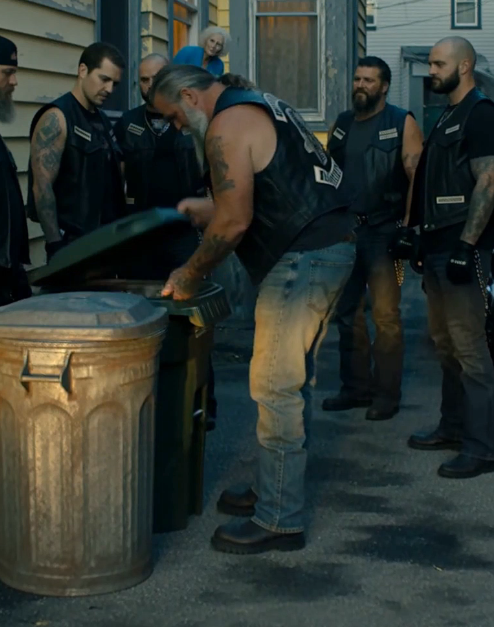
“Be at Mill Street at five forty-five,” he said.
“For what?”
“Trash day.”
I laughed.
Boone didn’t.
The next Tuesday, I followed five Harleys through the sleeping town of Beckford, Ohio. Rain glazed the narrow streets, and the V-twins sounded too large for the alley behind the old houses. Bedroom lights came on as we passed. Curtains moved. A dog barked from behind a chain-link fence.
We stopped behind a faded yellow house with white trim.
A single porch light was burning.
Boone shut off his engine. The others followed, and the alley dropped into a silence filled with cooling metal, rainwater, and the soft creak of leather as six large men dismounted.
Nobody knocked.
Nobody spoke.
We walked around the side of the house, where two heavy trash bins stood beneath a sagging carport. Boone unlocked a small chain with the brass key, checked that the lids were secure, and rolled the first bin toward the street.
I took the second.
“Whose house is this?” I whispered.
“Mrs. Hart’s.”
“Does she know we’re here?”
“Yes.”
“Does she pay the club?”
Boone stopped.
He looked at me with the expression older bikers reserve for younger men who have said something stupid without yet understanding why.
“No.”
“Then why are we doing it?”
“Because it’s Tuesday.”
That was all he gave me.
Mrs. Eleanor Hart was eighty-nine and lived alone. She was small, sharp-eyed, and rarely opened the door while we worked. Most mornings, I saw only a pale hand lifting the kitchen curtain.
At precisely six, the curtain would fall.
We left before the city truck arrived.
The ritual seemed absurdly excessive. One of us could have moved the bins. Boone sent five or six riders every week, regardless of heat, rain, ice, illness, or holidays. If Tuesday fell after a long charity ride, the men returned at midnight and still appeared in the alley before dawn.
The neighbors did not understand.
Neither did I.
During my third week, an elderly man across the street stepped outside wearing slippers and a bathrobe.
“You boys bothering Ellie?” he demanded.
Boone removed his gloves. “No, sir.”
“Then why do you keep surrounding her house?”
“We’re taking out the trash.”
“It takes six motorcycles?”
“Sometimes the lids stick.”
The neighbor stared at us as though deciding whether to call the police.
Inside the house, Mrs. Hart tapped twice on the kitchen window.
Boone raised two fingers toward her.
The neighbor noticed.
“What does that mean?”
Boone pulled on his glove. “Means we’re done.”
By winter, I had learned the procedure. Recycling went first. Household trash followed. The bins had to face the street with their handles toward the house because Mrs. Hart could not turn them after collection. In freezing weather, we cleared the wheels. If snow blocked the curb, we shoveled a path.
We never entered without permission.
We never photographed her.
We never wore club colors on the property during public events because Boone did not want strangers turning an old woman’s Tuesday morning into biker publicity.
Once, a new prospect tried to record us for social media.
Boone took the phone from his hand, deleted the video in front of him, and sent him home.
“This isn’t content,” he said.
The prospect never returned.
Four months into my assignment, Mrs. Hart opened the side door while I was securing the empty bins after collection. She wore a blue robe and leaned on a walker.
“You’re the new one,” she said.
“Yes, ma’am.”
“What do they call you?”
“Switch.”
“That isn’t what your mother called you.”
“Caleb.”
She smiled. “Better.”
I asked how she knew there was a new rider when she rarely came outside.
“I listen.”
“To the engines?”
“To the boots. Young men hurry. Old men drag their left heels.”
Then she pointed toward my motorcycle.
“You ride a Softail?”
“Yes.”
“My husband said men bought Softails when they wanted comfort but didn’t want anyone to know.”
I laughed, but her expression had changed.
Behind her, on a narrow hallway table, stood a framed photograph of a young man beside an old black motorcycle. His hair reached his shoulders. A denim vest hung open over a work shirt. One hand rested on the handlebar.
The other held Mrs. Hart’s hand.
Before I could ask about him, she closed the door.
For four years, I continued riding the Tuesday Route. Mrs. Hart aged from eighty-nine to ninety-three. Our riders changed. Boone’s knees failed, prospects earned patches, two brothers moved away, and one died of cancer.
Still, every Tuesday, the engines arrived before daylight.
Then one cold November morning, the porch light was dark.
The kitchen curtain never moved.
And tied around the trash-bin handle was the old brass key, a black funeral ribbon, and an envelope addressed to sixty bikers—most of whom Mrs. Hart had never met.
Inside that envelope was the reason generations of strangers had guarded her Tuesdays—and the name of a dead rider whose final journey had never actually ended.
Part 2 — Four Years Measured in Trash Days
Mrs. Hart did not become part of my life through conversation. She entered it through repetition: a porch light at dawn, two taps on glass, a walker glimpsed behind the curtain, and the smell of cinnamon escaping whenever she opened the side door.
Every Tuesday added one small fact.
She drank tea, not coffee. She placed newspapers in a paper grocery bag even though the city allowed them loose. She tied the trash lids with green cord during storms. At Christmas, she left six paper sacks on the step, each containing two oatmeal cookies and a handwritten name.
Mine said Caleb.
Nobody had told her my legal name except me.
She remembered.
That frightened me more than I expected because being remembered creates obligations that being noticed does not.
I had joined the Iron Lanterns after losing my job, marriage, and most of my patience within the same year. I was thirty-seven and living above a transmission shop. My daughter visited every other weekend but disliked the apartment because the pipes hammered at night.
The club gave me structure.
Rides began on time. Tools returned to their drawers. If a brother promised to help, he appeared. Nobody asked me to explain every bad decision before allowing me to make a useful one.
Then came the Tuesday Route.
At first, I treated it as another club assignment. After three months, I began setting two alarms. After six, I checked the weather on Monday nights and carried salt for Mrs. Hart’s walkway.
Nobody ordered me to do that.
The route had begun changing from something I was required to perform into something I could not imagine abandoning.
The work expanded cautiously. If a storm knocked branches into the alley, we cleared them. When Mrs. Hart’s gate sagged, Boone repaired it after receiving permission. When the porch railing loosened, our carpenter welded a new bracket.
She paid for materials whenever she could.
If we refused the money, she became angry.
“I’m old,” she told Boone once. “Not helpless.”
After that, we accepted one dollar for every repair. Boone kept the bills in a tobacco tin at the clubhouse. He called it Ellie’s Account, though none of us knew what it would eventually purchase.
The club knew rules but not reasons.
Patched members were told that Mrs. Hart’s address was protected, her dignity mattered, and the Tuesday Route could not be skipped. Boone knew more. So did our road captain, Amos Reed, who was seventy-two and rode only during warm months.
Whenever we asked, Amos answered with the same phrase.
“We finish what was started.”
“What was started?” I pressed him one morning.
“A ride home.”
“Whose?”
He tightened the strap on Mrs. Hart’s recycling lid. “Not yours to tell yet.”
The secrecy irritated several younger riders. One accused Boone of turning club tradition into obedience without explanation. Another asked whether Mrs. Hart had donated property or money decades earlier.
Boone listened.
Then he placed the brass key on the table.
“Anyone who believes the reason matters more than the promise can leave the key here.”
No one touched it.
Winter tested us hardest. Beckford sat close enough to Lake Erie for the cold to arrive sideways. Engines resisted starting. Alley ice hid beneath snow. Once, a city plow buried Mrs. Hart’s bins behind a frozen ridge nearly three feet high.
We arrived with shovels.
The work took forty minutes.
Mrs. Hart watched from the kitchen window and tapped twice when we finished. Before leaving, I noticed her front door open. She stood there wearing a wool coat over her pajamas.
“You’ll catch pneumonia,” I called.
“So will you.”
“We’re younger.”
“Not all of you.”
Amos laughed so hard he had to lean against the gate.
She held out a thermos filled with hot chocolate. We passed it around using paper cups while snow settled on our shoulders. For ten minutes, six bikers and one widow stood in an alley drinking something made for children.
She still offered no explanation.
The following spring, Mrs. Hart fell in her kitchen. A neighbor found her after hearing the smoke alarm chirp continuously. She spent nine days in the hospital and three weeks in rehabilitation.
The trash bins remained empty.
We rolled them out anyway.
I thought the ritual looked foolish without her inside the house. Boone disagreed.
“A promise doesn’t check whether anyone is watching.”
When Mrs. Hart returned, the porch light came on before we arrived. The kitchen curtain lifted. She tapped twice.
That morning, Boone turned away quickly and pretended to inspect a tire.
He was crying.
Not openly. Boone had lived too long among men who hid grief behind work. He wiped his face with a glove, kicked ice from his boot, and told us to move faster.
After the bins were returned, Mrs. Hart called me inside.
It was the first time.
Her house smelled of furniture polish, cinnamon, and old paper. Photographs crowded every wall. Most showed children and grandchildren who now lived in other states. Several showed motorcycles.
The black motorcycle from the hallway photograph appeared repeatedly.
So did the young man.
“My husband, Thomas,” she said.
“Was he in the club?”
“No.”
That answer deepened the mystery.
“Did he know Boone?”
“Boone was fourteen when Thomas died.”
I stared at her.
Every theory I had built collapsed.
Mrs. Hart touched the photograph’s frame. “The men who made the promise are gone now.”
“What promise?”
She looked toward the alley, where our motorcycles waited.
“The one they keep sending forward.”
Before I could ask anything else, she handed me the thermos and told me the others were getting cold.
Part 3 — The Tuesday Nobody Wanted to Ride
By the third year, Mrs. Hart’s health declined in small visible ways. She stopped standing behind the curtain and began watching from a chair near the window. The walker was replaced by a wheelchair after another fall.
Her mind remained sharp.
“Your rear tire sounds wrong,” she told Deacon through the screen door one morning.
He laughed until we checked it.
A nail had entered near the sidewall.
Mrs. Hart heard motorcycles the way some people recognized birds. She could distinguish Boone’s Road King from Amos’s old Shovelhead before we turned into the alley. She knew when Clay adjusted his exhaust and when I changed motorcycles after my Softail was damaged.
She never confused the Tuesday sound with noise.
“It’s a roll call,” she said.
“For who?” I asked.
“For the promise.”
Still, she refused to explain more.
Then came the Tuesday when freezing rain coated every road between the clubhouse and Mill Street. The county advised residents to stay home. Schools closed. Trash collection was delayed until Wednesday.
Our group chat filled with messages.
No pickup today.
Roads are dangerous.
We can move the bins tomorrow.
Boone answered with four words.
Tuesday is still Tuesday.
The decision divided us.
Riding motorcycles on ice would have been reckless. The club did not romanticize preventable accidents, especially not while keeping a promise connected to an elderly widow. We left the Harleys at home and met in trucks near the county garage.
Two riders refused to come.
One was caring for a sick child. Nobody questioned him.
The other, a younger member named Scott, said dragging empty bins through ice served no purpose.
“Mrs. Hart won’t expect us,” he wrote.
Boone replied, “You sure?”
Scott stayed home.
Five of us reached the alley shortly before six. Ice covered the bins, chain, gate, and side steps. Mrs. Hart’s porch light burned through the rain.
We moved the containers only to the gate because collection had been postponed. Then we salted the path and checked the exterior pipes.
The kitchen curtain rose.
Two taps.
She had expected us.
The next week, Scott surrendered his patch.
Nobody demanded it. Boone did not punish him. Scott simply placed the leather cut on the clubhouse table and admitted that a tradition he could not understand meant less to him than it did to us.
“I need reasons,” he said.
“So did I,” I answered.
“What changed?”
I thought about the porch light shining through ice.
“I stopped believing she owed me one.”
Brotherhood was not tested by fights or dramatic rescues. It was tested by whether men kept showing up after the work stopped making them feel important.
Mrs. Hart’s ninetieth birthday fell on a Tuesday. We expected family cars, balloons, and activity at the house. Instead, the alley remained empty.
Her daughter’s flight had been canceled. Her grandson was serving overseas. The others planned to call later.
Mrs. Hart left the bins outside as usual.
On top of the recycling lid sat a chocolate cake large enough for eight people.
The icing showed a crooked motorcycle drawn by a grocery-store bakery employee. A small card read, “For the Tuesday boys.”
We moved the bins.
Then we sat on overturned milk crates beneath the carport and shared the cake with her. She wore a red sweater and insisted on cutting her own slice.
“Make a wish,” I said.
“At ninety, wishes become scheduling requests.”
“Make one anyway.”
She looked around the carport at six bikers holding paper plates.
“I wish you’d stop calling me Mrs. Hart.”
“What should we call you?”
“Ellie.”
From that morning forward, the Tuesday Route belonged to Ellie.
She learned our names, children, jobs, and preferred cookies. She knew who was sober, who was struggling, and whose marriage had entered dangerous silence. Men arrived believing they were checking on an elderly widow and left carrying advice they had not requested.
She told Clay to apologize before pride changed his address.
She told Deacon to have the mole on his neck examined.
She told me my daughter needed a bedroom more than I needed another motorcycle.
I sold the damaged Softail, moved into a small two-bedroom rental, and painted one room purple.
My daughter began staying every scheduled weekend.
Ellie never mentioned the advice again.
During her ninety-second year, she gave Boone a sealed letter. He placed it in the same tobacco tin holding the one-dollar repair payments.
“When do we open it?” he asked.
“When I stop tapping.”
Boone’s face hardened.
“That won’t happen soon.”
“Promises don’t improve because people pretend time has stopped.”
The letter remained sealed.
The next months carried a different weight. Every Tuesday, someone checked the window before touching the bins. Every tap felt borrowed.
Ellie weakened.
The ritual continued.
Then the cold November morning arrived.
No porch light.
No curtain.
No taps.
I knocked on the side door while Boone used the brass key only on the trash-bin chain. The house key had never been entrusted to us. We called Ellie’s daughter, who contacted a neighbor with emergency access.
The neighbor entered.
Minutes later, she returned with tears running down her face.
Ellie had died peacefully in bed during the night.
She was ninety-three.
The six of us stood in the alley while sleet darkened our leather. Nobody knew what to do with the bins. Collection was still coming. Tuesday remained Tuesday.
So we rolled them to the curb.
On the handle, beneath the brass key, Ellie had tied a black ribbon before going to bed.
She had known.
When we returned to the clubhouse, Boone set the tobacco tin on the table and removed Ellie’s letter.
Under it lay a second envelope.
Its paper was yellow with age.
Across the front, written in faded blue ink, were seven words:
For every rider who comes after us.
Part 4 — The Man Stranded on County Road Nine
Boone opened the old envelope first.
Inside was a photograph, a newspaper clipping, and one page bearing twelve signatures. The photograph showed six young bikers standing beside a broken motorcycle on County Road Nine.
The man in the center was Amos Reed’s father.
Beside him stood Ellie’s husband, Thomas “Red” Hart.
Red was not a member of the Iron Lanterns. The club did not yet exist. He worked second shift at a machine factory, rode an old black Shovelhead, and stopped for stranded motorists long before phones could summon roadside assistance.
Forty years earlier, on a rainy October night, Red was riding home when he saw a young biker pushing a disabled motorcycle along County Road Nine. The rider’s name was Mack Reed—Amos’s father.
Mack had no tools, little money, and a wife expecting him home before midnight. His charging system had failed six miles outside Beckford.
Red stopped.
He could not repair the motorcycle beside the road because the required part was in his garage. He offered Mack his jacket, promised to return, and rode home through worsening rain.
Ellie was awake when he arrived.
She watched him search the garage for a spare regulator and asked why he intended to go back out.
“There’s a kid stranded,” Red said.
“You don’t know him.”
“I know the road.”
Ellie wrapped the replacement part in a kitchen towel. Before Red left, she told him to wait until morning.
He kissed her forehead.
“Twenty minutes.”
Those were his last words to her.
Red reached Mack, installed the part, and got the young rider’s motorcycle running. Mack offered money. Red refused.
“Do it for the next one.”
They separated near the railway crossing.
Mack rode east.
Red turned toward home.
Less than three miles later, a pickup crossed the center line on a rain-slick curve. Red was killed instantly. The pickup driver survived and was later convicted of driving under the influence.
The newspaper clipping contained none of the roadside details. It described Red only as a local factory worker and motorcyclist who died in a collision shortly before midnight.
Mack supplied the missing story.
He had reached home safely because a stranger returned to the rain for him.
The morning after the accident, Mack went to Ellie’s house carrying Red’s jacket, the kitchen towel, and the twenty dollars Red had refused.
Ellie had not yet chosen funeral clothes.
Mack stood on the porch and told her why her husband had been on County Road Nine.
Then he made a promise no grieving widow had requested.
“You won’t face the road alone.”
Mack brought eleven riders to Red’s funeral. They were not a formal club, merely factory workers, mechanics, veterans, and men who met at the same diner.
After the burial, all twelve signed one page.
The wording was plain:
Thomas Hart stopped because one of us was stranded. We will look after Eleanor Hart for as long as she lives. If we cannot, another rider will. The promise ends only when her road does.
Beneath the statement were twelve names.
Every man who signed was dead now.
Yet the promise remained.
Mack and the other riders began quietly. They repaired the porch after winter damaged it. They changed the oil in Ellie’s car. When the factory reduced her survivor benefits, they left groceries without names.
Ellie resisted.
She was fifty-three, employed, capable, and angry that men connected to the worst night of her life kept appearing at her door.
“I don’t need twelve husbands,” she told Mack.
“No, ma’am.”
“I don’t need charity.”
“No, ma’am.”
“Then why are you here?”
“Because Red told me to help the next one.”
That answer made her let them repair the porch.
Years passed. The informal riding group became the Iron Lanterns. Mack placed the signed promise inside the original club charter. Each president received the document and the responsibility of assigning help without turning Ellie into a public symbol.
The club paid no regular allowance. Ellie would never have accepted it. They responded to practical needs with her permission: repairs, rides to medical appointments, snow removal, roof work, and help after storms.
Most members knew only that Ellie was “family by promise.”
The full story remained private because Red’s death was not meant to become club mythology.
Mack died twenty-one years after signing the page. Before his death, he handed the envelope to Boone’s predecessor.
That president passed it to Boone.
The oath crossed from one pair of hands to another.
The Tuesday Route began only four years earlier, after Ellie injured her shoulder while dragging the bins through snow. Boone offered to send one rider.
She refused.
He sent six.
“Why six?” I asked after hearing the story.
Boone looked at the photograph. “That’s how many were in the first roadside picture.”
The number had never been about lifting two trash containers.
Every Tuesday, six riders represented the six men who had watched a stranger repair a motorcycle in the rain and then learned he had died on the way home.
Ellie knew exactly why we came.
The neighbors did not.
Most current members did not.
I had spent four years pulling trash for a woman whose husband died helping a biker I had never met, under an oath made before I was born.
The Tuesday Route was not a chore.
It was the unfinished part of Red’s ride home.
Part 5 — Ellie’s Final Letter
Boone opened Ellie’s letter with a pocketknife.
Her handwriting began firmly and weakened near the bottom. She addressed it to “the Tuesday boys, including the ones whose names I never learned.”
That line made several riders lower their heads.
She wrote that she had known the club’s promise from the beginning. Mack had tried to keep it secret, but secrecy was never his gift. For forty years, riders had repaired things, moved things, driven her places, and appeared after storms.
Some became friends.
Others remained engines in the driveway.
She preferred it that way.
“I did not need to know every man,” she wrote. “I needed to know the promise still knew my address.”
Boone stopped reading.
His voice had broken.
Amos took the letter and continued.
Ellie explained that she never blamed Mack for Red’s death. Red had chosen to return to County Road Nine because stopping for stranded people was part of who he was. Had Mack not been there, Red would eventually have stopped for someone else.
She had been angry at rain.
At the pickup driver.
At twenty minutes becoming forty years.
But never at the stranded rider.
Mack carried guilt for the rest of his life. Every time he repaired Ellie’s house, he behaved as though work might balance an account nobody had opened. Ellie finally told him that surviving another man’s kindness was not a debt.
He still came back.
His son Amos came after him.
Then Boone.
Then us.
Ellie described the Tuesday mornings in detail. She knew who arrived first and who allowed his engine to idle too long. She knew Clay whistled while checking the bin lids. She knew I rolled the recycling container more carefully after one wheel cracked.
She knew the young prospect had tried to record her.
She knew Boone made him delete it.
“Thank you,” she wrote, “for never turning an old widow into proof that you were good men.”
Those words landed heavily.
Bikers are accustomed to being judged by appearance. That can create another temptation—the desire to broadcast every compassionate act as evidence against the stereotype. Ellie understood that trap.
If we had photographed four years of Tuesday Routes, the images might have traveled across social media. People would have praised us. Sponsors might have called. The club might have gained followers.
Ellie would have lost the privacy of being helped without becoming a story.
The irony was that she had now chosen to tell it herself.
Her letter granted permission for the promise to be shared after her death, not to glorify the club but to explain why more than sixty riders had been invited to her funeral.
She had prepared the guest list with her daughter.
Some names belonged to men who had known her for decades. Others were prospects she had never met. Several came from chapters in neighboring states whose older members once helped repair her roof after a tornado.
Every rider who had carried the promise, even briefly, was welcome.
Ellie also addressed the tobacco tin.
The one-dollar payments had accumulated to $186.
She had added money of her own.
Her instruction was precise: use it to establish a roadside assistance fund for stranded motorcyclists who could not afford towing or repairs. No club logos. No photographs. No requirement that the rider belong to any group.
Name it Red’s Twenty Minutes.
I looked at the photograph of Thomas Hart beside the black Shovelhead.
His last promise to Ellie had been that he would return in twenty minutes.
He never did.
Four decades later, she had transformed those missing minutes into a way for strangers to reach home.
At the bottom of the letter, she wrote individual notes.
To Clay: “The whistling was off-key, but the alley needed it.”
To Deacon: “Thank you for checking the lock twice.”
To Boone: “You inherited Mack’s guilt. Put it down.”
Then my name appeared.
“Caleb, you asked me why they came. I’m sorry I did not answer. A promise survives longer when a person learns to keep it before learning how it began.”
I read that sentence three times.
For years, I believed understanding created commitment. Ellie believed repeated action could prepare the heart to understand later.
She had been right about me.
The letter’s final paragraph was short.
“Do not come next Tuesday. There will be nothing at the house that needs carrying. Ride somewhere else. Someone is always stranded.”
Nobody spoke after Amos finished.
Outside the clubhouse, wind rattled the metal sign. A motorcycle passed on the highway, its engine rising and fading into the evening.
Boone folded both letters and returned them to the envelope.
Then he opened his phone.
“How many are coming to the funeral?” I asked.
He looked at the messages arriving from three states.
“More than sixty.”
Part 6 — Two Kilometres of Motorcycles
Ellie’s funeral took place on Saturday morning at Beckford Community Church. The building held fewer than two hundred people, but cars filled every nearby street before nine.
The first motorcycle arrived at seven.
The second came four minutes later.
By eight thirty, sixty-three bikes lined the road from the church to the edge of town—a distance the sheriff later measured at just over two kilometres.
Most riders had never met Ellie.
They came because someone who trained them, patched them, repaired their first motorcycle, or stood beside them during a funeral had carried the promise before them.
The oldest attendee was Amos, now seventy-six. His father’s signature appeared first on the original oath. Arthritis prevented him from riding, so he arrived in a pickup carrying Red’s old jacket inside a garment bag.
The youngest was a twenty-two-year-old prospect named Luis.
He had joined three months earlier.
When I asked why he came, he answered, “Boone said a road was ending.”
Inside the church, Ellie’s family displayed photographs from ninety-three years of life: childhood, marriage, factory picnics, Christmas mornings, grandchildren, and the yellow house on Mill Street.
Near the casket stood the photograph of Red beside his motorcycle.
His leather gloves rested below it.
The pastor told the congregation about their marriage but left the roadside story to Amos. Leaning on two canes, he explained how his father had been stranded in the rain and how Red returned with the part that sent him home.
“My father spent the next twenty-one years trying to repay a man who would not accept twenty dollars,” Amos said. “He finally understood the only payment Red wanted.”
Amos looked toward the bikers occupying six rows.
“Help the next one.”
After the service, Boone placed Ellie’s brass trash-bin key beside Red’s gloves. The key had no practical value now. The house would be sold. The bins belonged to the city.
Yet that small piece of brass had summoned generations of riders before dawn.
Ellie’s daughter approached us near the church doors. Her name was Margaret, and she lived in Oregon. Guilt appeared in her face before she spoke.
“I should have been here more.”
Boone shook his head. “Your mother never said that.”
“She was alone.”
“No,” Amos said. “She lived alone. Different thing.”
Margaret looked at the motorcycles stretching down the road.
“I knew people helped her. I didn’t know there were this many.”
“There weren’t,” I said. “Not at once.”
That was the truth of it. Ellie had never been surrounded by sixty riders during ordinary life. The promise reached her in small groups: one man repairing a gutter, two clearing snow, six moving trash.
A crowd appeared only when she no longer needed one.
For the procession, the funeral coach traveled first. Family cars followed. Then came the motorcycles, paired in staggered formation, engines kept low through the residential streets.
No one revved.
No horns sounded.
The honor line required no display beyond its length.
Residents stepped onto porches as we passed. Some recognized Ellie’s Tuesday riders. Others had wondered for years why motorcycles visited the yellow house before sunrise.
Now they understood.
At Mill Street, the procession slowed.
The trash bins stood beside the house, empty and clean. Ellie’s daughter had asked the city not to remove them until after the funeral.
Boone lifted two fingers.
Every rider behind him repeated the gesture.
Two taps returned by sixty-three hands.
The kitchen curtain did not move.
We continued toward the cemetery.
Part 7 — The First Tuesday After Ellie
Tuesday arrived three days after the funeral.
I woke at five without an alarm.
For four years, my body had learned the route: coffee before dawn, boots by the door, gloves on the counter, engine started carefully so my daughter would not wake when she stayed over.
Boone had told us not to visit Mill Street.
Ellie had written the same instruction.
Still, six riders gathered at the clubhouse.
Nobody had organized it.
We stood beside our motorcycles, uncertain what to do with a Tuesday that no longer contained Ellie’s bins.
Boone carried the tobacco tin. Inside were the 186 one-dollar bills and Ellie’s added money. The club had matched the amount, then other chapters contributed after the funeral.
Red’s Twenty Minutes began with enough money to provide emergency towing, fuel, batteries, and minor roadside repairs for riders in three counties.
No membership required.
No photographs allowed.
The first call arrived at 6:12 that morning.
A nursing assistant had finished a night shift when her small motorcycle failed near County Road Nine. She had no towing coverage and needed to get home before taking her children to school.
Six of us went.
The problem was a loose battery connection. Clay repaired it in less than ten minutes. She tried to pay, but Boone refused.
“Do it for the next one,” he said.
The sentence had traveled forty years to reach her.
As she rode away, I looked down County Road Nine. Rain darkened the fields, though the morning remained calm. Somewhere along that road, Red Hart had stopped for a stranger. Somewhere farther ahead, he had begun a journey home he would never finish.
Yet his kindness had kept moving.
Through Mack.
Through twelve signatures.
Through Amos and Boone.
Through six motorcycles entering an alley before sunrise.
Through an old widow who listened to boots and remembered every name.
On the following Tuesday, we did not return to Mill Street. We answered another roadside call. Then another.
Months later, the yellow house was sold to a young family. The city replaced the trash bins. The new owners never knew why six bikers sometimes slowed near the alley but did not stop.
Ellie’s brass key now hangs inside the clubhouse beside the original oath. Beneath it is a plain wooden sign bearing four words:
Tuesday is still Tuesday.
Every new patched member hears the full story. Before receiving the club key, he or she takes one shift with Red’s Twenty Minutes. No one is required to become a hero.
They only have to answer.
Sometimes, after an early call, I ride past the cemetery. Ellie rests beside Red beneath a simple gray stone. I never stay long.
I leave two small taps against the handlebar.
Then the V-twin catches, the sound rolls across the grass, and another Tuesday begins.
Follow our page for more unforgettable biker stories about promises, brotherhood, and quiet kindness that keeps traveling long after the rider is gone.