Part 2: A BACA Biker Let a Blind Girl Touch Every Part of His Harley—But Her Final Description Made His Wife Turn Away and Cry
Part 2:
I had been married to Mason Rourke for twenty-three years before I understood that the parts of him most people called hard were often the same parts holding everything else together.
Stone grew up outside Johnson City in a house where anger arrived before explanation. His father repaired heavy equipment, drank bourbon after work and treated tenderness as a weakness boys needed beaten out of them. Mason learned to read footsteps before he learned multiplication, and by twelve, he could identify his father’s mood from the way a truck door closed.
His mother tried to protect him quietly. She kept spare food beneath the sink, left the porch light burning and placed herself between father and son whenever voices rose. Quiet protection was still protection, but it taught Mason that love usually stood somewhere nearby getting hurt.
He left at seventeen.
Motorcycles came later. A mechanic in Knoxville hired him to sweep floors, then taught him to rebuild engines. Mason discovered that metal responded honestly. A loose bolt caused vibration. Worn bearings produced heat. Damage made a sound if someone listened closely enough.
People were harder.
The Iron Hounds Motorcycle Club gave him structure without demanding explanations. He earned the road name Stone because he could stand through bad weather, funerals and hospital corridors without appearing to move.
Then our son died.
Eli was nine when a congenital heart defect took him during surgery. His room remained unchanged for nearly a year. Mason spent evenings in the garage rebuilding the same carburetor because finishing it would leave his hands with nothing to do.
Our marriage survived, but not neatly. We attended counseling. We fought. We learned there were mornings when staying married required less romance than discipline.
Stone joined the Knoxville-area BACA chapter two years afterward.
He never claimed he wanted to replace Eli. He said only that frightened children deserved adults who arrived when they promised.
I understood the rest.
Ava Bennett entered our lives through the chapter’s child liaison.
She had been born with bilateral anophthalmia, a rare condition that left her without functional vision. Her mother, Danielle, loved her but struggled with addiction and unstable housing. Ava’s biological father, Caleb Bennett, disappeared before her second birthday.
For several years, Ava moved between her mother, relatives and temporary care. The adults around her changed frequently, so she learned not to trust voices until they returned enough times.
She also learned that danger had sound.
Raised voices carried through walls. Bottles struck kitchen counters. A belt buckle made a particular metallic click. Doors slammed differently when someone intended to return and when someone did not.
After a violent incident involving Danielle’s boyfriend, a social worker referred the family to BACA for additional emotional support while the legal process continued.
Stone attended the first meeting without his motorcycle.
Ava noticed.
“You’re a biker,” she said.
“Yes.”
“Where’s your bike?”
“Didn’t know if you liked loud engines.”
“I don’t know.”
“Then I left it home.”
She considered that answer.
Most adults decided what she could tolerate before asking.
Stone asked.
At the second meeting, Ava requested the motorcycle. He parked half a block away and allowed her to approach the sound at her own pace.
She stopped ten feet from the idling Harley.
“Turn it off.”
Stone did.
She listened to the engine tick as it cooled.
“Again next week,” she said.
He came again.
Stone never used his size to manufacture trust. He sat on floors, kept his voice low and announced every movement before making it.
“I’m standing.”
“I’m two steps to your left.”
“My hand is open if you want it.”
Ava accepted the hand after seven weeks.
Three months later, she touched his beard.
“Why is there hair on your face?”
“Bad decisions.”
“Rachel likes it.”
“Rachel has poor judgment.”
I was sitting nearby.
“I can hear you.”
Ava laughed.
That laugh became one of the few sounds capable of making Stone lose his place in a sentence.
Our involvement was supposed to remain limited to the advocacy role. Then Danielle entered a long-term treatment program, and the county needed a licensed respite placement familiar with Ava’s mobility and communication needs.
Stone and I completed the training.
We installed tactile labels throughout our home, placed raised markers on appliances and learned never to leave a chair in a new position without warning. Ava mapped the hallway with her cane and counted twelve steps from her bedroom to the bathroom.
The first night, she slept wearing her shoes.
By the fourth week, she left them beside the bed.
That was trust, too.
The Harley exploration began because Ava objected to how sighted people described motorcycles.
At school, a classmate said Harleys were shiny. A teacher called them beautiful. Another child said they looked scary.
Ava asked what shiny looked like.
Everyone offered a visual comparison.
She came home irritated.
“People keep using eye words.”
Stone was cleaning tools at the kitchen table.
“What would you use?”
“Cold. Smooth. Loud. Heavy. Smells like the garage.”
“That’s better than shiny.”
“Does your motorcycle feel like it sounds?”
Stone set down the wrench.
“Want to find out?”
That question led to nearly a week of preparation.
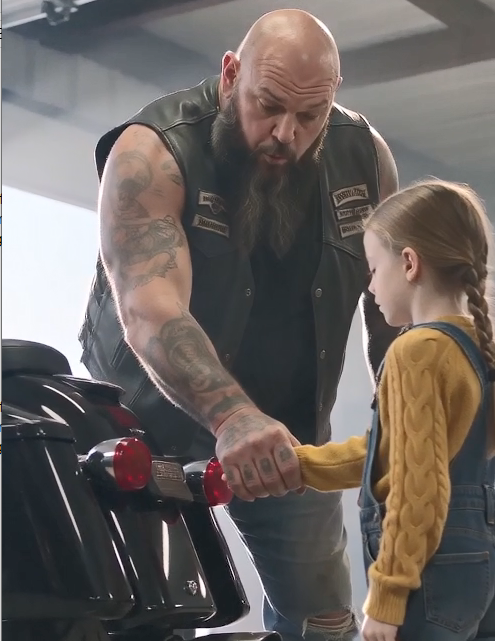
He brought the Road King into the club’s private garage so they could control heat, noise and interruptions. Preacher inspected exposed cables. Rosa covered sharp edges. Boone placed nonslip mats around the bike.
Stone ran the engine long enough to warm the seat and exhaust, then waited until every surface fell within the safe range. He borrowed a thermal thermometer from the shop and checked the pipe six times.
“You planning to let her touch it or cook dinner on it?” Preacher asked.
Stone checked again.
Bikers could joke.
The temperature could not.
Ava arrived holding my hand but released it when her cane found the rubber mat.
Stone stood near the front tire.
“Tell me where you are,” she said.
“Eleven o’clock, about four feet.”
“Bike?”
“Twelve o’clock, two feet.”
She extended her cane until the tip met the front tire.
The contact produced a soft rubber tap.
Ava smiled.
“There you are.”
Stone began at the handlebar because it gave the motorcycle a clear width. He asked permission before guiding her wrist, then let her fingers travel independently.
The chrome felt cold. The grips felt warmer and rougher. The brake lever moved beneath light pressure.
“What happens if I squeeze this?”
“Front brake.”
“Can I break it?”
“No.”
“Can you?”
“Everything breaks if I work hard enough.”
“Rachel says you’re not funny.”
“Rachel’s correct.”
She traced the circular mirror and asked what it did. Stone explained that it showed what was behind the rider.
Ava frowned.
“So it’s for seeing?”
“Yes.”
“Useless.”
“To you.”
She touched the edge thoughtfully.
“Could be a tiny plate.”
Stone nodded, though she could not see him.
“Tiny plate it is.”
The fuel tank took longer. Ava moved both palms across its curve, trying to understand how a surface could feel wide and narrow within the same shape.
Stone tapped it gently with one knuckle.
The metal answered.
Ava tapped back.
“Hollow.”
“Mostly.”
“Like a drum?”
“Drum full of gasoline.”
“Bad drum.”
“Terrible drum.”
At the leather seat, she pressed her palms downward and laughed at the warmth.
“Hard bike has a soft chair.”
“Riders are delicate.”
“You’re not delicate.”
I saw Stone glance at me.
Ava noticed the silence.
“Am I wrong?”
“No,” he said. “Just rude.”
She leaned against the seat, feeling the stitched seams and the dip where a rider’s weight rested. Then she explored the passenger pad.
“This is mine?”
“If you want it to be someday.”
The word someday held more than either of them acknowledged.
The rear tire fascinated her. She followed every groove in the tread and asked why the rubber needed cuts.
Stone explained rain, traction and the way water moved beneath a tire. Ava listened with her head tilted, constructing motion through pressure and sound.
Then she reached the exhaust.
Stone’s hand trembled before hers made contact with his wrist.
He blamed the old injury. That part was true. Two fingers had been crushed by a falling transmission years earlier.
It was not the whole truth.
The garage moment frightened him because it resembled the last afternoon he spent with Eli.
Our son had sat on the same motorcycle, tracing the tank and asking when he would be large enough to ride. Stone promised they would take the Harley together after his surgery.
Eli never came home.
For years, Stone believed the motorcycle had preserved the shape of an unfinished promise. Now another child stood beside it, and hope felt dangerously similar to memory.
Ava heard his breathing change.
She touched his wrist.
“You’re scared.”
Stone could have denied it.
He had denied worse things to adults.
“Yes,” he said.
“Of me touching the hot part?”
“Little.”
“And?”
“And liking this too much.”
Ava did not ask what “this” meant.
She placed her palm flat over the back of his hand. Together, they approached the pipe until warmth reached her skin.
She stopped.
“Hot inside.”
“Even after the engine quits.”
Ava repeated those words softly, saving them.
After an hour, she had built her Harley.
Not a picture in the visual sense, but a complete arrangement of temperature, texture, material, distance and sound. Cold chrome widened into handlebars. Smooth painted metal curved into a tank. Warm leather formed the saddle. Deep rubber grooves supported everything.
She stepped back.
“I know what it looks like now.”
Stone remained crouched.
“Tell me.”
“It looks like Dad.”
My throat tightened before she explained.
“Hard on the outside,” she said, placing one hand against the fuel tank. “Soft where somebody sits.” She moved to the exhaust area, stopping before the heat. “And hot inside after everybody thinks it stopped.”
Stone did not move.
Ava reached toward his voice and found his beard.
Then she asked, “Can Dad be you?”
I began crying.
Not because the word completed our family. It complicated it.
Ava still had a mother. She had a biological father whose absence had shaped her. She had social workers, court orders and adults responsible for deciding where she could live.
Love did not erase those people.
Stone understood that.
He covered Ava’s small hand with his scarred one.
“If that’s what Dad means to you,” he said, “I’ll work for it.”
Not yes.
Not I already am.
He refused to claim a title she had only begun to offer.
Ava nodded.
“Okay, Dad.”
Stone turned his face toward the motorcycle.
I saw the tears enter his beard.
The court envelope arrived minutes later.
Caleb Bennett had resurfaced after five years. He had completed a recovery program, found steady construction work in North Carolina and petitioned for visitation that could eventually lead to custody.
The timing felt cruel.
Legally, his request deserved consideration. Biological fathers are not permanently defined by absence if they demonstrate sustained change and the court determines contact serves the child.
Emotionally, Stone could not separate the petition from the word Ava had just given him.
Then came the photograph.
Someone had captured Ava beside the Harley, one hand on Stone’s beard. Her face was visible. The image appeared in a private motorcycle group with a caption celebrating the “newest BACA daughter.”
From there, it spread.
Caleb’s attorney found it and argued that the chapter had encouraged Ava to replace her biological father with a biker advocate.
The allegation threatened Stone, our foster-care license and the credibility of the chapter.
Worst of all, Ava’s privacy had been broken.
Only six people had been in the garage.
One of them had betrayed her.
Preacher called an emergency club meeting.
Stone wanted names immediately.
The riders gathered around the clubhouse table: Preacher, Rosa, Boone, Mateo, a younger member called Finch and several chapter volunteers.
No one wore phones inside.
Stone placed the printed photograph at the center.
“Who took it?”
Silence.
The man people called Stone looked close to breaking.
Preacher warned him to sit.
Stone remained standing.
“If one of you used that kid for a feel-good post, put your cut down now.”
Finch lowered his eyes.
He was thirty-three, recently divorced and desperate to prove he belonged to something decent. He had taken the picture through the partially open window. He claimed he never meant for it to leave the private group.
“You didn’t ask her,” Rosa said.
“She couldn’t see me.”
The room changed.
Stone crossed the distance before anyone expected him to move. Boone and Preacher stepped between them.
No punches were thrown.
That restraint cost him.
Ava had spent her life around adults who used what she could not see as permission. Finch had repeated the same violation while believing he was honoring her.
Stone removed Finch’s leather cut.
“You’re suspended.”
Finch looked toward Preacher.
The chapter president did not intervene.
Brotherhood did not protect a man from consequences simply because his intentions were better than the harm he caused.
The court reviewed the situation carefully.
Stone and I were questioned about the garage, the word “Dad” and our role in Ava’s life. BACA representatives clarified that advocates do not replace parents and that the photograph violated policy.
Ava’s therapist asked whether Stone had told her to call him Dad.
“No,” Ava said.
“Why did you choose it?”
“He comes when he says.”
The therapist allowed silence.
Ava continued.
“My first dad left. Mason came back enough times that I stopped counting.”
That answer entered the report.
It did not decide the case by itself, nor should it have. Children’s loyalty cannot be used as the only measure of legal parenthood, especially when adults have created the conditions around them.
Caleb was granted supervised contact.
Stone hated the decision.
I understood why the court made it.
Both truths lived in our kitchen for weeks.
Caleb’s first visit took place at a family-services center. He arrived early wearing clean work clothes and carrying a doll that spoke when its stomach was pressed.
Ava disliked talking toys.
He did not know.
Stone drove her but was asked to remain outside. He sat on the Harley for forty-seven minutes without starting it.
When Ava emerged, she seemed tired.
“How was it?” I asked.
“He cried.”
“What did you do?”
“Waited.”
Stone looked toward the building.
“Want to come back?”
Ava considered the question.
“Yes.”
The answer hurt him.
He nodded anyway.
“Then we come back.”
That was fatherhood, too: not confusing a child’s expanding world with your own replacement.
Caleb attended six supervised visits. He learned how to announce himself before touching Ava’s shoulder. He stopped buying visual toys and brought objects she could explore through texture and sound.
During the seventh visit, he asked to meet Stone.
They sat across from each other at a diner near the interstate.
I remained with Ava in another booth.
Caleb was thirty-six, thin and nervous, with a pale scar near his chin. He did not resemble the monster Stone had built from five years of silence.
He looked like a man carrying the consequences of cowardice.
“She calls you Dad,” Caleb said.
Stone held his coffee without drinking.
“She calls me Stone sometimes, too.”
“You want to adopt her.”
“I want her safe.”
“That’s not an answer.”
“It’s the only one you get today.”
Caleb looked down.
“I left because I couldn’t handle the blindness.”
Stone’s expression hardened.
“She wasn’t the thing you couldn’t handle.”
“I know that now.”
“Good.”
Caleb did not ask for forgiveness.
He asked Stone to teach him how Ava “saw” the motorcycle.
That request changed the conversation.
Not the history.
The direction.
Two weeks later, Caleb entered the same garage.
Stone placed no cameras nearby. Finch was not present. Ava stood between the two men, her white cane resting against the toolbox.
She led this time.
She showed Caleb the cold handlebar, the warm leather and the deep tire tread. She explained the mirror as a tiny useless plate.
At the exhaust, she placed Caleb’s palm over the back of her hand.
“Stop when it’s enough,” she told him.
Stone turned away.
His own words had returned through her.
Caleb felt the remaining heat.
“I understand,” he said.
Ava shook her head.
“No. You understand this part.”
She touched the motorcycle.
“The rest takes an hour.”
Stone almost smiled.
The child had learned boundaries from both metal and men.
Finch completed a six-month suspension. During that time, he volunteered with an organization teaching digital safety to foster families and children with disabilities.
He did not post photographs of the work.
He returned to the club without expecting his patch. First, he asked to apologize to Ava.
The meeting took place with her therapist present.
“I took your picture without asking,” Finch said. “I thought because you couldn’t see the camera, it wouldn’t bother you.”
Ava held her cane across her lap.
“Did you think I couldn’t say no because I couldn’t see?”
Finch’s face tightened.
“I think that’s what I did.”
“Do you understand now?”
“Yes.”
“How?”
“Because seeing me isn’t the same as having permission to keep me.”
Ava thought about it.
“Okay.”
She did not forgive him on command. She did not ask for punishment. She ended the conversation when she was ready.
Three months later, Stone returned Finch’s cut.
“Second road,” Stone said.
Finch nodded.
“Different rules.”
“Same rules. You just hear them now.”
The guardianship case did not produce a clean victory for anyone.
Danielle remained in treatment and maintained supervised contact. Caleb continued visiting and gradually became part of Ava’s life without receiving full custody. Stone and I became her permanent legal guardians after the court determined that stability should remain centered in our home.
Ava had a mother.
She had a biological father learning to return.
She had me.
And she had Stone.
She used different names depending on what each relationship could honestly hold.
Rachel.
Mom.
Caleb.
Dad Caleb, eventually.
Stone.
Dad.
No title canceled another.
Families built after harm are rarely neat enough for slogans.
They are more like old motorcycles: different metals, repaired parts, heat stored beneath surfaces and a shape that becomes understandable only after patient hands explore the whole thing.
Ava rode behind Stone for the first time when she was ten.
Preparation took months. Her therapist approved. Stone installed a secure passenger backrest, adjusted the foot pegs and practiced every signal until Ava could repeat them while half asleep.
The Iron Hounds closed a private road on club property.
Ava touched the motorcycle from handlebar to rear tire before climbing onto the seat.
“Same bike?” she asked.
“Same bike.”
“Feels older.”
“So do I.”
“You were already old.”
Stone looked toward me.
“I blame your parenting.”
I laughed.
Ava wrapped both arms around his waist.
The engine started.
She felt the machine through her feet, knees, chest and hands. The Harley no longer existed as separate pieces. The cold chrome, soft leather, grooved rubber and heat became movement beneath her.
Stone traveled one slow circle.
Then another.
When he stopped, Ava remained seated.
“What does riding look like?” I asked.
She considered it.
“Like the ground is singing through Dad.”
Stone removed his sunglasses.
There was no sun.
He wore them anyway until his eyes cleared.
The black Road King remains in our garage. Ava is fourteen now and can still identify it from several motorcycles by the rhythm of its idle.
Stone’s beard has gone mostly gray. His injured hand shakes more in winter, and he asks for help sooner than he once did.
That may be Ava’s influence.
Above his workbench hangs a small tactile diagram of the Harley that Ava created with leather, wire, rubber and raised metal strips. Each material marks the part it represents.
Beside it is a handwritten card in braille and print.
Stone never told me what it said.
Ava did.
Hard is not the opposite of soft. Sometimes hard is what keeps soft safe.
On Father’s Day, Caleb visits in the morning. Stone receives the afternoon. Nobody pretends that arrangement emerged without pain.
Ava chooses it.
Last year, she entered the garage while Stone was polishing the fuel tank. She found him by the sound of the cloth moving across metal.
“Dad?”
“Yeah, Cricket?”
“Can I see the bike again?”
Stone looked confused.
“You know every bolt.”
“People change.”
“So do bikes.”
“Exactly.”
He set down the cloth.
Then the 285-pound biker placed her hand on the cold chrome handlebar and began again.
One part at a time.
No cameras.
No hurry.
He kept returning until she could see him.