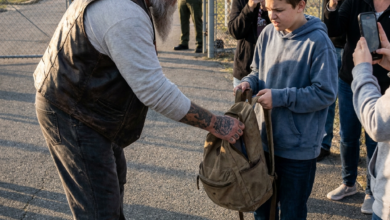
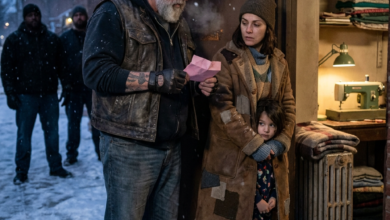
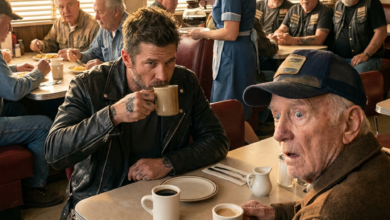
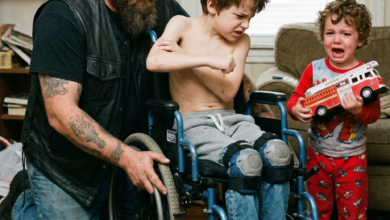
Part 2: A 300-Pound Biker Wore a Pink Tutu to Ballet Class for a Year—Then His Shy Daughter Stepped Onto the Stage Alone
Part 2 — The Girl Who Danced Only After Dark
I met Owen Callahan fourteen months before the pink tutu appeared.
He arrived at my studio on a September afternoon carrying a pair of ballet slippers as if they were delicate machine parts. Lily walked beside him in a faded denim jacket, one hand wrapped around two of his fingers because her palm could not close around his entire hand.
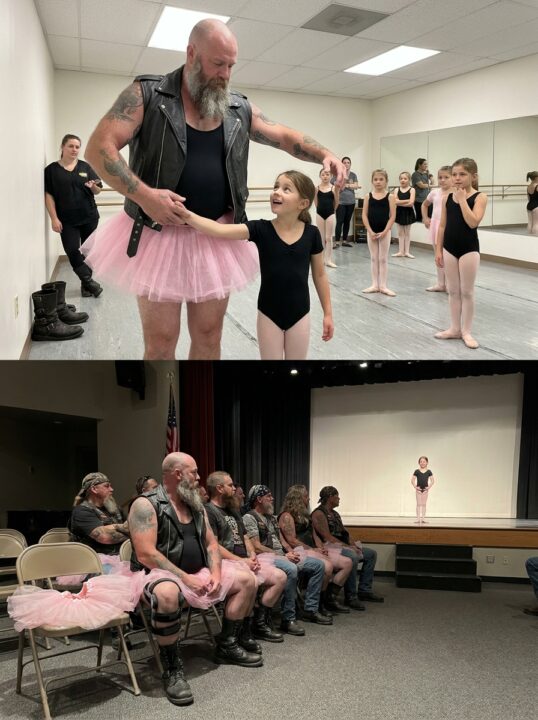
Other parents noticed the motorcycle first.
It was an older black Harley-Davidson Road King, clean but not polished, with worn leather saddlebags and a small passenger backrest Bear had reinforced himself. A child’s purple helmet hung from one handlebar.
Then they noticed him.
Bear had served nine years as a vehicle recovery specialist in the Army before returning to Iowa with a damaged left knee, two fingers that no longer straightened completely, and a habit of examining every exit whenever he entered a room. He did not discuss combat. When people thanked him for his service, he usually nodded and changed the subject.
After the Army, he opened Callahan Diesel & Recovery beside Highway 20. His shop handled disabled trucks, winter rollovers, and farm equipment that failed at the worst possible hour. He slept with his phone beside the bed and kept boots near the door.
His motorcycle club was not an outlaw club, though their worn leather, loud engines, and collection of scarred faces made explanations necessary whenever they held a fundraiser. The Iron Vale Riders escorted veterans’ funerals, repaired ramps for disabled residents, and delivered winter coats to two rural schools.
They also behaved like men who believed mockery was a form of affection.
Bear had learned to live inside that contradiction.
Lily’s mother, Rachel, had understood it too. She was a pediatric respiratory therapist with small hands, a quick temper, and a habit of keeping ballet music playing while she cooked. She met Bear when his Harley broke down outside the hospital after he had delivered toys during a Christmas ride.
Rachel stopped because she thought he was having a heart attack.
Bear was only swearing at a failed starter.
They argued for twelve minutes. She helped him push the bike. He bought her coffee the next morning. Seven years later, Lily was born.
Rachel wanted their daughter to dance, but she never forced the idea. She would move through the kitchen while Lily sat beneath the table, watching her feet. Sometimes Rachel lifted the little girl onto her toes and slowly turned her between the refrigerator and the sink.
Bear called it kitchen ballet.
Then Rachel became ill.
What began as exhaustion became a diagnosis of an aggressive heart condition complicated by damage from a childhood infection. She remained on the transplant list for eleven months. A suitable heart never arrived.
Lily was six when her mother died.
For nearly a year afterward, she refused music.
Bear removed the speaker from the kitchen but left Rachel’s ballet shoes in the hall closet. He did not know whether keeping them was healthy. He only knew throwing them away felt impossible.
The Iron Vale Riders tried to help.
Club president Hank “Deacon” Morris arranged meals. Mack Sloan fixed the leaking gutter. A prospect named Tyler mowed Bear’s lawn until snow covered it. Men who could rebuild transmissions stood helpless when Lily hid beneath the kitchen table and would not eat.
Bear never asked them to solve her.
He asked them to stay.
Gradually, Lily began speaking again. She talked to Bear, her teacher, and two girls at school, but unfamiliar rooms closed her voice. Crowds were worse. Being watched made her hands shake.
The first ballet brochure came home inside her school folder.
Bear found it folded into a square no larger than a postage stamp.
“Want to try?” he asked.
Lily shrugged.
Bear waited.
“Mom wanted me to,” she finally said.
“What do you want?”
She unfolded the paper, smoothed it on the table, and traced the photograph of a girl in white slippers.
“I want to want to.”
That was enough.
Bear called my studio.
During her first lesson, Lily stood in the back and copied every movement at half size. When the class raised both arms, hers reached her shoulders. When they crossed the room, she took three steps and stopped.
Bear watched through the glass.
He never pushed.
At home, however, Lily danced in the garage while Bear worked. She used a yellow floor stripe as her stage, moving between the hydraulic lift and a stack of winter tires while wrenches clicked and the radio played softly.
Bear began turning down work every Thursday afternoon.
That cost him money.
He said nothing about it.
The first small crisis came when another parent complained about his leather cut. She said the skull-shaped patch frightened her five-year-old and asked whether Bear could wait outside.
The skull was part of a memorial patch bearing the name of a club brother killed by a distracted driver. Bear could have explained that.
He did not.
He removed the cut, folded it over his arm, and sat in a black T-shirt that revealed more tattoos than the vest had covered. The parent did not complain again.
Lily noticed.
She noticed everything involving her father.
At school, two boys began calling him “the jail biker.” Bear had never been incarcerated, but facts have weak legs beside playground rumors. One child said men with neck tattoos hurt people. Another claimed motorcycle clubs stole children.
Lily punched neither boy.
She stopped telling classmates that Bear was her father.
A teacher discovered the change when Lily asked to use her mother’s last name on a family-tree assignment. The teacher sent a note home asking Bear to discuss “identity consistency.”
He read the note twice, folded it, and stitched it inside his leather cut.
The sentence that mattered was written in Lily’s pencil beneath the teacher’s message:
If they know he is mine, they will look at me too.
Bear carried those words against his chest for the next year.
He did not confront Lily.
He understood that shame grows stronger when dragged into the light before a child has words for it. Instead, he began searching for ways to make being seen feel survivable.
The opportunity arrived on a Thursday when Lily refused to enter ballet class.
Sitting beside her beneath the paper ballerinas, Bear asked what made the room different from the garage.
“In the garage, nobody watches.”
“What do you think they see here?”
She studied his knuckles.
“Somebody wrong.”
Bear looked through the glass at nine girls wearing matching black leotards.
“Wrong how?”
“Not like them.”
Then came the sentence that put him in pink tulle.
“I don’t want to be the strangest one.”
Bear drove directly from my studio to a costume shop beside the highway.
He had made a decision.
He would take that position from her.
Part 3 — Fifty-Two Thursdays in Pink
The first tutu lasted eleven minutes.
Bear lowered himself into a plié, the waistband rolled, and a section of tulle tore free with a sound like paper ripping. Three children laughed. Bear examined the loose fabric, tucked it under his belt, and continued.
Lily laughed too.
That mattered more.
By the second Thursday, the costume-shop owner had sewn a wide elastic panel into the skirt. Bear purchased black dance shoes online from a company that supplied theatrical costumes for large actors. They looked almost like ballet slippers if nobody examined them closely.
Everybody examined them closely.
Pictures appeared online after the third class.
One showed Bear attempting an arabesque with his tattooed arms extended and the pink tutu lifting behind him. The caption called him “Ballerina Bear.” Another image compared him to a circus animal.
Bear saw the posts.
He saved one.
I asked why.
“Lily laughed at that picture for eight minutes.”
He put the phone away.
“Worth keeping.”
His club brothers were less gentle.
At the Iron Vale clubhouse, Mack attached a pink ribbon to Bear’s handlebars. Tyler asked whether the Road King needed training wheels. A visiting rider began calling him Sugar Plum.
Bear answered every joke with the same question.
“You coming Thursday?”
Nobody accepted.
They preferred laughter at a safe distance.
Inside the studio, something unexpected happened. Bear became useful.
Children who feared making mistakes only needed to watch him miss a step. If they turned left when I said right, Bear had usually turned toward the storage closet. If someone lost balance, he demonstrated how far a large man could wobble without falling.
He never pretended to be competent.
That gave the children permission not to be.
Lily began correcting him. At first, she whispered. Then she touched his wrist or nudged one boot into place.
“Your heel goes there.”
“Which heel?”
“You only have two.”
“Both feel wrong.”
One afternoon, she became so frustrated that she moved in front of him and performed the entire sequence properly. She completed every step before realizing the class had stopped to watch.
Her face changed.
Bear immediately attempted a turn, collided gently with the barre, and knocked three foam blocks onto the floor.
Everyone looked at him instead.
Lily finished.
Bear understood the mechanics of attention long before I did. He never demanded that Lily tolerate the whole room at once. He became a larger target whenever she needed somewhere to hide.
Winter arrived.
Snow collected around the studio entrance. Bear came directly from recovery calls with road salt whitening his jeans and diesel fuel in the cracks of his hands. He changed in the restroom, pulled the tutu over thermal leggings, and joined the line.
His knee worsened.
I noticed him gripping the barre after class. The old injury had left damaged cartilage and two screws near the joint. A surgeon had recommended replacement surgery, but Bear kept postponing it because his shop depended on him.
“Ballet isn’t helping,” I said.
“Not supposed to help me.”
“You could sit and still support her.”
He looked toward Lily, who was practicing a turn near the mirror.
“She watches what I do when it hurts.”
That was true.
Lily had begun asking whether the knee was painful. Bear never lied.
“Yep.”
“Then stop.”
“Is your fear gone?”
She considered it.
“No.”
“Mine either.”
He returned to position.
In January, the Iron Vale Riders faced their first real test.
The club’s annual winter fundraiser provided heating fuel for older residents. Bear had planned the route and was expected to lead seventy motorcycles from Cedar Falls to three surrounding towns. A local television station would film the departure.
The schedule changed at the last minute.
Departure moved to 6:00 p.m.—twenty minutes after ballet ended.
Deacon told Bear to skip class.
“Lily has one every week.”
“This ride keeps people warm.”
“So let Mack lead.”
“You’re road captain.”
“I’m her father first.”
Deacon lowered his voice. “You know what cameras will catch if you arrive dressed like that.”
Bear glanced at the pink tulle extending beneath his leather cut.
“Then they’ll catch all of me.”
The president called an emergency vote. Some riders argued that the tutu would make the fundraiser look foolish. Others believed Bear’s family was nobody’s business. Mack, who had attached the ribbon to Bear’s handlebars, surprised everyone by defending him.
“He mapped every road,” Mack said. “Pink cloth doesn’t change the route.”
Deacon remained unconvinced.
“Take it off before formation.”
Bear removed his road-captain pin and placed it on the table.
“My daughter spent a year watching people decide who I am from my clothes,” he said. “I’m not teaching her they were right.”
He walked out.
Mack followed.
Then Tyler.
Within two minutes, nineteen riders had left the clubhouse and gathered outside the ballet studio. They did not own tutus. They did not enter. They waited beside their motorcycles while Bear completed class.
When the dancers emerged, Lily froze at the sight of them.
Bear lowered his voice.
“They’re riding with us.”
“Why?”
“Because sometimes brothers need extra time to understand.”
Deacon arrived last.
He returned the road-captain pin without making a speech.
Bear attached it beside the tutu’s waistband and led the fundraiser exactly as he was dressed. Pink tulle fluttered beneath his leather cut. The television crew filmed him. The story spread across Iowa by morning.
Donations tripled.
Everyone treated that as the climax.
It felt clean: the club accepted Bear, the public celebrated him, and Lily had begun crossing the studio without hiding.
Life rarely ends where applause begins.
At school the following Monday, several children surrounded Lily with screenshots of her father in the tutu. One boy asked whether Bear wanted to be a woman. Another said his parents thought the whole thing was a publicity stunt.
Lily did not defend him.
She locked herself in a restroom and missed two classes.
When Bear picked her up, she handed him his saved photograph.
“Please stop.”
He did not ask which part she meant.
He placed the tutu in the bottom of his saddlebag and drove home in silence.
That Thursday, Lily entered the studio alone.
Bear sat outside in jeans and his leather cut.
She lasted nine minutes.
Then she came through the door, sat beside him, and leaned against his arm.
“I thought I wanted you normal,” she whispered.
Bear waited.
“But normal makes me alone again.”
He opened the saddlebag.
The tutu was there.
Bear had not known what she would choose, but he had carried both possibilities.
He changed and returned to class.
The year continued.
Part 4 — The Empty Chair
By early spring, Lily could dance through an entire class while parents watched from the other side of the glass. She still avoided the front row, but she no longer measured every movement against the reactions around her.
I offered her a place in the annual recital.
Her answer came quickly.
“No.”
Bear did not argue.
I asked again three weeks later. This time, Lily looked toward the studio’s far corner where her father was stretching one thick leg against the barre.
“Would he be onstage?”
“The recital is for students.”
Bear nodded.
“Then she decides.”
Lily declined again.
Two days later, I found an envelope beneath my office door. Inside was a drawing of a large pink figure standing behind a smaller blue figure. The blue figure was beneath a yellow light.
One sentence appeared at the bottom:
What if the big one stays where I can see him?
We made a plan.
Lily would perform a ninety-second solo adapted from the movements Rachel had once practiced in their kitchen. Bear would sit in the front row, directly beyond the center aisle. He would wear the tutu over his jeans.
If Lily froze, she could look at him.
Nobody else needed to know.
Practice began after regular class. Bear sat in the same folding chair while Lily worked through the sequence. Sometimes she stopped. Sometimes she reached the final pose.
Each time, he remained where she could see him.
Then Bear’s knee collapsed.
It happened on Thursday number forty-nine. He attempted a slow turn, planted his left foot, and fell hard enough to shake the mirror. The children screamed. Lily reached him before I did.
Bear tried to rise.
His leg refused.
At the hospital, imaging showed that one of the old screws had shifted and damaged the joint. Surgery could no longer be postponed.
The earliest available date was the morning before Lily’s recital.
Bear refused it.
The surgeon was equally firm.
“You’re risking permanent damage.”
Bear pointed to the calendar.
“Move it one week.”
“We can’t guarantee the slot.”
“Then don’t.”
Lily heard the conversation from the hallway.
That evening, she placed the pink tutu on his hospital bed.
“You have to fix your leg.”
“I will.”
“Tomorrow.”
“Recital’s Saturday.”
“I know.”
Bear looked at her.
She was shaking, but she did not lower her eyes.
“You promised to sit where I could see you.”
“I did.”
“You also promised you’d come home.”
The words stopped him.
Bear had used that promise since Rachel’s death. Every recovery call, every highway ride, every winter storm began with the same exchange.
Come home.
Always.
Lily touched the swollen knee beneath his blanket.
“You can’t come home if you break everything.”
Bear agreed to surgery.
He told no one in the club that the timing frightened him. He had missed important moments before: Rachel’s last lucid afternoon because an overturned fuel truck closed the highway; Lily’s first school concert because a recovery call trapped him forty miles away.
Neither had blamed him.
That made the memories worse.
Surgery began Friday morning.
Complications developed before noon.
Scar tissue around the old injury made the procedure longer than expected. Bear’s blood pressure dropped under anesthesia. The hospital moved him to a monitored recovery unit and prohibited visitors for several hours.
Lily waited in the hallway holding his folded tutu.
Deacon arrived with Mack and Tyler. Their boots sounded heavy against the hospital tile. None of them knew what to say to a child facing another closed medical door.
Mack bought hot chocolate.
Lily did not drink it.
At 8:10 p.m., the surgeon told us Bear was stable but would remain overnight. He could not attend the recital in person. Standing, riding, or even sitting upright for several hours was impossible.
I offered to withdraw Lily’s solo.
She looked at me as if I had suggested removing the floor.
“No.”
Deacon knelt in front of her.
He was a stern sixty-one-year-old man with a gray beard, faded military tattoos, and two artificial fingers on his right hand. Children rarely trusted him quickly.
Lily did.
“What do you need?” he asked.
“My dad.”
Deacon’s face tightened.
“What else?”
She held out the tutu.
“I don’t know yet.”
The following afternoon, the auditorium filled with families carrying flowers and cameras. Lily dressed backstage in a pale blue costume her mother had selected from an old catalog years earlier.
Bear’s chair remained empty.
We placed a phone against the stage monitor so he could watch through a private video call. The connection failed twice. Hospital Wi-Fi froze the image. Bear’s face became a collection of gray squares.
Lily stood behind the curtain.
Her breathing shortened.
I reminded her of the first position. She could not move her feet.
From the auditorium came a low sound.
One engine.
Then another.
Then twenty-five more.
The V-twin thunder rolled through the school parking lot and stopped almost at once. Boots crossed the entrance hall. Leather creaked. Audience members turned toward the doors.
Deacon entered first.
A pink tutu circled his jeans.
Behind him came Mack, Tyler, Boone, and twenty-three members of the Iron Vale Riders. Some wore tulle over leather chaps. One had tied pink fabric around a knee brace. Another wore a tutu so small that it resembled a ruffled belt.
Nobody laughed.
The men filled the back row, leaving Bear’s front chair empty.
Deacon looked toward the curtain and lifted one artificial finger.
Lily saw him.
She also saw the empty seat.
The music started.
She did not step onto the stage.
We thought the fear had won.
Then Lily took Bear’s tutu from my hands, walked to the front row, and draped it over his chair. She spread the pink tulle carefully across the seat.
Only after that did she return to the wing.
The music restarted.
Lily entered alone.
Part 5 — What the Tutu Had Been Hiding
Lily’s first eight steps were smaller than we had practiced.
Her shoulders remained high. One hand trembled. She looked toward Bear’s empty chair after every turn.
The pink tutu waited there.
Behind it sat twenty-seven bikers dressed in their own imperfect versions of the same ridiculous courage.
Lily kept moving.
The solo used no difficult leaps. It was built from kitchen ballet—simple turns, a careful rise onto her toes, arms opening as if she were holding space for someone no longer present.
Rachel had created those movements while cooking dinner.
Bear had remembered them.
That was the truth Lily learned only the night before the recital.
Bear had recorded pieces of Rachel dancing in their kitchen during the final months of her illness. She moved slowly because her heart was failing, but she smiled whenever Lily copied her from beneath the table.
After Rachel died, Bear could not watch the videos.
He saved them on an old phone inside his shop safe.
When I asked him what Lily should perform, he finally opened that phone. We built the solo from Rachel’s movements without telling Lily their source. Bear feared the knowledge would place too much weight on her.
At the hospital, while Lily waited for his surgery, the old phone slipped from the pocket of his leather cut.
She watched every recording.
She recognized the first arm movement.
Then the turn.
Then the ending pose Rachel had made beside the stove, one hand extended toward six-year-old Lily beyond the camera.
The solo was not simply a dance Bear had watched for months.
It was a conversation he had rebuilt from memory.
That was the first truth hidden inside the tutu.
The second waited inside his vest.
After Lily finished, the audience rose. She did not bow immediately. She looked toward the empty chair, then toward the phone near the monitor.
The screen had frozen again.
Bear had not seen the final movement.
Lily bowed anyway.
Applause filled the auditorium. It rolled across the wooden stage, through the curtain, and into the hall where motorcycle helmets rested in a long row beside children’s winter coats.
Lily did not run from it.
She stood.
Afterward, the Iron Vale Riders formed a path from the stage door to Deacon’s truck. They did not rev their engines or draw attention away from the dancers. They held flowers purchased at a grocery store because none of them had remembered to order bouquets.
Mack handed Lily a bundle of pink carnations.
“You did good, kid.”
She looked at his tutu.
“You wore it backward.”
He examined the tulle.
“There’s a front?”
For the first time that day, she laughed.
We drove directly to the hospital.
Bear was awake, pale beneath his beard, with his left leg secured inside a brace. The road-captain pin and leather cut rested in a chair. When Lily entered wearing her costume, he tried to push himself upright.
She stopped him.
“You missed it.”
The words were blunt.
Bear accepted them.
“I did.”
“The video froze.”
“I know.”
“I danced anyway.”
His hands tightened against the blanket.
“I know that too.”
Lily placed the recital program beside him. Then she reached for the leather cut and turned it inside out.
The folded school note remained stitched behind the left chest panel.
I had seen the edge of it months earlier but had never understood why Bear carried it. Lily cut the thread with a nurse’s scissors and unfolded the paper.
The teacher’s message occupied the top half.
Beneath it was Lily’s sentence:
If they know he is mine, they will look at me too.
Bear’s face did not change, but one hand began to shake.
Lily read the sentence twice.
“You kept this?”
“Yep.”
“Why?”
“So I wouldn’t forget what I was asking you to carry.”
She touched the paper.
“I didn’t mean I was ashamed of you.”
“I know.”
“I was scared they’d see me.”
“I know that too.”
She glanced at the tutu still lying across the empty wheelchair we had used to move him from recovery.
“So you made them look at you.”
Bear nodded.
“I’m hard to miss.”
That was the second truth.
He had never worn the tutu to tell Lily that difference was easy. He wore it because he knew being watched could hurt. He took the larger share of that pain until she learned it did not have to control her.
The third truth belonged to his motorcycle club.
The twenty-seven men in pink had not invented the idea together. Deacon had called an emergency meeting after leaving the hospital. He placed Bear’s road-captain pin on the table and read the sentence Lily had once written.
Bear had shown it to him months earlier during the fundraiser dispute.
Deacon had remembered.
“We made the kid prove she could stand alone,” he told the club. “Now we prove alone doesn’t mean abandoned.”
Several riders resisted.
One said tutus would turn them into a joke. Another worried photographs could spread online. A visiting member walked out.
Deacon did not argue.
He placed a cardboard box of pink tulle on the table and put one around his own waist.
Mack followed.
Then Tyler.
The others made their choices.
Twenty-seven came.
The fourth truth emerged when Bear’s surgeon entered the room and recognized Lily’s costume. His own granddaughter had performed in the same recital. His wife had sent him a video of the solo.
The doctor held out his phone.
The recording was shaky and partially blocked by a man wearing a pink tutu, but it showed every movement from beginning to end.
Bear watched without speaking.
When Lily reached Rachel’s final pose, his thumb stopped on the screen.
He replayed the last nine seconds.
Then again.
Lily sat on the edge of the bed.
“Mom did that.”
“Yep.”
“You remembered.”
“Some things stick.”
She leaned against his chest carefully, avoiding the monitors. Bear placed one tattooed hand over the back of her head.
Outside the room, twenty-seven bikers waited in pink tulle while nurses pretended not to take pictures.
Lily pulled back and looked at her father.
“Do you know why I didn’t stop?”
Bear shook his head.
“I looked at your chair and thought, if you could be strange for a whole year, I could be scared for ninety seconds.”
Bear closed his eyes.
He did not cry easily. That afternoon, he did not need to.
The monitor betrayed him instead.
His heart rate climbed until the nurse entered and told everyone to stop upsetting the patient.
Part 6 — The Fifty-Third Thursday
Bear spent six weeks away from the studio.
His recovery was slow, and he disliked every part of it. He hated the walker. He hated asking Tyler to open the shop. He hated watching other men move his Road King when the battery needed charging.
Lily did not allow him to rush.
She taped a handwritten schedule beside his bed and crossed off each physical-therapy session. When he complained, she used the same answer he had given during ballet.
“Is the pain gone?”
“No.”
“Then do the next one.”
Bear accused me of teaching her too well.
On the fifty-third Thursday, a truck stopped outside the studio instead of a Harley. Mack drove. Bear climbed out with a cane, his leather cut, and the reinforced pink tutu folded beneath one arm.
Parents gathered near the glass.
He entered slowly.
Lily was already warming up at the barre.
Bear stopped beside the chairs.
“You need me back there?”
She considered the question with the seriousness it deserved.
“Not today.”
He nodded and sat down.
For the first time, Lily joined the front row.
The music began. She moved with the class while Bear watched from outside the dancing space. His tutu remained folded across his knees.
Halfway through the lesson, a new student arrived.
Her name was Ava. She was nine, taller than the other girls, and wore a brace along one lower leg. She stayed near the door while her mother completed paperwork.
I invited her to join.
Ava shook her head.
The room had seen that fear before.
Lily left the front row and walked toward her. She did not give a speech. She did not say there was nothing to fear.
She pointed at Bear.
“My dad wore that tutu because I thought I was weird.”
Ava looked at his tattoos, beard, cane, and enormous hands resting on pink tulle.
“Did it work?”
Lily shrugged.
“He was still weird.”
Bear grunted from the chair.
Lily held out her hand.
“But I wasn’t the only one.”
Ava entered.
Bear did not put on the tutu that afternoon.
He did not need to.
The ritual changed after that. He carried the pink skirt inside his saddlebag whenever he took Lily to class, but most weeks it stayed folded. If a new child froze at the door, Lily sometimes asked him to wear it.
Bear always did.
The Iron Vale Riders changed too, though none of them discussed the change as if it were a formal decision. The club began funding dance shoes for children whose families could not afford them. Mack built portable barres from steel pipe. Tyler repaired the studio’s aging delivery van and refused payment.
Deacon hung one photograph inside the clubhouse.
It showed Bear leading the winter charity ride with pink tulle beneath his leather cut. Lily stood at the edge of the frame, watching him leave.
No joke appeared beneath it.
Only a small metal plate:
THURSDAY ROAD CAPTAIN
The club also established a rule that was never written into its bylaws. If Lily had a recital, no official ride was scheduled at the same hour.
Bear returned to his Road King four months after surgery. Before the first ride, Lily walked around the motorcycle checking straps the way he had taught her. She tugged the passenger backrest, inspected her helmet, and touched the small patch Rachel had sewn inside his saddlebag years earlier.
Then she lifted the pink tutu.
“Taking it?”
Bear opened the saddlebag.
“Always.”
Lily folded it beside the tool roll.
The Harley started.
Its low rumble entered the garage floor, climbed the walls, and settled inside the metal shelves. Bear lowered the visor on Lily’s helmet, checked the buckle twice, and waited until her arms were around him.
They rode to ballet.
Not because she still needed him behind her.
Because Thursday belonged to them.
Part 7 — The Girl in the Front Row
One year after Lily’s first solo, the studio held another recital.
This time, she did not ask where Bear would sit.
She knew.
Front row. Center aisle. A little too large for the folding chair. Leather cut open over a clean black shirt. Pink tutu spread unapologetically across his jeans.
His repaired knee extended into the aisle.
The Iron Vale Riders occupied only six seats that year. The rest had volunteered to direct traffic, carry costumes, and keep the entrance clear. Deacon wore a pink ribbon around his wrist. Mack still wore his tutu backward.
Ava performed in the opening group with her leg brace visible beneath pale tights. When she finished, Lily waited in the wing and touched her hand.
Then Lily walked onto the stage.
No one pushed her.
No one distracted the audience.
Bear did not need to become the strangest person in the room.
Lily stood beneath the light and looked directly at the crowd. Her shoulders stayed low. Her hands remained still.
The music started.
She performed a longer version of Rachel’s kitchen dance, including the same turn, the same open arms, and the final extended hand. This time, she added a movement of her own.
She stepped forward.
Bear recognized the difference immediately.
When the solo ended, Lily bowed. Applause rose around her, but she did not escape into the curtain. She remained onstage until the sound reached her and passed.
Afterward, a local reporter approached Bear in the lobby. By then, photographs of the three-hundred-pound biker in a tutu had circulated far beyond Iowa.
She asked why he had continued wearing it after Lily stopped needing him in class.
Bear glanced toward his daughter, who was showing Ava how to pin a flower into her hair.
“My kid thought different meant alone,” he said.
The reporter waited for more.
Bear gave it to her.
“So I showed her different can have company.”
“What did you tell Lily that first day?”
Bear looked down at the pink tulle around his waist.
“She said she felt strange. I told her, ‘Different—so what? Look at your dad.’”
He did not describe himself as brave.
He did not mention the photographs, the pain in his knee, the club vote, or the men who had laughed. Bear measured the year in smaller things: the first time Lily corrected him aloud, the first time she entered without holding his hand, and the night she danced while his chair remained empty.
The tutu eventually faded.
Its elastic stretched. Several layers tore. Glitter remained permanently embedded in Bear’s leather cut, his truck seat, and one corner of the Iron Vale clubhouse.
Lily refused to replace it.
Years later, it still traveled in the left saddlebag of his Road King. The tool roll sat on one side. Rachel’s old phone rested in a padded case beneath it.
Pink tulle filled the space between them.
Every Thursday, the Harley stopped outside the ballet studio. Sometimes Lily rode behind Bear. Sometimes she arrived with friends and pretended not to notice him until he held the door.
He always stayed.
When music crossed the parking lot, Bear sat on the curb beside his motorcycle, the largest man on the block, waiting for his daughter to finish dancing.
The tutu remained within reach.
Follow our page for more biker stories where intimidating men, quiet sacrifices, and unexpected courage reveal the fathers beneath the leather.