Part 2: A 290-Pound Biker With Skull Tattoos Walked His Frightened Five-Year-Old Into Ballet Class — Then Took Off His Leather Vest and Joined Twenty Girls at the Barre
Part 2
I began with pliés because I always began with pliés. Bend. Rise. Keep the back tall. Knees over toes. For children, those instructions become music after a few weeks. For Daniel, they sounded like orders issued in a language his body had never learned.
He followed anyway.
Each time I bent my knees, he bent his. Each time Rosie glanced toward him, he exaggerated the movement until she smiled. His left knee clicked loudly enough for the nearest girls to hear. He ignored it. When we moved one hand above the head, his arm formed a shape closer to someone changing a ceiling bulb than classical port de bras.
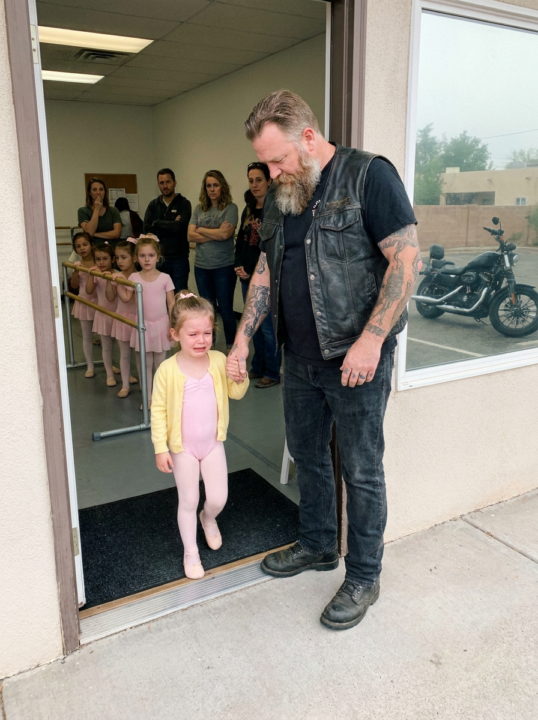
Still, Rosie copied him.
That was when I understood his purpose. He was not trying to become graceful. He was making himself the least graceful person in the room so his daughter no longer had to fear being the worst.
Mara remained by the back wall, recording only short pieces. Later she told me Daniel hated cameras. He had spent years refusing family photographs, partly because he disliked the way strangers saw his tattoos and partly because every image seemed to remind him who was missing. That morning he never asked her to stop.
After class, while Rosie accepted a star sticker from me, Daniel sat on the floor to pull on his boots. His face had gone pale beneath his beard.
“Your knee?” I asked.
“Old motorcycle wreck.”
Mara gave him a look. “Old stubborn-man injury.”
He tied the boot and stood slowly. Rosie ran back to him carrying the sticker on one finger.
“Daddy, you did ballet.”
“I survived ballet.”
“You have to come next week.”
For the first time that morning, Daniel hesitated.
Then he touched the inside seam of his vest. “If you go, I go.”
He said it quietly. Rosie heard a father making a simple promise. Mara heard something else. Her eyes dropped to the pink stitches, and the two of them shared the kind of silence married people build around old grief.
I learned more about Daniel over the following days, mostly because Albuquerque is smaller than it pretends to be. His motorcycle repair shop sat three miles west of my studio on Central Avenue, along the old Route 66 corridor, between a tire warehouse and a diner that poured coffee strong enough to strip paint. He repaired touring bikes, old pickups, and anything else people could not afford to replace.
The men from his club, the Iron Mesa Riders, used the garage as an unofficial headquarters. They were not the criminal gang some parents imagined after seeing the leather cuts. Most were mechanics, roofers, veterans, and warehouse workers. They collected winter coats, escorted veterans’ funerals, and had once repaired every wheelchair ramp at a local senior complex without putting their names on the work.
Daniel was the one they called when a promise became inconvenient.
He drove two hours to replace a stranded brother’s belt at midnight. He kept a folding crib in the office because one mechanic sometimes brought his toddler to work. Every December he tuned the motorcycles of three older riders for free, then lied that the parts supplier had covered the bill.
But nobody in the club talked about the pink thread.
The next Saturday, Rosie returned. Daniel returned too.
This time he wore sweatpants beneath his leather vest and carried a pair of black canvas dance shoes in a grocery bag. They were too small.
“The store clerk guessed,” he said.
I found an old pair of men’s jazz shoes in the costume closet. They pinched his toes but did not slide. Daniel stood at the end of the barre again.
One of the mothers who had clutched her purse the week before moved her chair to make room for his vest.
Daniel thanked her.
Then, as he hung the leather over the chair, a folded photograph slipped from the inside pocket and landed faceup on the floor.
It showed a thin eleven-year-old girl wearing a secondhand white leotard, standing beside a teenage Daniel who had no beard, no motorcycle, and no skulls on his arms. Around the girl’s ankle was a ribbon the same faded pink as the thread in his vest.
Daniel picked up the photograph before Rosie could see it.
But I had already seen the date written along the bottom.
October 14, 2003.
Part 3
By the fourth week, Daniel could manage first position without looking down. His plié remained shallow, his shoulders rose whenever he concentrated, and every jump landed with a sound that made the mirrors shiver. But Rosie entered the studio without holding his hand.
That should have been the whole story.
A frightening-looking father joined a ballet class. His daughter found courage. Everyone became kinder. The video Mara had posted for family was shared by one of Daniel’s cousins, then by a local parent page, then by accounts none of us knew. Within five days it had passed eighteen million views.
Messages filled the studio inbox. Most were warm. Fathers sent photographs of painted fingernails, tea parties, and tiny chairs. Veterans wrote that Daniel’s stiff attempt at first position made them call daughters they had not spoken to in years.
Some messages were cruel.
People called him fake. They accused us of staging the class. A few zoomed in on the skull tattoos and invented crimes. Someone identified his shop. Another person posted Mara’s workplace. A television producer offered money for Rosie to repeat the moment under professional lights.
Daniel refused every interview.
“It was her class,” he told me. “Not my show.”
The attention frightened Rosie more than ballet ever had. Parents arrived outside the studio hoping to see “the biker dad.” A man leaned through the doorway with a camera during warmup. Rosie froze at the barre, then crawled behind Daniel’s legs.
Daniel crossed the room and blocked the lens with one scarred hand.
“No pictures of my kid.”
The man argued that the family had already gone public. Daniel did not raise his voice. That somehow made him more intimidating.
“My wife shared one moment. You don’t own the next one.”
The man left, but the damage remained. Rosie cried in the costume room and said she never wanted to dance again.
Daniel sat outside the door. He did not enter. He spoke through the wood.
“Want me to take you home?”
No answer.
“I will.”
After a minute Rosie asked, “Will you be mad?”
“No.”
“But you did all this.”
Daniel rested his forehead against the door. “I didn’t do it so you had to dance. I did it so fear didn’t get to choose for you. You can choose home.”
The room stayed silent for nearly a minute. Then the door opened. Rosie’s face was wet. She climbed onto his lap, and he held her without telling her what bravery should look like.
She chose to finish class with the blinds closed.
The false ending arrived that afternoon. Daniel announced that he would no longer join the children’s class. He believed his presence attracted cameras and turned Rosie’s safe place into public property. I agreed, though it hurt to watch him fold the borrowed black shoes into their grocery bag.
The mothers organized a private entrance through the alley. The club stationed two riders outside only when strangers gathered. Mara deleted the original post, though copies kept spreading.
Rosie continued.
Daniel watched through a narrow gap in the blinds.
On the final Saturday of the beginner session, Rosie crossed the floor alone and performed eight counts of tiny sautés. Daniel stood in the hallway, arms folded, eyes shining but dry. When she finished, he struck his palm once against his chest—the gesture his club used instead of applause at funerals.
Rosie bowed to him.
I thought that was the ending: the father stepping back so the daughter could own the room.
Then Mara gave me the photograph that had fallen from Daniel’s vest.
“Her name was Lena,” she said. “And Daniel thinks what happened to her was his fault.”
Part 4
Lena Walker was Daniel’s younger sister. She was eleven in the photograph and Daniel was sixteen, already broad-shouldered, already learning that size could be used as armor. Their father drank. Their mother worked nights at a motel near the interstate. Home was a place where doors slammed hard enough to shake plates.
Lena discovered ballet through a library videotape. She watched the same performance until the picture warped, practicing along in socks on cracked kitchen linoleum. A teacher at school found her a scholarship at a small studio. What Lena needed was transportation, permission, and someone willing to stand between her dream and their father’s ridicule.
Daniel tried.
He stole no money and told no grand lie. He simply began walking her three miles to class every Tuesday. He waited outside because boys from his neighborhood already mocked him for carrying her dance bag. When winter came, he bought her secondhand slippers with money earned unloading trucks.
The pink ribbon in the photograph came from those shoes.
Their father found out after Lena’s first recital. He threw the shoes into a trash barrel behind the house and told her ballet was for rich people who had never missed dinner. Daniel pulled the shoes out after midnight. One ribbon had burned at the end. He saved what remained.
Then he made Lena a promise.
“When I get my own truck, I’ll take you anywhere.”
He was sixteen. Promises sound like transportation when you are sixteen.
Three weeks later, Daniel was arrested for taking part in a garage burglary with older boys. He spent nine months in juvenile detention. Without him, Lena stopped attending class. Their mother moved away from Daniel’s father, but instability followed. Lena grew older, drifted through foster placements and temporary homes, and carried the belief that every good thing eventually became too expensive to keep.
Daniel found her again when he was twenty-four. By then he had become a mechanic and bought his first used Harley because it was cheaper than a reliable truck. Lena was trying to stay sober. He drove her to meetings. He fixed the heater in her apartment. He kept telling her they could start over.
She died from an overdose on October 14, 2003.
Inside the pocket of her coat, Daniel found the shortened pink ribbon from her ballet shoe. She had kept it for eight years.
He folded the ribbon around the photograph and carried both inside every vest he owned. When the ribbon began to fray, Mara used matching thread to secure the seam. Those were the three faded loops I had noticed on the first morning.
“He never forgave himself for leaving,” Mara told me.
“He was a child too.”
“He knows the sentence. He doesn’t believe it.”
Rosie knew Lena only as Aunt Lena in a framed photograph. She did not know the full story. Daniel had never planned to turn his daughter into a memorial or use ballet to repair his past. In fact, when Rosie first asked for lessons after seeing dancers at a city festival, he became quiet for three days.
Mara expected him to refuse.
Instead, he rebuilt an old motorcycle in the evenings and sold it to pay for a year of classes, leotards, shoes, and whatever else Rosie might need. He kept one strip of pink thread from the repaired vest in the cash envelope.
The morning Rosie cried outside my studio, Daniel did not see a timid child embarrassing him. He saw Lena in a hallway twenty-three years earlier, waiting for someone older to make courage feel less lonely.
His act inside the class was not penance. It was not a performance. It was a correction so small nobody would have recognized it unless they knew what had once gone wrong.
He could not walk Lena back into ballet.
He could walk Rosie.
The following Monday, Daniel entered my studio alone. He placed the grocery bag of borrowed shoes on my desk and handed me a registration form.
“Adult beginner class?” I asked.
He nodded.
“You don’t have to keep doing this for Rosie.”
“I’m not.”
From his vest, he removed the old photograph and set it beside the form.
“I’m finishing one class for Lena.”
Part 5
Our adult beginner class met Tuesday nights after the children had gone home. Seven women had enrolled. Daniel became the eighth student and the only man.
He arrived directly from the garage, washed but still carrying machine oil in the creases of his hands. He changed from boots into properly fitted black ballet shoes. The leather vest stayed on a chair where he could see it in the mirror.
Nobody laughed the first night.
That almost made things worse. Daniel could handle ridicule. Kindness left him with nowhere to hide.
We worked slowly. His damaged knee limited turnout, so I adjusted the exercises. He learned that ballet was not about forcing the body into shapes it could not hold. It was about control, alignment, and listening before movement. He liked that. Mechanics and dancers, he discovered, both survive by noticing small resistance before something breaks.
Rosie watched from the doorway with Mara. She had brought a hand-drawn sign showing a stick figure with a beard and a pink tutu. Daniel looked at it, then at her.
“That me?”
“Your arms are too skinny,” she said.
He taped the drawing inside his toolbox the next morning.
The viral video slowly stopped being the center of the story. Daniel’s classmates knew nothing about eighteen million views after the first week. They knew he forgot combinations, counted under his breath, and always cleaned the barre after class. They knew he carried spare hair ties because Rosie lost hers. They knew that when one student felt ashamed of her body, Daniel stood beside her at the mirror and said, “This room didn’t ask you to be smaller.”
He rarely spoke, but that sentence stayed.
The Iron Mesa Riders learned about the class when one of them saw Daniel’s dance shoes drying near the garage heater. For two days, nobody mentioned them. On the third, a rider named Miguel left a new duffel bag on Daniel’s workbench. It was plain black, without jokes, except for one tiny pink zipper pull.
“Club colors?” Daniel asked.
Miguel shrugged. “Close enough.”
Brotherhood was tested not by a fight, but by whether men who had spent their lives protecting toughness could make room for tenderness without turning it into humiliation. They did.
At the end of eight weeks, I planned a private studio showing. No press, no public post, no strangers. Families only. Daniel agreed to perform the first exercise Lena would have learned: plié, tendu, rise, close. Nothing difficult. Everything meaningful.
Before the showing, he opened the photograph in his vest and discovered something behind it. The paper backing had loosened with age. Between the layers was a line written in Lena’s handwriting, invisible for more than two decades.
Danny waits outside because he thinks boys can't dance.
Below it, in smaller letters:
One day I will make him come in.
Daniel sat alone in the costume room holding the photograph. He did not cry loudly. His shoulders moved once, then again. The old radiator clicked beside him, the same small sound it had made the morning he entered Rosie’s class.
When he came out, he handed me the picture.
“She got me in,” he said.
Every seed returned at once. The pink thread was not only grief; it was Lena’s invitation. Daniel’s place at the end of the barre was not merely beside Rosie; it was the place he had refused to take as a boy. Even the stiff black shoes in the grocery bag belonged to a promise that had waited until his daughter was brave enough to open it.
The music began.
Daniel placed one hand on the barre. Rosie stood beside him in first position. He bent his knees carefully, rose, and moved his foot forward. No one reached for a phone.
When he finished, the riders struck their palms once against their chests.
Rosie bowed.
Daniel bowed to the empty space on his other side.
Part 6
The ritual began without anyone naming it.
Every Tuesday before adult class, Daniel stopped at the Route 66 Diner and ordered two hot chocolates. One was for Rosie. The other sat unopened at the edge of the table while he studied the combination I had written on an index card. After ten minutes, he carried the second cup outside and gave it to whoever was waiting at the bus stop.
He said Lena hated coffee.
Rosie advanced to the next children’s class. Daniel did not stand beside her anymore, but he attended every lesson. Sometimes he watched through the glass. Sometimes he practiced quietly in the empty room across the hall. When fear returned before Rosie’s first recital, he did not promise she would be perfect.
He held out his hand.
“Want me at the barre?”
Rosie shook her head. “Just where I can see you.”
So he stood in the wings wearing his leather vest over a black dress shirt. The three faded loops of pink thread remained visible under his arm. His club filled the last row, boots lined beneath folding chairs, their motorcycles parked silently across the street so the engines would not drown out the music.
After the recital, Daniel returned to the garage and mounted a narrow wooden barre along one wall between the tool cabinets. The mechanics used it to stretch bad backs and stiff knees. A few pretended that was all.
On October 14 each year, the shop closed an hour early. Daniel placed Lena’s photograph on the workbench. The riders did not offer speeches. They turned off the compressors, let the last engine tick itself cool, and stood in first position while Rosie counted five slow pliés.
Nobody did them well.
That was never the point.
The old pink ribbon stayed inside Daniel’s vest, but he stopped touching it whenever Rosie entered a room. Grief no longer had to warn him that happiness could be taken. It had become a seam holding two parts of his life together: the girl he could not bring back and the girl he would never ask to carry that loss.
Part 7
Three years after that first morning, I watched Rosie dance across the same wooden floor without looking toward the door. She was eight, taller now, her bun straight, her ribbons tied correctly. Daniel sat in the front row between Mara and six men from Iron Mesa.
He still weighed close to 290 pounds. The skull tattoos had not softened. The vest still made strangers move aside in grocery-store aisles.
But the studio knew him differently.
After Rosie’s final bow, she ran to him and pushed a small box into his hands. Inside was a pair of black ballet shoes with pink stitching around the heel. The adult class had ordered them for him.
Daniel turned one shoe over slowly.
Stitched inside were two names.
Lena.
Rosie.
He closed his fist around the shoe and looked toward the empty end of the barre. Then he removed his vest, placed it over the familiar chair, and joined Rosie on the floor for one last plié.
Outside, the Harley cooled beneath the Albuquerque sunset. Metal ticked softly. Traffic moved along Central Avenue. Inside, a little girl counted, a biker bent his scarred knees, and twenty families stayed quiet enough to hear leather shoes brush wood.
Mara lowered her phone. For once, the moment belonged only to the people inside the room, and to one girl whose ribbon had brought Daniel there.
Follow the page for more stories about bikers whose quiet choices reveal the people beneath the leather.
Some promises arrive late. They still arrive.
Part 1 — Version 2
When Daniel “Graves” Walker removed his leather vest in my ballet studio, three mothers reached for their children—but his crying five-year-old daughter stopped trembling, because she understood what the rest of us did not.
The vest landed across a plastic chair with a heavy slap. It was black, weathered, and crowded with patches I did not try to read. Along the inside seam, nearly hidden beneath Daniel’s left arm, three faded loops of pink thread caught the morning light.
Daniel stepped out of his boots.
“Sir,” I said, “parents watch through the window.”
He looked down at Rosie, who had wrapped both arms around one of his legs. She wore a yellow cardigan over her new pink leotard. Her bun leaned left. One ballet ribbon had come loose and trailed across the floor.
“She says everybody’s looking,” he replied.
They were.
Daniel stood six-foot-four and weighed close to 290 pounds. Skull tattoos covered both forearms. His beard was black and gray, his knuckles scarred, and his Harley had rattled the glass when he arrived outside our Albuquerque studio. The twenty girls waiting at the barre had gone silent. So had their mothers.
Rosie pressed her wet face against his jeans. “Take me home.”
Daniel crouched. Leather creaked. Machine oil lingered on his hands even though he had scrubbed them clean.
“Do you want to go home,” he asked, “or do you want me to be scared with you?”
Rosie looked up.
That question changed the room.
He did not tell her there was nothing to fear. He did not call her brave before she had chosen anything. He offered to share the part adults usually demand children carry alone.
Rosie pointed toward the empty place at the end of the barre.
Daniel turned to me. “What do I do?”
I showed him first position. He forced his heels together and turned his toes outward. His damaged left knee clicked. His balance shifted. The floor groaned beneath his weight.
One child giggled.
Daniel raised an eyebrow. “That bad?”
“Worse,” she said.
Rosie laughed through her tears.
At the back wall, Daniel’s wife Mara lifted her phone. Her hands shook. She knew he hated being recorded, but he gave no sign that she should stop.
The music began.
Outside, rainwater hissed beneath passing tires on Central Avenue, and the cooling Harley ticked behind the glass like a clock counting down.
For forty-five minutes, Daniel followed every exercise. He bent when we bent. He raised one massive tattooed arm above his head. He pointed a foot that had spent more years inside steel-toed boots than anywhere else. He missed counts, faced the wrong direction, and once nearly collided with a five-year-old named Sophie.
Each mistake made Rosie stand taller.
By the end of class, she had released his hand. During the final jumps, she moved two places away. Daniel watched her instead of the mirror, breathing hard, his face pale from pain he did not mention.
When the children bowed, Rosie bowed too.
Then she ran into him.
“You did ballet, Daddy.”
“I did something.”
“Next week too?”
Daniel looked toward his vest. His eyes settled on the pink stitches. Mara stopped filming.
“If you go,” he said, “I go.”
The short video she posted for family would eventually be watched more than eighteen million times. Strangers would call Daniel a perfect father, a fake, a hero, and worse. They would think his decision began when Rosie cried outside my door.
It did not.
Twenty-three years earlier, another little girl had stood in secondhand ballet shoes and asked Daniel to come inside with her. He had stayed in the hallway because he was sixteen, ashamed, and afraid of being laughed at.
The photograph of that girl was still hidden inside his vest.
So was the ribbon from the ballet shoe she wore before she disappeared from his life—and the promise Daniel had never found a way to keep.