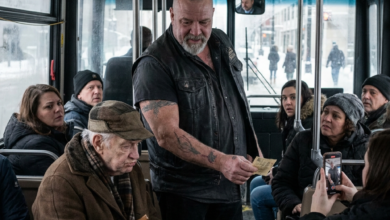
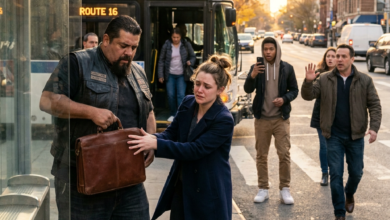
A 285-Pound Biker Struck a Woman Five Times in a Crowded Route 66 Restaurant — Then the Food on the Floor Revealed Why He Recognized Her Silence
Part 2 — Booth Twelve
The paramedics arrived six minutes after Carolyn began breathing again. By then, color had returned slowly to her cheeks, but every breath still sounded scraped and uncertain.
They examined her airway, checked her oxygen level, and recommended hospital evaluation because forceful abdominal thrusts can cause internal injury even when they save a life. Carolyn agreed. Thomas did not take his eyes off Hammer.
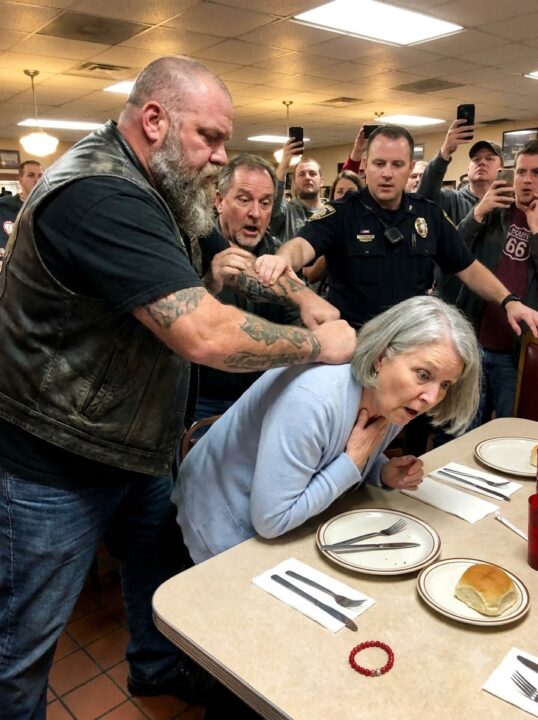
The off-duty police officer introduced himself as Daniel Reeves. He had still been in uniform after completing a court appearance, and what he saw from his table looked like an assault: a giant biker rising without warning, crossing the dining room, and striking a woman who had not spoken to him.
Three customers described it exactly that way.
The videos told a different story.
One recording began several seconds before Hammer moved. Carolyn’s hand went to her throat. Her mouth opened, but no cough came. Hammer looked directly at her, scanned her face, and rose before Thomas understood anything was wrong.
Officer Reeves replayed the clip twice.
“You saw that from twenty feet away?”
Hammer nodded.
“How?”
“She went quiet.”
“So did half the room after you hit her.”
“Wrong kind of quiet.”
Reeves waited, but Hammer turned toward the paramedics and gave them the sequence without embellishment: five firm back blows, five abdominal thrusts, no response, another thrust as she became limp, object expelled, breathing restored.
He spoke like a man who had rehearsed those words for years.
One paramedic asked whether he had current first-aid training.
“Renewed in March.”
“Occupation?”
“Diesel mechanic.”
“Military?”
“No.”
“Fire service?”
“No.”
“Then why renew every year?”
Hammer glanced toward booth twelve. “Because once wasn’t enough.”
Frank Bell, the sixty-eight-year-old owner of the Rosewood Grill, had emerged from the kitchen during the commotion. He moved slowly on two replaced knees, but he crossed the dining room as though every table had vanished except the one beneath the west window.
He looked at Hammer.
Hammer looked back.
They did not greet each other.
Thomas approached while the paramedics secured Carolyn to a stretcher. “I owe you an apology.”
Hammer shook his head.
“I grabbed you.”
“You thought I was hurting her.”
“I should’ve noticed.”
“You were talking to your wife, not watching for her to die.”
The sentence was blunt, but Hammer’s voice held no accusation. Thomas’s face folded anyway.
Carolyn reached from the stretcher and caught Hammer’s wrist before he could withdraw. Her fingers closed around the faded bracelet.
“Emma,” she read.
Hammer went still.
“Your daughter?”
He nodded once.
“What happened to her?”
Frank made a small sound behind the counter.
Hammer removed Carolyn’s hand carefully, pulled his sleeve over the bracelet, and stepped away. “You need the hospital.”
“So do you,” Carolyn said.
A faint bruise had already formed where Thomas grabbed his arm, but that was not what she meant.
Hammer understood.
He left without answering.
The Black River Riders followed him outside. Eleven Harley engines started one after another, but Hammer remained beside his Road King with both hands resting on the handlebars.
His club president, Marcus “Stone” Callahan, stood nearby. Stone was sixty, broad through the chest, with a long gray beard and a voice that sounded like gravel pouring from a steel bucket.
“You did it right,” Stone said.
Hammer stared through the window at booth twelve.
“This time.”
“That ain’t the same night.”
“Same silence.”
“There wasn’t any sound.”
“Exactly.”
Stone placed a hand against Hammer’s shoulder. Hammer pulled away—not angrily, but because he could not bear comfort yet.
Inside, Frank knelt painfully beside Carolyn’s table. He picked up the expelled food with a napkin, disposed of it, and cleaned the floor himself.
When he finished, he unlocked the manager’s office and removed a thin folder from the bottom drawer.
I had seen it before. I assumed it contained old insurance records.
Instead, it held photographs of an eight-year-old girl with dark braids, a missing front tooth, and a denim jacket covered in tiny fabric stars. One picture showed her sitting behind a younger, clean-shaven Hammer on a parked Harley. Her helmet looked too large.
Both of them were laughing.
The next document was an incident report dated July 14, nineteen years earlier.
EMMA DAWSON—FATAL AIRWAY OBSTRUCTION.
My hands became cold. “She died here?”
Frank sat in the manager’s chair.
“No,” he said. “She died eleven months later.”
That answer was worse.
Nineteen years earlier, Hammer had entered the Rosewood Grill as a thirty-seven-year-old single father. He was already enormous, already tattooed, and already known along Route 66 for ending arguments with his hands before his mouth became involved.
Emma was the exception to everything rough in him.
She collected star-shaped buttons. She refused to eat toast if the crust had been cut unevenly. She made Hammer stop the Harley three blocks from school because she did not want classmates seeing her father’s motorcycle helmet covered in faded flame decals.
That July evening, they took booth twelve. Emma ordered a hamburger and fries. Hammer ordered meatloaf, coffee, and a dinner roll.
He never ate the roll.
A group of young bikers entered while they were eating. One recognized Hammer from a bar fight and made a remark about the scar beneath his jaw. Hammer told Emma he would be back in one minute, then followed the man into the parking lot.
There was no fight.
But there was an argument.
Inside, Emma tore a piece from Hammer’s dinner roll and placed it in her mouth. Frank saw her stand suddenly, one hand at her throat.
He believed she needed the restroom.
She did not cough.
She did not call for her father.
She made no sound at all.
By the time Frank understood, Emma’s knees had buckled beside booth twelve. He attempted back blows, but fear made his movements weak. A waitress called 911. Another customer tried to help, and their hands collided as both reached for the child.
Then Hammer came through the door.
He saw Frank striking his daughter.
He misunderstood.
Hammer grabbed him by the shirt and threw him against the counter.
The customer shouted that Emma was choking. Hammer released Frank, but his mind went empty. The man who had fought three adults without backing away could not remember where to place his hands on an eight-year-old child.
Stone arrived from the parking lot.
At the time, he was an Army medic recently returned to Missouri, although almost nobody in the club knew it. He cleared the obstruction and began rescue breathing when Emma did not wake.
The ambulance arrived nine minutes after the first call.
Emma’s heart restarted.
Her brain had already gone too long without oxygen.
Doctors told Hammer she might never recognize him. They were wrong about that. She recognized him every day for eleven months, though she lost most of her speech and could no longer lift her arms without help.
Hammer visited the Rosewood once during that year.
He stood at the counter and blamed Frank for waiting.
Frank did not defend himself.
“I did wait,” he told me nineteen years later. “Not long. But long enough to spend the rest of my life measuring it.”
After Emma died, Hammer returned to the diner on every anniversary. Some years he sat in the parking lot without entering. Some years he occupied booth twelve and ordered the same meal.
He always left the dinner roll untouched.
Part 3 — Eleven Months That Changed a Biker
Hammer did not become a quieter man immediately after Emma’s injury.
For the first three weeks, he became more dangerous.
He slept in a vinyl chair beside her hospital bed and rode aimlessly when nurses forced him to leave. He broke a bathroom mirror after a physician used the phrase “permanent impairment.” He threatened a young resident who suggested discussing long-term care.
Stone stopped him before security arrived.
“You hit that doctor,” Stone said, “and your girl wakes up without you here.”
Hammer’s fist remained raised.
Then it dropped.
That was the first time the Black River Riders saw their largest member obey a sentence he could not overpower.
The club faced its first test a week later. Several riders wanted to confront Frank and the customer who had interfered with the rescue. One suggested parking thirty motorcycles outside the Rosewood until the owner admitted fault.
Hammer wanted to go.
Stone refused.
“If we need somebody to blame,” Hammer said, “I got a name.”
“Yeah,” Stone answered. “Ray Dawson.”
Hammer swung at him.
Stone did not fight back. The punch split his lip and knocked him against a hospital vending machine, but he wiped the blood with his thumb and returned to the chair beside Hammer.
“You done?”
Hammer stared at him.
“No.”
“Then hit me tomorrow. Tonight, your kid needs her socks changed.”
Stone handed him a pair covered in yellow cartoon ducks.
Hammer changed them.
The brotherhood did not retaliate against the restaurant. Instead, its members took turns sitting outside Emma’s room so Hammer could shower, work short shifts, or ride until the rage burned down enough for him to return.
Bishop brought food Emma could no longer swallow and cried in the elevator when a nurse stopped him. Grudge repaired the dent in Hammer’s fuel tank without mentioning where it came from. Switch learned how to clean the feeding tube connection because Hammer’s hands shook the first time he tried.
Emma changed too.
She could not walk, but she could move two fingers on her left hand. Carolyn Hayes, then a forty-three-year-old pediatric rehabilitation nurse, taught her to use those fingers for yes and no.
One tap meant yes.
Two meant no.
Carolyn also taught Hammer how to move his daughter without frightening her, how to recognize a blocked airway, and how to listen for the absence of sound.
“If she’s coughing, let her cough,” Carolyn told him. “If she can’t make sound, act. Silence can be the emergency.”
Hammer practiced on a training mannequin until the plastic ribs cracked.
Carolyn made him start again with another one.
Emma could not speak clearly, but she remained stubborn. She rejected the first wheelchair because it was purple. She demanded that Hammer shave after his beard scratched her cheek. She insisted on sitting outside whenever the Black River Riders visited.
The first time the motorcycles started beneath her rehabilitation-room window, a nurse rushed to close it.
Emma tapped twice.
No.
Hammer rolled her closer to the glass. The V-twin pulse reached through the floor and into the chair. Emma’s left fingers began moving against the blanket in time with the engines.
For twelve seconds, her father smiled.
Then the engines faded and the hospital returned.
Carolyn was present on Emma’s hardest night, eight months after the choking. A respiratory infection had weakened her. Hammer sat beside the bed with his leather cut folded beneath his head, waking every time the oxygen monitor changed pitch.
Emma’s fingers moved.
One tap.
He leaned closer. “What?”
She struggled to form words. Air moved past her damaged voice box in broken pieces.
Carolyn bent near her mouth and listened.
Emma tried again.
“Dad… stayed.”
Hammer looked at Carolyn, uncertain whether he had understood.
Carolyn nodded.
Emma’s two fingers touched the faded red identification bracelet she had worn since the night at Rosewood. Hammer had refused to let staff cut it away after the printing wore thin, so a nurse transferred the name and date onto a small metal clasp.
Emma tapped once.
Yes.
Hammer placed his hand beneath hers.
Eleven months after the choking, Emma developed another infection. Her damaged lungs could not recover.
She died at 4:12 on a Sunday morning.
Hammer did not punch a wall.
He did not shout.
He sat beside the bed until the sun reached the bottom of the window, then asked Carolyn to remove the bracelet.
She gave it to him in a white envelope.
“Silence can be the emergency,” she reminded him.
Hammer wrapped the bracelet around his wrist before walking out.
Three months later, Stone found him drinking alone in the garage with his motorcycle keys on the table. Hammer had been sober for four years, but grief had convinced him that old rules no longer mattered.
Stone took the keys.
Hammer pulled a wrench from the workbench.
Every Black River Rider in the garage stood.
It would have been easy for them to restrain him. It would have been easier to let him leave and call it personal choice.
Stone placed Emma’s photograph beside the keys.
“No bike tonight.”
Hammer’s grip tightened around the wrench.
“That an order?”
“No. It’s eleven men deciding they’d rather have you hate us tomorrow than bury you Monday.”
Hammer looked from one face to the next. Nobody moved.
He dropped the wrench.
The club slept on his garage floor that night. Some used jackets as pillows. Bishop snored beneath a motorcycle lift. Stone remained beside the keys until sunrise.
Hammer never drank again.
He also began taking first-aid courses. At first, he sat in the back and refused to participate when children’s mannequins were brought out. Then he attended again. And again.
He learned the difference between coughing and complete obstruction. He learned that back blows needed to be firm. He learned abdominal thrusts, chest thrusts, CPR, automated defibrillators, and how quickly a living face could change when oxygen disappeared.
Every March, he renewed the certification.
Every July, he returned to booth twelve.
Frank eventually installed a small brass plaque beneath the window.
IN MEMORY OF EMMA DAWSON.
Hammer threatened to tear it down.
Frank told him he could.
Hammer stood with a screwdriver in one hand for almost an hour.
Then he put the tool back in his saddlebag.
The plaque remained.
Part 4 — The Video That Cut Away Too Soon
By sunrise after Carolyn’s rescue, a seventeen-second video had been viewed more than two hundred thousand times.
It began when Hammer delivered the first back blow.
It ended before the food came out.
The caption called him a biker who attacked an elderly woman for asking his club to be quiet. Nothing in the video showed Carolyn’s hand at her throat. Nothing showed her blue lips, the abdominal thrusts, or her first breath.
It showed only violence without its reason.
The Rosewood’s phone began ringing before we opened. Strangers demanded Hammer’s arrest. Others threatened the restaurant for allowing motorcycle gangs inside. One caller said she had identified the woman and intended to help her sue.
A local station sent a reporter.
Officer Reeves had already reviewed longer recordings and taken witness statements, but he could not stop the edited clip from moving faster than facts. Carolyn remained in the hospital for observation. Because of swelling in her throat and her previous surgery, doctors advised her not to speak.
Thomas refused interviews.
His silence looked like confirmation.
The Black River Riders gathered at their clubhouse that afternoon. Hammer arrived last and placed his phone facedown on the table.
Grudge wanted the person who uploaded the clip identified. Bishop wanted the club to release helmet-camera footage from the parking lot showing Carolyn leaving alive. Switch suggested riding to the television station and demanding a correction.
Stone listened.
Then he looked at Hammer.
“No bikes at the station,” Hammer said.
“They made you look like you beat a woman,” Bishop answered.
“Then ten loud men outside their door will fix that?”
“We don’t sit while somebody buries a brother.”
Hammer’s skull ring struck the table once. “Nobody touches the woman. Nobody touches her husband. Nobody threatens the kid who posted it.”
“He lied.”
“He showed what he saw.”
“He cut the rescue.”
“Maybe his phone stopped.”
Grudge laughed bitterly. “You defending him now?”
Hammer stood. Chairs scraped backward around him.
“I’m defending the line,” he said. “We cross it because we’re angry, there ain’t a video long enough to explain us.”
Nobody answered.
The brotherhood had defended Hammer in hospitals, courtrooms, garages, and roadside ditches. Now he asked them to do something harder than fighting.
He asked them to remain quiet.
That evening, Officer Reeves came to the clubhouse. He carried no arrest warrant, but Hammer walked outside before the officer reached the door.
“You need me?”
“I need a formal statement.”
Hammer held out both wrists.
Reeves looked at them. “I’m not arresting you.”
“Video says different.”
“The video isn’t the evidence.”
A group of younger club members watched from the doorway. Reeves saw the anger in their faces and kept his hands visible.
“Mrs. Hayes survived because you acted,” he said. “But we still document force used during a rescue. You knew that.”
Hammer lowered his wrists.
They completed the interview at the station. Hammer described each action and admitted that he continued after being ordered to stop.
“You ignored a police officer,” Reeves said.
“You hadn’t seen her face.”
“You could have told me.”
“Airway was closed.”
“Yours wasn’t.”
Hammer looked down at his scarred hands. “Wasn’t thinking about mine.”
Reeves closed the notebook. His father had been a paramedic. He understood how a rescue could look when viewed from the wrong angle.
“What made you recognize it?”
Hammer touched the bracelet under his sleeve.
“My kid.”
That was all he offered.
While Hammer was inside the station, someone spray-painted WOMAN BEATER across the Black River clubhouse door. The first riders who saw it wanted to follow tire tracks visible in the gravel.
Stone stopped them.
“Brother gave an order.”
“He ain’t road captain today.”
“He’s the reason we need one.”
They cleaned the paint before Hammer returned.
He noticed the wet door but asked no questions.
The next morning brought another blow. A lawyer representing Thomas and Carolyn contacted the restaurant and requested all surveillance footage. Frank assumed a lawsuit was coming. His insurance company instructed him not to speak publicly.
Hammer heard and returned to the Rosewood.
Frank was alone in booth twelve, holding Emma’s file.
“If they sue,” Hammer said, “leave the club out.”
Frank looked up. “You saved her.”
“Did damage too.”
“You did what was required.”
“That don’t mean her ribs agree.”
Frank closed the folder. “You planning to accept blame for every injury connected to keeping someone alive?”
Hammer’s jaw tightened.
Frank had not meant Emma.
They both knew it.
Nineteen years of unspoken accusation entered the booth.
“You waited,” Hammer said.
“Yes.”
“You watched her stand there.”
“For seconds.”
“Seconds count.”
“I know.”
Hammer leaned over the table. “Then why didn’t you tell me to stop blaming you?”
Frank’s hands rested on the folder. “Because you were right.”
“No. I threw you off her.”
“You walked outside.”
“So?”
“So we both lost time.”
Hammer stared through the window toward his Harley.
Frank opened the file and removed a receipt. It showed annual payments to a first-aid training company beginning eighteen years earlier.
Every employee at the Rosewood had been trained since Emma’s death.
Hammer had asked each year whether certifications were current. He never knew Frank personally paid for them.
“There’s more,” Frank said.
“I don’t need more.”
“Carolyn called from the hospital.”
Hammer stopped.
“She asked for you.”
“No.”
“She used your full name.”
Hammer’s face hardened. “Video give it to her?”
Frank turned the incident report around.
Near the bottom was a witness and medical liaison entry.
CAROLYN HAYES, RN.
Hammer read it twice.
The gray-haired woman he had saved was the nurse who taught him how to recognize silent choking.
Part 5 — The Woman Who Taught Him to Listen
Hammer refused to go to the hospital for three hours.
He rode east along Route 66, turned around near Strafford, and passed the Rosewood twice without stopping. Stone followed at a distance but did not pull beside him.
At the third traffic light, Hammer looked in his mirror.
Stone remained there.
Hammer signaled toward the hospital.
They parked beneath a concrete overhang. Hammer removed his leather cut and folded it across the motorcycle seat.
“You leaving that?” Stone asked.
“She was scared of us in the restaurant.”
“She was scared before she knew who you were.”
“Exactly.”
He entered wearing only his faded charcoal work shirt, jeans, and boots. Without the leather, he still looked too large for the hospital hallway. Tattoos covered his arms. The old red bracelet remained visible beneath his watch.
Carolyn sat upright with an oxygen tube beneath her nose. Purple bruising had begun to appear along her abdomen. Thomas stood when Hammer entered, but Carolyn lifted one hand.
“Let him in.”
Her voice was weak.
Hammer remained near the door. “Shouldn’t talk.”
“I spent thirty-seven years telling men what to do in hospitals. Retirement didn’t cure it.”
Thomas pulled out a chair. Hammer did not take it.
Carolyn studied the bracelet. “I knew the name first. I knew your eyes after.”
Hammer looked toward the window.
“You had less beard then,” she continued.
“Had a kid then.”
Carolyn absorbed the sentence without trying to soften it.
Thomas stepped into the hall, leaving them privacy. Stone remained outside the room.
Hammer finally sat.
“You taught me,” he said.
“I reminded you. Stone taught your hands.”
“You said listen for nothing.”
Carolyn touched the pale scar at the base of her throat. Six months earlier, surgeons had removed a tumor pressing against her esophagus. Radiation and reconstructive surgery left her with difficulty swallowing.
She had spent decades helping other people eat safely.
Then she had hidden her own problem.
“My therapist told me to use softer food,” she said. “I wanted one ordinary dinner. I cut the meat small. I thought I could manage.”
Hammer’s voice roughened. “You couldn’t.”
“No.”
“Your husband know?”
“Not how bad it had become.”
Hammer looked toward the doorway where Thomas stood beyond the glass.
Carolyn’s fingers closed around the blanket. “I didn’t want every meal to become a medical procedure. I didn’t want him watching every bite.”
“So nobody watched.”
The words landed harder than he intended.
Carolyn nodded. “Until you.”
Neither spoke for several seconds.
Then she asked, “Do you remember Emma’s last night?”
“Every minute.”
“Do you remember what she said?”
Hammer’s hand moved to the bracelet. “Dad stayed.”
“That was one sentence.”
He looked at her.
Carolyn explained that Emma had awakened again shortly before dawn while Hammer slept with his head beside the bed. Her breathing was weak. Carolyn leaned close when the girl attempted to speak.
Emma had asked whether her father was still there.
Carolyn pointed toward his hand beneath hers.
Emma saw him.
She tapped once.
Then she whispered four words Carolyn had never been certain Hammer heard.
“He came back inside.”
Hammer stopped breathing for a moment.
Carolyn repeated them. “That’s what she said.”
The diner door. The parking lot argument. The terrible seconds he had spent outside while his daughter’s airway closed—those moments had become the center of Hammer’s guilt.
He believed Emma’s final understanding of him was that he had left.
“She knew you came back,” Carolyn said.
“Too late.”
“She didn’t say that.”
“Didn’t have to.”
“You have spent nineteen years finishing her sentence for her.”
Hammer pushed back from the chair. The metal legs scraped the floor.
Carolyn did not flinch.
“I threw Frank off her.”
“Yes.”
“I froze.”
“Yes.”
“I was outside because somebody ran his mouth.”
“Yes.”
Each answer struck cleanly. She neither excused nor condemned him.
Hammer’s hand closed into a fist.
Carolyn looked at the scars across his knuckles. “And when I stopped breathing, you came back inside again.”
His fist opened.
She reached toward him. This time, Hammer allowed her fingers to touch the bracelet.
“I gave this to you in an envelope,” she said.
“Still got the envelope.”
“I wrote something on it.”
He knew the words.
ACT BEFORE THE SILENCE GETS LONGER.
Hammer had kept the envelope inside a locked drawer with Emma’s hospital photographs. He read the sentence before every first-aid renewal.
Carolyn smiled faintly. “You listened.”
Thomas entered with a phone in his hand. A restaurant customer had sent him a complete recording of the rescue from another angle. It began before Hammer stood and continued until the paramedics arrived.
Thomas wanted permission to release it.
Hammer refused at first.
“Your name is already everywhere,” Thomas said.
“Then leave hers out.”
“Carolyn said yes.”
Hammer looked at her.
“I spent my career telling patients that hiding a medical danger can make it worse,” she said. “Then I hid mine. Someone else might recognize that hand at the throat because they see this.”
Hammer did not want to become a hero in a video. Carolyn did not want to remain a helpless victim.
They agreed on conditions: no mention of Emma, no club promotion, no hospital images, and no edited dramatic music. Release the full sequence with a statement explaining the signs of complete choking and recommending accredited first-aid training.
The video went online that evening.
It showed Carolyn become silent.
It showed Hammer act.
It showed Thomas grab him, Officer Reeves approach, and the bikers stand before obeying Hammer’s command to remain back. It showed the food leave Carolyn’s mouth and her body pull in its first breath.
The reaction changed within hours.
News stations that had aired the short clip added corrections. The original uploader apologized. He was a nineteen-year-old college student named Caleb who claimed his phone storage had filled before the rescue ended.
Grudge did not believe him.
Hammer did.
“He showed the part that scared him,” Hammer said. “Most people do.”
Caleb arrived at the clubhouse the following afternoon expecting a confrontation. Hammer made him scrub the remaining paint from the door.
“You think I’m gonna hurt you?” Hammer asked.
Caleb nodded.
“Good. Remember that feeling next time you post half of somebody.”
Hammer handed him another brush.
Then he scrubbed beside him.
Part 6 — The Table Nobody Wanted
Carolyn left the hospital two days later with bruised ribs, a swallowing plan, and strict instructions to return if her breathing changed.
Thomas wanted to take her home.
She asked him to stop at the Rosewood first.
The restaurant was closed between lunch and dinner, but Frank unlocked the door. Hammer was already inside with Stone and Officer Reeves. The complete video had cleared him of wrongdoing, yet none of them behaved as though they had arrived to celebrate.
Carolyn approached booth twelve.
She ran one finger beneath Emma’s brass plaque.
“I never knew you put this here,” she told Frank.
“He wanted to remove it.”
Hammer stood near the counter. “Still might.”
Frank took the old incident file from beneath the register and placed it on the table. He had carried it between the office and booth twelve for nineteen years without deciding what should happen to it.
Carolyn opened the folder.
The original report blamed no single person. It listed delays, confusion, incomplete training, and interference by multiple adults. Frank had hesitated. Hammer had pulled him away. Another customer attempted the wrong technique. The ambulance lost time because the caller gave the restaurant’s old highway address.
There was no villain.
That made the grief harder, not easier.
Hammer had spent years wanting one person to carry the full weight. Frank had quietly volunteered. Neither man had noticed that guilt did not become lighter merely because it was transferred.
Frank pushed the folder toward Hammer.
“Take it.”
Hammer read the first page, then the second. His thumb stopped beside his own statement, given at the hospital while Emma was unconscious.
I LEFT HER FOR LESS THAN TWO MINUTES.
The sentence had been underlined twice.
“Your handwriting?” Hammer asked.
Frank shook his head.
Carolyn leaned closer. “Mine.”
Hammer looked at her.
“You kept saying it,” she explained. “I underlined it because I wanted the physician to understand you were repeating yourself.”
“Thought you were marking fault.”
“I was marking shock.”
One line. Nineteen years of the wrong meaning.
Hammer closed the folder.
Frank placed a fresh dinner roll on a white plate and set it before him.
Nobody spoke.
Hammer stared at the roll. It looked ordinary—brown on top, pale where the crust had split. The restaurant had served thousands like it since Emma tore off the bite that changed every person in the room.
He could not touch it.
Carolyn sat opposite him. “You don’t have to.”
Hammer’s jaw moved. “That what you told yourself about roast beef?”
She almost laughed, then pressed a hand carefully against her bruised ribs.
“No,” she said. “I told myself I had to prove something.”
“Did you?”
“Yes. I proved stubborn people need witnesses.”
Stone lowered his eyes so no one would see him smile.
Hammer broke the roll in half.
His scarred fingers trembled. He placed one half on Emma’s side of the table and took a small bite from the other.
He chewed slowly.
Then swallowed.
Frank turned away and wiped the counter though it was already clean.
The restaurant began closing booth twelve every July 14. Hammer objected.
“People gotta eat,” he said.
Frank stopped closing it.
Instead, he placed choking-response information in the staff area and paid for additional training. Officer Reeves arranged a session for local restaurant workers. Carolyn, after receiving medical clearance, agreed to speak about swallowing difficulties and the danger of silent obstruction.
Hammer demonstrated the physical response.
The first training class contained eighteen people. The second contained forty-three. By autumn, the Black River Riders had funded training kits for six diners along Route 66.
They never placed their club name on them.
When a reporter asked Hammer why, he answered with seven words.
“Air don’t care who paid for it.”
The brotherhood changed too.
Stone required every full member and prospect to maintain basic first-aid certification. Grudge complained until Hammer placed a child-sized training mannequin in front of him.
Grudge completed the course twice.
Bishop added compact first-aid kits to the club’s support truck. Switch learned sign language for “choking,” “breathe,” and “call for help.” Two members’ wives organized training for school cafeteria volunteers.
Caleb, the student who posted the clipped video, attended every session.
He eventually admitted his phone had not run out of storage. He had stopped recording after Officer Reeves approached because he believed the assault was over and wanted to upload the evidence quickly.
Hammer did not raise his voice.
“You lied about the storage.”
“Yes.”
“Why?”
“I thought you’d come after me.”
“Was scared of what I’d do because of something you did?”
Caleb looked down.
Hammer handed him a stack of training cards. “Welcome to consequences. Put these on every table.”
Caleb spent the afternoon doing exactly that.
Before leaving, he paused beside booth twelve.
“I’m sorry.”
Hammer tightened a loose screw beneath the table. “Be accurate next time.”
It was the only forgiveness Caleb received.
It was enough.
Part 7 — The Sound That Returned
One year after Carolyn’s rescue, twelve Black River motorcycles entered the Rosewood parking lot at 6:52 p.m.
They arrived without revving. Engines shut down in a rolling sequence until the last V-twin pulse disappeared beneath the sound of traffic on Route 66.
Hammer entered first.
People still noticed him. They saw the size, leather, tattoos, skull ring, chain wallet, and scarred hands. Some moved aside.
He no longer mistook their caution for hatred.
Carolyn and Thomas waited at booth twelve. Frank stood behind the register. Officer Reeves occupied a stool near the counter, off duty and out of uniform.
Caleb carried plates from the kitchen. He had completed first-aid instructor training and volunteered twice a month with a community emergency-response program.
Hammer sat opposite Carolyn.
“You cutting that small enough?” he asked.
She looked at the soft chicken on her plate. “Thomas measured it.”
Thomas held up a pocket ruler.
Hammer stared at him.
Thomas smiled. “That was a joke.”
“Bad one.”
Carolyn laughed carefully.
Maya brought Hammer’s usual order: meatloaf, black coffee, and one dinner roll. This time, she did not place the roll on a separate plate.
Hammer broke it open.
A little steam rose from the center.
He ate half.
No one applauded.
That mattered.
Emma’s plaque remained beneath the window, but Frank had added nothing around it. No photographs. No flowers. No dramatic account of what happened. Just her name and the dates she lived.
After dinner, Hammer reached into his leather cut and removed the red hospital bracelet. He had worn it beneath his watch for nineteen years, replacing the cord whenever it frayed.
Carolyn watched him set it beside the plaque.
“You leaving it?”
Hammer shook his head. “Just letting her sit here while I finish coffee.”
Outside, the club prepared to leave. Boots crossed pavement. Leather creaked. Keys turned in twelve ignitions.
Carolyn stood beside Hammer’s Harley while Thomas helped secure her helmet. After months of swallowing therapy and medical follow-up, she had asked for one short ride.
Hammer had refused.
Stone volunteered.
Hammer rejected that too.
Finally, Carolyn reminded him that saving a life did not mean owning it.
Hammer placed her on the passenger seat behind Thomas, who had borrowed a three-wheeled touring motorcycle and completed a safety course before bringing her near it.
“Soft roads,” Hammer told him.
“There’s no such thing.”
“Then soft throttle.”
Thomas nodded.
Before mounting Mabel, Hammer looked through the restaurant window. Emma’s bracelet was still visible on the table beneath the small brass plaque.
Frank stood beside it.
He lifted two fingers.
Hammer answered the same way.
The motorcycles started one at a time. Carolyn flinched at the first engine, then settled when the pulse became steady. Thomas glanced back. She tightened her hands around his waist.
Hammer led them east along Route 66.
At the edge of Springfield, the other riders turned north, south, or toward homes scattered beyond the city. Thomas and Carolyn continued together. Stone disappeared behind a line of cottonwoods.
Hammer returned alone to the Rosewood.
The parking lot was empty when he shut down the Road King. Frank had locked the front door but left the bracelet beneath the window.
Hammer used the key Frank had given him months earlier.
He entered the dark restaurant, crossed to booth twelve, and picked up the faded red band. Before fastening it beneath his watch, he sat where Emma had once sat.
No jukebox.
No plates.
No shouting from the kitchen.
Only the refrigerator motors and distant traffic.
Hammer closed his eyes.
The silence was no longer empty.
After a minute, he stood, locked the door, and walked back to his motorcycle. The Harley’s engine turned over with one deep pulse, then another.
He rode east beneath the Route 66 lights.
Emma came back inside with him.
Follow the page and leave HAMMER below for more stories about misunderstood bikers who quietly choose to save a stranger.