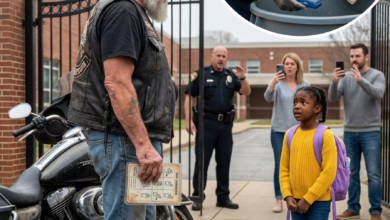
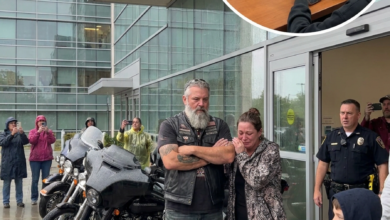
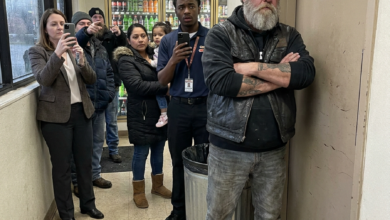
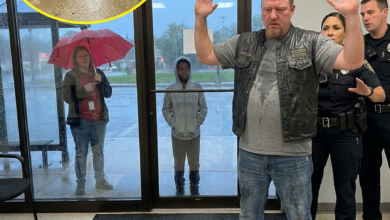
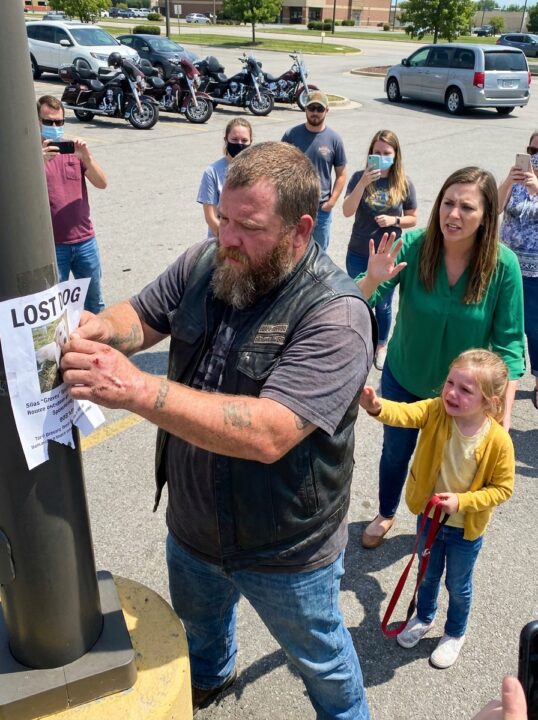
Part 2: A Biker Tore Down a Little Girl’s Lost Dog Poster Outside a Grocery Store — Her Mother Called Him Heartless Until Police Traced the Address
Part 2 — The Man Outside Dawson’s Market
My name is Nora Bennett, and for the first ten years of my daughter’s life, I thought I understood the shape danger usually took. It came as a speeding car, a stranger offering a ride, a dark parking lot, or a door left unlocked after midnight. I did not expect it to arrive as fifty helpful posters, neatly printed and handed to us by a man carrying bottled water.
Officer Ortiz took Ellie and me inside Dawson’s Market while two patrol cars blocked the exits. Graves remained outside beside his motorcycle, voluntarily handing over his phone, the torn flyers, and the registration number of every rider who had responded to him.
The silver minivan was already gone.
The man in the Cardinals cap had introduced himself as Aaron Vale. Nobody at the community search table knew him. He had arrived shortly after sunrise carrying coffee and claimed that he lived three streets from us.
The address he provided belonged to a vacant rental.
Security footage showed him entering the parking lot with the glossy posters already printed. He had lied about leaving to collect them from a print shop.
That was the first crack in the story.
The second was Maple’s collar.
Ellie had seen it in his hand, but when police reviewed the distant security video, the object looked like an ordinary red strap. Graves was the only person who believed her immediately.
“Kids see what adults explain away,” he told Officer Ortiz.
He did not speak gently. He spoke as if the sentence had cost him sixteen years to learn.
Ortiz asked how he knew Quarry Spur. Graves looked toward Ellie, then refused to answer until a child advocate arrived.
His refusal made the officers suspicious. A records check revealed that Silas Rourke had served four years at Algoa Correctional Center for aggravated assault. The victim had been found inside the abandoned Fulbright packing plant at 118 Quarry Spur.
The same address on the poster.
Officer Ortiz separated Graves from the other bikers. She asked whether Aaron Vale had been involved in the old assault. Graves said he did not know that name.
“Then why did you react to his van?”
“I recognized his face.”
“From where?”
“The plant.”
“You said you didn’t know him.”
“I didn’t know his name.”
Ortiz folded her arms. “Sixteen years is a long time to remember a stranger’s face.”
“No,” Graves said. “It isn’t.”
His club called themselves the Ash River Riders. They were not an outlaw organization, although their appearance encouraged that assumption. Mercy Cole, the older Black rider, had retired after thirty-one years as a city bus mechanic. Tessa Ward ran a tattoo studio. Luis Mendoza worked night shifts as an emergency-room nurse. Reed Parker installed commercial alarms.
Graves owned Rourke Recovery, a two-truck towing shop off Commercial Street.
They rode Harleys, wore leather, repaired wheelchair ramps, transported veterans to clinic appointments, and scared people without trying.
Their brotherhood had one hard rule concerning children: no photographs, no direct contact, and no private promises. Anything they did for a child went through a parent, school, shelter, or police liaison.
That rule had been written because of June.
Graves still would not explain who she was.
Instead, he told the club to divide the city map into public search zones. Nobody was to visit Quarry Spur. Nobody was to contact Vale. Nobody was to approach a child holding one of the altered posters without a uniformed officer present.
Reed objected.
“If the dog is inside that plant, every minute matters.”
“And if Vale is watching,” Graves answered, “every motorcycle tells him we found the address.”
“We could enter from the railroad side.”
“No.”
“You afraid of going back?”
Graves met his eyes.
“Yes.”
The honesty ended the argument.
Officer Ortiz asked the bikers to remain available but ordered them not to conduct their own raid. Mercy agreed. Reed turned away, his jaw working beneath his beard.
I sat in the market manager’s office with Ellie on my lap, though she was almost too big for it. She held Maple’s leash and stared through the glass at Graves.
“Why does he have a picture of that girl?”
“I don’t know.”
“Did she find her dog?”
I could not answer.
Ellie slipped off my lap and walked toward the office door. I caught her wrist.
“I only want to ask him.”
“No.”
“He believed me about the collar.”
That hurt because it was true. I had not believed her at first. I told her grief could make familiar objects appear everywhere.
Graves had seen the same thing she saw and moved before anyone else did.
Officer Ortiz allowed him into the office only after he removed his vest and left it with Mercy. Without the black leather, he looked less like a threat and more like a tired fifty-eight-year-old mechanic wearing a faded charcoal T-shirt. The tattoos remained. So did the scars.
Ellie asked her question.
“Did the girl in your picture get her dog back?”
Graves pulled a chair away from us and sat.
“His name was Ranger.”
“That’s not what I asked.”
“No,” he said. “She didn’t.”
Ellie’s fingers tightened around Maple’s leash.
“Did she come home?”
Graves looked at the tile floor.
“Yeah.”
He did not say she came home safely.
Before Ellie could ask more, Mercy appeared in the doorway carrying another flyer. This one was printed on cheap white paper, not glossy stock. A cashier had found it beneath a stack of shopping circulars.
It showed Maple.
The address was different.
Old Route 13 Rest Area, Locker 6.
A blue triangle marked the corner.
Officer Ortiz called the county sheriff. Graves took a step toward the door, but Mercy blocked him.
“You gave your word,” Mercy said.
“My word covered Quarry Spur.”
“It covered letting police work.”
“That paper could mean the dog moved.”
“Or it could mean somebody wants you moving.”
Graves stared at his oldest friend.
The club had reached its first test: follow the man who had recognized the trap, or stop him from becoming part of it.
Mercy did not move.
Graves finally sat down again.
“Call the sheriff,” he said.
They did.
Locker 6 contained no dog.
Inside was a child’s yellow hair ribbon, a disposable phone with its battery removed, and a photograph taken outside our duplex the night Maple disappeared.
Ellie was visible through her bedroom window.
Someone had been watching before the gate ever opened.
Part 3 — The Search That Was Watching Us Back
The police moved Ellie and me to a family interview room at headquarters. Curtains were closed around the windows, our address was removed from the public alert, and officers asked news stations not to broadcast the altered posters.
That request came too late.
Pictures of Graves tearing them down had already spread online. The first clip ended with Ellie crying. It did not show the false address, the minivan, or the old flyer falling from Graves’s hand.
By noon, thousands of strangers had decided what kind of man he was.
Some called him a monster. Others identified his towing business and posted its phone number. A woman claimed the Ash River Riders had probably taken Maple themselves so they could pretend to rescue her later.
Graves shut off his phone.
He did not defend himself.
“Why won’t you tell them?” I asked.
“Because Vale’s reading too.”
The answer silenced me.
If Graves publicly explained what he recognized, the man holding Maple would learn exactly how much police knew. Silence protected the investigation, but it left the biker wearing all the blame.
His club did not wear it as easily.
Reed wanted to post the full security video. Tessa argued that one edited accusation could destroy years of work with schools and shelters. Two newer riders worried their employers would see the clip. A prospect named Colin quietly removed his vest before leaving headquarters.
Mercy placed the vest on the chair where Graves could see it.
“Another one gone,” Reed said.
“No,” Graves answered. “Another one choosing.”
“You’re going to let the club burn.”
“Leather burns.”
“What about our name?”
Graves looked at Ellie through the interview-room glass.
“Names grow back.”
The police traced the disposable phone from the locker to a convenience store outside Lebanon, Missouri. Camera footage showed a man purchasing it while wearing a hooded rain jacket. His face remained hidden, but the silver minivan appeared behind the store.
The license plate Graves memorized belonged to a sedan scrapped three years earlier.
Reed said the result proved police were moving too slowly.
Mercy disagreed.
Their voices rose in the hallway, and for the first time the Ash River Riders looked less like a wall and more like men divided by fear.
Then Officer Ortiz received a message from the cybercrime unit.
Someone had sent an email to the address printed on our original homemade flyers before Vale replaced them. The message included a fresh photograph of Maple sitting beside a concrete wall. Her ears were lowered. A length of rope disappeared outside the frame, but she appeared uninjured.
The message contained only one sentence:
Ellie knows where dogs go when grown-ups stop looking.
My daughter read it over Ortiz’s shoulder.
She whispered, “He wants me.”
Nobody contradicted her.
Graves asked to see the image. He enlarged the concrete behind Maple, not the dog. A rust-colored line crossed one corner, and a row of white mineral stains ran down the wall.
“Basement,” he said.
Ortiz asked how he knew.
“Fulbright plant flooded every spring. Water line reached three feet.”
“The building was renovated after your case.”
“No. They painted the front offices. Basement still leaks.”
Reed stepped forward. “Then we go.”
Graves turned on him. “No bikes.”
“We can reach the service road in six minutes.”
“And tell Vale every man in black leather is coming before police clear the first intersection?”
“He has the dog.”
“He wants the girl.”
The words hit the hallway hard.
Graves walked to the map and placed one scarred finger over Quarry Spur. He explained that the packing plant had three vehicle entrances, a rail-loading tunnel, and a drainage corridor running toward Wilson’s Creek. Sixteen years earlier, police had focused on the main gate while someone escaped through that corridor.
“You saw him?” Ortiz asked.
Graves nodded.
“The man from the van?”
Another nod.
“Why wasn’t that in your statement?”
“I was on the floor with June. My hands were on the other man’s throat. Nobody cared who ran.”
That was the third crack.
There had been two men at Quarry Spur sixteen years earlier.
Only one was arrested.
Ortiz requested the old case file. While we waited, a detective brought Ellie food. She pushed the sandwich away and asked to use the restroom. A female officer escorted her down the hall.
Five minutes later, the officer returned alone.
Ellie had entered the restroom, locked the stall, climbed through a low maintenance door leading into the adjacent records corridor, and left through an emergency exit before the alarm registered at dispatch.
Her yellow cardigan was found beside the stairwell.
My mind stopped working.
I remember Officer Ortiz shouting at the desk. I remember Mercy catching me when my knees folded. I remember Graves standing absolutely still, one hand pressed against the place where the old flyer had rested beneath his vest.
Then every sound arrived at once.
Radios. Boots. Doors. Engines starting outside.
Graves picked up Ellie’s cardigan and smelled the sleeve.
“Her tablet,” he said. “Does she have it?”
I checked her backpack.
The tablet was gone.
A technician accessed its family-location account. The signal moved north along Boonville Avenue, stopped briefly near a bus shelter, and disappeared.
Graves looked at the city map.
“That bus goes toward Quarry Spur.”
Ortiz ordered units to intercept it. The driver reported that a girl matching Ellie’s description had boarded alone, carrying a red dog leash. She left four stops later after a woman passenger asked why she was traveling without an adult.
She was now less than a mile from the abandoned plant.
Graves reached for his vest.
Mercy held it away.
“You ride in there and she hears the engine, she may run toward the building.”
“Give me the vest.”
“No.”
The hallway became silent.
Mercy was sixty-three, smaller than Graves and old enough to know he could not win a physical fight. He stood there anyway.
“You taught us the rule,” he said. “No private hero work with children.”
“That’s my history.”
“That’s why you wrote it.”
For several seconds, I thought the brotherhood would break.
Then Graves let go of the vest.
He took Mercy’s city-bus maintenance jacket instead. Tessa gave him the keys to her quiet hybrid car. Officer Ortiz placed a radio in his hand and ordered him to remain behind the first patrol unit.
Graves agreed.
He kept that promise for eleven minutes.
At the entrance to Quarry Spur, traffic had stopped behind a stalled delivery truck. The patrol cars could not pass. Graves left Tessa’s car and moved on foot along the drainage ditch.
Mercy followed.
So did I, until Ortiz caught me and forced me into a cruiser.
Through the windshield, I saw a small figure walking beside the weeds.
Ellie.
A silver minivan waited near the tree line fifty yards ahead. Its side door was open.
Graves did not call her name. He did not run.
He stepped into the road between Ellie and the van, turned his back toward the vehicle, and knelt.
My daughter froze.
“Maple’s in there,” she said.
“Maybe.”
“I heard her bark.”
“That’s why you stop.”
The minivan engine started.
Graves extended one hand toward Ellie without moving closer.
“Come stand behind me.”
The van accelerated.
Mercy pulled Ellie into the ditch as Graves remained in the road long enough to force the driver wide. The minivan clipped a mailbox, crossed the shoulder, and vanished through the plant’s rear service entrance.
Police vehicles arrived seconds later.
Ellie was safe.
That should have been the ending.
Then a beagle began howling inside the abandoned building, and Graves whispered, “He left the door open on purpose.”
Part 4 — The Girl on the Old Flyer
Police established a perimeter around the Fulbright plant. They would not enter blindly. The basement, loading tunnels, broken floors, and multiple exits made the building dangerous even without a man waiting inside.
Ellie sat in an ambulance wrapped in a gray blanket. I held her so tightly she finally asked me to loosen my arms.
“I thought I could bring Maple back,” she said.
“I know.”
“The message said grown-ups had stopped looking.”
“We never stopped.”
She stared at Graves.
“He knew I’d go.”
The biker stood near the police line wearing Mercy’s faded bus jacket instead of his leather vest. Without the vest, his hands seemed more exposed. One palm was bleeding where the minivan’s side mirror had struck it.
He ignored the blood.
Officer Ortiz brought him the old case file.
Sixteen years earlier, Silas Rourke’s twelve-year-old daughter, June, had owned a black Labrador puppy named Ranger. The dog disappeared from their yard on a Monday afternoon. The gate remained closed, and his collar was placed beside the back steps.
The same beginning.
Three days later, posters appeared near June’s middle school. They included a sighting address at the Fulbright plant and a small blue triangle in one corner.
Silas never printed those posters.
June saw one after school. Believing an adult had found Ranger, she rode her bicycle to Quarry Spur without telling anyone.
By the time Silas noticed the altered flyer, she had been gone forty minutes.
He rode his Harley through a thunderstorm, following the only address he had. The V-twin announced his arrival long before he reached the plant. Two men inside heard him and began moving June through the rear loading corridor.
Silas entered through a broken office window.
He found his daughter in a storage room, alive but injured, while one man tried to hold the door closed. Silas pulled him away and kept hitting after June was safe.
The second man escaped.
Silas was still kneeling over the first when police arrived.
The arrested man, Douglas Vane, received a lengthy prison sentence. Silas pleaded guilty to aggravated assault because prosecutors had photographs, witnesses, and no doubt about what his hands had done after the immediate threat ended.
He never denied it.
June came home.
Ranger did not.
The old file contained a blurry photograph taken from a gas-station camera two days before the rescue. Douglas Vane stood beside another younger man near a silver work van.
The younger man was Aaron Vale.
Police interviewed Vale in 2010. He claimed he had sold Vane a used van and knew nothing about June. No physical evidence placed him inside the plant. Silas identified him as the man he saw running toward the drainage corridor, but defense attorneys attacked his memory because he had entered the building enraged, struck his head during the fight, and initially described the fleeing figure only as thin and dark-haired.
Vale was released.
Then he disappeared from Springfield.
“That’s the man outside Dawson’s,” Graves said.
Ortiz compared the old image with current store footage. Sixteen years had changed the hairline and weight, but the ears, narrow jaw, and slight bend in the left shoulder matched.
“Why return now?” I asked.
Graves looked at the building.
“Because Vane died in prison four months ago.”
The death had appeared in a local news brief. Graves believed Vale saw it too. Perhaps the old partnership had been buried beneath fear while Vane remained alive. Perhaps his death removed the last person who could contradict Vale’s version of the past.
Or perhaps Vale had never stopped.
Ortiz’s team contacted agencies in three states where he had lived. Two unsolved cases involved missing pets followed by suspicious messages to children. Neither child had reached the proposed meeting location.
A third child had.
She escaped after a truck driver saw her crying outside a closed warehouse and called police. She reported hearing a dog inside, but officers found only a recording played through a portable speaker.
The bark from Fulbright might not have been Maple.
Police used a small camera to inspect the first corridor. They found the minivan empty with both rear doors open.
It was another invitation.
Graves asked to join the entry team because he knew the basement layout. Ortiz refused. He argued once, then stopped.
That restraint told me more about him than the conviction did.
Sixteen years earlier, he had entered alone because June had nobody else between her and the men inside. This time, he stood behind trained officers, even while Maple’s cries traveled through the broken windows.
The Ash River Riders arrived gradually, not on motorcycles but in ordinary cars and trucks. Mercy had called them after making one request: no engines, no threats, no club display.
Reed came last.
He approached Graves and handed him the black leather vest.
“I searched the rail tunnel,” Reed admitted.
Graves’s face hardened.
“You disobeyed me.”
“I did.”
“Find anything?”
“A camera tied above the tunnel mouth.”
Ortiz heard him.
Reed surrendered his phone and showed detectives photographs taken from outside. The camera pointed toward the service road, meaning Vale had been watching for police and motorcycles.
Reed had also found tire impressions leaving the far side of the property.
Vale might no longer be inside.
The club’s unauthorized search could have endangered the operation. It also revealed an escape route officers had not yet covered.
Graves did not praise Reed.
He did not throw him out.
“Take off your patch until this is over,” he said.
Reed removed it and placed it inside the vest pocket.
The brotherhood’s second test was not whether members would follow Graves anywhere. It was whether they could accept consequences when fear made them stop following him.
At 4:17 p.m., the entry team reached the basement.
They found Maple inside a portable kennel placed beneath a leaking pipe. She was frightened, dehydrated, and wearing a different collar, but she stood when officers called her name.
Beside the kennel were fifty blank posters, photographs of our duplex, a map of Ellie’s school route, and copies of social-media posts showing how attached she was to Maple.
The dog had not wandered away.
Vale had selected her.
A second room contained photographs of other dogs and children taken across several states. Some were years old. Several had never resulted in reported contact because the families moved, changed telephone numbers, or stopped posting publicly.
Vale had been studying which children might go looking alone.
The blue triangle marked the ones he considered likely.
Ellie’s poster carried two triangles.
When Maple was brought outside, she pulled free of the officer holding her leash and ran toward Ellie. My daughter dropped the blanket and met her halfway.
For a moment, the parking lot, police lights, cameras, and ruined building disappeared behind the sound of a beagle crying into a child’s shoulder.
Graves turned away.
A woman stepped from a dark blue sedan behind the ambulances. She was twenty-eight, with dark hair, a crooked smile, and a black Labrador’s old brass tag hanging from her neck.
“Dad,” she called.
Graves stopped.
June had come home again.
Part 5 — What June Remembered
June Rourke worked as a victim advocate in Kansas City. Mercy had called her after Ellie disappeared, but he warned her not to contact Graves while police were searching the plant. He knew Silas would hear fear in his daughter’s voice and forget every promise he had made about waiting.
She crossed the parking lot and touched his injured hand.
“You let the police go first,” she said.
“Wasn’t easy.”
“It wasn’t supposed to be.”
He looked at her as if he still expected to see a twelve-year-old girl carrying a red backpack.
June hugged him.
Graves’s arms remained at his sides for one second. Then they closed around her with enough care to contradict everything his appearance suggested.
He did not cry.
His beard moved once against her hair.
That was all.
June later sat beside Ellie in the ambulance and told her the part of the old story her father could not.
When Ranger disappeared, June blamed Silas. He had been working late at the towing yard and forgot to repair a loose fence board. She believed the puppy escaped because her father cared more about engines than their home.
The false poster gave her a chance to fix his mistake.
That was the hook Vale and Vane used.
They did not need to force June into a vehicle. They needed her to believe grown-ups had failed and only she could save something she loved.
Ellie lowered her eyes.
“That’s what I thought.”
“I know,” June said.
“Were you scared?”
“Not until I realized Ranger wasn’t there.”
“What did they want?”
June glanced toward me before answering.
“They wanted me separated from everyone who would notice what was happening. The rest belongs to police reports, not to you.”
She refused to make fear larger than it needed to be. She spoke about the decision, not the harm.
That distinction helped Ellie breathe.
Graves remained outside the ambulance, near enough to hear but unwilling to interrupt. June told us he went to prison because he could not stop hitting Douglas Vane after rescuing her. Many people treated that violence as proof of devotion.
June never did.
“I needed my father home,” she said. “He gave four more years to the man who hurt us because he couldn’t put his hands down.”
Graves heard every word.
He did not defend himself.
Prison had not transformed him into a gentle man. It taught him that rage could continue serving an enemy after the danger ended. When he was released, June was sixteen and afraid of sudden movement. He spoke too loudly, slept badly, and checked every window twice.
She refused to live with him at first.
Mercy, then a bus mechanic and weekend rider, gave Graves work sweeping the city garage. He did not let him repair engines for six months. Instead, Graves cleaned floors, sorted bolts, and learned to finish ordinary days without breaking anything.
The Harley came later.
So did the Ash River Riders.
The club’s rules about children came from June. Public places. Verified adults. No secret gifts. No posting photographs. No using a child’s trust to make a biker feel important.
Graves had written each rule in thick block letters and kept them taped inside the clubhouse cabinet.
Now Vale had used the opposite method. He watched from a distance, studied private details shared publicly, inserted himself into a family’s panic, and offered help that bypassed verification.
The glossy posters had looked more trustworthy than our homemade ones.
That was why they worked.
Police found the printer in Vale’s minivan. He could produce altered flyers anywhere. He had also carried magnetic signs identifying him as a volunteer for different rescue groups, none of which existed.
The Cardinals cap, bottled water, and soft voice were costumes no less deliberate than a mask.
At 6:40 p.m., a highway patrol officer spotted the silver minivan near Interstate 44. Vale abandoned it beside a motel and fled through an overgrown drainage area.
The search expanded.
Reed asked for his patch back so he could join. Graves refused.
“You search as Reed,” he said. “Not under our name.”
Reed nodded.
The entire club volunteered vehicles, work radios, fuel receipts, and surveillance from their businesses. Nobody confronted Vale. Nobody posted his location online. They provided information through Officer Ortiz.
That discipline was harder for some riders than any fight would have been.
Near midnight, a tow dispatcher at Graves’s shop received a request for roadside assistance. The caller claimed his sedan had overheated beside an old farm road south of Strafford.
The account name was false.
The telephone signal was not.
Vale had called the towing company without realizing it belonged to the biker who tore down the poster.
A young dispatcher named Kayla kept him talking while sending the location directly to police. Graves stood behind her desk, hands clenched around the back of a chair.
“Truck’s fifteen minutes out,” Kayla told Vale.
A sheriff’s unit arrived in seven.
Vale ran toward a soybean field and was arrested without the Ash River Riders ever leaving the towing yard.
When the radio confirmed it, Reed punched a locker.
Graves looked at the dent.
“Feel better?”
“No.”
“Good. Fix it tomorrow.”
Reed did.
The evidence against Vale eventually connected him to stalking, attempted abduction, animal theft, and offenses in multiple jurisdictions. Maple’s fur was recovered from the minivan. The photographs and printer linked him to the altered flyers. Store video placed him beside Ellie, and the old gas-station image reopened questions from June’s case.
He could no longer disappear through a drainage tunnel.
The next morning, Officer Ortiz returned the torn pieces of Ellie’s first poster after photographing them. My daughter spread them across Graves’s towing-shop workbench.
“I want to tape it back together,” she said.
Graves handed her a roll of clear tape.
She aligned Maple’s face first.
Then she cut away the false address.
Part 6 — The Posters Graves Would Not Tear
For several weeks, Ellie refused to let Maple outside without standing beside her. The dog no longer liked closed gates. If a vehicle slowed near our duplex, Maple pressed her body against Ellie’s legs and watched until it passed.
Neither of them returned to normal.
They built something different.
June called every Thursday evening. Sometimes she spoke with Ellie; sometimes she spoke with me. She never promised fear would vanish. She taught us how to keep it from making decisions alone.
Graves visited only when invited.
The first time he came to our duplex, Maple barked at his boots. He sat on the sidewalk with his back against the fence, placing his scarred hands on his knees. He waited twenty-three minutes before she crossed the yard to smell the motor oil on his jeans.
He brought no treats.
“Why not?” Ellie asked.
“Trust shouldn’t come from my pocket.”
Maple eventually leaned against him.
The Ash River Riders created a verified lost-pet board outside Dawson’s Market. Store employees checked the contact information before any flyer was displayed. Personal home addresses were forbidden. Each poster showed a central shelter number or veterinary clinic instead.
The club paid for the first year of the telephone line.
They placed no logo on the board.
When a reporter asked Graves why, he answered, “It’s for dogs, not reputations.”
The video of him tearing Ellie’s poster spread again after Vale’s arrest, this time with the full context. Interview requests arrived from national programs. Graves declined them. June accepted one local interview, but only to discuss safe community searches and the risks of sharing a child’s routine publicly.
She never called her father a hero.
He preferred that.
Reed spent three months without his club patch. He repaired the dented locker, installed lights along the towing yard, and helped police map the Fulbright rail tunnel. Graves returned the patch after Reed added a new rule to the clubhouse list:
Courage does not cancel coordination.
The sentence remained inside the cabinet, where only members saw it.
Colin, the prospect who left headquarters, returned two months later. He admitted that his employer had threatened to fire him after seeing the edited video.
“Did they?” Graves asked.
“No. I showed them the full report.”
“Then why come back?”
“Because I left before there was a report.”
Graves made him begin his prospect period again from the first day.
Colin accepted.
Mercy kept the old flyer with June’s photograph in a locked frame at the clubhouse. Graves objected until June wrote a note for the back:
The address mattered. So did who believed me.
Ellie added her repaired Maple poster below it. A wide strip was missing where she had cut out Quarry Spur.
The blank space became the most important part.
A year later, another Lost Dog flyer appeared on a telephone pole outside Dawson’s Market. It showed an elderly golden retriever named Sampson. A teenage boy had handwritten his personal address at the bottom.
Graves arrived on his Road King just before sunset.
The V-twin shut down. Leather creaked. Heavy boots crossed the pavement.
The boy saw him reaching toward the flyer and stepped between them.
“Don’t tear it.”
Graves stopped.
He asked whether the address had been verified and whether a parent knew it was public. The boy shook his head.
Graves did not touch the paper.
He called the shelter with him, replaced the address with its public number, and moved the poster to the verified board.
Sampson was found the next morning sleeping beneath a neighbor’s porch.
When the boy came to remove the notice, Graves was tightening a loose bolt on the board.
“You knew he’d come home?” the teenager asked.
“No.”
“Then why help?”
Graves looked at the blank space where a private address would once have been.
“Because looking shouldn’t make you easier to find.”
Part 7 — The Sound at the Gate
Vale pleaded guilty before Ellie had to enter a courtroom. Several other families received answers from the evidence recovered at Fulbright, though not every answer brought relief.
The building was eventually demolished.
Graves watched from across Quarry Spur with June, Mercy, and Reed. He did not ask for bricks, signs, or pieces of the old wall. When the basement collapsed under the excavator, he placed the yellowed flyer inside a metal box and gave it to June.
“You carried it long enough,” she said.
“So did you.”
She took the box.
The Ash River Riders rode away in pairs. Their engines faded beyond the railroad crossing while dust settled across the empty lot.
Ellie and I did not attend.
We were at Dawson’s Market helping a family post a notice for a missing terrier. Ellie checked the contact number twice and asked the store manager to sign the verification corner.
Maple sat beneath the board wearing her red collar.
The collar recovered from Vale remained in police evidence. Graves bought a replacement buckle but made Ellie attach it herself at his workbench.
“Pull harder,” he told her.
“I’ll break it.”
“Then better here.”
She pulled.
The buckle held.
On the second anniversary of Maple’s disappearance, we invited Graves, June, Mercy, and the other riders to our backyard. There were no speeches. Mercy burned hamburgers. Reed repaired the gate latch even though it was not broken. Tessa painted a small blue triangle on a flowerpot, then drew a line through it.
Maple stole half a hamburger from Graves’s plate.
He pretended not to notice.
At dusk, the riders walked toward their motorcycles. Ellie followed Graves to his black Road King, carrying the repaired poster inside a clear plastic sleeve.
“I made you another copy.”
He shook his head. “Keep it.”
“I already have one.”
“So do I.”
From his saddlebag, he removed a smaller copy. Maple’s face was held together by clear tape, and the dangerous address had been replaced with one handwritten word:
HOME.
Ellie touched the torn edge.
“Are you still sorry you made me cry?”
“Yeah.”
“Would you tear it again?”
Graves looked at Maple, then at my daughter.
“Faster.”
His engine started with a deep uneven rumble. Ellie covered Maple’s ears while the Road King rolled toward the street, followed by the other Harleys one at a time.
At our gate, Graves raised two scarred fingers without turning around.
The taillights disappeared beyond North Fremont.
Maple stayed beside Ellie.
And the poster stayed whole.
Follow our page for more biker stories about rough-looking riders whose quiet choices protect others before anyone understands their reasons.