A Nine-Year-Old Boy Mowed Six Hundred Lawns for Two Dollars Each to Pay His Grandmother’s Hospital Bill—Then Seven Bikers Recognized Her
The nine-year-old boy returned forty-eight dollars of the fifty I gave him for mowing our clubhouse lawn, wiped the sweat from his eyes, and said, “The price is two dollars. I don’t take extra.”
His name was Noah Whitaker.
He stood beside an old manual reel mower that reached nearly to his shoulders, wearing a soaked green T-shirt, khaki shorts, and sneakers darkened by wet grass. Several crumpled one-dollar bills protruded from his pocket, held together by a pink rubber band.
It was nearly noon on the hottest Saturday of June in Bellwood, Ohio.
Nobody should have been pushing a mower in that heat.
Especially not a child.
The Iron Lanterns clubhouse sat behind a repair garage on three acres of stubborn weeds, uneven ground, and grass that seemed to grow faster whenever we postponed cutting it. Eleven motorcycles were parked beneath the awning, their engines ticking as they cooled.
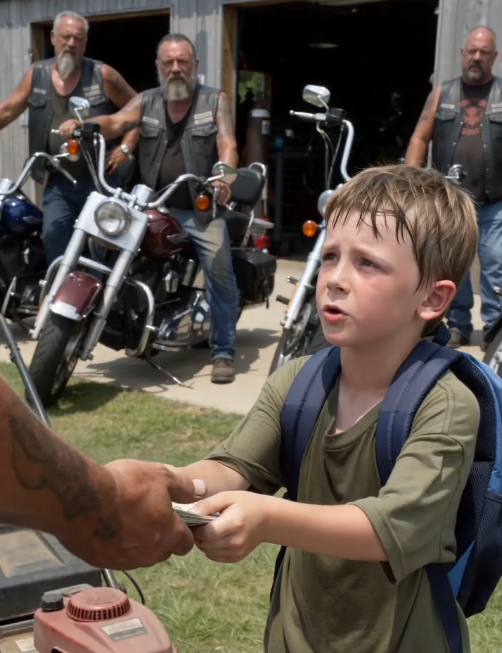
Noah had appeared at our gate pulling the mower behind him.
He carried a cardboard sign under one arm.
LAWNS CUT — $2
Boone laughed when he first saw the price.
“Two dollars for the whole lawn?”
Noah nodded.
“You know this place is nearly an acre?”
“I saw it from the road.”
“And it’s still two dollars?”
“That’s the price.”
I watched the boy’s eyes while he said it. He was not confused about money. He knew our property was larger than the suburban yards around it.
He simply refused to change his number.
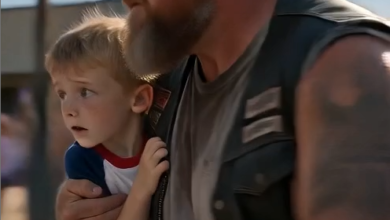
My name is Frank Sullivan, though most people around the club call me Rook. I was fifty-eight that summer, six-foot-three, 265 pounds, with a gray beard, scarred knuckles, faded tattoos, and a black leather cut that made nervous parents pull their children closer in grocery stores.
I had been president of the Iron Lanterns for twelve years.
I thought I understood stubbornness.
Then I met Noah.
We offered him cold water before he started. He drank half the bottle, placed the rest beneath a tree, and began pushing.
The reel mower was old enough to complain with every turn. Its metal blades made a dry clipping sound, and one wheel squeaked whenever Noah leaned right. He had to cross the same thick patches twice because he did not weigh enough to force the blades through them on the first pass.
Travis wanted to help.
Noah refused.
“If you cut it, I didn’t earn it.”
So we moved fallen branches, marked a hole near the drain, and let him work.
It took nearly two hours.
When he finished, the lines were crooked, one corner remained slightly high, and the strip beside the garage looked as though it had been attacked rather than mowed.
It was still the hardest-earned lawn service I had ever witnessed.
I gave him fifty dollars.
He counted it.
Then he removed two bills, folded the remaining forty-eight, and held them toward me.
“Keep it,” I said.
“The price is two.”
“Call the rest a tip.”
“I don’t take tips.”
“Why?”
“Because then my numbers won’t match.”
That answer got my attention.
“What numbers?”
Noah sat beneath the tree, opened a blue school backpack, and removed a composition notebook. Its corners were soft, the cover had been repaired with silver tape, and several pages had warped from sweat or rain.
Inside, he had recorded every yard he had cut.
There was a number, date, street name, payment received, and running total on each line.
Yard 1 — $2.
Yard 2 — $2.
The entries continued across two summers.
Number 417 had a note beside it: Mrs. Keene paid twice. Returned $2.
Number 503 said: Rain stopped after half. Finished next day.
Number 588 had no payment because the homeowner had been taken to the hospital before Noah completed the work. He returned later and finished without asking for the money.
The most recent entry was ours.
Yard 621 — Iron Lanterns — $2.
At the bottom of the page, Noah had written his total.
$1,242.
“You’ve cut more than six hundred lawns?” Boone asked.
“Yes, sir.”
“For two bucks each?”
“Yes.”
“Why?”
Noah closed the notebook.
He looked toward the repair garage, where three grown men had suddenly become very interested in a toolbox.
“I’m paying my grandma’s hospital bill.”
The heat seemed to press harder against the yard.
“How much is it?” I asked.
“Thirty-four thousand one hundred eighty-six dollars.”
He said the number without hesitation.
I asked how he knew.
He had seen a stack of statements on the kitchen table after his grandmother went into the hospital. The largest page showed a balance just above $34,000. His mother had been crying in the laundry room, so Noah wrote the amount inside his notebook and began calculating.
At two dollars per lawn, he needed to mow more than seventeen thousand yards.
He had already completed 621.
“How long do you think that’ll take?” Travis asked quietly.
Noah shrugged.
“About twenty years if I get faster.”
Nobody laughed.
He knew the math was imperfect. At his current rate, the job would take longer. But twenty years was the largest amount of time a nine-year-old could imagine while still believing steady work would eventually solve the problem.
“What happened to your grandmother?” I asked.
“She got sick after surgery. She’s at Mercy Regional.”
“Your mom know you’re doing this?”
“She knows I cut grass.”
“That wasn’t my question.”
Noah looked down.
His mother believed he was saving for a bicycle and helping elderly neighbors. She did not know he had written the hospital balance inside his school notebook. She did not know he kept the cash inside a cereal box beneath his bed.
“Your grandmother’s name?” Boone asked.
“Eleanor Whitaker.”
Something shifted behind me.
A socket wrench struck the garage floor.
Eddie Mercer stood inside the open bay with his face drained of color.
“What did you say?” he asked.
“Eleanor Whitaker.”
“Was she a teacher?”
Noah nodded. “First grade. For a long time.”
Eddie stepped into the sunlight.
He was sixty years old, tattooed from wrist to shoulder, and had once repaired his own broken nose beside a highway because he refused to miss a charity ride.
Now his eyes were wet.
I felt a memory move inside me: chalk dust, paper stars, a woman with red-framed glasses kneeling beside a desk while a frightened six-year-old pretended not to understand the assignment.
I looked at Boone.
He had remembered her, too.
So had three other men.
Mrs. Whitaker had taught first grade at Bellwood Elementary for forty-one years.
Seven members of our club had once sat in her classroom.
We had spent months riding past Mercy Regional without knowing she was there, while her nine-year-old grandson pushed a rusted mower across 621 lawns trying to save her two dollars at a time.
I handed Noah his forty-eight dollars.
He pushed it back.
“The price is two.”
I closed his fingers around the bills.
“Then you’re coming with us.”
His expression tightened.
“Where?”
I looked toward the hospital three miles away.
“To introduce us to the woman who taught half this club how to read.”
Part 2
We did not put Noah on a motorcycle.
He had no helmet, his mother had not granted permission, and eleven bikers arriving at a hospital with a child nobody knew would create the wrong kind of story.
Instead, Boone called Noah’s mother.
Jamie Whitaker answered during her lunch break at a pharmacy distribution warehouse. At first, she assumed something had happened with the mower. Then Boone explained where Noah was, how much he had earned, and what he had told us.
The line went quiet.
“He saw the statement?” she asked.
“Yes.”
“That isn’t the final bill.”
Noah’s shoulders lowered.
Jamie had tried to explain medical statements to him, but he only remembered the largest number. Some charges were under review, several had been denied pending documentation, and the hospital’s financial counselor had not yet completed an assistance application.
Still, there would be a substantial balance.
Jamie did not know how much.
Neither did anyone else yet.
“Please don’t give him more money,” she said. “He’ll think this is how he fixes everything.”
I looked at the forty-eight dollars still in his hand.
“I understand.”
She gave permission for Noah to ride with us in Boone’s truck to Mercy Regional, where she would meet us after arranging coverage for the rest of her shift.
The mower went inside our locked garage.
Noah recorded that, too.
Machine stored at club. Pick up later.
The drive took eight minutes.
Noah sat between Boone and me, holding the notebook against his chest. He smelled of cut grass and sun-heated cotton. His hair remained flattened with sweat even after the truck’s air conditioner began working.
“Did Grandma teach you?” he asked.
“First grade.”
“All of you?”
“Seven of us.”
“Were you in the same class?”
“Different years.”
“Was she nice?”
Boone laughed once.
“She was terrifying.”
I glanced at him.
“She weighed maybe a hundred twenty pounds.”
“Exactly. Terrifying.”
Noah looked worried until he realized Boone was smiling.
Mrs. Whitaker was not frightening because she shouted. She rarely did. She had a way of standing beside a desk and waiting until the truth became easier than maintaining the lie.
She remembered missing lunches.
She noticed bruises.
She kept clean socks inside the bottom drawer of her filing cabinet without asking children to explain why they needed them.
At age six, I had been known as Franklin Sullivan, the boy who could not sit still and arrived at school smelling like cigarette smoke. My father worked irregular construction jobs and drank most of what he earned. My mother disappeared for weeks at a time.
I fought.
I stole pencils.
I once glued another child’s workbook shut because he laughed at my torn shoes.
Mrs. Whitaker made me repair every damaged page during recess.
Then she gave me lunch.
She did not confuse accountability with abandonment.
That distinction probably saved me.
At Mercy Regional, Jamie was waiting near the information desk. She was thirty-two, thin from exhaustion, with her work badge still clipped to her navy polo shirt.
Noah ran to her.
“I didn’t take the fifty.”
“I heard.”
“The price was two.”
“I heard that, too.”
Jamie hugged him long enough that he stopped explaining.
Then she looked at us.
“You don’t have to do this.”
“We’re visiting an old teacher,” I said.
“Seven large men in leather?”
“She had difficult students.”
That earned the smallest smile.
Hospital policy allowed only two visitors at a time, and Mrs. Whitaker was resting. Jamie checked with the nurse before bringing anyone upstairs.
We waited in the lobby.
Nobody revved engines outside. Nobody blocked doors. We sat in molded plastic chairs beneath a television showing a home-renovation program without sound.
Eddie could not remain still.
“What if it isn’t her?”
“It’s her,” Boone said.
“How do you know?”
“Same name. Same school. Forty-one years.”
“What if she doesn’t remember us?”
I understood the real question.
What if the woman who remembered every frightened child had become too sick to remember herself?
Jamie returned with a nurse.
“Two at a time,” she said. “She tires quickly.”
Eddie looked at me.
“You go.”
We followed Noah down the hallway.
Mrs. Whitaker’s room was near the end of the medical-surgical wing. A walker stood beside the bathroom. Plastic tubing ran beneath her blanket, and a bouquet of grocery-store flowers leaned unevenly in a water pitcher.
She looked smaller than the woman in my memory.
Her hair had turned white. Red-framed glasses rested on the bedside table, and her hands appeared thin against the hospital sheet.
Noah entered first.
“Grandma, I brought customers.”
Her eyes opened.
Then she saw me.
For several seconds, she stared at my beard, tattoos, and leather vest. I expected confusion.
Instead, one corner of her mouth lifted.
“Franklin Sullivan,” she said. “Are you still leaning your chair back after being told not to?”
I stopped beside the door.
Eddie made a sound behind me.
Mrs. Whitaker turned toward him.
“And Edward Mercer. You used to hide crackers in your desk because your brother took your lunch money.”
Eddie covered his face with one scarred hand.
He had not told anyone that story.
Not his wife.
Not the club.
Mrs. Whitaker remembered.
Part 3
The other members entered two at a time.
Hospital rules remained hospital rules, even when six grown men waited in a hallway trying not to cry.
Mrs. Whitaker remembered every one.
Boone Callahan had been “Daniel, who drew motorcycles in the margins.” Nobody called him Daniel anymore.
Travis’s father, who was not with our club but had visited her classroom thirty years earlier, had been “Thomas with the red shoelaces.”
She remembered Eddie’s crackers, my damaged workbook, and the year Marcus Lee stopped speaking after his mother died. She remembered teaching him to answer questions by tapping once for yes and twice for no until words returned.
Marcus stood near her bed, silent again.
This time, he was smiling.
Noah watched each recognition with growing amazement.
“You really taught all of them?”
“I tried,” she said. “Some required additional years.”
Her voice was weak, but the timing remained perfect.
We laughed quietly.
A nurse asked us to keep the visit brief, so we did. Nobody demanded photographs. Nobody turned her room into a club event.
Before leaving, I asked whether she knew about Noah’s mowing business.
Mrs. Whitaker sighed.
“He said he wanted a bicycle.”
Noah studied the floor.
“You lied to your grandmother?” I asked.
“I didn’t say which bicycle.”
Jamie raised an eyebrow.
Noah surrendered.
“I lied a little.”
Mrs. Whitaker reached toward him.
He moved beside the bed and placed his hand inside hers.
“Why, sweetheart?”
He opened the notebook.
The hospital amount was written on the first page beneath a title in careful block letters:
GRANDMA’S BILL
Mrs. Whitaker read the number.
Then she looked at the running total.
Her thumb moved over the final entry.
“Six hundred twenty-one yards?”
“Yes.”
“In this heat?”
“I drink water.”
“That does not answer my question.”
Noah’s mouth tightened.
“You taught me not to quit.”
Mrs. Whitaker closed her eyes.
For a moment, I thought the conversation had exhausted her. Then a tear slipped beneath her lashes.
“I taught you to finish your homework.”
“This is more important.”
Jamie turned toward the window.
Noah continued explaining his plan. If he completed three lawns each weekday and ten on Saturdays, he could increase his total. Winter would be slower, but he could shovel snow for the same price.
“At two dollars?” Boone asked from the doorway.
“That’s my rate.”
Mrs. Whitaker looked at us.
“Please don’t encourage this.”
“We’re not,” I said.
Noah frowned. “Then why are you here?”
Because she had taught us.
Because he should not be carrying a hospital balance in a school notebook.
Because 621 lawns had been cut within a few miles of men who claimed to care about their community.
None of those answers felt complete.
I sat in the visitor chair.
“We’re here because adults missed something.”
Mrs. Whitaker studied me the way she had when I was six.
“Then adults should correct it without making him feel foolish for trying.”
That sentence shaped everything that followed.
It would have been easy to hand Noah a large check, photograph ourselves beside his grandmother, and call the problem solved. It would also have taught him that his work mattered only because bigger people arrived with bigger money.
Mrs. Whitaker would not allow that.
Neither would Jamie.
After the visit, we met with a hospital financial counselor named Priya Shah. Jamie authorized her to discuss the account while Noah waited with Boone near the vending machines.
The $34,186 figure was real, but it was not yet an enforceable patient balance. It combined denied claims, pending adjustments, rehabilitation estimates, and charges awaiting review.
Mrs. Whitaker had developed a serious infection following emergency abdominal surgery. She spent nine days in intensive care, required a second procedure, and would need weeks of rehabilitation.
Medicare covered much of the approved care. A supplemental policy was disputing several charges. Jamie had received so many statements that she could no longer distinguish notices from bills.
Priya explained the process.
Appeals first.
Financial assistance second.
A verified balance after that.
“We may reduce this significantly,” she said.
“How long?” Jamie asked.
“Several weeks.”
Noah believed his grandmother owed $34,186 today.
The adults knew the number could change.
The fear was still real.
Outside the counseling office, Boone had purchased Noah a sandwich. The boy had separated the turkey from the bread and was saving half in a napkin for his grandmother.
I sat beside him.
“How much did you make today?”
“Two dollars.”
“How much work did you do?”
“One lawn.”
“Then your book is right.”
He glanced toward the counseling office.
“But it isn’t enough.”
“Not by itself.”
His face hardened.
“I don’t want somebody doing it for me.”
“What if they’re doing it for her?”
He considered that.
“What if they’re doing it because she already did something for them?”
He looked down at the notebook.
That was the first moment his plan made room for anyone else.
When we returned to the clubhouse, seven former first graders sat around the scarred meeting table.
Each man told one Mrs. Whitaker story.
Eddie remembered the crackers.
Marcus remembered tapping answers.
Boone remembered being allowed to draw a motorcycle after finishing his reading assignment.
I remembered the workbook.
Then Travis asked the question nobody had yet said aloud.
“How many other kids did she do that for?”
Mrs. Whitaker had taught forty-one years, averaging twenty to twenty-five students per class.
Nearly a thousand first graders had passed through her room.
We did not need to find strangers.
We needed to find her children.
Part 4
Our first idea was bad.
We planned to publish a photograph of Mrs. Whitaker in her hospital bed, show Noah’s notebook, post the largest bill, and ask everyone in Bellwood to donate.
Denise Ward stopped us before we violated three kinds of privacy and embarrassed the woman we claimed to honor.
Denise was the club’s attorney, though she preferred “the person who prevents your compassion from creating paperwork.”
She met Jamie at the hospital, reviewed the statements, spoke with Priya, and asked Mrs. Whitaker directly what information she consented to share.
Mrs. Whitaker refused a hospital-bed photograph.
“I taught children to comb their hair before picture day,” she said. “I will not appear online looking like a dropped mop.”
She permitted us to use her most recent school portrait.
She allowed us to say she had undergone emergency surgery and faced significant unresolved medical and rehabilitation costs.
She agreed to a fundraiser only if financial records were independently verified and unused money could support her long-term care.
Then she added one condition.
“Noah’s notebook stays in the story.”
Jamie worried people would criticize her for letting a child mow lawns.
“They will,” Denise said.
That honesty helped.
Mrs. Whitaker looked at Noah.
“Do you want people to see it?”
He held the notebook against his chest.
“Will they know I’m not quitting?”
“Yes.”
“Then okay.”
We built the appeal around facts.
Noah was nine.
His rate was two dollars.
He had cut 621 lawns across two summers.
His recorded earnings totaled $1,242.
He believed his grandmother owed $34,186, though the final verified balance remained under review.
Seven members of the Iron Lanterns had recognized their former first-grade teacher only after hiring her grandson to cut the clubhouse lawn.
We did not describe ourselves as rescuers.
That word belonged to Mrs. Whitaker.
The photograph that stopped people was not her hospital portrait.
It showed Noah sitting beneath the clubhouse tree, soaked with sweat, one hand on the mower and the other holding open his notebook. Behind him stood seven bikers who had once been six-year-old boys in the same woman’s classroom.
Denise wrote the post.
I added one sentence:
She taught half this club to read, and we didn’t know her grandson was three miles away trying to save her two dollars at a time.
Before publishing, we sent it to Mrs. Whitaker.
She corrected my grammar.
Then she approved it.
The post went online at 7:12 on a Tuesday evening.
The first contribution was two dollars.
It came from Sarah Mills, Mrs. Whitaker’s student from 1988.
Her note said: For one lawn I never had to cut.
The second donation was twenty dollars from a former student in Arizona.
Then forty-one dollars arrived from someone marking each year Mrs. Whitaker had taught.
By midnight, 186 people had contributed.
The comments became an unofficial attendance list.
Class of 1996.
Room 4, 2003.
She bought my winter coat.
She sat with me until my foster mother arrived.
She knew I couldn’t see the board before my parents did.
She kept my spelling test because it was the first paper I ever passed.
Stories spread faster than our fundraiser link.
A retired firefighter remembered Mrs. Whitaker teaching his son after a house fire. A nurse at Mercy Regional had been in her 1999 class. The mayor had not been her student, but his two brothers had.
The post reached former pupils in twenty-seven states.
By the third day, more than a thousand people had donated.
Noah recorded each day’s total on a fresh notebook page. He stopped writing individual names after the entries became impossible to manage, but he continued marking the time and amount displayed on the fundraiser.
He also kept mowing.
That caused another argument.
Jamie wanted him to stop during the heat wave.
Noah insisted the fundraiser did not cancel his work.
We reached a compromise. He could mow only in the morning, use a safer lightweight reel mower inspected by the club, and work only at homes where an adult was present.
His rate remained two dollars.
People tried paying more.
He returned the difference.
A local television reporter offered to interview him. Noah agreed only after Denise confirmed the questions. During the interview, the reporter asked what he would buy if money remained after his grandmother’s care.
Noah looked genuinely confused.
“It isn’t mine.”
That clip spread farther than the original post.
On day seven, donations passed $60,000.
Then the hospital appeal was resolved.
Several denied charges were approved. Financial assistance reduced the remaining patient responsibility. The verified balance, including anticipated rehabilitation copays, was lower than the original stack of statements.
Denise and Priya established an account that would pay approved medical expenses directly. Additional funds would enter a managed care trust for transportation, home modifications, medication copays, and future support.
Mrs. Whitaker would not receive a bag of cash.
No club member controlled the account.
Everything was documented.
On the eleventh day, the fundraiser closed.
Two thousand three hundred people had contributed.
The total was enough to satisfy the verified hospital obligation and create the care fund Mrs. Whitaker had reluctantly agreed to accept.
Noah wrote the final amount in his notebook.
Then he drew a double line beneath it.
Boone looked over his shoulder.
“Finished?”
Noah shook his head.
“I still have my money.”
The $1,242 remained inside the cereal box at home.
Jamie wanted him to keep it.
Mrs. Whitaker wanted him to use it for school.
Noah wanted to place every dollar toward her care because that had been the promise written on his first page.
The adults argued around him until he closed the notebook.
“You all said my work counted.”
Nobody spoke.
“If you don’t let me use any, then it didn’t.”
He was right.
The care account accepted his contribution.
Not all of it.
Noah deposited $1,240 and kept two dollars—the payment from our clubhouse lawn.
“Why that one?” I asked.
He folded the bills into the notebook’s back pocket.
“Because that’s the lawn where you found her.”
Part 5
Mrs. Whitaker remained in rehabilitation for another three weeks.
Recovery was slow.
She tired after walking twenty feet with a therapist. Food tasted wrong. Some mornings she refused exercises until Noah opened his notebook and reminded her he had not pushed a mower through two summers so she could argue over ten steps.
She called that manipulation.
He called it teaching.
Jamie returned to regular shifts once transportation and home-care expenses were covered. The care fund paid for a temporary ramp at the duplex and grab bars in the bathroom. Eddie and Boone installed them under a licensed contractor’s supervision because Denise no longer trusted us with unsupervised generosity.
Meanwhile, Bellwood Elementary learned about the notebook.
The principal, Dr. Elaine Cho, had started teaching during Mrs. Whitaker’s final decade at the school. She asked whether the notebook could be displayed temporarily during an alumni gathering.
Noah refused.
“I still need it.”
Dr. Cho asked when he would be finished.
Noah considered that.
“When Grandma comes home.”
The school made a copy for the display.
Former students began sending letters. Not public posts. Actual letters.
Some included first-grade photographs. Others contained the kind of memory adults rarely realize a teacher preserved: the first book they read alone, a hand on the shoulder during a parent’s divorce, a clean shirt before a school assembly.
Mrs. Whitaker received too many to read in one sitting.
Noah brought five each evening.
She corrected the spelling in several.
On the morning of her discharge, Jamie expected a quiet exit through the hospital’s east lobby.
Denise had coordinated with security because several former students asked to be present. We estimated forty people.
More than four hundred came.
They did not block medical traffic. Hospital staff arranged them along one side of the atrium and through the covered walkway outside. Fire exits remained clear, elevators remained accessible, and nobody brought motorcycles into the ambulance lane.
People held old class photographs.
Some carried books Mrs. Whitaker had read aloud.
One man brought the cardboard alphabet card he had kept since 1982.
When the elevator doors opened, Noah pushed his grandmother’s wheelchair into the lobby.
Mrs. Whitaker saw the crowd.
She stopped speaking.
The first person to approach was Sarah Mills, who had made the original two-dollar donation. She was now a middle-school counselor with silver beginning at her temples.
“Mrs. Whitaker?”
The teacher narrowed her eyes.
“Sarah Anne Mills. You put paste in Kevin’s hair.”
Sarah began laughing and crying at once.
Mrs. Whitaker remembered dozens of names.
Not all four hundred.
Nobody expected that.
But she recognized enough faces to turn the crowd from strangers into a classroom spread across forty-one years.
Eddie stood beside me near the wall.
“This is what 41 years looks like,” he said.
Noah heard him.
He looked around the lobby, then down at the notebook resting on his grandmother’s lap.
Until that moment, his arithmetic had contained only lawns and dollars.
Two dollars multiplied by 621.
Thirty-four thousand divided by two.
Twenty imagined years of work.
Now he saw another kind of multiplication.
One teacher.
Forty-one classes.
Hundreds of children who became firefighters, mechanics, nurses, warehouse workers, counselors, parents, and bikers.
Mrs. Whitaker had been making deposits her entire life.
Nobody had written them down.
The crowd had.
Outside, seven motorcycles waited along the far edge of the visitor parking area. We did not start them until Jamie’s car pulled away because Mrs. Whitaker needed quiet.
Then the engines came alive one by one.
The low sound rolled beneath the hospital canopy.
Mrs. Whitaker lowered her window.
“Franklin!” she called.
I walked toward the car.
“Don’t lean your motorcycle back.”
“I think you’re confused about how motorcycles work.”
“I think you still argue too much.”
Some things survive every hospital stay.
Two days later, Bellwood Elementary held a small ceremony in its library. Dr. Cho presented Noah with a new notebook because his original pages had begun separating from the binding.
The original notebook was placed inside a simple wooden frame with UV-protective glass. Noah kept the final two dollars in the back pocket before it was sealed.
The framed pages showed the first yard, the six-hundred-twenty-first yard, the $34,186 target, and the final double line.
It was hung in the school’s history room beneath Mrs. Whitaker’s first faculty photograph.
The plaque did not mention the club.
It read:
621 LAWNS. TWO DOLLARS EACH. ONE GRANDMOTHER.
Noah approved every word.
Part 6
After Mrs. Whitaker returned home, Noah continued cutting grass.
That surprised people.
The hospital balance had been resolved. The care fund was established. He no longer needed to calculate how many decades separated him from his goal.
But mowing had become more than a payment plan.
It was something he could do when the world felt too large.
His price remained two dollars for elderly and disabled neighbors. Everyone else paid the rate posted by a small neighborhood lawn service Boone helped him organize after Noah turned eleven.
Jamie required adult supervision.
The club maintained the equipment.
Noah kept the books.
He still returned overpayments.
The first time he came back to our clubhouse, I tried paying ten dollars.
He gave me eight back.
“You never learn,” he said.
“That sounds familiar.”
Mrs. Whitaker regained enough strength to visit the school twice a month. She did not return to full-time teaching. Instead, she listened to first graders read in the library.
Children still leaned chairs backward.
She still noticed.
Seven Iron Lanterns began volunteering at the school’s summer reading program. The first afternoon was a disaster. Eddie frightened two children by clearing his throat, Boone mispronounced the name of a cartoon unicorn, and I discovered that sitting cross-legged on a classroom rug was no longer physically available to me.
Mrs. Whitaker watched from a chair.
“You require additional years,” she said.
We kept returning.
The fundraiser also changed how Bellwood handled medical hardship. Denise, Priya, and the school district created a referral sheet explaining hospital assistance, insurance appeals, verified fundraising, and local support programs.
It could not erase every bill.
It helped families understand which number was real before a child copied it into a notebook.
Noah’s framed ledger became the first object visitors saw in the school history room. People expected the display to be about a successful fundraiser.
Dr. Cho said it was about what adults can miss when children become quietly responsible.
I visited it once alone.
Behind the glass, Yard 621 still read:
Iron Lanterns — $2.
That line bothered me for months.
Not because Noah had charged too little.
Because he had worked three miles from our clubhouse through two summers, and it took us until Yard 621 to ask the right question.
Part 7
One year after Mrs. Whitaker left the hospital, the Iron Lanterns held a cookout behind the clubhouse.
Noah arrived pushing the same old reel mower.
Boone had restored it during winter. The blades were sharpened, the handles repainted, and the squeaking wheel finally moved without complaint.
“You cutting the yard?” I asked.
“No.”
He parked it beneath the tree where he had first opened his notebook.
Mrs. Whitaker stepped from Jamie’s car using a cane. She moved slowly, but she walked without assistance. Four hundred former students were not waiting this time.
Only seven difficult ones.
We had placed an ordinary wooden chair in the shade for her.
She sat and inspected the lawn.
“You missed a strip near the garage.”
Boone looked offended.
“That’s decorative.”
“It’s negligence.”
Noah laughed.
Later, he opened his new notebook and showed me the current accounts. The first pages contained lawn jobs. The middle section tracked school assignments. Near the back, he maintained a list of reading-program hours completed by club members.
Eddie owed four.
I owed two.
“You’re keeping records on us now?”
“Grandma says adults need reminders.”
Mrs. Whitaker raised her lemonade.
“She learns quickly.”
Before leaving, Noah removed two wrinkled dollar bills from the notebook’s back pocket. They were the same bills sealed inside the framed ledger, returned temporarily by the school for the anniversary gathering.
He placed them in my palm.
“What’s this?”
“Payment.”
“For what?”
“The club cut Grandma’s lawn while I was at school.”
“We weren’t charging.”
“The price is two dollars.”
I tried returning them.
He closed my fingers exactly as I had once closed his.
“Then call it a tip.”
Mrs. Whitaker watched from beneath the tree, smiling at seven former first graders who had finally learned to accept correction.
Behind her, the old mower stood upright in the grass.
The boy had once believed it would take twenty years to save his grandmother.
Instead, the people she had spent forty-one years teaching came back in eleven days.
And inside the school three miles away, a child’s notebook remained behind glass, preserving every crooked yard that brought them home.
Follow our page for more biker stories about stubborn kindness, forgotten teachers, and small promises that grow larger than anyone expects.