Part 2: A Biker Carried a Screaming Old Man Away From His Grandson’s Coffin — Then the Son Everyone Thought Was Dead Walked Through the Chapel Doors
Part 2 — The Red Instructions Inside His Vest
I learned the story of Rook’s vest that afternoon, after the police left without arresting anyone and after Daniel convinced Arthur that the man in the coffin was not him.
The red label had not been part of the Iron Lanterns’ colors. Lucas stitched it inside Rook’s cut three months earlier, using a strip cut from a mechanic’s warning flag and thick black thread that looked clumsy against the aged leather.
On it were five instructions.
Face him. Use his name. One voice only. Don’t explain death. Find Daniel.
Lucas had learned those rules during visits to Arthur’s memory-care residence. Alzheimer’s had not simply removed memories in an orderly line. It rearranged them. Some mornings Arthur believed Daniel was ten. On others, he remembered Lucas as an infant but could describe every bolt inside the 1968 shovelhead he had owned before either boy was born.
Trying to correct him often deepened the fear.
Lucas taught the family to enter Arthur’s reality without lying about what mattered. If Arthur asked for his late wife, they did not announce her death again. They said she was not there, placed her old record on the turntable, and asked him to tell them how they met.
Rook understood faster than most.
His own mother, June Mercer, had lived with early-onset Alzheimer’s for nine years. During the last two, she forgot that Silas was her son. She remembered him only as “the tall mechanic” who came on Wednesdays.
Rook still came every day.
He shaved before visiting because his beard frightened her. He removed his vest in the parking lot. When June asked him to repair the same broken kitchen clock, he opened its casing, tightened a screw that did not need tightening, and returned it as if the job were new.
The clock was not broken.
Time was.
June died while Rook was serving eighteen months of a three-year sentence for aggravated assault. He had attacked a man who stole her purse outside a pharmacy, continued after the man fell, and ignored two people ordering him to stop.
That conviction followed him for thirty-one years.
Rook did not pretend it was unfair.
“I was angry,” he told me. “Anger doesn’t become justice because your reason sounds good.”
After prison, he stopped drinking, opened a towing shop, and joined the Iron Lanterns. The club gave him work when employers saw his record, a couch when his landlord refused renewal, and men who noticed when he missed recovery meetings.
Lucas entered that shop at nineteen.
He had dropped out of community college, owed money on a truck he could not afford, and believed talent should excuse unreliability. Rook saw him repair a carburetor nobody else could diagnose, then fired him three times in his first year.
Lucas returned four times.
The last time, he brought coffee, arrived before sunrise, and said, “If you fire me again, at least teach me why first.”
Rook kept him.
Daniel did not approve. He worked as a safety inspector and believed his son’s future should not depend on motorcycles, towing calls, and men with convictions. Their arguments hardened until Lucas stopped attending Sunday dinners.
Arthur remained the bridge.
He had been a machinist for forty-six years and respected anyone who could make damaged metal useful again. He visited Mercer Cycle, sat on an overturned bucket, and told stories nobody knew were already beginning to repeat.
Rook always listened.
When Arthur’s diagnosis came, Lucas asked Rook to help. Not because Rook had medical training, but because he knew what correction could do to a frightened mind.
The club learned too.
Forty tattooed riders practiced approaching Arthur from the front. They removed sunglasses before speaking. They stopped correcting him when he called motorcycles by the wrong years.
One rider named Boone objected.
“You want us lying to him?”
Rook shook his head. “I want you to stop making him lose people twice.”
The words ended the argument.
Lucas made the red instruction strip after Arthur wandered from a family picnic and hid beneath a bridge because he believed Daniel, then twelve years old in his mind, had fallen into the river.
Rook found him.
He did not say Daniel was fifty-five and safe. He sat beneath the bridge, called Daniel on speaker, and allowed Arthur to hear his son’s voice.
That was why “Find Daniel” became the final instruction.
Lucas knew another crisis would come.
What he could not know was that it would happen beside his own coffin.
Two weeks before he died, Lucas gave Rook a photograph showing the three of them beside Arthur’s restored shovelhead. On the back he wrote, If Grandpa ever sees me and thinks I’m Dad, don’t let them correct him inside the room. Get him outside. Call Dad. Make him see.
Rook placed the photograph behind the red strip.
Daniel knew about it.
Nobody else did.
That omission would divide the family before it brought them back together.
Part 3 — The Coffin Wheel That Lifted From the Floor
The morning of Lucas’s funeral began with a mechanical problem.
One brake beneath the casket bier would not lock completely. My assistant suggested replacing it, but the matching bier was being used at another service. I tested the remaining wheels, placed a rubber chock beneath the weak one, and decided it was secure.
It was not.
That small failure almost changed everything.
Arthur sat beside Elaine while Daniel called repeatedly from the highway. The cellular signal broke his words apart, so Elaine told him to concentrate on driving and promised they would delay the final prayer if necessary.
She did not tell Arthur about the calls.
The decision came from tenderness. Daniel wanted his father to see his face, not hear a distorted voice through a telephone.
But Arthur kept asking.
“Where’s Danny?”
“On his way.”
“From where?”
“Fort Smith.”
“Why was he in Fort Smith?”
Each answer created another opening for confusion. By the time the service began, Arthur had forgotten Lucas was dead but remembered that Daniel had once wrecked a pickup outside Fort Smith when he was nineteen.
The old accident filled the missing space.
Arthur became convinced Daniel had been hurt again.
Rook noticed before the family did. He saw Arthur rubbing the white identification bracelet around his wrist. He saw him watching the chapel entrance instead of the minister. He saw the old man’s breathing change when Daniel’s name appeared in the eulogy.
Rook moved from the rear pew to the aisle.
Elaine intercepted him.
“Don’t.”
“He needs one voice.”
“He needs his family.”
“He needs Daniel.”
Her grief heard an accusation Rook had not spoken.
“Daniel should be here,” she snapped. “And Lucas should be alive. Neither of those things is my fault.”
Rook stepped back.
That hesitation cost them.
The minister invited the family forward. Arthur saw Lucas without the beard and entered a memory nearly three decades old. He did not see his grandson. He saw Daniel after the Fort Smith crash.
“Danny?”
He bent lower.
The embalmed stillness terrified him.
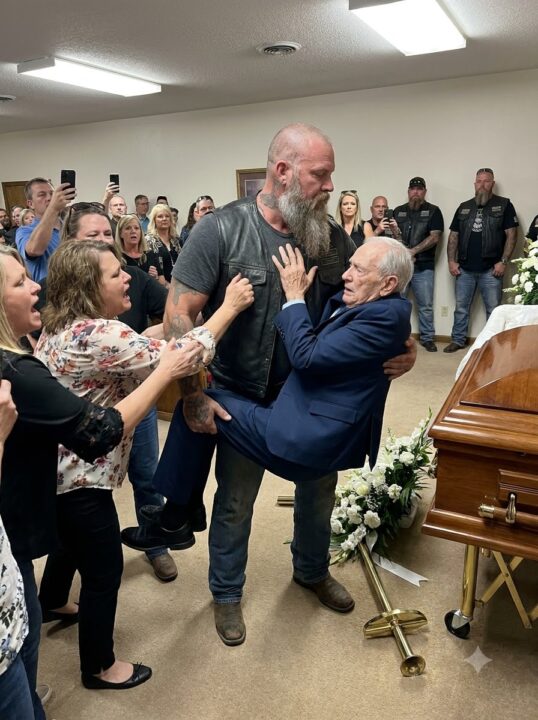
Arthur placed both hands beneath Lucas’s shoulders as if he could lift him. Elaine tried to turn him around. Her uncle grabbed his wrist. Four people spoke at once.
Wrong name.
Wrong decade.
Wrong room.
Arthur pulled.
The bier moved six inches.
Flowers fell. A glass vase shattered. The weak wheel climbed over its chock, and one corner of the casket rolled toward the aisle.
I caught the handle.
Rook reached Arthur.
Elaine shoved him. “Stay away from my father.”
Arthur struck at anyone between him and Lucas. His fist caught Elaine near the mouth. The shock on her face lasted less than a second, but it shattered what little control remained in the room.
Two cousins seized Arthur from behind.
He believed they were stopping him from rescuing Daniel.
He screamed.
Rook’s club rose together, boots striking the floor in one heavy movement. Several relatives turned toward them, certain the bikers intended to take over the chapel.
Boone waited for Rook’s command.
Rook gave a different one.
“Everybody back.”
Nobody listened.
Arthur reached for the casket again. His fingers slid between Lucas’s folded hands, pulling one arm from its arranged position. Elaine cried out as though her son had been injured.
Then Rook made the choice everyone judged.
He drove his shoulder between the cousins, caught Arthur beneath the arms, and lifted him away from the body. Arthur kicked. Rook shifted his grip, placing one arm beneath the old man’s knees and the other behind his back.
It looked like an abduction.
Phones appeared.
Elaine struck Rook’s neck. Her brother seized the patch on his cut and pulled hard enough to choke him. Rook continued walking, protecting Arthur’s head with one scarred hand whenever they passed a pew.
“Put him down!”
“Call the police!”
“He’s stealing Dad!”
Rook said nothing.
That silence made him look colder.
I stepped before the doors because the funeral home was my responsibility. “Mr. Mercer, stop.”
“He can’t see the box.”
“You do not have authority.”
“Daniel gave it.”
“Daniel is not his legal guardian.”
Rook looked at Arthur, who was sobbing against his chest and repeating that his boy could not breathe.
“Then arrest me outside.”
He whispered the six words.
“Daniel is alive. He sent me.”
Arthur’s body softened, but only briefly. Alzheimer’s allowed the statement into his mind without guaranteeing it would remain.
“Where?”
“Coming.”
“You saw him?”
“He called.”
Rook pushed through the doors.
Rain had started. It struck the motorcycles in a thousand small metallic taps, too soft to resemble applause and too steady to ignore.
Rook lowered Arthur onto a stone bench. He did not release him until Arthur’s shoes touched the ground and his back rested safely against the wall.
Then he knelt.
The biker’s jeans darkened in the rain. Water gathered in his beard. Arthur grabbed both lapels of the leather cut and demanded proof.
Rook removed the photograph.
Arthur studied Daniel’s face, then Lucas’s, then his own restored motorcycle behind them. For one moment, recognition returned.
“That’s my boy.”
“Which one?”
Arthur pointed to Daniel.
Rook nodded. “Alive.”
The chapel doors opened behind us. Elaine came outside with two officers who had been attending the funeral as family friends.
She pointed at Rook.
“He assaulted my father.”
Rook rose and placed his hands where the officers could see them.
Arthur caught the chain wallet hanging from his jeans.
“Don’t take him.”
Everyone stopped.
Arthur no longer remembered why Rook had carried him outside.
He only knew the large man had shown him proof his son was alive.
A pickup turned into the lot.
Daniel Bell jumped out before setting the parking brake. The truck rolled several inches, forcing him to run back and pull the lever, an awkward human mistake that would have been funny anywhere else.
Then Arthur saw him.
“Danny?”
Daniel crossed the rain and dropped before his father.
“I’m here.”
Arthur touched his face with both hands. He checked Daniel’s forehead, throat, and chest, confirming warmth and breath.
Behind them, Elaine covered her mouth.
The police looked toward Rook.
He was already walking away.
Daniel called his name.
Rook did not turn until Daniel said, “Lucas left something else.”
That was the moment I believed the crisis had ended.
It had not.
Part 4 — The Message Lucas Recorded Before His Heart Stopped
Daniel helped Arthur into the funeral home’s arrangement office, away from the chapel and the casket. We closed the blinds, brought water, and allowed only one person to speak at a time.
Arthur asked why everyone was dressed in black.
Daniel told him they were saying goodbye to someone.
“To who?”
Daniel looked toward Elaine.
She shook her head.
“Someone we loved,” Daniel answered.
Arthur accepted that. Five minutes later, he asked again.
Rook remained outside beneath the awning, refusing to enter until Elaine requested him. She did not.
Daniel went to him.
Their conversation began quietly, then sharpened. I could hear only fragments through the glass doors.
“You promised.”
“I got him out.”
“You were supposed to call me sooner.”
“Road had you trapped.”
“You carried him through a room full of people.”
“He was moving the casket.”
“You made my family think—”
Rook turned away.
Daniel caught his shoulder.
Every Iron Lantern in the lot went still.
Rook looked at Daniel’s hand, then at Daniel.
“Finish that sentence.”
Daniel released him.
The anger between them had not begun that morning. Daniel blamed Rook for encouraging Lucas to remain at the garage. Rook blamed Daniel for treating Lucas’s work as a wasted life. Both men loved Lucas. Neither had learned to speak without using him as a weapon.
Daniel reached into his truck and removed a padded envelope.
Lucas’s name appeared across it in grease-darkened handwriting.
Rook stared at the envelope. “Where’d you get that?”
“His apartment.”
Inside was a flash drive, a notarized medical directive for Arthur’s care, and a letter addressed to Daniel, Elaine, and Rook.
Lucas had written it after the bridge incident.
He described the possibility that Arthur might one day mistake him for Daniel. Their faces had resembled each other since Lucas’s twenties, and Arthur already confused their names during periods of stress.
Lucas did not want anyone forcing his grandfather to understand a death he could not retain.
If it happened at a funeral, hospital, or accident scene, the instructions were precise: remove Arthur from the visual trigger, reduce the number of voices, contact Daniel, and do not restrain him unless immediate danger required it.
Then came the part nobody expected.
Lucas named Rook as Arthur’s temporary emergency companion whenever Daniel could not be reached.
Not Elaine.
Not another blood relative.
Rook.
Elaine read the document twice. “He had no right.”
Daniel’s answer was quiet. “Dad signed it.”
Arthur had approved the directive during a lucid appointment with his neurologist. Daniel had signed as primary guardian. Lucas became the alternate contact, with Rook listed beneath him because Rook had cared for his mother and completed dementia-response training through a Tulsa caregiver program.
The intimidating biker had more training for that crisis than anyone in the chapel.
He had simply never told us.
“Why hide it?” I asked.
Rook glanced toward Arthur. “People treat him different when they know somebody’s managing him.”
The flash drive contained a video.
We played it on my office computer while Arthur rested in another room. Lucas appeared inside the motorcycle shop wearing a work shirt, his hands blackened with grease. Rook’s old Harley stood behind him with its fuel tank removed.
Lucas looked uncomfortable before speaking.
“If Grandpa mixed me up with Dad today, this isn’t a joke, and it isn’t a story to embarrass him with later. His mind is protecting something. Let it.”
Elaine sat down.
Lucas continued.
“If you’re watching because I’m dead, don’t make him understand that just so the rest of you feel honest. He’ll understand for five minutes. Then he’ll lose me again. You’ll give him fresh grief every time.”
Daniel turned his face away.
On screen, Lucas lifted the red strip he had planned to sew inside Rook’s vest.
“Rook knows what to do because he did it wrong first.”
The biker’s expression changed.
Lucas explained the final night of June Mercer’s life. Rook had visited her after an argument with the prison chaplain who arranged supervised leave. June asked where her son was.
Rook tried to force recognition.
He told her he was Silas. He showed childhood photographs. He reminded her of the scar she bandaged when he was nine. Each proof frightened her more because the stranger before her possessed intimate details about a life she could no longer access.
She called for help.
Rook was removed.
June died hours later.
His last conversation with his mother had been an interrogation disguised as love.
That failure became the reason Lucas trusted him.
Rook had spent thirty-one years learning the difference between being correct and being kind.
The video ended with Lucas looking toward someone beyond the camera.
“Anything else?”
Arthur’s voice came from off-screen.
“Tell Danny I’m not afraid.”
Lucas smiled. “You just did.”
Arthur had been present while the video was recorded.
He had helped plan his own protection.
Elaine looked at Rook. “You knew Lucas expected this?”
“Knew it could happen.”
“And you still came?”
Rook rubbed water from his beard. “He asked.”
“You sat in the back as if you didn’t belong.”
“I didn’t.”
Daniel closed the laptop.
“That isn’t why.”
Rook’s jaw tightened.
Daniel opened the letter and read the final paragraph aloud. Lucas had asked Rook to sit in the rear because he knew Elaine might refuse him a family seat. He also asked Daniel to place something beneath the casket lining.
I had not been told.
We returned to the chapel.
Under the removable fabric panel near Lucas’s left hand, Daniel found a small motorcycle key attached to a plain steel tag.
It belonged to Arthur’s restored shovelhead.
Lucas had finished rebuilding it before he died.
Part 5 — The Motorcycle Lucas Rebuilt for a Man Who Could No Longer Ride
Arthur’s 1968 shovelhead had spent twenty-three years beneath a canvas cover inside Daniel’s barn.
It was the motorcycle Arthur bought after returning from Vietnam, the machine on which he taught Daniel to balance, use a clutch, and listen for trouble before metal began to knock.
Arthur sold it when Daniel was sixteen.
The buyer abandoned it behind a repair shop outside Broken Arrow. Decades later, Lucas found the frame through an online registry and bought it back without telling anyone.
The restoration took four years.
Lucas rebuilt the engine with Rook, polished the tank by hand, and preserved a shallow dent near the right knee where Daniel had dropped the motorcycle during his first lesson. He refused to repair that mark.
“Damage isn’t always the broken part,” he told Rook.
Lucas planned to reveal the motorcycle on Arthur’s eighty-second birthday. He knew his grandfather could never ride it alone, so he installed a sidecar with a secure seat, a low step, and a hidden safety belt.
The family saw risk.
Lucas saw recognition.
During difficult visits, Arthur no longer remembered names, but he remembered engine rhythm. A Harley’s uneven idle could pull old stories from him when photographs failed. He could identify a shovelhead by sound before he could identify his grandson by face.
That was the second reason the Iron Lanterns attended the funeral.
They had ridden there to escort Arthur to the garage afterward.
Elaine had refused the plan when Daniel first mentioned it. She believed taking her father near motorcycles on the day of Lucas’s burial was grotesque.
After the chapel crisis, she still refused.
“You expect Dad to celebrate something Lucas built while Lucas is lying in there?”
Rook answered with four words.
“Lucas expected him to.”
Elaine slapped the steel key against his chest.
“My son is not one of your club stories.”
Rook caught the key before it fell. “Never said he was.”
“You turned him against his father.”
Daniel flinched.
Rook could have defended himself. Instead, he held the key toward Daniel.
“Your ride. Your call.”
That restraint exposed another truth.
Lucas had not avoided his family because Rook encouraged him. He stayed away because Daniel had once told him repairing motorcycles was “what men did when they were afraid to build a real life.”
Daniel remembered the sentence.
Lucas had remembered every word.
Rook repeatedly urged him to go home. The photograph inside his vest came from the one afternoon when he finally succeeded. Rook had invited Daniel to the garage under the pretense of inspecting a lift, then locked father and son inside the office until they spoke.
Daniel stayed six hours.
They did not repair everything, but Lucas showed him Arthur’s motorcycle. Daniel helped install the sidecar.
The three men took the photograph afterward.
Daniel turned it over. Beneath Lucas’s funeral instructions was another line I had not noticed:
If Dad and Rook start blaming each other, make them finish the bike.
Daniel began to laugh.
It was not joyful. It broke into something rough and helpless, the sound of a father recognizing his dead son’s handwriting inside a trap built from love.
Rook lowered his head.
Elaine walked away.
For several minutes, I assumed she had rejected the idea. Then she returned with Arthur’s coat.
“We are not calling it a final ride,” she said.
Rook nodded.
“No speeches.”
“Fine.”
“No club ceremony.”
“Fine.”
“And he sits in the sidecar.”
“Wouldn’t let him drive.”
It was the closest either of them came to peace that day.
We delayed the burial for forty-five minutes.
The Iron Lanterns rode to Mercer Cycle in two quiet columns. Daniel drove Arthur in the pickup because the rain had strengthened, while Elaine and I followed.
The garage door opened.
Inside stood a deep red shovelhead with cream pinstriping, a black sidecar, and the old dent preserved near the tank’s right edge.
Arthur entered slowly.
He did not recognize Daniel.
He did not recognize Elaine.
He recognized the motorcycle.
“My God,” he whispered. “That’s mine.”
Rook stood beside him. “Was.”
“Who took it?”
“Your grandson.”
Arthur studied Rook. “I have a grandson?”
Rook’s throat moved.
“Good kid.”
Arthur walked around the motorcycle, touching the tank, the handgrip, and the leather seat. His fingers found the dent.
“Danny dropped it.”
Daniel turned away, pressing his fist against his mouth.
Arthur looked toward him.
“You Danny?”
“Yes.”
“How old are you?”
“Fifty-five.”
Arthur smiled. “You got old.”
Daniel laughed through his tears. “So did you.”
For the first time that day, Arthur held the right son inside the right decade.
It lasted perhaps a minute.
That was enough.
Rook helped him into the sidecar. He checked the belt twice and tucked a blanket around Arthur’s legs. His tattooed hands moved with the practiced gentleness of someone who had once frightened his mother and refused to make the same mistake again.
They rode only through the industrial lot.
No highway.
No crowd.
Rook kept the motorcycle barely above idle while Daniel walked beside the sidecar. Arthur rested one palm against the metal and listened to the engine Lucas had rebuilt.
When they stopped, he looked at Rook.
“Did my boy fix this?”
“Both of them did.”
Arthur nodded as though that made perfect sense.
Then he asked why everyone was dressed for a funeral.
Nobody answered immediately.
Rook pointed toward the motorcycle.
“Had somewhere important to be.”
Arthur accepted that too.
We returned to the chapel and buried Lucas beneath a stand of red oaks just before sunset. Arthur did not approach the coffin again.
Rook stood behind him.
Close enough to catch him.
Far enough to let him stand alone.
Part 6 — Every Thursday at 4:10
After the funeral, Daniel moved Arthur to a smaller memory-care residence closer to Mercer Cycle.
Every Thursday at 4:10 p.m., Rook parked the restored shovelhead beneath Arthur’s window. He never revved the engine. He let it idle until a nurse brought Arthur outside.
Some weeks Arthur knew him.
Most weeks he did not.
“Are you the tall mechanic?” Arthur would ask.
“Sometimes.”
“Is that my motorcycle?”
“Sometimes.”
Rook stopped correcting the details.
If the weather was dry and Arthur seemed steady, they circled the parking lot with him secured inside the sidecar. Daniel often walked beside them. Elaine began attending in spring.
The Iron Lanterns came one at a time because a crowd confused Arthur. Boone brought coffee. Mack polished the sidecar. Another rider replaced the blanket when the old one became stained.
Nobody wore a funeral face.
Rook kept Lucas’s red instruction strip inside his vest. Beneath it, he added a second piece of fabric containing one sentence in Arthur’s handwriting:
Don’t make me lose them twice.
Arthur had written it during a lucid afternoon with his neurologist.
The white hospital bracelet from the funeral remained looped around the handle inside the sidecar. Elaine once tried to discard it, believing it carried a painful memory.
Rook stopped her.
“That got him home.”
She left it there.
Six months after Lucas’s death, Arthur asked Rook why the motorcycle’s engine sounded new.
“My grandson rebuild it?”
“Yeah.”
“Where is he?”
Rook looked toward Daniel.
The old answer would have been accurate and cruel. The new answer required no lie.
“Not here today.”
Arthur rubbed the dent in the tank.
“Good boy?”
“The best kind.”
Arthur nodded.
Then he pointed at Rook’s leather vest and asked why the faded word HOLD was tattooed across his knuckles.
Rook looked at the hands that had once carried him away from a coffin.
“Reminder.”
“For what?”
“To know when to let go.”
Arthur considered that.
“And when to hold on?”
Rook started the engine.
“That too.”
Part 7 — The Day Arthur Recognized Both of Them
Arthur died eighteen months after Lucas.
His final morning was quiet. Daniel sat on one side of the bed. Elaine sat on the other. Rook remained near the window because he still believed family should occupy the closest chairs.
Arthur opened his eyes shortly after sunrise.
He recognized Daniel.
Then he saw Rook.
“Tall mechanic.”
Rook stepped forward. “That’s me.”
Arthur looked at their faces for a long time. “Lucas working today?”
Daniel closed his eyes.
Rook answered.
“Shop’s closed.”
Arthur nodded, as if a closed shop explained every absence. His hand moved weakly across the blanket until Rook placed two scarred fingers beneath it.
“You brought Danny,” Arthur whispered.
“Yeah.”
“Good.”
Those were his last clear words.
At Arthur’s funeral, the family placed no open casket in the chapel. They displayed the restored motorcycle key, the photograph of Arthur, Daniel, Lucas, and Rook, and the red instruction strip from the leather vest.
Rook sat in the front pew.
Elaine had reserved the seat.
After the burial, Daniel rolled the shovelhead from a trailer. He secured Arthur’s empty coat inside the sidecar and looped the old hospital bracelet around the handle.
The Iron Lanterns formed two lines, but no engines started until Elaine nodded.
Rook mounted the motorcycle.
Daniel stood beside him. “Where are you taking it?”
“Shop.”
“Long way?”
Rook looked toward the empty sidecar.
“Long enough.”
The shovelhead started on the second attempt. Its uneven V-twin pulse moved through the cemetery soil, steady and familiar.
Rook rode past Lucas’s grave first.
Then Arthur’s.
The club followed at walking speed until they reached the cemetery gate. There, Daniel watched the motorcycles turn south beneath the red oaks, their taillights disappearing one by one into the Oklahoma evening.
The empty sidecar stayed between them.
Follow the page for more unforgettable biker stories, and leave ROOK below if you want the next full story from the Iron Lanterns.