The Boy Was Asked to Leave for Ordering Only Water — Then a Biker Took the Seat Across from Him
When the waitress told the boy he had to leave for ordering nothing but a glass of water, the entire diner went quiet—but no one moved to stop it.
It was late afternoon at Millstone Diner, the kind of small-town place where the coffee is always hot and the regulars sit in the same booths every day. The bell above the door chimed softly when people came in, and the smell of grilled onions lingered in the air like something permanent.
The boy sat alone at a booth near the window.
Twelve, maybe thirteen. Too thin for his oversized sweatshirt. Hair falling into his eyes. A cracked backpack leaned against the vinyl seat beside him.
He’d asked politely.
“Just water is fine, ma’am.”
The waitress had hesitated. Then returned with a tall glass and a forced smile.
But the manager noticed.
He stepped out from behind the counter, wiping his hands on a towel, and said in a voice loud enough for half the diner to hear, “This isn’t a shelter.”
The boy’s fingers tightened around the glass.
“I’m not bothering anyone,” he whispered.
A man at the counter shrugged. A woman stirred her coffee and looked away.
The manager pointed toward the door. “If you’re not ordering, you can’t stay.”
The boy stood slowly.
Embarrassment spread across his face like heat.
He reached for his backpack.
That’s when the door chimed again.
A gust of cold air slipped inside.
Heavy boots crossed the tile floor.
And a broad-shouldered man in a worn leather vest walked in, scanning the room with eyes that didn’t miss much.
No one yet knew who he was.
Or why he chose the booth by the window.
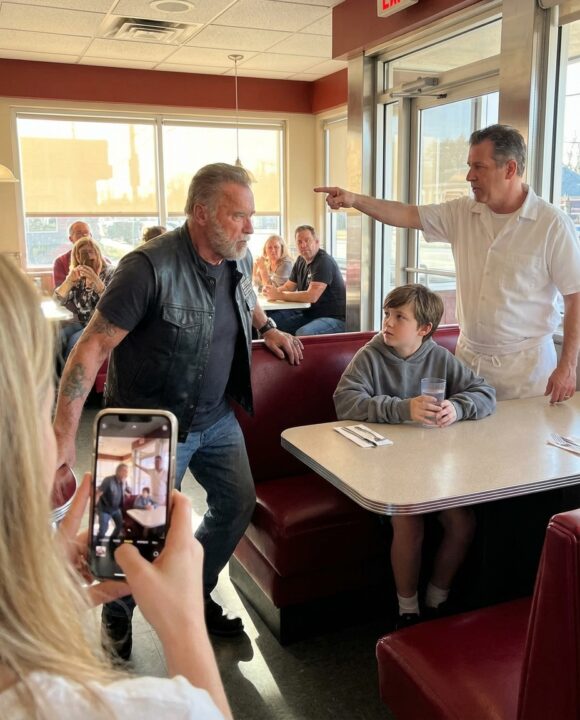
The biker didn’t look at the menu.
He didn’t greet anyone.
He walked straight past the counter and slid into the booth across from the boy.
The boy froze.
The manager blinked. “Sir, can I help you?”
The biker placed his gloves on the table deliberately.
“Yes.”
He nodded toward the boy. “He’s staying.”
The room shifted.
The manager’s jaw tightened. “We have policies.”
“So do I,” the biker replied calmly.
From across the diner, it didn’t look protective.
It looked confrontational.
Late fifties. Thick gray beard. Sleeveless leather vest with faded patches. Inked forearms resting on the table like stone.
The kind of presence that makes people uneasy.
The manager stepped closer. “If he’s not ordering food, he can’t take up a booth.”
The biker didn’t raise his voice.
“Bring two menus.”
The manager scoffed. “That’s not the point.”
“It is now.”
A couple near the window whispered.
“This is going to get ugly.”
The boy looked like he wanted to disappear.
“I can go,” he said quietly.
The biker shook his head once.
“No.”
The manager folded his arms. “Sir, if you’re trying to intimidate my staff—”
The biker leaned back slightly, hands visible, posture controlled.
“No intimidation.”
“Then what is this?”
The biker glanced around the diner—at the half-finished plates, the people pretending not to watch, the quiet that had replaced conversation.
“This,” he said evenly, “is a table.”
The simplicity of it only made things worse.
The manager’s face reddened.
“Either he orders, or you both leave.”
The biker nodded slowly.
“Fine.”
He reached into his vest.
Half the diner tensed.
Was he pulling out cash? A phone? Something else?
He placed a folded stack of bills on the table.
“Bring whatever you recommend.”
The manager hesitated.
“You think throwing money fixes it?”
“No,” the biker replied. “Sitting does.”
The waitress hovered nearby, unsure.
The room felt brittle.
Like one wrong word would shatter it.
The boy stared at the table, blinking hard.
The biker leaned forward slightly and said something too quiet for anyone else to hear.
The manager looked around, weighing his next move.
Then, from outside—
the low rumble of motorcycle engines rolled across the parking lot.
And every head in the diner turned toward the window.
The engines didn’t rev.
They idled.
One by one, motorcycles lined the curb outside Millstone Diner.
Chrome reflecting afternoon light.
Helmets coming off slowly.
Inside, the tension shifted from irritation to something closer to fear.
“Is this a gang thing?” someone whispered.
The manager’s posture stiffened.
The biker remained seated.
Calm.
Unmoving.
The boy’s eyes flicked toward the window, then back to the table.
“I didn’t ask for this,” he murmured.
“You didn’t,” the biker replied.
The door chimed again.
Another rider stepped in—mid-forties, leather vest, steady eyes. He didn’t crowd the booth. He simply stood near the entrance, hands relaxed at his sides.
Then another.
And another.
Not loud.
Not aggressive.
Just present.
The waitress looked at the manager.
“Should we call someone?”
“For what?” the biker asked evenly.
No one answered.
The manager tried to regain control.
“This is harassment.”
The biker shook his head.
“No one’s touching anyone.”
The boy’s water glass trembled slightly in his hand.
The biker noticed.
He reached across the table and slid the folded bills closer to the edge.
“Keep the change,” he said.
“To what?” the manager snapped.
“To the idea that he doesn’t belong.”
The sentence landed heavy.
Outside, the row of motorcycles grew longer.
Customers shifted in their seats.
Some gathered their purses.
One man stood as if preparing to leave.
The biker didn’t look toward the window.
He kept his eyes on the boy.
“Tell me your name.”
“Lucas.”
“You hungry, Lucas?”
Lucas nodded faintly.
The waitress finally approached with two menus.
The manager hissed under his breath.
“This isn’t how businesses run.”
The biker looked at him steadily.
“Sometimes that’s the problem.”
A silence spread through the diner.
The kind that feels historical in retrospect.
The manager stepped closer to the booth.
“If you’re threatening my establishment—”
The biker lifted one hand slowly.
Not in warning.
In pause.
“No threats.”
“Then why are they here?”
The biker didn’t answer.
Instead, he pulled out his phone.
Typed something.
Sent it.
And set it face down on the table.
The engines outside cut off one by one.
Not leaving.
Arrived.
The boy’s shoulders loosened slightly.
The manager looked toward the window again.
The power dynamic had shifted—but no one had shouted.
No one had flipped a table.
It felt like something larger than a meal was being decided.
And just as the manager opened his mouth to speak again—
the diner door chimed once more.
The bell above the diner door didn’t jingle this time.
It rang.
Clear. Sharp. Final.
Every head turned.
The man who stepped inside didn’t wear leather.
He wore a navy blazer over a pressed white shirt. Late sixties. Silver hair combed neatly back. Thin glasses balanced low on his nose. The kind of man who didn’t raise his voice because he didn’t need to.
He paused just inside the doorway, taking in the scene—the row of motorcycles outside, the manager standing rigid near the booth, the gray-bearded biker seated calmly across from a thin boy with both hands wrapped around a sweating glass of water.
“Afternoon,” the older man said quietly.
The manager blinked. “Sir, we’re in the middle of—”
“I’m aware.”
The older man walked slowly toward the booth.
The bikers near the entrance stepped aside without being asked.
Not deferential.
Respectful.
The room noticed.
The older man stopped beside the booth and looked at Lucas first, not the manager.
“You must be Lucas.”
The boy swallowed. “Yes, sir.”
The manager frowned. “Do I know you?”
The older man finally turned.
“Yes,” he said calmly. “You do.”
The silence tightened.
“I’m Thomas Whitaker.”
Recognition flickered across the manager’s face.
Owner.
Millstone Diner had been in the Whitaker family for forty-three years.
The manager straightened instinctively. “Mr. Whitaker, I didn’t expect—”
“No,” Whitaker replied softly. “You didn’t.”
He glanced at the biker.
“You texted.”
The biker gave a small nod.
Nothing theatrical.
Nothing triumphant.
The room shifted again.
This wasn’t a gang standoff.
This was something else.
Whitaker pulled a chair from a nearby table and sat down beside Lucas.
Not across.
Beside.
“Tell me what happened,” he said gently.
The manager tried to speak first.
“He wasn’t ordering food—”
Whitaker lifted one hand, not sharply, but decisively.
“I asked him.”
Lucas stared at the tabletop.
“I just needed somewhere warm,” he said. “I wasn’t trying to cause trouble.”
Whitaker studied the boy’s worn backpack, the frayed sleeves, the hollow look behind his eyes.
Then he looked at the manager.
“When did we start charging people for a glass of water and a seat?”
The manager flushed. “We can’t let people take advantage—”
Whitaker’s gaze didn’t rise.
“Is he taking advantage?”
The room felt smaller.
The biker remained still, forearms resting on the table, eyes calm.
The engines outside were silent now.
Present, but quiet.
Whitaker turned slightly toward the biker.
“You said this mattered.”
“It does,” the biker replied.
“Why?”
The biker took a moment.
“Because thirty years ago, someone let me sit.”
The weight of that sentence settled over the diner like dust after a storm.
Whitaker nodded once.
Then he stood.
He walked behind the counter, removed the manager’s name badge from its hook, and placed it gently on the surface.
“You’re done for the day.”
The manager opened his mouth.
Closed it.
The crowd that had braced for chaos now watched something quieter.
More powerful.
Whitaker faced the diner.
“We serve people here,” he said evenly. “Not just plates.”
No applause followed.
Just silence.
The kind that feels corrective.
Whitaker turned back to Lucas.
“Stay as long as you need.”
The boy blinked hard.
The biker didn’t smile.
He simply leaned back in the booth as the tension drained from the room.
Outside, the row of motorcycles remained where they were.
Not as a threat.
As witnesses.
The waitress brought out two plates without being asked.
Burger. Fries. Extra pickles.
Lucas stared at it like he wasn’t sure it was real.
“Eat,” Whitaker said softly.
The diner slowly resumed its rhythm.
Forks scraped plates again. Coffee refilled cups. Conversations restarted in lower tones.
But something had shifted.
The manager slipped quietly out the side door.
No dramatic exit.
Just absence.
The biker stayed seated while Lucas took his first bite.
Not watching him eat.
Just staying.
Whitaker returned to the counter, speaking quietly with staff. Adjusting things without raising his voice.
After a few minutes, the biker stood.
“You’re not staying?” Lucas asked quickly.
The man shook his head.
“I never planned to.”
He slid a folded business card across the table.
No speech.
No lecture.
Just paper.
Lucas looked at it.
Community Outreach Legal Services.
The biker’s name printed neatly beneath it.
“You’re a lawyer?” Lucas asked, surprised.
The man shrugged slightly.
“Some days.”
Lucas stared at him.
“Why help me?”
The biker paused near the booth, hands resting on the back of the seat.
“Because the world’s loud enough,” he said quietly. “Someone has to sit down.”
Outside, engines started one by one.
Low.
Measured.
The row of motorcycles pulled away slowly, not revving, not celebrating.
Just leaving.
Lucas watched through the window as the gray-bearded biker mounted his bike, adjusted his gloves, and rode off without looking back.
No handshake.
No photo.
No recognition.
Inside the diner, Whitaker replaced the old chalkboard menu with a new line written carefully in white chalk:
Water is always free. So is a seat.
Lucas finished his fries.
He didn’t rush.
For the first time that day, he didn’t look like he needed to disappear.
Sometimes change doesn’t come with sirens.
Sometimes it arrives on two wheels.
Sits down quietly.
And reminds a room who it used to be.
The bell above the door chimed once more.
But this time—
no one looked away.