An Elderly Woman Unzipped a Feared Biker’s Leather Jacket in a Crowded Supermarket—Then a Forty-Year-Old Rescue Returned to Save Him
The elderly woman grabbed the largest biker in our supermarket and pulled his leather jacket open before anyone could stop her; customers thought she was confused, but the sound beneath his shirt made her hands move faster.
I was the evening manager at Mesa Market, an independent grocery store two blocks south of Route 66 in Amarillo, Texas. At 5:37 on a Thursday evening, every register was open, rain tapped against the front windows, and customers moved through the aisles with the impatient rhythm of people trying to get home before the roads froze.
Ray Dawson stood near the pharmacy counter.
Most people called him Hammer.
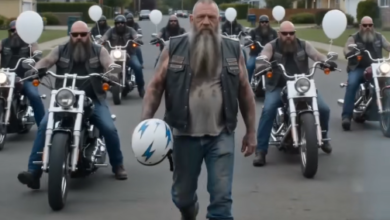
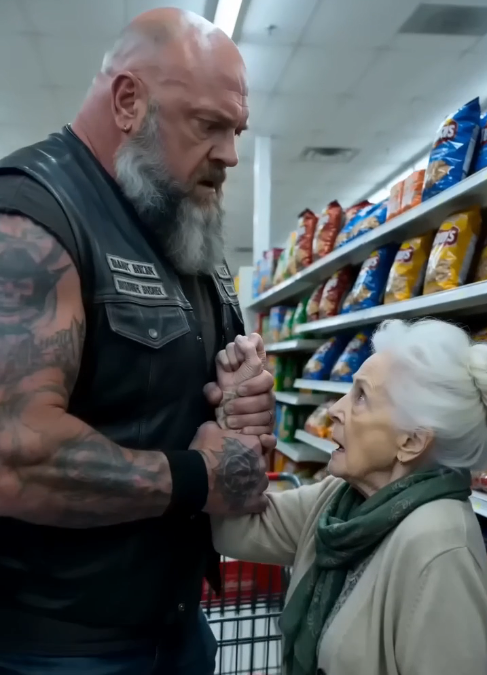
He was fifty-six, six feet four, and built like somebody had stacked two ordinary men inside one leather cut. His head was shaved. A thick black-and-gray beard covered his throat, old tattoos wrapped both forearms, and his scarred knuckles rested on a shopping cart filled with canned soup, bananas, oatmeal, and three boxes of low-sodium crackers.
Four Harleys waited outside beneath the awning. Their engines had gone silent, but rainwater continued ticking against hot exhaust pipes.
Hammer’s three club brothers were in the next aisle arguing about coffee. He stood alone, reading a nutrition label with the concentration of a man defusing something dangerous.
That was when Evelyn Carter noticed him.
Evelyn was seventy-nine, barely five feet three in orthopedic shoes, with white hair pinned beneath a green rain scarf. She came into our store every Thursday for tea, rye bread, and one lottery ticket she never scratched until Sunday morning. Most employees knew she had once been a cardiac nurse, but to the other customers she was simply an old woman pushing a small cart with a squeaking front wheel.
She stopped six feet from Hammer.
Her head tilted.
Hammer shifted his weight and pressed a fist briefly beneath the left side of his jacket. A faint electronic tone sounded—two notes, a pause, then two more.
Most people mistook it for a phone.
Evelyn did not.
She abandoned her cart, walked straight toward him, and reached for his zipper.
Hammer caught her wrist before she touched it. His hand completely covered hers.
“Ma’am,” he said, his voice low but controlled. “Don’t.”
Evelyn looked into his face. “How long has it been doing that?”
He released her wrist but stepped backward.
A second alert sounded beneath the leather.
Two notes. A pause. Two more.
“What are you doing?” a customer demanded as Evelyn reached again.
This time she pulled the zipper down.
The aisle erupted.
A woman near the pharmacy shouted for security. A man raised his phone and began recording. One of Hammer’s brothers came around the corner, saw an elderly stranger opening his club president’s jacket, and moved toward them with both hands raised.
Evelyn ignored everyone.
Beneath Hammer’s jacket was a faded black T-shirt. The fabric over his left chest shifted with his breathing, revealing a thin surgical scar and the outline of an implanted cardiac device beneath the skin. A small medical transmitter clipped near his belt was flashing amber.
Hammer’s face had gone gray.
Not pale.
Gray.
Sweat stood along his forehead even though cold air blew through the automatic doors. His right hand trembled against the shopping cart. The label he had been reading slipped between his fingers and landed beside Evelyn’s shoe.
She pressed two fingers against his wrist.
“Call 911,” she told me.
Hammer tried to pull his jacket closed. “I’m fine.”
“No,” Evelyn said. “You’re still standing.”
There was something in the way she said it that made those two statements sound completely different.
His club brothers surrounded them. The largest was Leon Brooks, a broad Black man with a trimmed beard and a blue bandanna. He asked Hammer whether he wanted to leave. Hammer nodded once and reached toward him.
Evelyn slapped Leon’s hand away.
“Do not walk him anywhere.”
People gasped as though she had struck a police officer.
Hammer’s knees bent.
Evelyn caught his jacket with both hands, but she could not support his weight. Leon and I lowered him to the floor while groceries rolled beneath the shelves. The electronic warning continued beneath his shirt.
Two notes.
A pause.
Two more.
Evelyn knelt beside the man everyone else was afraid to touch and placed her ear near his mouth. She checked his pulse again, looked toward our customer-service counter, and shouted for the automated defibrillator.
Then Hammer opened his eyes.
He looked at the elderly woman above him, not with recognition, but with the distant fear of someone hearing a voice from another lifetime.
Evelyn leaned close and said, “Stay with me, Ray. Don’t close your eyes.”
Hammer stopped fighting her.
Forty years earlier, beside a flooded drainage canal outside Amarillo, a sixteen-year-old boy in a torn leather jacket had spoken those exact words to Evelyn’s eight-year-old son.
But Evelyn did not yet know the biker on our supermarket floor was that boy.
She would learn his identity only after his heart stopped—and after the paramedic running through our doors called him by the name she had spent four decades trying to find.
Want to know why Evelyn recognized the warning and what Hammer had carried from the 1986 rescue for forty years? Drop HEART in the comments — I’ll share more soon.
Part 2 — The Man Who Bought Low-Sodium Soup
Before that Thursday, Hammer Dawson was a man I recognized without knowing.
He came to Mesa Market two or three times a week, usually late enough that the dinner crowd had thinned. He parked his black Road King at the far end of the building, folded his gloves into his helmet, and walked the aisles with an old paper list. He never blocked carts, never argued about prices, and always returned the loose cart someone had abandoned beside the handicap spaces.
People still watched him.
His leather cut had no words a customer could read from ten feet away, but the worn patches, chain wallet, heavy boots, and dark tattoos supplied whatever story they expected. Mothers drew children closer. Men who had been laughing lowered their voices. New cashiers sometimes called me to stand near their register while he paid.
Hammer noticed.
He never complained.
Six months before the supermarket incident, his purchases changed. He stopped buying bacon, canned chili, and the strong coffee his club favored. He began studying sodium levels and carrying a folded cardiology handout between the pages of his grocery list.
I once teased him about the crackers.
He looked at the box and said, “Cardboard’s got less salt.”
“Does it taste better?”
“No.”
That was the entire conversation.
His brothers knew he had undergone heart surgery, but Hammer had told them it was routine. The implanted device beneath his collarbone was not a simple pacemaker. It was an implantable cardioverter-defibrillator—an ICD—which monitored dangerous rhythms and could deliver a shock if his heart slipped into one.
To most people, it was still a pacemaker.
To Hammer, it was an insult beneath his skin.
He had spent his life being the man who lifted engines, separated fights, pushed broken motorcycles onto trailers, and rode into storms to collect stranded club members. Depending on a device felt like betraying the body that had carried everyone else.
Leon told me later that Hammer had ignored two appointments.
The first time, he said the shop was busy. The second time, a club prospect needed help moving his mother into assisted living. When the cardiology office called about data transmitted from the implant, Hammer turned off his phone and went back to rebuilding a carburetor.
Brotherhood had taught him to show up for others.
It had never taught him how to become the one waiting for help.
Evelyn Carter lived by a different rule. She had retired from cardiac nursing seventeen years earlier, but she still noticed breathing patterns, swollen ankles, blue fingernails, and the tiny pauses people inserted into sentences when they were hiding pain.
She noticed Hammer before she heard the alert.
His cart contained food selected by somebody recently frightened by a doctor. His shoulders were rigid. He had read the same soup label for nearly a minute without turning it. When he lifted his left arm, his face tightened.
Then came the sound.
Modern implanted heart devices can produce patient-alert tones or vibrations when they detect certain rhythm changes, battery problems, or lead issues. The sound alone does not explain the emergency, but Evelyn knew it should never be ignored—especially when the patient was sweating, unsteady, and turning gray.
Hammer knew it too.
That was why he tried to leave.
Later, Leon found a cardiology appointment card in the saddlebag of Hammer’s motorcycle. The appointment had been scheduled for that morning. Hammer had written SHOP FIRST across the time in black marker.
He had gone to repair a single mother’s minivan instead.
By the time he reached Mesa Market, his chest felt tight. His pulse alternated between racing and long, sickening pauses. He entered the supermarket because he needed the prescription waiting at the pharmacy and because he believed he could finish one more errand before admitting anything was wrong.
Men like Hammer often bargain with pain.
One aisle.
One task.
One mile.
Then help.
Evelyn’s hand on his zipper ended the bargain.
The strange part was that she had touched another leather jacket four decades earlier. That jacket had belonged to a thin sixteen-year-old boy kneeling in mud beside her son. She had cut it open along one sleeve because the boy’s shoulder had been torn by barbed wire during the rescue.
The memory lived in fragments: floodwater hammering through concrete, a motorcycle headlight aimed into the ditch, her son coughing against a stranger’s chest, and a teenage boy repeating the same command Evelyn later gave him.
Stay with me.
Don’t close your eyes.
She never knew the boy’s full name. The sheriff’s report listed him as Raymond D., a juvenile witness. A newspaper called him an unidentified teenage motorcyclist. By the time Evelyn returned from the hospital with her son, the boy was gone.
She kept searching anyway.
Every anniversary of the flood, she placed a notice in the local paper thanking the unknown rider. Years passed. Her son finished school, became a firefighter, then a paramedic. Evelyn retired. The clipping yellowed inside a kitchen drawer.
The boy grew into Hammer Dawson.
Neither of them knew they still lived twenty-three minutes apart.
Until the alarm sounded.
Part 3 — Seven Minutes on the Supermarket Floor
Hammer lost consciousness before our cashier returned with the automated external defibrillator.
His head rolled against Leon’s folded vest. Evelyn leaned over him, called his name, and pressed two fingers to the side of his neck. She watched his chest.
Nothing.
“No normal breathing,” she said.
The supermarket changed around those words.
People stopped filming. Carts stopped moving. A baby cried near the produce section, and somewhere behind the deli counter a timer continued ringing because nobody remembered to silence it.
Evelyn pointed at me. “Emergency services?”
“On the line.”
“Tell them cardiac arrest. Start the clock.”
Then she placed both hands at the center of Hammer’s chest.
Her first compression pushed air from his lungs. Her second made Leon flinch. By the fifth, the old nurse had found a rhythm her body remembered after seventeen years away from a hospital.
Hard.
Fast.
Steady.
A customer asked whether he should take over. Evelyn told him to kneel beside her and wait for instructions. She did not waste breath on explanations.
I opened the AED case with shaking hands. The device spoke in a calm electronic voice, telling us to remove clothing from the patient’s chest. Hammer’s T-shirt had to be cut, but Leon hesitated when he saw the scissors.
The leather cut was different.
A biker’s cut carries years that cannot be replaced: funerals, road names, promises, miles, and men no longer alive. Hammer’s had been with him longer than some of the riders standing around him.
Evelyn understood none of the club rules, but she understood the hesitation.
“The leather can stay,” she said. “The shirt cannot.”
Leon cut the fabric.
Beneath it we saw the raised outline of the implanted device, old surgical scars, and two adhesive monitoring patches placed by Hammer’s cardiology clinic. The small transmitter at his belt continued flashing amber. Evelyn positioned the AED pads away from the implanted device, following the printed diagram and the machine’s instructions.
“Clear.”
We moved back.
The AED analyzed.
No one breathed.
“Shock advised.”
The sound that followed was smaller than people imagine. Hammer’s body tightened once, then dropped. Evelyn immediately resumed compressions.
One of his brothers, a younger rider named Boone Mercer, backed into a display of cereal. Boxes fell around his boots. Boone had tattoos across his throat and a stare that usually made customers choose a different aisle, but in that moment he looked about twelve.
“Fix him,” Boone said.
Evelyn did not look up. “Then count.”
Boone fell to his knees.
“One. Two. Three. Four.”
His voice broke at seven.
Leon continued at eight.
The club had arrived at the supermarket as four men who believed they could carry their president anywhere he needed to go. Now they were kneeling beside an elderly woman who refused to let them move him.
That was the first time their loyalty was tested.
The second came less than two minutes later, when Hammer’s eyelids fluttered and he began trying to rise.
“Truck,” he muttered.
Leon leaned closer. “What?”
“No ambulance. Take me in the truck.”
Evelyn pressed a hand against his shoulder. “You are not going anywhere except with paramedics.”
Hammer’s gaze found hers. “Hospital costs.”
“You can argue about money after your heart decides whether to keep you.”
Boone said they could transport him faster. The hospital was only six minutes away. Leon looked toward the entrance, then down at Hammer. Their instinct was to obey the man on the floor.
Evelyn refused.
“If he arrests again in your pickup, what do you have?”
Boone opened his mouth.
“What do you have?” she repeated.
Nothing.
No monitor. No oxygen. No cardiac medications. No way to communicate with an emergency department before arrival.
Hammer tried to sit again. His face twisted as the implanted device delivered an internal shock. Leon held his shoulders while Evelyn checked his pulse.
The front doors opened.
Three paramedics entered with a stretcher, monitor, airway kit, and medication bag. The lead medic wore a navy uniform and had close-cropped gray hair. He moved with the same clipped certainty Evelyn had shown.
“Who witnessed the arrest?”
“I did,” Evelyn said.
“Initial rhythm?”
“AED advised shock. One delivered. Pulse returned.”
“Implant?”
“Left upper chest. Patient-alert tone before collapse. He reported nothing because he’s stubborn.”
The paramedic almost smiled. “That diagnosis fits half my patients.”
Then he looked at Hammer.
His expression changed.
“Ray?”
Hammer’s eyes opened a fraction.
The medic crouched closer. “Ray Dawson?”
Evelyn turned sharply.
The name struck her before the face did.
Dawson.
In 1986, the deputy who brought her son’s bicycle to the hospital had mentioned a boy named Dawson. Evelyn had written the surname on the back of the newspaper clipping, then added a question mark because the juvenile report withheld the full identity.
She stared at Hammer’s right forearm.
Beneath layers of newer tattoos, near the elbow, was a pale crescent scar where barbed wire had cut through the teenage rescuer’s jacket forty years earlier.
Evelyn touched the scar.
Hammer recoiled.
“How did you get this?” she asked.
He looked at her as paramedics attached the monitor.
“Fence,” he whispered.
“What fence?”
“Drainage canal.”
The lead paramedic froze with one electrode in his hand.
His name was Daniel Carter.
He was Evelyn’s son.
The eight-year-old boy pulled from floodwater had become the man now preparing to carry his rescuer into an ambulance.
Daniel looked from the scar to Hammer’s face. For several seconds, his professional composure disappeared. His hands remained steady, but his mouth opened without producing words.
Hammer recognized him first.
Not the adult face. Not the uniform.
The eyes.
“You got old, kid,” he murmured.
Daniel swallowed. “You came back.”
Hammer shook his head slightly. “Never left.”
The monitor alarm interrupted them. Hammer’s rhythm was becoming unstable again.
Daniel became a paramedic once more.
He administered medication, called the receiving hospital, and ordered the stretcher brought closer. As the team lifted Hammer, something slipped from the inside pocket of his leather cut and landed on the supermarket floor.
It was a folded newspaper clipping protected inside a clear plastic sleeve.
The paper was yellow with age.
The photograph showed floodwater, an eight-year-old boy wrapped in a blanket, and a thin teenage rider standing behind the ambulance with one sleeve of his leather jacket cut open.
Evelyn picked it up.
On the back, written in faded blue ink, were the same six words she had spoken moments earlier.
Stay with me. Don’t close your eyes.
Part 4 — The Boy Beneath the Highway Bridge
The flood came on June 14, 1986.
Amarillo had received weeks of dry heat before a violent storm broke over the city. Water rushed across roads too quickly for the storm drains to carry it. The drainage canal beneath an old highway bridge transformed from a strip of mud into a fast brown current filled with branches, bottles, and pieces of fencing.
Daniel Carter was eight.
He and two friends had been riding bicycles home when one boy dared the others to cross the shallow concrete channel before the water rose. Daniel’s front tire slipped. He fell from the bicycle, struck the wall, and disappeared beneath the runoff.
His friends ran for help.
Ray Dawson arrived first.
He was sixteen, thin, angry, and riding a motorcycle assembled from parts nobody else wanted. The machine had a cracked headlamp housing, mismatched mirrors, and a starter that worked only when the engine was warm.
Ray had been running away.
His stepfather had thrown him out that afternoon after an argument. Ray carried nineteen dollars, a wrench, two shirts, and a juvenile-court notice he intended to ignore. He planned to ride west until the motorcycle broke or nobody remembered his name.
He never made it beyond the bridge.
One of Daniel’s friends ran into the road waving both arms. Ray nearly passed him. He had spent years learning that other people’s emergencies became traps for boys like him.
Then he saw the bicycle in the water.
Ray abandoned his motorcycle beneath the bridge and climbed over the barrier. A length of damaged barbed wire caught his sleeve and tore into his right arm. He left part of his jacket hanging from the fence.
Daniel surfaced once.
Ray jumped.
The current drove both of them against the concrete wall. Ray caught Daniel’s shirt, lost it, then grabbed the child around the chest. He could not climb the bank where he entered, so he fought downstream until his boots found a maintenance ledge.
A truck driver stopped and called emergency services from a nearby pay phone. Before help arrived, Daniel stopped breathing.
Ray had learned basic CPR three weeks earlier during a court-ordered safety class he nearly skipped.
He tilted Daniel’s head, gave rescue breaths, and compressed the child’s chest with hands that would later become scarred by engines, fights, winter roads, and forty years of work.
“Stay with me,” he kept saying. “Don’t close your eyes.”
Daniel coughed water onto Ray’s shirt.
Evelyn arrived in the first ambulance because she had been covering an extra shift. She climbed down the embankment, saw her son alive in a stranger’s arms, and nearly stopped functioning as a nurse.
Nearly.
She checked Daniel, delivered oxygen, and directed the rescue crew. Only after her son was secured did she notice the teenage rider leaning against the concrete wall with blood running from his forearm and his right shoulder hanging low.
Ray tried to leave.
Evelyn caught his torn jacket.
“You’re injured.”
“I’m fine.”
It was the first lie he ever told her.
The pattern lasted forty years.
At the hospital, Ray refused to give his home address. Evelyn cleaned the cut on his arm, helped a doctor reduce his dislocated shoulder, and found the juvenile-court notice folded in his pocket.
Ray expected police.
Instead, Evelyn called the public defender listed on the paper and told him exactly what the boy had done beneath the bridge. She made the responding deputy record Ray’s actions. She made the newspaper photographer include him, though juvenile privacy rules prevented publication of his name.
Then she sat beside Ray until morning.
He asked about Daniel once.
“He’ll recover,” she said.
Ray nodded and looked toward the door.
“You saved my son.”
“Anybody would’ve.”
“No. Three cars passed before you stopped.”
He stared at his boots.
Evelyn put the torn piece of leather on the chair beside him. “You need to stop deciding who you are based on the people who failed you.”
Ray looked at her for the first time.
“What am I, then?”
“Tonight? The reason my boy is breathing.”
That sentence disrupted his escape plan.
Ray appeared in juvenile court two weeks later. The judge considered the rescue, ordered supervised community service at a motorcycle repair shop, and allowed him to remain with an uncle rather than return to his stepfather’s home.
The repair shop became his education.
Its owner became his first stable adult.
The motorcycle club formed years later around that garage.
Ray tried to visit Daniel after leaving community service, but the Carter family had moved to Lubbock when Evelyn accepted a hospital position. Their apartment address changed. The telephone number was disconnected. Ray kept the newspaper clipping because it was the first evidence he possessed that his life had added something instead of damaging it.
Evelyn searched too.
She wrote letters to the newspaper, the sheriff’s office, and the hospital social worker. Privacy rules protected Ray’s identity. One letter came back marked undeliverable. Another disappeared into an archive.
Daniel grew up with only fragments of his rescuer: sixteen years old, motorcycle rider, injured arm, first name possibly Ray.
That was enough.
Daniel became a firefighter at twenty-two and a paramedic at twenty-eight. He specialized in water rescue. Every new recruit heard the story of the teenage motorcyclist who had performed CPR beneath the bridge.
Ray built Dawson Custom & Repair. He employed men leaving prison, veterans sleeping in cars, teenagers with court papers folded in their pockets, and anyone who reminded him of the boy he had been.
He rarely explained why.
Inside the office, behind a cabinet door, he kept two photographs. One showed his motorcycle beneath the bridge. The other showed Daniel wrapped in a blanket.
Beneath the photographs hung the torn sleeve from Ray’s first leather jacket.
For forty years, a rescue shaped two lives moving through the same Texas Panhandle without meeting.
Then Hammer’s heart failed beside aisle nine.
The coincidence was not that Evelyn happened to be there. She shopped every Thursday. Hammer collected his prescription every fourth Thursday. Their paths had crossed before, perhaps dozens of times, but neither recognized the other through age, distance, and the ordinary disguises of time.
The miracle was smaller.
Evelyn heard the warning.
She believed it.
And once again, someone stopped.
Part 5 — The Order His Brothers Refused
Hammer reached the cardiac unit alive, but the danger was not over.
His ICD had detected repeated episodes of ventricular tachycardia. One lead was malfunctioning, and the device had reached a condition requiring urgent evaluation. The cardiology team stabilized his rhythm, but he needed a procedure the next morning.
Hammer objected as soon as he could speak clearly.
He wanted medication and discharge papers. The shop had three unfinished motorcycles. A club member’s daughter needed her car repaired before college classes. He had promised to lead a charity ride that weekend.
Leon listened until Hammer finished.
Then he said no.
The hospital room went silent.
Hammer had led their club for twenty-one years. His orders carried weight because he rarely gave them. He had driven through snow to retrieve stranded brothers, paid rent anonymously, sat outside recovery meetings, and attended court dates when families would not.
Leon had never openly refused him.
“You taking my cut?” Hammer asked.
“If that’s what staying means.”
Boone stood beside Leon. “Mine too.”
A third rider placed his folded vest on the visitor’s chair.
They were not abandoning him.
They were refusing to help him abandon himself.
Hammer looked toward the window. “I said I’m leaving.”
Evelyn sat in the corner knitting a crooked line into a scarf she had been working on for six months. She had no official reason to remain, but Daniel knew better than to ask her to leave.
“Then leave,” she said. “You’ll make it to the elevator if you’re lucky.”
Hammer glared at her.
She continued knitting.
“Your brothers can obey you,” she added. “Or they can keep you alive. Today they cannot do both.”
Leon folded his arms.
Hammer stayed.
The procedure repaired the device system and replaced the failing component. Doctors later said the supermarket response—the early call, immediate CPR, correct AED use, and rapid transport—gave him the best chance of recovering without neurological damage.
Hammer credited the machine.
Daniel credited Evelyn.
Evelyn credited the cashier who remembered where the AED was stored.
Nobody was allowed to become a hero alone.
After the procedure, Daniel brought the old clipping to Hammer’s room. He placed it beside the bed and sat without speaking.
Hammer studied the paramedic uniform.
“You remember the water?”
“Pieces.”
“What pieces?”
“A headlight. Your jacket. You swearing when you hit the fence.”
Hammer almost smiled. “Didn’t know you heard that.”
“I remember you telling me to keep my eyes open.”
Daniel touched the plastic sleeve around the clipping. “I used those words on hundreds of patients.”
Hammer nodded.
“My mother looked for you.”
“I looked too.”
“Why didn’t you put your name in the paper?”
“Wasn’t my choice. Juvenile record.”
Daniel glanced toward the hallway where club members waited. “You kept this for forty years.”
Hammer rubbed a thumb across the blanket in the photograph. “Some days I needed proof.”
“Proof of what?”
“That stopping once mattered.”
Daniel’s hand tightened against the bedrail.
He had spent most of his life imagining a fearless stranger beneath the bridge. The man in front of him was not fearless. Ray had been a frightened boy who considered riding past.
That made the rescue heavier, not smaller.
Evelyn entered with two paper cups of tea. Hammer tried to sit straighter.
She handed him one.
“You cut my jacket,” he said.
“You needed treatment.”
“Today you unzipped this one.”
“You still needed treatment.”
Hammer looked at her over the cup. “You always undress strangers in emergencies?”
“Only stubborn ones.”
Leon laughed from the hallway. The tension broke.
Later, Evelyn asked Hammer why he had missed his cardiology appointment. He gave the answer about the single mother’s minivan.
She shook her head. “Saving everyone is not a medical plan.”
Hammer said nothing.
“You gave Daniel forty years,” she continued. “Do not make him repay them in one afternoon.”
That reached him.
Before discharge, Hammer agreed to cardiac rehabilitation, device checks, medication changes, and temporary restrictions on riding and heavy lifting. He made the promises quietly, without performance.
His club reorganized the garage. Boone handled towing. Leon supervised the shop. Younger riders carried the parts Hammer was forbidden to lift.
The man who had built brotherhood around being useful had to learn another form of membership.
He had to receive.
It embarrassed him more than any scar.
Yet every morning, a different motorcycle appeared outside his house. One rider brought breakfast. Another drove him to rehabilitation. A third sat on the porch without conversation until Hammer stopped pretending he wanted to be alone.
Nobody called it care.
They called it a schedule.
Part 6 — Every Fourth Thursday
After Hammer recovered, he returned to Mesa Market on the fourth Thursday of the month.
He no longer came alone.
Evelyn waited beside the pharmacy with her squeaking cart, and Daniel joined them whenever his shift allowed. Hammer collected his prescription, then the three of them drank weak supermarket coffee near the front windows.
The first meeting lasted eleven minutes.
The second lasted twenty-three.
By spring, Leon and Boone had begun occupying the next table. Their leather cuts frightened new customers until Evelyn asked them to carry her groceries. After that, nobody looked particularly dangerous while arguing over which tea bags were cheapest.
Hammer also changed the club’s first-aid rules.
Every group ride now included two members trained in CPR and AED use. The clubhouse installed a defibrillator beside the entrance. Daniel taught quarterly classes, including one in which Boone broke three practice-manikin ribs and apologized to the plastic torso.
Evelyn taught them how to recognize less dramatic warning signs: unexplained sweating, gray skin, confusion, pressure in the chest, unusual fatigue, and the stubborn insistence that everything was fine.
“That last symptom describes the whole room,” Leon said.
Nobody disagreed.
The club began helping small stores and community halls purchase AEDs. They held a benefit ride, but Hammer refused to put his name on it. The money equipped six locations along Route 66 and paid for public training sessions.
Mesa Market received a replacement unit and moved it from a back office to a visible cabinet near customer service. Every employee practiced retrieving it.
The video recorded in aisle nine continued circulating online. The first seven seconds showed Evelyn pulling down Hammer’s zipper while shocked shoppers protested. Some accounts shared only that portion and mocked the “confused grandmother.”
The complete version showed everything that followed.
Evelyn did not care about the comments.
Hammer cared even less.
When a local reporter asked what people misunderstood about the moment, Evelyn answered, “They thought I was looking at his clothes. I was looking at his color.”
Hammer answered the same question differently.
“They stopped seeing an old woman before I did.”
At the anniversary of the 1986 flood, Daniel took Hammer and Evelyn beneath the rebuilt highway bridge. The old drainage canal had been widened and fenced. Water moved slowly through the concrete channel.
Hammer stood near the place where he had abandoned his motorcycle forty years earlier. He carried the repaired scrap of his first jacket beneath one arm.
Daniel asked why he had saved the sleeve.
Hammer looked at Evelyn.
“She gave it back.”
Evelyn remembered placing the torn leather beside him in the hospital. “It belonged to you.”
“No,” Hammer said. “What you said belonged to me.”
She understood.
The leather was proof that the angry boy on the hospital bed had once been something else in another person’s eyes.
Evelyn reached into her purse and removed the newspaper notice she had published each year for more than a decade. The paper had yellowed around the folds.
To the young rider who saved my son: he lived. He remembers. We are still looking for you.
Hammer read it twice.
Then he folded it carefully and placed it inside the same plastic sleeve as his original clipping.
Two people had carried opposite halves of the story for forty years.
Now they rested together.
Part 7 — The Zipper and the Scar
A year after the supermarket incident, I saw Evelyn and Hammer in aisle nine again.
He stood beside the soup shelves wearing the same black leather cut, though his cardiac device had been checked that morning and his club brothers had photographic proof of the appointment. Evelyn inspected the food in his cart with the authority of someone reviewing a patient’s chart.
She lifted one can.
“Too much sodium.”
Hammer took it back. “Tastes better.”
“That is not a medical argument.”
“It’s the only one I got.”
She replaced the can with another. Hammer complained but left it in the cart.
Customers passed without staring. Most people in the neighborhood knew the story now, though pieces had grown exaggerated. Some claimed Evelyn had diagnosed him from across the store. Others said Hammer had carried Daniel five miles through floodwater. A child insisted the biker’s heart had exploded and Evelyn put it back.
The truth was quieter.
An old nurse noticed.
A frightened crowd stepped aside.
A club chose disobedience.
A teenage rescue finally found its way home.
Before leaving, Hammer zipped his jacket halfway, then stopped. He touched the scar beneath his left collarbone and checked the medical card in his wallet.
Evelyn watched him.
“You hear anything?” she asked.
“Just Leon complaining.”
From the next aisle, Leon shouted, “I heard that.”
Evelyn smiled and pushed her squeaking cart toward the registers. Hammer followed, carrying her rye bread beneath one arm while Daniel walked beside them in his paramedic jacket.
Outside, rain darkened the parking lot. Four Harleys waited beneath the awning, their chrome reflecting the supermarket lights. Hammer was riding again, but only after completing rehabilitation and receiving clearance from his cardiologist.
He handed Evelyn’s groceries to Daniel, fastened his helmet, and started the Road King.
The V-twin settled into its uneven rhythm.
Evelyn listened for several seconds.
Forty years earlier, a motorcycle engine had stopped beneath a flooded bridge because a boy chose not to ride past. Forty years later, a heart nearly stopped in aisle nine because its owner kept trying to carry everyone alone.
This time, someone else stopped for him.
Hammer lifted two fingers toward Evelyn and pulled onto the wet service road. His brothers followed, red taillights stretching beneath the old Route 66 sign.
Evelyn stood beneath the awning until the sound faded.
Then she zipped her raincoat and went home.
Follow the page for more unforgettable biker stories about misunderstood riders, tested brotherhood, and the quiet debts people sometimes spend an entire lifetime repaying.