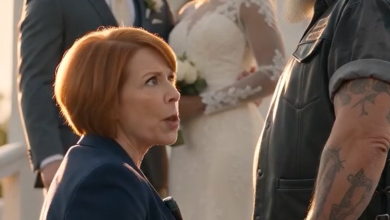
A GRAIN BUYER ORDERED FORTY BIKERS OFF AN INJURED FARMER’S LAND, THEN THEIR LEADER OPENED HIS SADDLEBAG AND THE FARMER REACHED FOR SOMETHING INSIDE
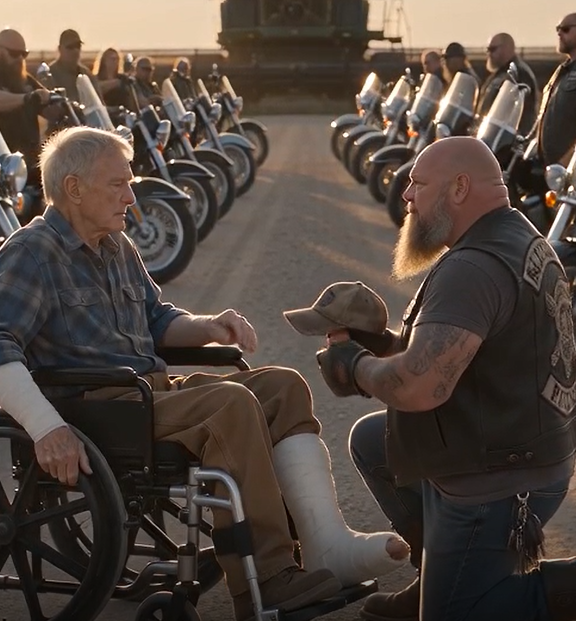
THE GRAIN BUYER ORDERED FORTY BIKERS OFF THE FARM. THEN THEIR LEADER KNELT BESIDE THE WHEELCHAIR AND HELD UP A BATTERED CAP.
On a Thursday morning in July, Ruth Bell wheeled her husband to the edge of their wheat field outside Hays, Kansas. She’d brought him coffee in a chipped mug because he was tired of drinking everything out of a cup with a lid. Earl had both legs in casts. Getting from the kitchen to the headland took them twelve minutes, and by the time they got there, the coffee was cold.
Glen Voss, the grain buyer, set a clipboard down hard across Earl’s lap. He’d been explaining what it meant to sell the wheat standing in the field. His crew would take care of the harvest. Earl would take whatever Glen offered that morning.
Then the motorcycles turned in.
They came slowly, forty of them, and parked along the gravel lane. Behind them came a pickup escorting a borrowed combine. Glen looked at the lead rider’s leather vest and the stitched wheat emblem on the back.
“Get these people off your land,” he told Earl. Then he turned to the rider. “This is a farm, not a place for you boys to play dress-up.”
The rider took off his helmet. He had a long gray-streaked beard, shaved hair, and the kind of tattooed hands Ruth would have guessed belonged to a man who made his living outdoors. He set his helmet on the seat of his cruiser. The other riders waited beside their bikes. Nobody touched a piece of equipment.
Ruth heard the wind move through the standing wheat. A few stalks leaned far enough across the field edge to brush Earl’s cast. She pushed them back with the side of her shoe.
Glen tapped the clipboard. “They’ll be gone when something breaks. My name is on the agreement.”
“So is mine,” Earl said. “And I haven’t signed it.”
Ruth felt Earl’s fingers tighten on the wheelchair rim. She’d heard him spend half the previous evening on the phone asking men he’d known for thirty years whether they could spare a combine. Each one had wheat of his own standing.
The lead rider walked only as far as the first row of stubble.
“Earl Bell?” he asked.
“That’s me.”
“Jack Turner. I saw your picture in the paper.”
Glen picked up the clipboard, leaving the pen across Earl’s knees. Jack went back to his cruiser and opened the saddlebag. Ruth expected a folded clipping. He drew out something soft, gray-green, and flattened on one side.
“Been carrying this around for four years,” he said.
He came back at a walk, stopped where Earl could see him, and lowered himself to one knee. Then he held up the cap. Its brim had split once and been stitched together with a crooked line of blue thread.
Earl looked at the stitches. His hand lifted off the wheelchair rim and reached toward the cap.
Part 2
Earl pinched the brim between his thumb and forefinger and turned it over.
“I thought I left this on a fence post,” he said.
“You left it at the hospital.”
Earl looked at Jack’s face. Then he looked down at the knee Jack had planted in the dirt.
“Which leg was it?”
“Left.”
“I told you to stop trying to stand on it.”
“I thought it was asleep.”
Earl laughed once, and his coffee mug rattled against the wheelchair arm. Ruth took it before it tipped. She had known Earl long enough to hear the difference between a laugh that came easy and one he used to give himself a second to think.
“You’re the man from the ditch,” he said.
Four years earlier, Jack had ridden off a county road where gravel had washed across a bend. His motorcycle slid into the ditch and pinned him against the bank. Earl heard him shouting from the field. He drove the tractor out, shut it down above the ditch, and went down on foot to see what was holding Jack there.
“I remember the chain,” Jack said. “I thought you were going to pull me with it.”
“Just the bike. You were loud enough already.”
Earl had moved the motorcycle clear while Jack stayed where he was. A neighbor brought towels and helped Earl get him into the pickup. They couldn’t get a call through at the ditch. The neighbor drove ahead until she got a signal and called for help. Earl drove the rest of the twenty-five miles to the hospital himself.
Ruth had heard about the accident that night, in the clipped account Earl gave her while he ate a cold pork chop at the kitchen counter. He’d said a man came off a motorcycle and needed a ride. He’d called it a ride the way he called going out for a part a trip into town. Ruth had looked at the clock, then at his plate, and asked whether she should warm it up.
“You waited there?” she asked now.
Jack looked at her. “Until I was out of surgery.”
Earl settled the cap onto his lap. “I told the nurse I’d wait until somebody came for him.”
“My brother was three hours away,” Jack said. “The nurse told me you’d been sitting in the same chair since they wheeled me back. I asked her what your name was. All she had was the cap.”
Ruth saw the crooked blue stitches and remembered making them. Earl had snagged the brim on a grain bin latch and asked her to sew it while she had the machine out. She’d done it by hand at the kitchen table. Blue was the color she could reach without getting up.
Glen cleared his throat. “I’m glad you found each other. I still need a decision before I send my crew to the next place.”
Ruth almost asked him to give them five minutes. She’d spent the previous night figuring out whether his offer would cover the operating note and leave enough to fix the combine. It wouldn’t do both. Five minutes would have been a request to put off saying what she already knew.
Jack got to his feet. He dusted his knee with one glove and looked back at the parked riders.
“Before you sign,” he said to Earl, “you ought to meet the woman who brought the combine. She’s got a question about your north field.”
Part 3
The woman came up the lane carrying a ring of keys and a paper map folded into quarters. Ruth recognized her as Mary Kline, whose farm was two townships over. She’d seen Mary at equipment auctions in a sun hat and work boots. She’d never seen her in a black leather vest.
“Where’s the old well?” Mary asked Earl.
“What old well?”
“The one you made my dad drive around when he helped your father.”
Earl squinted at her. Then he asked whose daughter she was. Mary told him and crouched so he could see the map. He put one finger down between a strip of trees and a corner of the field. Ruth had worked the books for twenty-six years. She couldn’t have told Mary there was a well there.
“I’ve got a cap over it,” Earl said. “You want to stay east of that line.”
Mary marked it with a pen. “That’s what I came for.”
Glen looked out at the combine. “You’re lending them that?”
“I’m running it. My brother’s bringing the second machine after lunch.”
Ruth had spent two days calling neighbors. The men she’d talked to had sounded genuinely sorry. One said he could maybe be there Saturday if his own field came in dry. Another had a machine down waiting on a belt. Mary explained that she and her brother had finished their first acreage the previous evening. They’d been expecting to spend Thursday moving equipment south. Jack had asked whether they could move it north first.
“How’d you even see the article?” Ruth asked him.
He pulled out his phone and showed her the photo she’d taken. She’d sent it to the weekly paper after Earl fell coming down from the combine and broke both legs. The editor had called to ask if they wanted a fundraiser link. Earl had said what he needed was help getting the wheat off. The editor put that in the second paragraph. Jack had seen it because the woman who handled dispatch at his repair shop sent him the story. Her sister rented ground nearby.
“She sent it because she thought I might know somebody with a machine,” he said. “I knew the face.”
“You called forty people overnight?”
“I called three. They knew who to call after that.”
A few of the riders, Ruth learned, made their living on farms. Two drove grain trucks for a local hauler. One woman had spent seventeen years dispatching road crews and had brought a legal pad to organize loads. Several had never been near a combine. Jack had asked them to handle water, meals, traffic at the gate, and errands for parts. The first pair who arrived with pickups had already gone to get a portable toilet.
Glen took Ruth aside, though everybody could still hear him.
“You can let them have a go at it,” he said. “But my offer goes away when I send my crew elsewhere. Think about which of us can put a number in your hands today.”
Ruth looked at Mary’s map. There was a ring around the old well. Mary had drawn it before anyone asked her to.
“How much of the crop would your crew take at the price you quoted?” Ruth asked Glen.
“All of it.”
She held out her hand for the clipboard. He gave it to her with the contract folded over the back. Ruth unfolded it all the way. There was another page tucked beneath the first one, held by the same clip.
“Then why,” she asked, “does this say we’d have to give you part of next year’s crop too?”
Part 4
Glen looked at the second page long enough for Ruth to know he could see the line.
“That only kicks in if the settlement comes up short.”
“The amount you told us this morning could come up short?”
“It’s an advance. The final amount depends on what we bring in.”
She read the paragraph again. There was a charge for bringing in the machines and a charge for hauling. If the grain came in below Glen’s estimate, his company could deduct the difference from wheat delivered the following year. He’d described it to Earl as a clean sale that ended when the field was empty.
“Did you think I’d read this after he signed?” she asked.
“I thought you wanted the crop off the ground.”
“We do.”
“Then I was giving you an option.”
Earl held out his hand. Ruth passed him the agreement. He laid it over the cap, leaving the blue seam showing below the bottom edge. He asked Glen who was doing the hauling. Glen named a carrier. Mary looked up from the map.
“That’s funny,” she said. “His two drivers are standing by the gate. I asked them what they were hauling this week. Nobody told them they were hauling for you.”
Glen said his scheduler would have lined up the trucks after he had the signed agreement. Ruth believed him. She also believed he’d meant them to picture his machines and drivers already waiting to go while their own chances ran out. He’d said it twice that morning, once while Earl was still at the kitchen table struggling to get his footrests adjusted.
“Take the papers,” Earl said.
Glen did. His face had gone pink across the cheeks. He looked at the riders again, then at Ruth.
“Call me when the first machine breaks.”
He left in his pickup. Dust hung low enough along the lane that Ruth could see boots through it before she could see faces.
Mary waited until the truck reached the road. “You still have a grain buyer at the elevator?”
“If they’ll take it.”
“Call and ask what they need from us.”
Ruth made the call from the kitchen so she could get to her records. The elevator had room if the first trucks came in that afternoon. It would take the crop on the Bells’ existing account and issue tickets in their name. When Ruth came back out, a retired driver named Don had set up a folding table by the field edge. He had a pencil, an old ruler, and four clean envelopes so she could keep the loads separated by day.
“Your farm?” he asked.
“Mine and Earl’s.”
“Then I’ll hand the tickets to you.”
Ruth stood there with the empty envelopes for a minute. She’d been bracing herself to hand over the only part of the farm that could pay for the rest. Now she had to decide which drawer to put the receipts in.
By midafternoon, Mary had the combine running. Jack stayed clear while she made the first pass, then brought Earl a chair cushion from the pickup. Ruth noticed he asked before he bent to help. Earl said he was fine. Jack put the cushion on an empty folding chair and waited. A few minutes later Earl asked him to bring it back.
The first truck left for the elevator just before four. Earl watched the tailgate all the way to the road. Then he asked Ruth whether she remembered the year the west strip started sprouting in the head.
She did. She’d gone over those figures until she could see the numbers with her eyes shut.
“That was the year the rain got ahead of us,” she said.
Earl turned the cap over in his hands. “The rain got ahead of me the day I took Jack to the hospital.”
Part 5
Ruth remembered three wet days and Earl coming inside in socks because he’d left his muddy boots by the propane tank. She remembered the grain sample the buyer rolled between his fingers and the way he’d set it down before he told them what he could pay. She’d known what the weather cost them. She hadn’t known where Earl had been on the last dry afternoon.
“You said you were near done when you heard him,” she said.
“I was near done with the pass I was on.”
“How much was still standing?”
“The west strip and most of the bottom.”
That was about a third of the crop. The wheat from those acres had come in too damaged for the price they’d planned on. Some had gone as feed. Some had cost more to bring in than it fetched. They’d paid off the difference across two seasons. Ruth had taken extra shifts at the school kitchen and told Earl she liked having somewhere to be on Fridays.
“Why didn’t you tell me?” she asked.
Earl looked at the cap. “It sounded like I was putting a price on him.”
“You could’ve told me where you were.”
“I could have.”
Jack was at the table with Don, checking where the next truck was supposed to go. He came over when Ruth said his name. She watched Earl think about whether to ask him to sit. There was an empty folding chair beside them. Earl finally hooked his thumb toward it.
“The rain cost us part of the crop that year,” Earl said.
Jack sat. His eyes moved to Ruth and back to Earl. “How much?”
“About a third.”
Jack kept his elbows on his knees. Ruth could see the crease in one leather glove where he’d folded it backward and stuck it into his pocket.
“You could have left me with the nurse,” he said.
Earl nodded. “I could’ve.”
“Why didn’t you?”
“You asked me if I’d be there when you woke up. You probably don’t remember it.”
Jack opened his mouth, then closed it. He sat still for long enough that Ruth thought he might have heard a truck on the road. What she could hear was Mary’s combine turning at the far end.
“I remember asking somebody,” he said finally. “I thought it was my brother.”
Earl put the cap on. It sat too high on his head, bent out of shape from all that time in the saddlebag.
Ruth started crying when he tried to straighten the brim. She’d expected to feel angry for longer than she did. Mostly she was remembering the sandwich she’d made him to take to the field that morning four years ago. She could see it in the truck cooler, wrapped in wax paper, and Earl in a hospital chair until after dark with nobody there who knew his name.
“Did you eat that day?” she asked.
“Your sandwich in the parking lot.”
“Good.”
She went back to the table and got the first elevator ticket. Earl took it, studied the grade and weight, and handed it to Jack. Jack read it carefully and passed it back. There was a smudge on the corner from Ruth’s thumb.
Mary’s brother arrived with the second combine near supper. Ruth had already called the elevator to say there would be more trucks in the morning. She was about to call their lender too when Mary came in from the north field holding a handful of kernels.
“We can finish,” Mary said. “But I need you both to look at where I’m stopping tonight.”
Part 6
Mary led Ruth to the low end of the field. Earl came in his wheelchair as far as the firm ground, then asked them to bring a sample back to him. The heads in the low corner were heavier and greener than the wheat on the rise. They’d dry, Mary said, but they needed more time. If the crew took them that evening, the elevator might dock the load hard enough to undo a day’s good work.
“How much time?” Ruth asked.
“Let’s see tomorrow afternoon.”
They looked at the sky. Ruth knew there was rain in the forecast for the following week. She’d stopped trusting the hour printed on her phone because it moved every time she opened it.
“Do the high ground first,” Earl said.
Mary looked at him. “Then if we lose a day, we lose a day on the lowest-value ground.”
Earl nodded. Ruth had heard him talk through harvest decisions for years. This was the first one he’d made from a chair at the edge of a field while another person held the keys. On the way back to the house he asked twice whether they were in anybody’s way. Ruth told him where the truck lane was and let him decide where he wanted to sit.
They worked for six days. Each morning Ruth set out the envelopes and filled a cooler with ice. The forty riders had arrived together, but they worked in shifts. Some left their motorcycles at home after the first day and came back in pickups. The people who knew the machinery operated it. The others brought meals, checked in trucks, fetched parts, and cleared the gate between loads. One rider kept a pair of hand sickles in his truck. He used them with Ruth to cut sample heads along the edge before Mary tested the moisture.
On the third day the smaller combine quit feeding wheat. Mary shut it down. Jack and the operator checked it while the riders waited at the folding table. Ruth remembered what Glen had said about people leaving when something broke. Three of them did leave. One went to get the right part, one drove a load to the elevator, and one took Earl back to the house because he’d missed lunch and his legs were hurting.
By supper the machine was working. Jack found Earl on the porch with a bag of frozen peas over one knee and a book open facedown on his stomach.
“You want the number?” Jack asked.
“On the repair?”
“On the loads.”
Earl pushed the book aside. Ruth came out with the tickets and watched them add the weights against the back of an envelope. She could smell the machine oil on Jack’s shirt. Earl had taken to calling him Sprocket, the name the riders used, although he always called him Jack when the conversation mattered.
That evening the lender called Ruth back. If the last trucks came in at the same grade as the first ones, there would be enough to bring the operating note current. They’d have to talk about the combine repair separately. Ruth wrote the numbers on the kitchen calendar where Earl could see them without asking.
On the fifth morning, Mary tested the low strip again. She brought the sample to the folding table and put it in Earl’s hand.
“It’ll go,” she said. “I just need one thing before I send the trucks in there.”
She laid the map across his knees. A grain truck had sunk to the axle in that corner once, twenty years earlier. Earl stared at the lines, then tapped a faint track that Ruth had taken for a fold.
“Ask Jack to come here,” he said. “I want him to see how we get out.”
Part 7
Jack bent over the map. Earl traced the track with one finger, stopping when the line reached the creek.
“The old lane comes out behind the cottonwoods,” he said. “The ground holds better there.”
Jack carried two marking flags out to the turn, walked back, and asked Mary to look at it with him. Ruth watched from the folding table. Four years earlier Earl had come out of a field to get Jack out of a ditch. Now he was still telling him which ground would carry a truck. She could hear the two of them call back and forth over the wheat, short questions and shorter answers.
The low ground took the rest of that day and most of the next one. The last truck left just before supper on day six. Nobody sounded a horn. Don crossed out the final line on his pad. Mary climbed down from the combine with a sandwich bag full of sunflower seed shells and asked Ruth where she could throw it away.
“Did you leave anything?” Earl asked her.
“A strip around the well.”
“That can stay.”
Ruth carried the folding table in while Jack helped Earl over the threshold. They waited at the kitchen table for the final ticket. It came as a photograph from the driver. Ruth enlarged it until she could read the numbers and checked them against the envelope in front of her.
“We’ve got it,” she said.
Earl asked her how much was left to pay on the operating note. She told him. Then she told him what they had left after that. He looked at the figures without saying anything. Ruth knew he was going over all the places that money had already been promised. The combine repair. A set of tires. The bathroom doorway they would have to widen if he was going to stay in the chair a while longer. They still had things to work out. They had a crop to pay for them.
Rain started while she was rinsing coffee mugs. It hit the metal awning in separate drops, then came hard enough that they couldn’t hear the television from the kitchen. Earl asked her to open the back door. She did. They sat listening to rain fall on stubble.
The following morning, Glen called to ask whether the Bells wanted a bid for any of the grain they hadn’t sold. Ruth told him the crop was accounted for. She asked him to send written confirmation that the standing-crop offer had expired and that there was no agreement on the following year’s wheat. His office emailed it that afternoon. Ruth printed the page and filed it with the unsigned copy. The next season she invited two other buyers to bid. She didn’t call Glen.
Jack came by at the end of the week to return a grease gun he’d borrowed. Earl was at the table making a list of the riders. Ruth figured he meant to send them notes. Then she saw he’d written brisket at the top of the page and drawn a line under it twice.
“You can’t stand at the smoker yet,” she said.
“I can sit by the smoker.”
Jack picked up the list. “You missed the woman who brought the portable toilet.”
“I didn’t know her name.”
“Donna. She got the last one the rental place had.”
Earl added her. Then he asked Jack what the club did when somebody else in the county had a harvest they couldn’t get in.
Jack set the grease gun down. “So far,” he said, “we’ve waited until somebody made the paper.”
Part 8
Ruth put a clean sheet of paper beside Earl’s barbecue list. Jack wrote down the people who had lent equipment and the ones who knew how to run it. Earl added two names Jack didn’t know. Ruth put Donna at the top because somebody was going to have to answer the phone while everybody else was out in a field.
They called it the county’s emergency harvest crew. It started with a phone tree and a list of people who could commit to half a day at short notice. Ruth kept a separate column for the people who could deliver meals or sit with a spouse during a hospital appointment. There had been afternoons during Earl’s recovery when she would have given anything for one person who could stay at the house while she went for parts.
A few months later, the first call came from a woman whose husband had been admitted to the hospital during milo harvest. She wanted help getting two fields in. When Ruth asked which one mattered first, the woman said neither of them did until somebody moved the cattle out of the road pasture. Earl took the map from Ruth and asked for the name of the neighbor who knew the cattle. They were behind a gate before anyone sent for a combine.
Over the following seasons the crew helped eleven farms. Some needed a day. One needed three trucks for a single afternoon. Mary still asked for a map before she went into a field she hadn’t worked. Jack still checked that the crop tickets went to the farmer. Donna kept a spare pencil in the truck because Earl had once spent ten minutes looking for the one tucked in the band of his cap.
The riders came back to the Bell place every wheat harvest. Earl eventually got out of the wheelchair and could walk across the yard with a cane. When he tired, he’d sit at the smoker and tell whoever was helping him that they had the lid open too long. He made enough barbecue for forty the first year. The second year Ruth made him count the people who had lent trucks and combines too.
One July evening Jack arrived late. A belt had come off a mower at the shop, and by the time he’d washed up, all the folding chairs in the shade were taken. He stood beside the porch eating off a paper plate until Earl pointed to an upside-down bucket near the smoker.
“That one’s yours,” Earl said.
Jack sat. Ruth came out with a jug of iced tea and saw Earl take off the gray-green cap. The stitches were starting to pull through the old fabric. He had found a spool of blue thread in the kitchen drawer that morning and put it beside her coffee cup without saying a word.
“You want me to fix the brim again?” she asked.
“Whenever you get to it.”
She took the cap inside. Through the screen she could hear Jack asking Earl how much longer before the next batch came off. Earl said it depended how often people opened the lid. There was a pause, then the soft sound of the smoker shutting.
Ruth sat at the kitchen table and threaded the needle. She put the first new stitch through an old hole.
Follow the page for more stories like Earl and Jack’s.