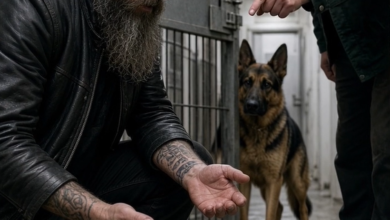
The Boy Was Bullied for Wearing Old Clothes — Until “The Biker” Walked Into the Parent Meeting
They laughed at his clothes again—not because they were dirty, but because they were old, faded, and reminded everyone how easy it is to choose a target.
The boy sat at the edge of the classroom, shoulders slightly hunched, hands folded tight in his lap. His shirt had once been blue. Now it was something between gray and washed-out sky, soft at the elbows, frayed just enough to be noticed.
The other kids noticed.
They always did.
A snicker came from the back row.
Then another.
“Did you wear that yesterday too?” someone whispered, loud enough to land.
The boy kept his eyes down. He had learned that looking up only made it worse.
At recess, it followed him outside. The same voices. The same pointing. One kid tugged lightly at the hem of his jacket and laughed.
“My dad says poor people shouldn’t complain,” the kid said, grinning.
The teacher saw it happen.
She sighed.
“Alright, that’s enough,” she said, clapping her hands once. “Everyone line up.”
Enough.
The word sounded helpful. It wasn’t.
By the end of the week, the boy had stopped raising his hand. Stopped asking questions. He ate lunch quickly, alone, careful not to take up space.
At home, his mother noticed the change immediately.
He didn’t complain.
Didn’t cry.
He just folded his clothes more carefully than before.
On Friday afternoon, a note went home.
Parent–Teacher Meeting. Mandatory Attendance.
The boy read it once, then folded it neatly and placed it on the kitchen counter, face down.
He didn’t ask who would come.
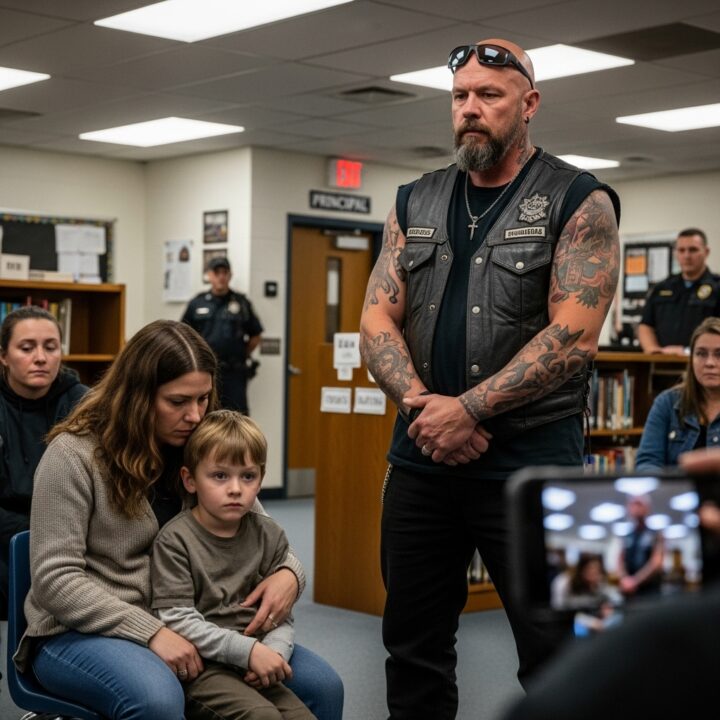
The meeting was held in the school library.
Long tables pushed together. Plastic chairs arranged in uneven rows. Posters about kindness taped crookedly on the walls, their bright colors at odds with the tension already settling in the room.
Parents filtered in slowly.
Some chatted. Some scrolled. Some wore expressions sharpened by long workdays and short patience.
The boy sat beside his mother, feet not quite touching the floor. She wore a simple cardigan, hands clasped tightly, eyes scanning the room as if looking for danger.
Then the door opened.
The conversation dipped.
A man stepped inside.
He was big—not towering, but solid. Sleeveless black shirt. Faded jeans. Heavy boots. Tattoos wrapped around both arms like something permanent and unfinished. A leather vest hung open, worn smooth by time.
A biker.
The room reacted before he spoke.
Chairs shifted.
Eyes narrowed.
Whispers bloomed.
“Is he in the right place?”
“Whose parent is that?”
“Why would he wear that here?”
The biker didn’t look around.
He scanned the room once, found an empty chair at the back, and sat down. Back straight. Hands resting calmly on his thighs. Sunglasses pushed up on his head.
The teacher froze for half a second before continuing.
“We’re here to address concerns about classroom behavior,” she said carefully. “Specifically… repeated incidents of teasing.”
A few parents nodded.
The boy felt his chest tighten.
“And clothing-related comments,” the teacher added.
The room grew uncomfortable.
One parent laughed softly. “Kids tease. That’s life.”
Another shrugged. “Maybe he should try fitting in more.”
The biker lifted his head.
“Who are we talking about?” he asked.
His voice wasn’t loud.
That made it worse.
The teacher hesitated. “Your… child?”
The biker looked down the table.
That’s when the boy realized something.
The biker wasn’t looking at him.
He was looking at his mother.
The room followed his gaze.
“Oh,” someone muttered.
The teacher cleared her throat. “You’re… family?”
The biker nodded once. “I’m his uncle.”
A pause.
The boy’s heart began to pound.
The teacher gestured politely. “We appreciate you coming. We were just discussing how—”
“How he’s being treated,” the biker said.
A few parents shifted.
“Well,” a man across the table said, leaning back, “kids notice differences. Maybe if—”
The biker leaned forward slightly.
Just slightly.
The room reacted as if he’d stood up.
A chair scraped.
Someone whispered, “Easy.”
The teacher raised her hand quickly. “Sir, please—”
“He’s being bullied,” the biker said. Calm. Flat. “Because he wears old clothes.”
Silence dropped hard.
“That’s a strong word,” the man said defensively. “Nobody’s hurting him.”
The biker’s jaw tightened.
“He comes home quiet,” he said. “That’s how I know.”
The room felt smaller now.
Phones came out.
A woman near the door murmured, “Should we call security?”
The biker noticed.
He leaned back again.
Hands open.
“I’m not here to cause trouble,” he said.
No one believed him.
The principal entered halfway through the discussion.
She took in the scene in seconds: the biker at the back, the tense parents, the boy shrinking into his chair.
“What’s going on?” she asked.
The teacher spoke quickly. “We’re addressing concerns about bullying.”
“And intimidation,” a parent added, glancing pointedly at the biker.
The principal’s eyes narrowed slightly. “Intimidation?”
The biker didn’t move.
The boy’s mother finally spoke. Her voice shook. “My son is being mocked every day.”
“Well,” another parent said, arms crossed, “maybe if he dressed more appropriately—”
The biker stood up.
Slowly.
Every movement controlled.
The room erupted.
“Sit down!”
“Don’t!”
“Someone call security!”
The principal stepped forward. “Sir, I’m going to need you to—”
“I’m standing,” the biker said quietly. “Not touching anyone.”
He was right.
But fear doesn’t wait for facts.
Security was already being waved over from the hallway.
The boy’s hands began to shake.
The biker looked down at him.
“Hey,” he said softly. “It’s okay.”
That made it worse.
Security entered. Two men. Uncertain. Watching the biker’s hands.
The principal spoke firmly. “Sir, if you don’t leave, we’ll have to—”
The biker reached into his vest.
Gasps.
A mother pulled her child closer.
The security guards tensed.
The biker pulled out his phone.
“I’m calling someone,” he said calmly.
“To who?” the principal demanded.
The biker didn’t answer.
He typed slowly. Deliberately. Like someone choosing the exact right moment.
The room waited.
Breathing shallow.
Eyes locked.
The boy stared at the floor.
The biker finished typing and slipped the phone back into his vest.
He looked up.
“You should hear what they have to say,” he said.
Outside the library, footsteps approached.
More than one pair.
And in that moment, everyone in the room realized the situation had already gone further than they could control.
The sound came before the explanation.
Footsteps.
Not hurried.
Not heavy.
Measured.
They echoed down the hallway outside the library—more than one pair, steady enough to feel intentional. Conversations inside the room slowed, then stopped entirely. Even the security guards glanced toward the door.
The biker didn’t turn around.
He stood where he was, shoulders square, hands relaxed at his sides, as if he had already calculated the distance between himself and everyone else in the room. He didn’t look like someone waiting to be rescued. He looked like someone who had prepared for this moment.
The door opened.
A man in a navy blazer stepped inside first. Late forties. Calm eyes. The kind of posture that suggested he didn’t raise his voice often—and didn’t need to. Behind him came a woman with a tablet tucked under her arm, then another man wearing a school district badge.
The principal’s expression shifted instantly.
“Mr. Alvarez?” she said, surprised. “I didn’t expect—”
“I got the message,” the man said, nodding once. His voice was even, controlled. He scanned the room quickly, taking in the security guards, the biker, the boy, the parents frozen mid-judgment.
He stopped when his eyes reached the boy.
“Is this him?” he asked quietly.
The biker nodded.
The man in the blazer turned back to the principal. “You said there was an incident involving repeated harassment.”
The principal cleared her throat. “We were in the middle of addressing—”
“Addressing or minimizing?” the man asked, not unkindly.
A ripple moved through the parents.
The woman with the tablet stepped forward. “We’ve received three written reports this semester,” she said calmly. “All involving clothing-related bullying toward the same student.”
She tapped the screen once and turned it toward the table.
Silence deepened.
“That’s… not the full context,” a parent muttered.
The man in the blazer looked at him. “It rarely is, from the outside.”
He turned to the biker for the first time. “You’re his uncle.”
“Yes,” the biker said.
“You reached out because you felt this meeting wasn’t being handled safely,” the man continued.
The biker didn’t nod. Didn’t confirm.
He simply said, “I didn’t want him blamed again.”
The boy’s chest tightened.
The man in the blazer absorbed that. Then he turned to the room.
“We’re not here to escalate,” he said. “We’re here to correct.”
One of the security guards relaxed his stance slightly.
The principal folded her hands. “What exactly are you suggesting?”
The man glanced at the boy again. “That we listen to the person this is actually happening to.”
Every head turned.
The boy froze.
His mother’s hand found his knee, trembling.
The biker didn’t look at him. He stared straight ahead, jaw set, giving the boy the space to choose.
The man in the blazer crouched slightly so he was closer to the boy’s eye level. “You don’t have to say anything,” he said gently. “But if you want to, we’re listening.”
The room waited.
The boy swallowed.
“They call me ‘hand-me-down,’” he said finally, voice barely above a whisper. “They say I smell like thrift stores.”
A parent shifted uncomfortably.
“They hide my backpack,” he continued. “And when I tell the teacher… they stop for that day.”
His hands twisted together. “Then it starts again.”
No one interrupted.
The man in the blazer stood slowly.
“That’s enough,” he said—not loud, but final.
The truth didn’t land with a speech.
It landed with consequences.
The principal nodded once, stiffly. “We’ll review disciplinary action.”
“You’ll do more than review,” the man in the blazer replied. “You’ll implement.”
He turned to the parents. “Bullying doesn’t require bruises. It requires permission. And today, permission was given.”
No one argued.
No one could.
The meeting ended quietly after that.
Parents stood, gathered their things, avoided eye contact. A few offered apologies that sounded rehearsed. Others said nothing at all.
The biker didn’t respond to any of it.
He waited until the room was nearly empty before kneeling in front of the boy.
“You did good,” he said softly.
The boy nodded, unsure what to do with the words.
Outside, the late afternoon sun hung low over the parking lot. The biker walked beside the boy, not ahead of him, not behind. Just there.
As they reached the car, the boy looked up. “Are they going to stop?”
The biker paused.
“They’ll try,” he said. “And if they forget—people will remind them.”
The boy considered that.
Inside the building, the library lights dimmed as staff locked up for the evening. On the table where the parents had sat, a single folded note remained, left behind in the rush.
Kindness is not a dress code.
No one ever admitted who wrote it.
But the next Monday, the boy walked into school wearing the same faded shirt.
And no one laughed.
Not because the world had suddenly become kind—
but because someone had finally refused to look away.