A Little Girl Drew a Lipstick Heart Across a Biker’s Scarred Face in Court—Then the Jury Learned Why He Refused to Wipe It Off
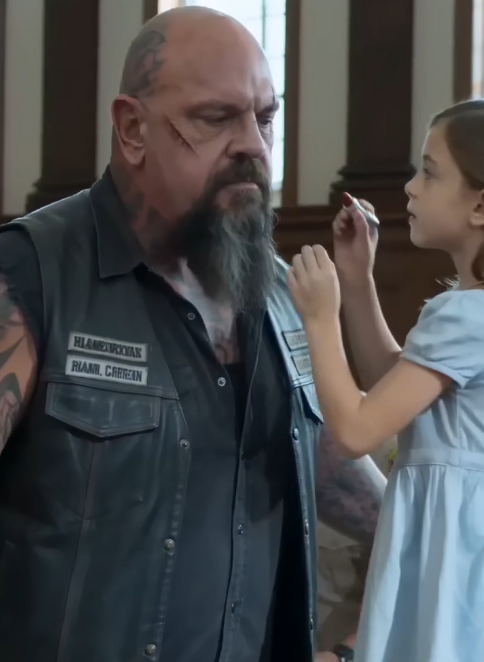
The little girl climbed over the courtroom rail, pressed red lipstick against the biker’s scarred cheek, and began drawing a crooked heart while two guards rushed forward—yet the enormous man never raised a hand to stop her.
I was sitting ten feet away when it happened.
My name is Lena Ortiz. I was thirty-eight that winter, working as a victim advocate at the Coconino County courthouse in Flagstaff, Arizona, and I had spent three months preparing eight-year-old Ellie Harper to testify without ever promising her that the room would feel safe.
Courtrooms rarely do.
They smell like old paper, burnt coffee, damp wool, and the lemon cleaner custodians use before dawn. Every cough sounds guilty. Every chair leg scraping the floor makes someone turn. Even whispers seem to climb the walls and wait beneath the ceiling.
Ray “Hammer” Dawson looked like the last person a frightened child should have approached.
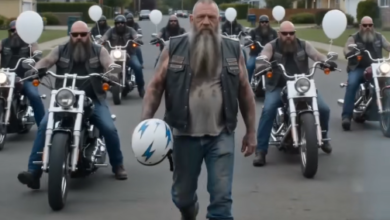
He was fifty-six, six-foot-four, and close to 285 pounds, with a shaved head, a thick black-and-gray beard, tattooed forearms, scarred knuckles, and a plain black leather cut stretched across shoulders wide enough to block a doorway. Three fresh scars crossed the left side of his face—one beginning near his temple, another cutting through his eyebrow, and the deepest running down his cheek toward the corner of his mouth.
People stared at those scars.
Ellie stared through them.
Hammer was seated behind the prosecution table because the judge had not yet called him to testify. His motorcycle boots were planted squarely beneath his knees, his hands remained open on his thighs, and his midnight-blue Harley waited outside beneath a thin crust of February snow.
Across the aisle sat Calvin Rusk, the man accused of taking Ellie from a roadside diner seventy-three days earlier.
Rusk wore a charcoal suit, polished shoes, and the mild expression of a Sunday-school treasurer. Nothing about him suggested the white cargo van, the plastic restraints found beneath its passenger seat, or the deserted weigh station where Ellie had finally been recovered.
That was the problem.
Hammer looked dangerous.
Rusk looked reasonable.
When Ellie entered the courtroom with me, she did not look toward the defendant. She fixed her eyes on the floor and counted the brass strips between the tiles, just as her therapist had taught her.
One.
Two.
Three.
At the fourth strip, she stopped.
Hammer’s boots stood directly ahead of her.
He leaned away to give her room, but Ellie lifted her face and saw the scars. Her breathing changed. I reached for her hand, expecting her to retreat.
Instead, she opened the small plastic purse hanging from her shoulder.
She removed a tube of bright red lipstick.
Then she climbed over the rail.
The bailiff moved first. A second guard came from beside the jury box. Rusk’s attorney stood and objected before the child had even touched Hammer.
“Miss Harper,” I called, trying not to frighten her.
Hammer did not move.
Ellie placed one small hand against his beard, twisted the lipstick upward, and drew the first curved line across the scar beneath his eye. The lipstick caught in the rough tissue. She pressed harder, completing a trembling heart that covered half his cheek.
The room erupted in whispers.
“Step away from him,” the bailiff ordered.
Hammer slowly lifted both hands where everyone could see them.
“Don’t grab her,” he said.
His voice was low, worn down by cigarettes and winter roads. It was the first time the jury heard him speak, and several people stiffened.
Ellie drew another small line over the scar beside his mouth.
The judge called for order. Rusk’s attorney demanded that the jury be removed, arguing that the display was staged to create sympathy. A deputy reached for Ellie’s shoulder.
She flinched so hard the lipstick fell.
Hammer caught it before it struck the floor.
Then Ellie said seven words that silenced every person in Courtroom Three.
“I’m marking the face that covered mine.”
Rusk stopped smiling.
Hammer returned the lipstick to her, but he did not wipe away the heart. Not when the judge sent the jury out. Not when the prosecutor told him the mark might make him appear theatrical. Not when his own attorney warned that Rusk’s defense would use it against him.
He wore that crooked red heart through every question.
He wore it while the defense called him a violent felon.
He wore it when photographs of the deserted weigh station appeared on the screen.
He wore it when Ellie finally described the sound of metal striking bone in the darkness, and when the courtroom learned that Hammer’s face had not always carried those scars.
But the jurors still had not heard why a biker with a criminal record had followed a white van for thirty-eight miles, why three members of his own club had initially lied about where he had been, or what Ellie had whispered beneath his leather vest while another man tried to pull him away.
Then Rusk’s attorney displayed a photograph no one on our side had seen.
It showed Hammer standing beside the kidnapper’s van hours before Ellie disappeared.
Want to know why Hammer had already approached that van and what Ellie hid inside his vest after he found her? Drop HEART in the comments—I’ll share more soon.
Part 2 — The Child Who Counted Every Door
Ellie Harper had learned to count exits before she learned long division.
The habit began after her father, Daniel, died in a winter collision on Interstate 40. She had been six. Her mother, Claire, began taking Ellie to a grief counselor after the girl stopped entering rooms unless she knew another way out.
At restaurants, Ellie counted doors.
At school, she sat beside windows.
In my courthouse office, she chose the chair facing the hallway and asked whether the narrow door behind my desk opened from both sides. I told her the truth: it led to a storage closet.
“Then it doesn’t count,” she said.
Claire worked mornings at the Juniper Bell Diner, a low stone building outside Flagstaff where Route 66 curved past a shuttered tire shop and an abandoned motel with half its neon letters missing. She sometimes brought Ellie to the diner before school when the babysitter canceled.
That was where Calvin Rusk first noticed her.
He had been coming in every Wednesday for nearly two months. He ordered black coffee, two eggs over medium, dry wheat toast, and a side of bacon he never finished. He told Claire he serviced medical equipment across northern Arizona and needed quiet places to complete paperwork.
He tipped well.
He remembered names.
He once repaired the loose wheel on Ellie’s backpack with a screwdriver from his van.
People later treated those details like warnings. They were not. They were ordinary fragments arranged by hindsight into something sinister, the way broken glass can look like a pattern only after blood reaches it.
Hammer noticed Rusk for a different reason.
Every Wednesday, the Iron Lanterns met at the Juniper Bell before riding north to deliver groceries and propane vouchers to older residents along Highway 89. They were not an outlaw club, though strangers often decided otherwise after seeing twelve Harleys, black leather cuts, tattooed necks, chain wallets, and boots carrying red mud across the diner floor.
Most of the Lanterns were mechanics, veterans, linemen, welders, paramedics, and retired firefighters. Hammer ran a small motorcycle repair shop behind a tire warehouse in Flagstaff. He charged strangers full price and people in trouble whatever they could pay.
Sometimes that meant nothing.
He had a record. The defense would later make certain the jury knew every line of it.
At twenty-nine, Hammer had served three years for aggravated assault after nearly killing a man during a bar fight in Kingman. He never claimed innocence. He had been drunk, angry, and strong enough to do permanent damage before anyone could pull him away.
Prison removed the drinking.
It did not remove the anger.
For years, he controlled it with routine: open the garage at six, coffee from the same dented thermos, engines first, arguments later. Every Thursday evening, he taught basic motorcycle repair to teenagers referred by a youth shelter. Every Sunday, he rode forty miles to visit his older brother in a veterans’ care home.
The club knew when Hammer’s anger was rising because he became quieter.
On the Wednesday before Ellie vanished, he noticed Rusk photographing the parking lot.
Rusk claimed he was documenting damage to his company van. Hammer accepted that until he saw the camera angle. The lens was not pointed toward the dent in the rear door.
It was pointed toward Ellie.
Hammer walked outside.
That became the photograph Rusk’s attorney later displayed in court: Hammer beside the white van, one fist resting against its door, his scarless face inches from Rusk’s.
The image had been captured by the diner’s rear security camera. Without sound, it looked like intimidation.
The conversation lasted less than thirty seconds.
“You taking pictures of the kid?” Hammer asked.
Rusk smiled. “I’m taking pictures of my vehicle.”
“Then keep her out of them.”
“You her father?”
“No.”
“Then mind your business.”
Hammer looked through the passenger window. A coil of orange extension cable lay on the floor beside a folded moving blanket. Nothing appeared illegal. Nothing gave him a right to open the door.
So he stepped away.
That decision lived inside him afterward.
He told Claire what he had seen. She checked Rusk’s phone when he returned to pay and found photographs of the van’s dent. Ellie appeared in the background of one image, blurred and partially blocked by a gas pump.
Claire believed him.
So did the deputy who took Hammer’s nonemergency report. Photographing a public parking lot was not a crime. The deputy wrote down Rusk’s license plate and told Hammer to call if the man returned.
Rusk did not return the next Wednesday.
He came on Friday.
Snow had begun falling before noon. The school released students early, and Claire’s neighbor brought Ellie to the diner because Claire could not leave her shift. At 2:17 p.m., a plumbing line burst behind the kitchen. Claire went outside with the manager to shut off the water.
Ellie remained in booth seven with a coloring book.
When Claire returned four minutes later, the booth was empty.
A red crayon lay on the table.
The side door stood open.
No one had seen Ellie leave, but a delivery driver remembered a white van pulling away without headlights. Claire called 911. The sheriff’s office issued an alert. Patrol cars sealed the highway exits while volunteers searched bathrooms, dumpsters, drainage ditches, and the abandoned motel across the road.
Hammer heard the alert through a mechanic’s radio at his shop.
He recognized the van description.
The Iron Lanterns were preparing for their grocery ride. Eleven engines had already begun warming behind the garage, the V-twin rumble shaking snow from the corrugated roof.
Hammer killed every engine with one raised hand.
Then he gave the club Rusk’s plate number.
“Find the van,” he said. “Nobody touches the driver.”
The last instruction mattered.
Hammer knew what people expected from men wearing leather. He also knew what anger could destroy. If the club found Rusk first and turned the roadside into a beating, evidence could disappear, witnesses could become suspects, and Ellie could be hurt in the confusion.
The Lanterns divided the highways into sectors. Boone Carter took Interstate 40 west. Mack and Cody checked gas stations east toward Winslow. Hammer rode north along Highway 89 because Rusk had once mentioned servicing clinics near Page.
Forty minutes passed.
Then a trucker reported a white cargo van entering an old weigh station that had been closed for six years.
Hammer was fourteen miles away.
The sheriff’s nearest unit was twenty-three.
He opened the throttle.
Part 3 — Thirty-Eight Miles Behind the White Van
The snow turned sharp beyond the city limit, striking Hammer’s visor like thrown sand. Highway 89 climbed through dark pines before opening into bare country where the wind swept powder across the asphalt in pale moving sheets.
Hammer saw the van near mile marker 432.
It was traveling below the speed limit, drifting toward the shoulder whenever another vehicle approached from behind. The rear windows had been painted white from the inside. One taillight flickered.
Hammer did not pull alongside it.
He stayed six car lengths back and called dispatch through the headset inside his helmet. He gave the plate, location, direction, and road conditions. The dispatcher ordered him not to intervene.
“Understood,” he said.
He continued following.
Rusk accelerated. Hammer matched him without closing the distance. The van passed the road leading to the closed weigh station, braked abruptly, then cut across the opposite lane and turned through the exit.
Hammer rode past.
That saved Ellie’s life.
Had he followed immediately, Rusk would have known he had been tracked. Instead, Hammer continued nearly half a mile, disappeared around a bend, then turned into a maintenance pullout and came back with his headlight off.
By the time he reached the weigh station, the van was parked behind the ruined inspection building. No tire tracks left the opposite entrance. Rusk was still there.
Hammer stopped on the access road and waited for sirens.
None came.
He heard something else.
Three short strikes against metal.
Pause.
Three more.
The sound came from inside the van.
Hammer told dispatch he could hear a possible signal from the victim. The dispatcher repeated that deputies were eleven minutes away.
Then the van’s engine started.
Hammer had seconds.
He rode his Harley across the narrow exit and laid the motorcycle sideways on its crash bars. Nearly eight hundred pounds of steel blocked the only clear path back to the highway. The engine continued running, its low mechanical pulse filling the empty station.
Rusk stepped from the driver’s door.
He held nothing in his hands. That fact would later become important because the defense repeatedly showed the jury the first thirty seconds of Hammer’s helmet camera, when Rusk appeared unarmed and Hammer appeared to be the aggressor.
“You followed me,” Rusk said.
Hammer remained beside the motorcycle. “Open the back.”
“This is harassment.”
“Kid’s in there.”
“You’re insane.”
Three knocks came from inside the van.
Rusk glanced over his shoulder.
Hammer moved.
Rusk reached the rear door first and pulled something from beneath the bumper. It was not a gun. It was a short steel tire tool, the kind used to remove lug nuts. He swung once. Hammer raised his left arm and took the strike near his wrist.
Bone cracked.
Hammer did not go down.
He drove his shoulder into Rusk and pinned him against the van, but Rusk twisted free, ran to the driver’s door, and climbed inside. The engine screamed. The van lurched backward toward the loading ramp.
Hammer grabbed the rear handle.
The door was locked. He struck the small window with his gloved fist. It did not break. He drew the heavy flashlight from his belt and hit the glass again.
The pane shattered inward.
Ellie screamed.
Hammer reached through, opened the latch, and pulled the door wide. The cargo space was dark except for a strip of winter light. Ellie lay behind the passenger seat with one wrist secured by a plastic restraint. A moving blanket covered her legs.
Rusk came through the side door before Hammer could reach her.
The tire tool struck Hammer across the shoulder. A second blow hit the back of his helmet. Hammer collapsed halfway inside the van, one knee on the bumper and both hands braced against the floor.
Ellie crawled toward him.
“Under me,” he told her.
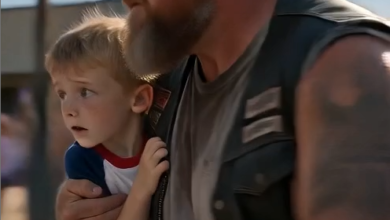
She moved beneath his chest, folding herself between the wheel housing and his body. Hammer pulled open his leather cut and wrapped both sides around her head like a curtain.
Darkness covered her.
Rusk grabbed the back of Hammer’s vest and pulled. The leather creaked but held. Hammer locked his elbows against the van floor, turning his body into a roof over the child.
Then Rusk broke the remaining window with the tire tool.
Glass fell across Hammer’s head and shoulders.
Ellie screamed again.
Hammer lowered his face until his beard touched her forehead.
“Look at me,” he said.
“I can’t.”
“Good. Keep it that way.”
Rusk reached through the broken window with a jagged piece of glass. He slashed at Hammer’s face, trying to force him backward. The first cut crossed his temple. The second opened his eyebrow. The third tore from his cheek toward his mouth.
Hammer did not uncover Ellie.
Blood ran into his beard and dripped onto the lining of his vest. Ellie pressed both hands against his chest. Beneath the leather, she could hear the hard uneven strike of his heart.
Rusk pulled again.
Hammer held.
The Lanterns arrived before the deputies.
Boone’s Harley entered first, followed by five motorcycles whose engines filled the abandoned station. Rusk released Hammer and turned toward them with the tire tool raised.
The bikers surrounded the van.
No one struck him.
That part never appeared in the first social-media posts. People uploaded images of tattooed men forming a circle around a bleeding suspect, and the internet supplied the violence it expected.
Boone kept both hands visible.
“Tool down, brother.”
Rusk stepped backward.
Mack moved toward Ellie. Hammer stopped him with one word.
“Police.”
He knew the scene had to remain untouched. He knew his club could not carry Ellie away, could not search the van, and could not punish the man standing ten feet from them.
Rusk understood that restraint as weakness.
He ran.
Cody started after him, but Hammer shouted from inside the van.
“Stay.”
Cody stopped.
Rusk reached the drainage ditch before two sheriff’s vehicles entered the station. A deputy tackled him in the snow. Another officer found Ellie beneath Hammer’s vest, still pressing both palms against his chest.
When the deputy tried to lift her, she screamed and clung to the leather.
Hammer was losing blood.
His left wrist was broken. Glass covered his beard. One eye had swollen shut. Yet he waited until Ellie loosened her hands before allowing paramedics to move him.
As they cut his vest away, a nurse found something tucked inside the inner pocket.
A red crayon.
Ellie had hidden it there while he covered her.
She told me later that she wanted the police to know which man was safe.
Part 4 — The Three Lies Told by the Iron Lanterns
The state believed the case would be simple.
Ellie had been found inside Rusk’s van. Her plastic restraint carried his fingerprints. Investigators recovered sedatives, children’s clothing in three sizes, a prepaid phone, and printed maps showing rural roads from Flagstaff to the Utah line.
Rusk’s defense attacked the rescue instead.
His attorney, Malcolm Vane, argued that Hammer had become obsessed after the diner confrontation, followed Rusk without cause, and initiated a violent encounter at the weigh station. According to Vane, Ellie had entered the van voluntarily after Rusk offered to help find her mother.
It was a disgusting argument.
It was also carefully constructed.
The van’s front camera had captured Hammer blocking the exit with his motorcycle. The first portion showed Rusk stepping outside empty-handed. His tire tool remained below the camera frame. Hammer’s helmet recording ended when the second strike damaged the unit.
Worst of all, three Iron Lanterns gave false information during their first interviews.
Boone said he had been riding alone when he reached the weigh station. Mack claimed the club had never discussed Rusk before the alert. Cody told investigators he had arrived after the deputies.
All three statements were wrong.
They lied for Hammer.
The night before the kidnapping, Hammer had driven to the Juniper Bell after closing and searched the dumpster behind the diner for anything Rusk might have discarded. He found a torn photograph of Ellie near the service door. He placed it in his saddlebag and told Boone, Mack, and Cody that he intended to confront Rusk if the man returned.
They worried that statement would make the rescue appear planned.
So they buried it.
Boone erased a group message in which Hammer had written, IF THAT VAN COMES BACK, CALL ME FIRST.
Mack removed the photograph from Hammer’s saddlebag before deputies inventoried the motorcycle.
Cody concealed that he had carried a short-barreled shotgun in his truck during the search. The weapon was legal, but bringing it to a suspected abduction scene would allow the defense to depict the Lanterns as an armed mob.
Their loyalty damaged the man they wanted to protect.
When prosecutors discovered the deleted messages, Vane asked the judge to suppress Hammer’s testimony and investigate the club for conspiracy, evidence tampering, and obstruction.
Hammer learned about the lies from his hospital bed.
He had received forty-three stitches across his face. Surgeons placed a metal plate beside his left eye and two screws in his wrist. Speaking pulled the deepest wound open, so he communicated by writing on a pad.
He wrote six words.
Tell them everything. Bring the picture back.
Boone refused.
The photograph could create reasonable doubt. It showed Ellie from a distance, stepping off her school bus three days before the kidnapping. Rusk’s fingerprint was not recoverable from the wet paper. The defense could claim Hammer had printed it himself.
Hammer wrote again.
Truth ain’t ours to edit.
Boone stared at the words for a long time. He had ridden beside Hammer for twenty-one years. He had collected him from prison, given him work, and watched him rebuild his life through a thousand ordinary choices no jury would ever see.
Now telling the truth might send Hammer back.
Boone returned the photograph.
He surrendered his phone.
Mack and Cody corrected their statements. The sheriff’s office opened an obstruction investigation. The club suspended all three men from wearing their patches until the case ended.
For two weeks, the Iron Lanterns nearly split apart.
Some members believed Boone had protected Hammer the only way he knew. Others argued that a brother who altered the truth was protecting himself, not the club. One rider resigned. Another stopped speaking to Hammer.
Hammer refused to participate in the argument.
He was released from the hospital with half his face covered in bandages and his left arm in a cast. He returned to the repair shop the next morning, sat beneath a broken heater, and rebuilt a carburetor one-handed.
When Boone arrived to apologize, Hammer pushed a stool toward him.
“Sit.”
“I should’ve trusted what happened.”
“Yeah.”
“I thought they’d use your record.”
“They did.”
“I thought they’d call us animals.”
“They did that too.”
Boone lowered his head. “You want my patch?”
Hammer looked at the empty wall above his workbench, where the club rules had once been framed.
“No. I want the truth before fear gets hold of it.”
Hammer then asked Boone to help him revise the Lanterns’ emergency protocol. From that day forward, riders responding to a missing-child alert had to record their route, notify dispatch, keep weapons away from search scenes, and preserve every message and photograph.
No private justice.
No cleaned-up stories.
No brotherhood built on lies.
The photograph Boone returned eventually helped the prosecution. Investigators enhanced the image and identified a reflection in the diner’s glass door: Rusk’s white van parked across the highway three days before he claimed to have met Ellie.
That was not the larger twist.
The larger twist came from another child.
A detective in Nevada saw the photograph after it entered a national database. The background matched an image recovered in a four-year-old missing-person case involving a nine-year-old girl named April Voss.
Rusk had been questioned in that case.
He had never been charged.
The plastic restraints, route maps, and children’s clothing inside his van were no longer evidence of one impulsive act. They suggested preparation extending across state lines and several years.
Hammer had not interrupted Rusk’s first attempt.
He had interrupted the next one.
Part 5 — The Face Ellie Could Not Forget
Ellie remembered very little of the drive from the diner.
She remembered the smell of peppermint gum.
She remembered a heater blowing against her shoes.
She remembered Rusk telling her that Claire had fallen behind the restaurant and needed help. When Ellie asked why he was driving away from town, he said the ambulance had taken her mother to a clinic near Page.
Then he removed the interior door handle.
Ellie began counting.
She counted traffic lights, turns, cattle guards, and the seconds between bumps in the road. Counting kept her from listening when Rusk told her that no one knew which van she had entered.
At the weigh station, she heard the Harley before she saw Hammer.
The V-twin engine had a low uneven rhythm, two heavy beats followed by a small pause. Ellie pressed her ear against the van floor and counted it.
One-two.
Wait.
One-two.
Wait.
When Hammer broke the rear window, she did not recognize him. Blood and snow entered together. His beard looked black in the dark, his shoulders filled the doorway, and his voice was too deep to sound safe.
Then he opened his vest around her.
The leather smelled of road dust, gasoline, cold air, and the cinnamon gum he chewed while working. Inside the left panel was a faded cloth patch sewn by his late daughter, Abby.
It showed a crooked red heart.
Abby had been fourteen when she died from leukemia. Hammer rarely spoke about her. She had painted the heart on a piece of denim during his first month out of prison, when he was still convinced that everyone saw only the conviction attached to his name.
She wrote three words beneath it.
STILL MY DAD.
Hammer carried the patch inside his vest where no one could see it. The club knew it existed, but even Boone had not looked at it in years.
Ellie saw it while hiding beneath him.
Each time Rusk pulled at Hammer’s vest, the little red heart moved above her face. She focused on it while glass cut him. She counted its uneven stitches instead of the blows landing outside.
When paramedics cut away the vest, the patch tore loose.
Ellie picked up the red crayon from the van floor and tucked it into the nearest inner pocket. The patch remained beneath the seat, unnoticed among the broken glass.
Investigators found it the following morning.
They sealed it in an evidence bag because Hammer’s blood and several fragments of glass covered the fabric. Months later, it appeared on the courtroom screen during Ellie’s testimony.
That was when the red lipstick finally made sense.
The morning of trial, Ellie had asked whether Hammer would still have the scars. I said yes.
“Did I put them there?” she asked.
“No.”
“He got them because he covered me.”
“Yes.”
She sat quietly beside Claire in the witness room. Then she opened her mother’s purse and removed the lipstick Claire wore only to church.
“Abby’s heart was under his face,” Ellie said. “Now it should be on top.”
I should have stopped her.
Court procedure required me to preserve boundaries, prevent surprises, and keep the child from approaching witnesses. I knew the rules. I had repeated them to Ellie twice that morning.
But trauma does not always return meaning through approved channels.
When she saw Hammer seated beyond the rail, Ellie no longer saw the scars as damage. She saw a blank place where the heart had protected her.
So she put it back.
Rusk’s attorney called the act rehearsed. The judge dismissed the jury and asked Ellie whether anyone had instructed her to draw on Hammer’s face.
“No.”
“Why did you do it?”
“Because he couldn’t see the other one.”
“What other one?”
“The heart inside his jacket.”
Hammer closed his good eye.
The judge looked toward the prosecutor, then toward the sealed denim patch on the evidence table. She allowed the lipstick heart to remain, but instructed the jury not to treat it as proof of guilt.
Hammer could have wiped it away.
He did not.
During cross-examination, Vane stood close enough to smell the road coffee on Hammer’s breath.
“You have a history of violence, correct?”
“Yeah.”
“You threatened my client at the diner.”
“I told him to quit photographing a kid.”
“You followed him.”
“Yeah.”
“You blocked his vehicle.”
“Yeah.”
“You broke his window.”
“Yeah.”
“You entered his van.”
“Yeah.”
The answers sounded terrible when stacked together. Vane let the silence work.
“Mr. Dawson, would you agree that you decided you were the law that afternoon?”
Hammer looked toward Ellie. The red heart pulled slightly at the scar beside his mouth.
“No.”
“Then why did you ignore the dispatcher’s command to wait?”
“Because she knocked three times.”
“That was enough for you?”
Hammer’s hands remained open on the witness rail.
“It had to be enough for her.”
Vane displayed the photograph of Hammer beside the van before the kidnapping. He accused Hammer of stalking Rusk and manufacturing a heroic confrontation to repair his reputation.
Hammer did not defend his reputation.
He described the knocks.
He described the broken wrist.
He described opening his vest and placing his face over Ellie’s because his helmet had cracked and there was nothing else between the child and the glass.
Then Vane made a mistake.
“If you were truly shielding her, Mr. Dawson, how could the child possibly identify her attacker?”
Hammer looked at him.
“She didn’t need to.”
The prosecutor rose and introduced the audio captured by Hammer’s damaged helmet unit. Engineers had recovered eleven seconds recorded after the image failed.
The courtroom heard Ellie crying beneath the leather.
It heard Rusk order Hammer to move.
It heard three strikes.
Then it heard Hammer’s voice, weak but steady.
“You want a face, take mine.”
The jury stopped looking at the scars.
They looked at Rusk.
Part 6 — The Verdict Beneath a Crooked Heart
The jury deliberated for eleven hours.
Hammer waited in the courthouse hallway because he said the wooden benches inside Courtroom Three made his shoulder ache. The lipstick heart had faded at the edges but remained bright across the deepest scar.
People offered him tissues.
He refused them.
A reporter asked whether he was keeping the mark for publicity. Hammer looked at her microphone, then at Ellie sitting on the floor twenty feet away, building a courthouse from plastic blocks.
“Kid drew it,” he said. “Kid decides when it comes off.”
The Iron Lanterns waited outside.
The judge had permitted four club members inside, but Hammer asked them to remain beside their motorcycles so the jury would not feel watched by a row of leather cuts. Twenty-seven bikers stood in February cold without starting a single engine.
Boone waited with them, wearing no patch.
The obstruction charges against him, Mack, and Cody were still pending. Hammer could have asked the prosecutor for leniency in exchange for cooperation.
He did not.
“They answer for their part,” he told me. “Same as me.”
At 6:43 p.m., the courtroom clerk received a note.
The jury had reached a verdict.
Everyone returned. Rusk stood between his attorneys. Claire held Ellie’s hands. Hammer took the same seat behind the prosecution table and leaned forward, forearms resting on his knees.
Guilty of kidnapping.
Guilty of unlawful restraint.
Guilty of aggravated assault.
Guilty of attempted child exploitation and possession of materials connected to planned abductions.
Rusk’s expression did not change until the clerk read the final count connected to the Nevada investigation.
Then he looked at Hammer.
Hammer did not look back.
He watched Ellie.
She listened to every verdict without understanding the legal language. When the judge thanked the jurors and ordered Rusk held without bond, Ellie leaned toward me.
“Does that mean he can’t take the heart?”
I swallowed before answering.
“No. He can’t take anything from you.”
Only then did she cross the aisle.
This time, no guard moved.
Ellie stood in front of Hammer and examined the fading lipstick. She used her thumb to repair one broken edge, pressing the red color back across his cheek.
“You can wash it now,” she said.
Hammer touched the heart with two fingers.
“Not yet.”
“Why?”
“Sentence ain’t done.”
The sentencing hearing was six weeks away.
Hammer wore the mark out of the courthouse, through the crowd of cameras, and into the cold evening where the Lanterns waited beside their silent Harleys. Boone saw the heart and removed his gloves.
“What happened in there?”
Hammer pulled on his helmet carefully so the padding would not rub his cheek.
“Jury saw him.”
That was all.
The engines started one by one. Their low thunder rolled against the courthouse stone while Ellie covered her ears and smiled.
Part 7 — What He Carried Behind the Scar
The judge sentenced Calvin Rusk to life in prison with no possibility of release for forty-two years. Evidence recovered through the Flagstaff case later helped authorities identify two additional attempted abductions and reopen April Voss’s disappearance.
April was never found.
Her mother attended sentencing and sat beside Claire. Hammer offered her no promises. He simply gave her Boone’s phone number and told her the Iron Lanterns would join any search law enforcement approved.
Boone and Mack pleaded guilty to misdemeanor evidence interference. They completed community service and paid fines. Cody received probation for his false statement and surrendered the shotgun voluntarily.
The club did not erase what they had done.
For one year, all three rode without patches. They rebuilt trust by maintaining search vehicles, teaching evidence-preservation workshops, and standing at the rear of every missing-child operation until an officer assigned them a task.
Hammer’s scars softened but never disappeared.
The deepest one still pulled at his mouth whenever he spoke. Children sometimes stared at him inside grocery stores. Adults often looked away after being caught doing the same thing.
Ellie did neither.
Every February, she visited Hammer’s repair shop with Claire. She sat on a stool beside the workbench, drank hot chocolate from Abby’s old metal cup, and drew a small red heart on the paper service tag attached to his Harley.
Hammer kept every tag.
The original denim heart was eventually released from evidence. He cleaned the dried blood as carefully as he could, stitched the torn edges, and returned it to the inside of his leather cut.
Beside it, he added Ellie’s red crayon.
On the first anniversary of the verdict, I asked why he had left the lipstick on through sentencing. By then, only a pale red shadow remained in the deeper lines of his scar.
Hammer closed his toolbox.
“When she was under the vest, she couldn’t see what was happening.”
“I know.”
“She only saw the heart.”
“Yes.”
He looked toward the garage door, where Ellie was helping Boone inspect a line of motorcycles prepared for a charity ride.
“Figured the rest of us could look at it awhile.”
That afternoon, twenty-seven Harleys left Flagstaff carrying winter coats, emergency radios, and child-identification kits to rural communities along Highway 89. Hammer rode first on his midnight-blue Road King. Ellie and Claire watched from the curb as he lowered one scarred hand in farewell.
A red heart still showed beneath his visor.
It stayed until the road took it.
Follow our page for more powerful biker stories about misunderstood riders, quiet sacrifice, and the lives protected by the men beneath the leather.