A Teenage Girl Punched a Biker When He Pressed His Ear to Her Chest — No One Knew Her Heart Had Once Beaten Inside His Son
Part 2 — The Letters That Crossed Arizona Without Names
After the deputy understood that the meeting had been mutually arranged, he did not arrest Jonah. He asked Maya—asked me—whether I wanted to make a complaint.
I said no.
Jonah immediately said my decision did not erase what had happened.
“If she changes her mind,” he told the deputy, “you have my plate.”
That was the first thing he gave me after I struck him: a way to hold him accountable.
The second was distance.
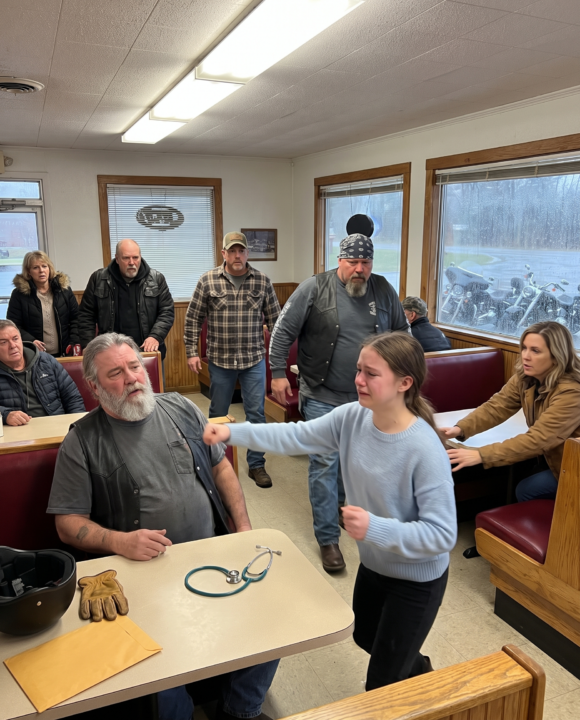
While my mother cleaned the cut on his lip inside Rosie’s diner, Jonah chose a booth across the aisle rather than the seat beside me. His club brothers waited outside. They had ridden hundreds of miles for him, yet not one entered until Jonah raised two fingers through the window.
Only then did a thin biker named Walter “Switch” Avery come inside.
Switch had known Jonah for thirty-four years. He wore wire-framed glasses, a white ponytail, and enough old grease beneath his nails to outlast soap. He placed a small recorder on the table, checked that it was off, and asked whether I wanted every phone recording from the parking lot deleted.
I did.
Switch went outside.
Within minutes, the Iron Lanterns were walking from person to person, politely asking them not to post a terrified teenager’s worst moment online. They could not force anyone. They did not threaten. When one man refused, Jonah told his brothers to leave him alone.
“No intimidation,” he said. “Caleb hated that garbage.”
The name changed him each time he spoke it.
My mother, Elena, placed the broken stethoscope on the table. Jonah looked at it but did not reach for me again.
Our connection had begun with a letter I wrote six months after my transplant. It took me four weeks to produce twelve sentences.
I thanked the unknown family. I promised to take every medication on schedule. I told them I had returned to school, although I did not mention the panic attacks, the nightmares, or the guilt that came whenever someone called my operation a miracle.
Miracles are simpler when nobody else has to die.
The transplant organization forwarded the letter only after counselors reviewed it. Donor families can choose silence. Recipients can do the same. Nobody owed anyone contact, gratitude, access, or a meeting.
Jonah answered seven months later.
His first letter contained no demand to know my name. He wrote that his son had been seventeen, impatient, mechanically gifted, and terrible at folding laundry. He said Caleb hated tomatoes, rescued spiders from bathtubs, and had once ridden thirty miles home in hail because he refused to abandon a broken-down friend.
Jonah ended with one sentence:
You do not owe us a performance of being happy. Just take care of yourself.
I carried those words in my medication bag.
We exchanged nine letters over three years. Jonah wrote about highways, repair work, and Caleb’s habit of tapping doorframes. I wrote about graduation, learning to swim again, and the first time I climbed a hill without my lips turning blue.
I never told him about the heartbeat pattern.
That detail felt too intimate, as though I had discovered a private language inside another family’s loss.
Jonah had his own omissions.
He never told me he was a biker. In the letters, he described himself as a diesel mechanic. He did not mention the Iron Lanterns, the Harley, or the faded patch with Caleb’s name. He feared I might believe the donor had died riding recklessly.
Caleb had not been on a motorcycle.
He was driving an old Ford pickup on Interstate 40 during a dust storm when a commercial van crossed into his lane. Caleb swerved, kept the truck from striking a family’s minivan, and hit the concrete divider. The brain injury was irreversible.
Jonah reached the hospital in forty-two minutes.
For the next two days, machines kept Caleb’s organs functioning while doctors completed tests. Caleb had registered as an organ donor when he received his driver’s license. He had also discussed the decision with his mother, Amy.
He had never discussed it with Jonah.
When the coordinator approached them, Jonah said no.
Then he learned Caleb’s registration was legally binding.
That knowledge did not comfort him. It made him furious at a world that could remove his son’s organs while asking him to sign forms beneath fluorescent lights.
He punched a hospital wall.
He broke two fingers.
Amy signed the remaining documents while Jonah sat in the parking garage beside Caleb’s unfinished Harley project, unable to enter the building.
For almost a year, he told no one about the recipients.
Some members of his club assumed all donation had been canceled. Jonah allowed the misunderstanding because he could not bear questions about where Caleb’s heart had gone.
Switch eventually found him alone in the garage, listening to an old voice message.
Caleb was laughing in the recording. An engine turned over behind him. Then he said, “Tell Dad the timing’s still wrong.”
It was the last message he ever sent.
Jonah had kept the phone charged for three years.
The object sewn inside his vest was not merely Caleb’s hospital bracelet. Beneath the leather lining lay the old phone in a waterproof pouch, along with a narrow cloth patch Caleb had designed but never earned.
It read ROAD HOME.
Caleb had been an Iron Lantern prospect. Jonah insisted that his son complete the same work and discipline expected of anyone else. No inherited privilege. No shortcuts.
On Caleb’s final night, the club planned to vote him in as a full member.
Instead, they stood outside an operating room.
When Jonah finally agreed to identify himself to me, the club split over what should happen next. Some wanted a public ride to honor organ donation. Others thought meeting me would break him. One rider believed I should receive Caleb’s unfinished motorcycle.
Jonah rejected all three ideas.
“She got his heart,” he said. “That doesn’t make her club property.”
He wanted to come alone.
The twenty-seven riders followed anyway because the night before our meeting, Jonah removed the road-captain patch from his vest and left it on Switch’s workbench.
Nobody knew whether he intended to return.
Inside Rosie’s diner, Jonah slid the broken stethoscope toward himself and repaired the earpiece using a small piece of fuel tubing from his saddlebag.
Then he set it between us.
“No hurry,” he said.
My mother began crying.
Not because he had fixed it.
Because she knew I had never been the person who first requested our meeting.
She had.
Part 3 — The Secret My Mother Kept Beside My Medication
My mother had written Jonah without telling me.
She did it through the transplant coordinator, not by secretly obtaining his identity. The organization forwarded her letter because both families had already consented to communication. Still, it felt like a betrayal.
“What did you tell him?” I asked.
She looked down at her hands.
“That you weren’t doing well.”
I laughed once. It came out bitter.
I had climbed stairs, passed every cardiac biopsy, graduated with honors, and started community college. My doctors called the transplant successful.
But survival had become the only subject everyone allowed me.
Friends stopped complaining around me because their problems seemed too small. Teachers introduced me as an inspiration. Strangers wanted to hear how grateful I felt. My mother checked my color whenever I stood too quickly and woke twice each night to make sure I was breathing.
I began skipping social events. I covered the scar beneath high collars. I avoided music with heavy bass because the vibration made me imagine a boy trapped inside my ribs.
Then the first anniversary of the transplant arrived.
I locked myself in the bathroom and stayed there for six hours.
On the second anniversary, I packed my medication into a backpack and drove toward California without telling anyone. I made it forty miles before turning around because missing even two doses could endanger the heart.
On the third anniversary, my mother found a note beneath my pillow.
It did not say I wanted to die.
It said I did not know how to live without feeling that every ordinary mistake dishonored someone who no longer had the chance to make one.
My mother sent those words to Jonah.
He answered within a day.
His response was only four lines:
Do not turn my son into a prison.
He hated locked doors.
If she wants to meet, I will come.
If she does not, tell her she still has permission to live.
I stared at my mother across the diner booth.
“You should have told me.”
“I was afraid you’d say no before you understood why.”
“That was my choice.”
“Yes.”
She did not defend herself. That made it harder to stay angry.
Jonah remained silent. He could have used my mother’s letter to explain his trip. Instead, he let the argument belong to us.
Outside, the situation worsened.
The man who had filmed the punch uploaded twelve seconds to social media. The clip began after I gave permission and ended before anyone explained the transplant. Within an hour, it had thousands of views.
The caption accused a motorcycle gang member of assaulting a teenage girl.
A local reporter arrived. Then another deputy. Rosie’s manager asked the bikers to move their motorcycles because customers were afraid to enter.
The Iron Lanterns complied.
All except Jonah.
His Harley would not start.
He pressed the ignition. The engine turned weakly, coughed, and died. Switch checked the battery and found the negative cable loose, likely shaken free during the long ride.
Several people in the parking lot interpreted the repair as a refusal to leave. Voices rose. One man shoved Switch. Another tried to pull Jonah’s phone from his hand after seeing Caleb’s photograph on the screen.
Jonah moved fast.
He caught the man’s wrist, turned it, and pinned him against the hood of a car.
The parking lot exploded with shouts.
Jonah released him immediately.
Then he placed his own hands on the Harley tank and allowed the deputy to handcuff him.
“Bear,” Switch warned.
Jonah looked at his club.
“Hold.”
Every biker stayed where he was.
That restraint cost them. They were cursed, filmed, and accused of protecting an abuser. A bottle struck the pavement beside one rider’s boot. Nobody retaliated.
The deputy took Jonah toward the patrol car.
I followed.
The heart inside me hammered so hard that my vision narrowed. The irregular beat returned—two, pause, one—then accelerated into something chaotic.
I tried to call Jonah’s name.
Air would not come.
The last thing I saw before collapsing was the giant biker turning in handcuffs, his face changing from grief to recognition.
“Her pulse,” he shouted. “Check her pulse!”
People assumed he was panicking because the donor heart might be failing.
He knew something they did not.
Caleb had inherited a rare electrical condition called catecholaminergic polymorphic ventricular tachycardia—CPVT—which could trigger dangerous rhythms during intense stress. Doctors had investigated Caleb after a fainting episode at thirteen, but later monitoring was inconclusive. The donor records mentioned an adolescent arrhythmia, though genetic results had not been available when the transplant occurred.
Jonah had carried the missing information inside his vest.
Six months after Caleb’s death, a stored blood sample had been retested during a family study. The result confirmed a mutation. Jonah submitted the update through the donor network, but a record-matching error placed it under an inactive case number.
He assumed my doctors knew.
They did not.
My mother shouted that I had an implanted monitor but no defibrillator. The deputy removed Jonah’s cuffs while another customer called emergency services.
Jonah knelt beside me without touching my chest.
“May I?” he asked.
I could barely nod.
He placed two fingers against my neck and counted. Switch brought an automated external defibrillator from the diner wall, but Jonah stopped him from applying it immediately because I still had a pulse and remained partially conscious.
“Pads ready,” he said. “Don’t shock unless it tells you.”
His voice became calm.
Too calm.
Later I learned why. For eighteen years, Jonah had volunteered with a motorcycle emergency-response group that assisted at rural crashes before ambulances arrived. Caleb had trained beside him.
Jonah kept talking to me.
“Stay here, kid.”
My heartbeat bucked.
“Look at me.”
I did.
“That heart’s yours now. Make it listen.”
The paramedics arrived in six minutes. The rhythm resolved before a shock was needed, but they transported me to Flagstaff Medical Center. Jonah followed on his Harley until the ambulance accelerated beyond city traffic.
My mother rode inside with me.
The Iron Lanterns followed Jonah.
At the hospital, a cardiologist confirmed the arrhythmia and began treatment. Genetic testing would take time, yet the pattern and donor history were enough to change my medication immediately.
Everyone called Jonah a hero.
He refused the word.
“I was three years late,” he said.
Then my mother asked why he had brought Caleb’s phone and medical bracelet if he believed the updated records had already reached my doctors.
Jonah looked at the floor.
Because the medical warning was not the reason.
He had come to give me something else—something Caleb recorded six days before the collision, when none of us knew I existed.
Part 4 — The Voice Inside the Unfinished Harley
Jonah did not play Caleb’s recording that night.
He sat outside my hospital room with his leather cut folded across his knees. The corridor lights bleached the tattoos on his arms. Without the vest, the chain, and the Harley beneath him, he looked less like the man strangers had feared and more like a tired father who had been holding his breath for three years.
Switch brought coffee.
Jonah did not drink it.
The rest of the Iron Lanterns filled the waiting room without taking over it. They left seats for families, kept their voices low, and removed their cuts when a nurse said the patches frightened a child.
One rider refused.
His name was Travis Cole. He was forty-three, broad through the shoulders, with a red beard and a temper that had caused trouble before. Travis believed the club had surrendered too much dignity in the diner parking lot.
“They called Bear a predator,” he said. “We stood there.”
Switch answered, “Because Bear ordered us to.”
“We should correct the story.”
“With what? Her medical history?”
Travis looked toward my closed door.
“We tell people why he did it.”
Jonah stood.
“No.”
“They’re burying you online.”
“Let them.”
“The club’s name is in it.”
Jonah’s voice lowered. “Her heart ain’t club property. Her scar ain’t our press release.”
Travis argued that silence would destroy the group’s reputation and jeopardize their charity permits. Jonah removed the Caleb patch from his vest and placed it on the chair.
“If our reputation costs her privacy, we can’t afford it.”
Travis left.
By morning, the video had reached local television. Hospital security placed an officer outside my room because strangers had begun calling. Some wanted to support me. Others accused me of lying once witnesses explained that I had invited Jonah to listen.
I became either a victim or a villain.
Nobody allowed me to be a frightened nineteen-year-old whose body reacted before her mind.
Jonah understood that.
When I woke, he asked through the nurse whether I wanted him to leave. I told him to come in.
He stopped at the doorway.
“Chair by the wall,” I said.
He sat there.
His split lip had swollen. Dried blood darkened his beard. I apologized.
“No,” he said. “You don’t owe me an apology for panic.”
“You had permission.”
“Then the world changed for you. Permission can change too.”
He spoke like someone who had learned that truth painfully.
I asked about Caleb.
Jonah looked toward my mother. She gave us privacy.
For the first time, he told me the parts that had never fit inside anonymous letters.
Caleb was not fearless. He hated thunderstorms until he was eleven. He failed his first driving test after forgetting the parking brake. He once hid a stray dog in the club workshop for six days because he knew Jonah would say they could not keep it.
The dog stayed twelve years.
Caleb joined the Iron Lanterns’ youth volunteer program at fourteen. He delivered food to housebound veterans, cleaned highway debris, and learned first aid. When he became old enough to prospect, Jonah was harder on him than on anyone else.
Their final argument happened over the unfinished Harley.
Caleb had rebuilt a 1998 Sportster from parts. Jonah found a hairline crack in the frame and forbade him to ride until it was welded. Caleb accused his father of never trusting him.
Jonah accused Caleb of confusing impatience with skill.
Caleb drove away in the pickup.
Six hours later, the collision happened.
For years, Jonah believed their last words had been angry ones.
Then Switch found an audio recorder beneath the Sportster’s seat while preparing to sell the parts. Caleb had used it to document engine noises during repairs.
The final file began with a starter motor and Caleb cursing the timing.
Then the engine stopped.
Caleb spoke directly into the recorder.
“Dad, you’re right about the frame. Don’t enjoy hearing that too much.”
There was a long pause.
“I signed the donor thing today. Mom knows. You’ll hate it because you think every part of me belongs at home. But you taught me parts don’t matter sitting on a shelf. They matter when they keep somebody moving.”
Jonah stopped the recording.
He could not continue.
I understood then. Caleb had not recorded a message for an unknown recipient. He had recorded an argument with his father, an attempt at reconciliation he never delivered.
Jonah believed I deserved to hear the rest.
He pressed play.
Caleb’s younger voice returned through the tiny speaker.
“If anything happens, don’t go looking for whoever gets what. Let them live. But if they ever come looking for you, don’t make them carry me. They’ve already got enough.”
The file ended with two taps against the recorder.
Pause.
One more.
My heart answered in the same rhythm.
Jonah bowed his head.
That was the moment he had requested. Not the public encounter outside the diner. Not his ear against my scar. That accidental intimacy had gone wrong because both of us tried to compress three years of grief into one heartbeat.
The true meeting happened in a hospital room with six feet between us.
I placed the repaired stethoscope on the blanket.
“Do you still want to listen?”
Jonah looked at it.
Then at me.
“Only if you do.”
I did not know.
So he waited.
Hours passed. He repaired the loose wheel on my mother’s suitcase. He bought coffee for the night nurses. He stood whenever a doctor entered and asked no questions that belonged to me.
Near midnight, I told him I was ready.
Jonah washed his hands.
He pulled a chair beside the bed but stopped before touching me. I fitted the stethoscope’s diaphragm against my upper chest myself, then handed him the earpieces.
That difference mattered.
He listened.
His eyes closed.
The room held only the monitor, the ventilation system, and the faint leather creak of his vest as his shoulders began to shake.
He did not say Caleb’s name.
He said mine.
“Maya.”
One word.
Acknowledgment, not replacement.
Then the heartbeat stumbled.
Two beats.
A pause.
One.
Jonah removed the stethoscope and gave it back.
“That’s his rhythm,” he whispered. “But it’s carrying you.”
I thought that was the final truth.
It was not.
My cardiologist entered with the transplant coordinator and a file they had recovered after Jonah’s warning. The genetic update had indeed been mishandled—but someone had noticed the problem two years earlier and tried repeatedly to correct it.
That person was Caleb’s mother, Amy.
Jonah had told me she could not attend the meeting because she had moved overseas.
Amy Mercer had died eleven months before we met.
And the sealed envelope my mother carried had been her final letter to me.
Part 5 — The Mother Who Refused to Make Me a Memorial
Amy Mercer developed ovarian cancer eighteen months after Caleb’s death.
She continued writing to the transplant organization throughout treatment. She asked whether updated genetic findings had reached every recipient whose health might be affected. Privacy rules prevented staff from giving her identifying information, but they could confirm that medical alerts had been forwarded.
A database migration interrupted that process.
Amy sensed something had gone wrong.
She sent the result again. Then again.
When no confirmation arrived, she placed a copy inside a sealed letter intended for the heart recipient if contact was ever mutually approved.
My mother received that envelope at the diner.
She had not opened it because it was addressed to me.
I opened it in the hospital with Jonah present.
Amy’s handwriting slanted sharply to the right. Her first paragraph explained the medical risk and instructed me to show the enclosed laboratory report to my cardiologist. Her second paragraph described Caleb’s childhood rhythm.
The rest was not about him.
It was about me.
Amy wrote that people might tell me I carried her son. She asked me not to accept that burden literally. A heart changed within the body receiving it. It responded to new hormones, new nerves, new fears, new laughter, and a life Caleb had never lived.
Please do not become our walking memorial, she wrote. A memorial cannot make mistakes. A living girl must be allowed thousands of them.
I read that sentence until the ink blurred.
Jonah turned toward the window.
He had never seen the letter. Amy had prepared it after their separation.
Caleb’s death did not end their marriage immediately. Silence did. Jonah spent nights in the garage with the unfinished Sportster. Amy joined donor-family groups and wanted to speak about the lives Caleb had helped save. Jonah considered those events a public disassembly of their son.
They loved each other.
They could no longer grieve in the same room.
Amy moved to her sister’s home in Oregon. Jonah remained in Arizona. When cancer appeared, she refused to let him become her caretaker out of guilt.
He rode north anyway.
For seven months, Jonah parked his Harley across the street from her apartment each morning. Some days she let him inside. Other days she asked him to leave.
He left.
Then he returned the next morning.
Near the end, Amy gave him Caleb’s hospital bracelet and told him about the sealed recipient letter. She asked him to make one promise.
“If she meets you,” Amy said, “see the girl before you see the heart.”
Jonah believed he had failed that promise outside the diner.
I disagreed.
He had made a mistake. Then he backed away, accepted responsibility, protected my privacy, and waited until I chose what happened next. That was not failure. It was the difficult correction Caleb had once described while rebuilding an engine: stop, listen, and reset the timing before damaged parts became permanent.
The Iron Lanterns faced their own correction.
Travis returned to the hospital that afternoon. He had found the man who uploaded the original video and persuaded him to replace it with a longer version showing my permission, the dropped tray, Jonah’s restraint, and my mother’s explanation.
The new upload included my medical information.
Travis had intended to defend us.
Instead, he exposed me.
Jonah removed his road-captain patch.
The club members gathered in the parking garage, where their voices echoed between concrete pillars. Jonah did not shout. He held the patch toward Travis.
“You wanted the club protected.”
“Yes.”
“So you used her.”
Travis lowered his head.
“I thought the truth would fix it.”
“Wasn’t yours.”
The club voted to suspend him.
I asked them not to.
That surprised Jonah. It surprised me too.
Travis had done harm, but I understood the desperation to control what strangers believed. I had spent three years shaping myself into the grateful survivor everyone expected. We had both mistaken a clean public story for repair.
I asked Travis to delete every post, contact each reporter, and publicly state only that the meeting had been consensual and the video lacked context. No donor details. No diagnosis. No heroic language.
Then I asked him to do something harder.
Nothing.
He was forbidden to defend himself when people accused him of helping spread the story.
Travis accepted.
For six weeks, he worked in the club garage without wearing his cut. He repaired donated wheelchairs and never placed his name on them. When the suspension ended, Jonah returned the vest but not the patch.
“Trust grows slower,” he said.
The original video eventually faded from attention.
The consequences did not.
Because Jonah’s warning revealed the medical-record failure, the transplant center reviewed dozens of legacy donor updates. Three other recipients were found to have incomplete genetic information. Their doctors altered monitoring plans before any crisis occurred.
The hospital called Jonah courageous.
He rejected that too.
“Amy did the work,” he said. “I just carried the paper late.”
Before leaving Flagstaff, Jonah rolled Caleb’s unfinished Sportster from a trailer. The cracked frame had been repaired. The fuel tank remained unpainted, marked with fingerprints, primer, and a thin line where Caleb had planned the stripe.
Everyone assumed he would give it to me.
He did not.
“You ride?” he asked.
“No.”
“Want to?”
“I don’t know.”
“Good answer.”
He placed Caleb’s ROAD HOME patch in my hand, but he kept the motorcycle.
The heart was mine.
The bike was still part of a father’s unfinished conversation with his son.
Instead, Jonah removed the small brass key from the Sportster and threaded it onto a plain cord.
“This doesn’t make it yours,” he said. “It means there’s a seat if you ever ask.”
For the first time since surgery, someone offered me a future without demanding that I accept it.
I put the key around my neck.
Then Jonah started his Harley.
The V-twin shook the hospital garage. My new medication held the rhythm inside me steady.
I expected the sound to feel like Caleb.
It felt like weather.
Loud. Physical. Passing through.
Nothing more had to be assigned to it.
Part 6 — The Ride That Stopped at Every Hospital Door
I did not ride with Jonah that year.
I returned to college. I changed my major twice, failed statistics, dated a boy my mother disliked, and missed a medication alarm once because I was dancing at a wedding.
I panicked afterward.
Then I remembered Amy’s letter.
A living girl must be allowed thousands of mistakes.
I took the late dose according to my transplant team’s instructions, documented it, and continued living.
Jonah called once a month. He never asked whether “Caleb’s heart” was healthy. He asked whether I was eating, whether my classes bored me, and whether my mother had finally stopped checking my breathing at night.
My mother had not.
Jonah told her to buy a loud fan.
The Iron Lanterns created the Mercer Route Fund in Amy and Caleb’s names. It paid travel expenses for donor and recipient families who mutually chose to meet, as well as counseling for families who chose not to.
That second part was Jonah’s condition.
“No meeting is an answer too,” he said.
Travis handled paperwork but appeared in no publicity. He spent Saturdays transporting transplant patients to appointments in an old van because most could not safely ride motorcycles.
Switch repaired stethoscopes for the pediatric cardiac floor, though nobody knew why he had accumulated so many broken earpieces.
Jonah completed Caleb’s Sportster slowly.
He left the tank unfinished.
On the first anniversary of our meeting, I returned to Rosie’s Route Diner. The same cracked section of parking-lot asphalt lay beside the gas pumps. The waitress who dropped the tray had moved to Phoenix. Helen still worked the counter.
Twenty-eight motorcycles arrived at two.
Jonah was last.
He parked, removed his helmet, and waited beside the Sportster. The passenger seat had been fitted with a backrest. A new helmet hung from the handlebar.
He did not hold it toward me.
He waited.
I walked around the motorcycle three times. I checked the frame weld because Caleb’s recording had taught me where the crack had been. Jonah watched without smiling.
“Good inspection,” he said.
I put on the helmet.
My mother objected for eleven straight minutes. Jonah listened to all of it, promised we would remain below the speed limit, and handed her our route map.
We rode only twelve miles.
The Iron Lanterns kept a wide gap around us. No cameras. No charity banner. No memorial formation.
At the first red light, Jonah looked over his shoulder.
“All right?”
I placed a hand against his leather cut.
Two taps.
A pause.
One.
His head lowered for a second.
Then the light changed.
We continued north beneath an Arizona sky washed pale by winter, the Harley engines surrounding us without swallowing the smaller Sportster’s uneven pulse.
The heart inside me accelerated.
Not dangerously.
Not as a message.
Because I was nineteen, frightened, and moving.
Part 7 — The Heartbeat That Belonged to the Living
Five years after the punch, the photograph most people remember is still the wrong one.
It shows Jonah bent toward my chest, my fist raised, his beard hiding the expression on his face. Cropped tightly, it contains a villain, a victim, and a simple conclusion.
The full photograph is wider.
My mother stands behind us holding the broken stethoscope. Switch is reaching beneath the truck for the missing earpiece. Jonah’s hands are open. I am already turning toward the shattered tray that triggered the hospital memory.
Truth often lives outside the crop.
Jonah keeps a printed copy in the Iron Lantern clubhouse. Beneath it, he mounted no explanation. Only the repaired stethoscope.
I am twenty-four now. The donor heart remains strong. Medication controls the inherited rhythm, and my cardiology team watches it closely. I work with transplant teenagers who are tired of being introduced as miracles.
I never tell them they must contact donor families.
I never tell donor families that meeting a recipient will heal them.
Sometimes it helps.
Sometimes it opens a different wound.
Jonah and I found something messier than healing. We found boundaries, mistakes, apologies, and a relationship that belongs neither to Caleb nor to the public.
He is not my replacement father.
I am not his replacement son.
On Caleb’s birthday, Jonah rides to a desert overlook outside Flagstaff. Amy’s ashes were scattered there. Caleb’s ROAD HOME patch remains inside Jonah’s vest, sewn over the pocket holding the old recorder.
Sometimes I join him.
We do not release balloons or count heartbeats. We drink terrible gas-station coffee while the motorcycles cool beside us.
One year, Jonah finally asked the question he had carried since Rosie’s diner.
“What did it sound like,” he said, “when they first told you the heart was working?”
I thought about the intensive-care room, the tubes, and my mother asleep in a chair with one shoe missing.
“Like somebody knocking from the other side of a wall.”
Jonah nodded.
“That sounds like him.”
Then he corrected himself.
“No. Sounds like you answered.”
Before we left, he fitted the stethoscope into his ears. I placed the diaphragm against my chest and held it there myself.
He listened for ten seconds.
Two beats.
A pause.
One.
Jonah handed it back.
“That enough?” I asked.
He looked toward the waiting motorcycles.
“More than enough.”
He started Caleb’s unfinished Sportster, now mine to ride but never mine to inherit as a debt. The raw metal tank still carried the line Caleb had drawn and Jonah refused to paint over.
We entered Route 89 together.
Jonah rode ahead. I followed in my own lane. Between us lay exactly the distance each of us had chosen.
Follow our page for more biker stories about misunderstood riders, quiet loyalty, and the families formed beyond blood and worn leather.