A Biker Carried a Ceramic Pig Into a Crowded Bar and Smashed It With a Hammer — Everyone Thought He Was Desperate for Cash Until the Waitress Saw Her Name Beneath the Broken Pieces
Hammer Dawson carried a pink ceramic pig into my crowded bar, set it beside a teenage waitress’s unpaid medical bills and shattered it with one swing—then every biker in the room stood when he reached into the broken pieces.
The Iron Lantern went silent before the last shard stopped spinning.
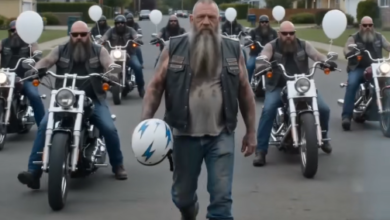
It was 9:17 on a Friday night in Flagstaff, Arizona, and I was standing behind the bar with a wet glass in one hand when Raymond “Hammer” Dawson raised the carpenter’s hammer again. He was fifty-six years old, six-foot-four, nearly 285 pounds, with a shaved head, a black-and-gray beard, tattooed forearms and scarred knuckles that made even sober men reconsider an argument.
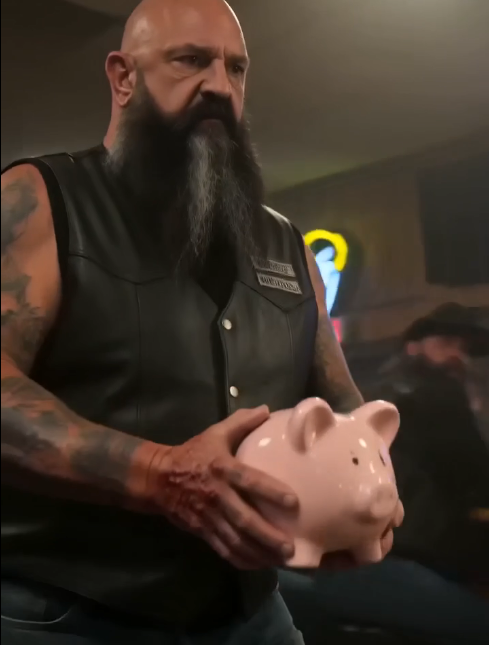
On the table before him lay a broken ceramic pig.
Cash covered the wood.
There were crumpled singles, rolled quarters, folded twenties, old silver dollars and several sealed envelopes thick enough to hold checks. The pig’s painted smile had split down the middle. One pink ear rested inside a puddle left by a customer’s beer.
“Don’t touch it,” Hammer said.
Those four words changed the room.
Three members of the Red Valley Riders pushed away from the bar. Two customers lifted their phones. Someone near the pool tables muttered that Hammer must be deeper in debt than the rumors suggested, because nobody carried a hammer into a business on Friday night unless he intended to collect money or take it.
I almost believed them.
The club’s repair garage had lost a major contract that winter. Hammer’s house had received two foreclosure notices. His Harley needed transmission work, and for six weeks he had been sleeping in a storage room behind the shop because the electricity at home had been disconnected.
Yet the money on Table Seven did not belong to him.
It belonged to all of them.
The ceramic pig had sat inside the Riders’ clubhouse for fourteen months, growing heavier after every meeting. Members fed it their change after beer runs. Prospects slid in folded bills. Men who complained about buying a five-dollar cup of coffee sometimes stood alone beside that pig and pushed fifty through the slot.
Nobody outside the club knew why.
Especially not nineteen-year-old Ellie Park, the waitress standing five feet from Hammer with a tray pressed against her chest.
Ellie had been working for me since she was sixteen. She was Korean American, small and stubborn, with black hair tied in a loose ponytail and a left leg that ended several inches above the knee. Her temporary prosthesis squeaked when she walked, and the socket had begun cutting her skin so badly that she sometimes served an entire shift while fighting a fever.
That night, she was hiding the pain.
She always did.
When Hammer reached into the pile, Ellie stepped forward.
“If you need money,” she said, “you could’ve asked instead of frightening everyone.”
Several customers nodded. One man laughed cruelly and said the big biker had finally cracked his retirement plan open.
Hammer ignored him.
He pulled a folded sheet of paper from beneath the coins, brushed pink dust from it and placed it beside Ellie’s tray. The top showed an estimate from a prosthetics clinic in Phoenix.
$46,870.
Ellie’s face lost its color.
She had never shown that estimate to anyone except me.
Her insurer called the microprocessor knee “an enhancement rather than a necessity.” The clinic required a deposit before fabrication. Ellie had stopped mentioning it after calculating that even if she saved every tip and ate nothing, she would need more than four years.
Now thousands of dollars covered the table.
“Count it,” Hammer said.
Ellie shook her head. “Whose money is this?”
Hammer looked around at the Riders. Men who appeared frightening beneath bar lights suddenly found reasons to study their boots.
“Ours,” he said.
“For what?”
His eyes dropped to her prosthetic leg.
That was when she understood.
The tray slipped from her hands and hit the floor.
But before anyone could explain, Ellie saw something among the broken ceramic pieces that made her kneel despite the pain in her stump. Beneath the pig’s shattered belly lay a brass key, a burned strip of red upholstery and a sealed envelope with her full name written across it.
Not by Hammer.
By Silas Crowe, the club treasurer who had disappeared three days earlier.
Ellie tore open the envelope.
She read one sentence, stopped breathing and looked directly at Hammer.
“You knew whose truck hit me?”
Every phone in the bar lowered.
Hammer did not deny it.
And while more than forty people watched, Ellie reached for the hammer he had used to break the pig.
Part 2 — The Girl Who Refused the Chair
My name is June Calder, and I had owned the Iron Lantern for eleven years before the night Hammer shattered that pig. It was the kind of roadside bar where truckers ate meatloaf at noon, nurses stopped after night shifts and bikers knew which loose floorboard to avoid when carrying a full pitcher.
Ellie was not my daughter, although I had signed enough school forms and emergency-room papers to make that distinction feel dishonest.
Her mother, Mina Park, had been my closest friend since community college. Mina died from ovarian cancer when Ellie was thirteen. Ellie’s father had left years earlier, sending birthday cards without return addresses until even those stopped arriving.
Mina asked me to take care of her girl.
I promised.
Ellie moved into the apartment above the Iron Lantern and began washing glasses for spending money. At sixteen, she could carry six plates without a tray. At eighteen, she enrolled in a nursing program at Coconino Community College and worked four evenings a week to pay tuition.
Then a red Ford pickup crossed the center line on Route 66.
It happened at 11:42 on a rainy October night. Ellie was driving home from clinical training when the truck clipped the front of her Honda, spun it sideways and pushed the driver’s door into a concrete barrier.
The truck stopped seventy yards ahead.
A witness saw its brake lights.
Then they vanished.
Hammer found Ellie before the paramedics did. He had been riding behind her at a distance, returning from a veterans’ food drive in Williams. He saw the Honda turn, saw sparks beneath it and laid his Harley down in the gravel because there was no safe place to stop.
The car smelled of coolant, wet fabric and something electrical burning behind the dashboard. Ellie was conscious. Her left leg was trapped, and she kept repeating that she had a pharmacology exam Monday.
Hammer crawled through the passenger window.
“Forget Monday,” he told her. “Stay here.”
“I am here.”
“Stay anyway.”
He pressed his vest against the wound and held pressure until firefighters cut the door away. When Ellie screamed, Hammer counted backward from one hundred. He deliberately skipped numbers so she would correct him.
She remained awake for ninety-three of them.
The surgeons saved her life but not her leg.
During rehabilitation, Ellie treated losing a limb like an inconvenience she could outwork. She learned to transfer from bed to chair before the therapist taught her. She completed assignments from the hospital. When a nurse offered to wheel her to the entrance on discharge day, Ellie refused.
She stood on crutches.
She fell before reaching the elevator.
Hammer caught her without making a sound.
“I don’t need a chair,” she snapped.
“No,” he said. “You need time.”
She hated him for that answer because it was true.
Her first prosthesis was basic, heavy and badly suited to ten-hour restaurant shifts. The socket fit when it was made, but her residual limb changed shape as swelling decreased. Within months, the plastic rim rubbed the skin raw.
Ellie wrapped it with gauze and kept moving.
Hammer noticed.
He noticed because Hammer noticed anything a person tried hardest to hide. Combat had trained him to read weight shifts and changes in breathing. Prison had sharpened the habit. Grief had made it permanent.
He had served as an Army mechanic in Iraq, returned with a damaged shoulder and a temper he did not know how to carry, then spent four years in prison after nearly killing a man during a bar fight. His daughter visited twice during the first year. After that, she stopped.
Hammer never blamed her.
He rebuilt motorcycles after his release, joined the Red Valley Riders and learned to repair small things before they became large enough to ruin a life. Engines were easier than people, but he kept trying both.
One closing night, he saw Ellie remove her prosthesis in the kitchen. Blood had soaked through the liner.
“You tell June?” he asked.
“No.”
“Doctor?”
“No.”
“Why?”
“Because neither one has forty-seven thousand dollars.”
Hammer said nothing.
The next morning, he placed a pink ceramic pig on the table during the club meeting. It had white flowers painted across its sides and a crooked tail. A thrift-store price sticker remained beneath one foot.
He dropped in the first twenty.
“What’s this?” Boone Rourke asked.
“A leg.”
The men laughed until they saw Hammer’s face.
Silas “Ledger” Crowe, our treasurer, calculated the target. At ordinary donation rates, the club would need six years. Hammer gave them eighteen months.
No social-media campaign. No photographs with Ellie. No charity ride carrying her name without permission. Hammer said if the money came with applause attached, it was advertising, not a gift.
The Riders agreed.
Every week, the pig grew heavier.
Hammer sold a custom chopper he had spent three years building and contributed $8,400. Boone gave his tax refund. A prospect named Mouse stopped smoking and inserted the price of each unbought pack. Widows of two dead members sent envelopes. Veterans mailed challenge coins with hundred-dollar bills folded around them.
Silas recorded every contribution.
He also made the largest anonymous deposits.
Five hundred dollars one month. Twelve hundred the next. Then three thousand in cash after selling his fishing boat.
Hammer asked where the money came from.
Silas said he was cleaning up old debts.
That answer should have sounded better than it did.
Two weeks before the pig was broken, Hammer discovered a red paint chip inside Silas’s garage, a brass key on his workbench and a photograph of a damaged Ford hidden beneath motorcycle-registration papers.
The truck in the photograph had a crushed left headlight.
Its passenger seat was upholstered in red vinyl.
Part 3 — The Vote Behind the Locked Door
Hammer did not confront Silas alone.
That mattered, because ten years earlier he would have.
Instead, he called me at 1:08 in the morning and asked for the clubhouse key. I found him standing beneath the security light with rain dripping from his beard, his fists opening and closing at his sides.
“What happened?” I asked.
“Need witnesses.”
Inside, he placed the photograph, paint chip and brass key on the officers’ table. Then he called the club president, road captain and sergeant-at-arms.
Silas arrived last.
He was sixty-one, narrow through the shoulders, with thinning gray hair, wire-rimmed glasses and the quiet manner of a man people trusted with account books. He did not look like the sort of biker strangers feared. He had no neck tattoos, never raised his voice and spent Sunday mornings repairing wheelchairs at a church warehouse.
He saw the photograph and sat down.
Hammer remained standing.
“Tell it,” he said.
Silas removed his glasses. “It isn’t what you think.”
“Then make it different.”
Silas said the Ford belonged to his older brother, Patrick, who died six months after Ellie’s collision. Patrick drank heavily, owed money across three counties and sometimes stored vehicles in Silas’s garage.
The damaged Ford arrived the morning after Ellie’s crash.
Patrick claimed he struck a deer.
Silas replaced the headlight, straightened the grille and removed fragments of silver Honda paint from the bumper. He did not know about Ellie until he saw the local news that evening.
When he confronted Patrick, his brother denied everything.
Silas wanted to believe him.
That was his first failure.
The second came three days later, when Silas found a nursing-school identification badge wedged beneath the Ford’s windshield wiper. Ellie’s photograph stared back at him from rain-warped plastic.
He hid the badge.
Patrick sold the truck to a salvage yard in Nevada. Silas kept the brass key, the photograph and a strip of upholstery cut from the passenger seat because some part of him understood that one day belief would no longer protect either brother.
“Was Patrick driving?” Boone asked.
Silas stared at the tabletop. “I thought so.”
Hammer leaned closer. “Thought?”
Silas’s hands began to shake.
Patrick had not been driving.
Silas had.
The room changed.
Boots moved against concrete. Leather creaked. Boone stood so fast his chair fell backward, and two members positioned themselves between Hammer and the treasurer.
Hammer did not move.
That frightened all of us more.
Silas told us he had been sober. Patrick was in the passenger seat, drunk and vomiting, when a small dog ran into the road. Silas swerved, crossed the center line and clipped Ellie’s car.
He stopped after the impact.
He looked in the mirror and saw the Honda against the barrier.
Then Patrick showed him the pistol beneath his coat.
Silas was still on federal probation for receiving stolen parts. Patrick had drugs in his pocket and an unregistered weapon. If police came, both men would return to prison.
Patrick told him to drive.
Silas did.
“Seventy yards,” Hammer said.
Silas looked up.
“You were seventy yards away when you chose your patch of road over her life.”
“I saw your headlight behind us.”
“You didn’t know it was me.”
“I knew somebody stopped.”
“No. You hoped.”
Hammer’s voice never rose.
Silas admitted that he had followed Ellie’s recovery through hospital updates. He attended one fundraiser wearing a hat and stood at the back. When the club began saving for her prosthesis, he volunteered to keep the records because it gave him a way to contribute without facing her.
The anonymous money came from selling nearly everything Patrick had left him.
The boat. Tools. A gun collection. A small parcel of land outside Kingman.
He had put $17,600 into the pig.
Boone struck him before anyone could react.
One punch.
Silas fell against the wall, and Hammer caught Boone’s wrist before he could swing again.
“Enough,” Hammer said.
“She ate through a tube for two weeks because of him.”
“I know.”
“He watched us pass that pig around.”
“I know.”
“And you’re protecting him?”
Hammer looked at Silas on the floor. “I’m protecting what happens next.”
The club rules demanded a vote. Some members wanted to strip Silas’s patch and deliver him to police immediately. Others argued that Patrick had forced him to flee and was now dead, making the full truth impossible to prove. One man said Silas had already paid more than most people ever would.
Hammer slammed the photograph onto the table.
“Money isn’t time served,” he said.
The vote split the club.
Eleven wanted Silas surrendered before sunrise. Nine wanted forty-eight hours to consult an attorney. Three refused to vote because Silas had once saved their homes from foreclosure by negotiating debts.
Brotherhood had become a shield.
Hammer hated shields.
He removed his own vest and placed it on the table. “If this patch means we hide him, take mine too.”
Nobody spoke after that.
Silas finally stood, touched the swelling beneath his eye and said he would confess. He asked for one night to write to his daughter.
Hammer refused.
“One hour.”
Silas nodded.
He went home under Boone’s supervision. Forty minutes later, Boone called. Silas had disappeared through a bathroom window, leaving his phone and wallet behind.
On the sink lay an empty bottle of heart medication.
In the driveway, his motorcycle was gone.
So was the brass key.
The next morning, Hammer brought the pig to the Iron Lantern. He knew Silas had placed something inside it during the previous meeting, but the slot was too narrow to retrieve an envelope.
He could have opened it privately.
He chose a Friday night, a crowded bar and one heavy swing.
Hammer wanted witnesses to whatever came out.
He just did not expect Ellie to be working.
Part 4 — The Letter Beneath the Money
Ellie held the hammer with both hands.
The crowd backed away.
She did not raise it toward Hammer. She brought it down on the remaining half of the ceramic pig, breaking the base into three pieces. More coins spilled across the table, followed by a second envelope wrapped in plastic.
I reached for her shoulder.
She pulled away.
“Don’t.”
It was the same word Hammer had used.
The first letter in Ellie’s hand was brief. Silas had written that he was driving the truck, that he left the scene and that the club’s money did not erase what he had done.
The second envelope contained a notarized confession, the location of the salvage yard that dismantled the Ford and authorization for police to search his property.
It also contained directions.
The key opens locker 214 at the old Greyhound depot. What’s inside belongs to Ellie Park. Hammer, don’t follow me. I’m doing the one honest thing I should have done eighteen months ago.
Ellie read the final line twice.
“Where is he?”
Hammer looked toward Boone.
Boone said Silas’s motorcycle had been seen traveling north on Highway 89. His brother’s ashes were buried near a turnout above the Colorado River, sixty miles beyond Page.
Ellie dropped the letter.
“He’s going there to die.”
Nobody contradicted her.
Silas’s heart medication controlled a serious arrhythmia. Missing a dose could trigger collapse. He had taken the bottle but left the pills, creating the appearance of an accidental mistake if someone found him too late.
Hammer picked up his helmet.
I blocked his path. “Police are already looking.”
“Police don’t know his road.”
“You’re exhausted.”
“So is he.”
Ellie removed her apron.
“You’re not coming,” I said.
She looked at me with a steadiness that had frightened hospital therapists. “He gets to decide whether I live with this, and now he gets to decide whether I live with his death too?”
Her prosthesis squeaked when she stepped around me.
Hammer glanced at the blood beginning to darken her pant leg near the socket.
“You can’t ride.”
“I didn’t ask to.”
He handed me his truck keys.
Five Riders left the bar on motorcycles. Ellie and I followed in Hammer’s old Ford. A deputy met us near Cameron, but jurisdictional questions and the lack of an exact destination slowed the official search.
Hammer did not slow.
The V-twin rumble moved ahead of us through the desert darkness, disappearing around bends and returning against the sandstone walls. Each time we lost sight of his taillight, Ellie gripped the dashboard.
She refused to talk about the money.
The pile at the bar had been counted after we left. Including Silas’s contributions, it held $48,220—enough for the deposit, the remaining balance and several fitting appointments.
Ellie called it blood money.
I told her twenty-seven people had contributed, most without knowing Silas’s secret.
She said twenty-seven good reasons did not remove one terrible one.
At 1:36 in the morning, Boone found Silas’s Harley beside a gravel turnout. The engine was cold. His helmet rested on the seat, and his leather vest hung from the handlebar.
Beyond the turnout, the ground fell toward a dry wash.
We searched with phone lights.
Hammer found him beneath a juniper tree, sitting beside a metal urn with Patrick’s name engraved across it. Silas had removed his boots. His lips looked gray, and his breathing came in shallow pulls.
A revolver lay six feet away.
It had not been fired.
Hammer kicked it farther into the dirt.
Silas looked up. “Told you not to follow.”
“Never listened.”
“You should’ve.”
“Probably.”
Ellie approached on crutches because the steep ground made her prosthesis unsafe. When Silas saw her, his entire body tightened.
He tried to stand.
His heart would not let him.
Ellie stopped several feet away. “Look at me.”
Silas did.
“No. Look at what you did.”
She released one crutch, balanced against the other and unlocked the prosthetic knee. The artificial leg folded beneath her. Hammer moved to catch her, but she waved him back and lowered herself onto a rock.
She rolled up her pant leg.
The socket rim had opened two wounds along her residual limb. Scar tissue crossed the skin where surgeons had removed everything the collision destroyed.
Silas stared until his eyes filled.
Ellie did not soften.
“This is not your punishment,” she said. “It’s my body.”
“I know.”
“You don’t get to turn it into the reason you die.”
His mouth trembled.
“I don’t know how to carry it.”
“You drove away once. Don’t do it again.”
That sentence reached him.
Silas bent forward, both hands covering his face, but Ellie did not touch him. Hammer did not either. Compassion was not the same as comfort, and neither of them offered what Silas had not yet earned.
The deputy arrived with paramedics. Silas received medication for his heart, then surrendered without resistance. Before officers placed him in the ambulance, he asked Hammer whether the club would use the money for Ellie.
Hammer looked at her.
Her answer was immediate.
“No.”
Silas nodded as if he expected it.
Then Ellie added, “Not yet.”
At the Greyhound depot, officers opened locker 214 with the brass key. Inside they found Ellie’s damaged nursing-school badge, the original Ford registration, a flash drive containing Silas’s recorded confession and a small wooden box.
The box held $22,000.
It was not stolen.
The money came from a life-insurance policy Silas received after Patrick’s death. He had separated it from the pig because he believed his brother’s final money should pay for part of the life they had damaged.
Beneath the cash lay a note addressed to Ellie.
This cannot purchase forgiveness. It can only stop being mine.
Part 5 — What a Gift Could Not Buy
Silas Crowe pleaded guilty to leaving the scene of a collision involving serious bodily injury, evidence tampering and obstruction.
His attorney argued that Patrick had threatened him with a weapon and that Silas knew another vehicle had stopped behind Ellie. The prosecutor acknowledged both facts but refused to call them excuses.
Ellie attended every hearing.
She wore her temporary prosthesis despite the wounds because she did not want Silas to see her enter the courtroom in a wheelchair. I told her she was proving something to the wrong person.
“I’m proving it to me,” she said.
Hammer sat two rows behind her.
He never wore his club vest inside the courthouse. He said a patch could look like support or intimidation, and neither belonged near a witness stand.
Silas confessed without a plea agreement that guaranteed leniency. He described the collision, the decision to flee and every object he had hidden. When the judge asked why he waited eighteen months, Silas did not mention the money he had donated.
“I was a coward longer than I was afraid,” he said.
Ellie lowered her eyes.
The judge sentenced him to prison, probation afterward, restitution and permanent revocation of his driver’s license. It was less time than Hammer believed he deserved and more than several club members expected.
Nobody celebrated.
The Red Valley Riders held their disciplinary vote that evening.
Some wanted Silas expelled before he entered state custody. Boone argued that a man who abandoned an injured girl did not deserve their colors. Others believed Silas’s confession, surrender and years of service should count for something.
Hammer listened until everyone finished.
Then he placed Silas’s vest on the table.
“He used this to hide,” Hammer said. “Make him wear the weight.”
The club voted to suspend his membership throughout his sentence and decide his final status only after he completed restitution. His vest remained locked inside the clubhouse safe.
It was not mercy.
It was unfinished judgment.
The larger problem was the money.
The $48,220 from the pig sat in a new account requiring signatures from me, Hammer and the club president. The $22,000 from Patrick’s insurance remained in evidence until the court determined ownership.
Ellie refused all of it.
For three weeks, she worked without discussing the prosthetic. She cleaned tables until the wounds worsened, then switched to crutches. When customers asked what happened to the famous pile of cash, I told them it belonged to a private matter.
Hammer came every night at closing.
He never pressured her.
He repaired a loose step, changed a kitchen light and drank coffee at Table Seven while Ellie counted tips. The broken ceramic pig remained in a cardboard box beneath the bar.
One night, Ellie brought the box to him.
“Why a pig?”
“Thrift store was out of armored trucks.”
She almost smiled.
Then she placed the painted pieces on the table. “Did everyone know it was for me?”
“Everybody except you.”
“Did they know about Silas?”
“No.”
“When you found out, why didn’t you remove his money?”
Hammer rubbed one scarred thumb across the broken pink ear.
“Wasn’t mine to decide what his money meant.”
“You decided to smash it in front of forty people.”
“I decided secrets were done.”
Ellie studied him. “You knew I might refuse it.”
“Yeah.”
“Then why keep saving?”
Hammer looked toward the window where his Harley stood beneath the parking-lot light.
“Because your answer and our promise are different things.”
That was the first crack in her refusal.
The next came from Mouse, the club prospect who had stopped smoking. He entered the bar carrying a glass jar filled with cash.
Ellie shook her head before he reached the counter.
“This isn’t Silas’s.”
“I know.”
“It isn’t club money either,” Mouse said. “It’s cigarettes I didn’t buy. My lungs are meaner than you. They won’t take it back.”
The following day, Boone brought his tax-refund receipt. A widow named Carla showed Ellie a letter explaining that her husband had spent his last months in a wheelchair and wanted his memorial donation used for mobility equipment.
A retired Marine placed three hundred dollars on the table and said his metal knee was government-issued, so Ellie deserved one chosen by somebody with taste.
Each contribution had a story separate from Silas.
The pig had hidden those stories by mixing the money together.
Ellie began separating them.
She returned Silas’s $17,600 to the restitution fund through the prosecutor’s office. She refused Patrick’s insurance money entirely. The court eventually directed part of it toward her medical debt, but Ellie donated that amount to a state fund for victims of hit-and-run collisions.
What remained from the Riders still totaled more than thirty thousand dollars.
It was not enough for the quoted prosthesis.
Then the Phoenix prosthetist called.
Dr. Mara Velez had heard about the broken pig through a paramedic who responded to Silas’s collapse. Her clinic could waive fabrication labor. A manufacturer offered the microprocessor knee at cost if Ellie allowed trainees to observe the fitting.
The remaining club fund would cover everything.
Ellie sat on the kitchen floor after the call.
Not because her leg hurt.
She held the broken pig’s pink ear in one hand and cried with her forehead against the refrigerator door, quietly enough that customers in the dining room never knew.
Hammer stood in the doorway.
He did not tell her everything would be fine.
He sat on the floor beside her.
After several minutes, Ellie asked, “What if I hate it?”
“Then we find another.”
“What if I fall?”
“You will.”
She looked at him sharply.
Hammer shrugged. “Then you get mean and stand up.”
That time, she laughed through the tears.
The first fitting appointment was scheduled for a Monday morning. Twenty-seven Riders offered to escort her to Phoenix.
Ellie allowed one.
Hammer rode behind my truck the entire way.
Part 6 — The First Step Was Backward
The new prosthesis arrived seven weeks later.
It had a carbon-fiber socket, a computerized knee and an ankle that adjusted to slopes. Ellie chose a dark matte finish instead of a skin-colored cover. She said she had spent enough time making strangers comfortable with her body.
Her first step went backward.
The knee responded differently from the temporary joint, and she lost balance between the parallel bars. Hammer caught the gait belt while Dr. Velez stabilized the prosthesis.
Ellie cursed.
Hammer nodded approvingly. “Good lungs.”
The second attempt carried her forward.
Then a third.
By the end of the session, sweat darkened the back of her shirt, her hands hurt from gripping the bars and she had traveled only twenty-two feet.
Hammer treated those twenty-two feet like a full day’s ride.
He did not clap. He did not film. He simply moved her chair farther away when she asked him to.
Recovery continued without a miraculous montage. Ellie fell in the Iron Lantern kitchen and broke two plates. She stumbled on gravel outside college. The knee battery died during a rainstorm, forcing Hammer to carry her the final distance to my truck while she insulted his beard.
Some days, the socket felt natural.
Other days, her body rejected it.
But the bleeding stopped. She could stand through a dinner shift without fever. She returned to clinical placement and learned how to kneel beside patients without locking the joint.
The club never asked for a photograph.
That mattered to Ellie.
Six months after the pig broke, she walked into the clubhouse during a meeting. Silas’s chair remained empty, and his vest stayed inside the safe.
Ellie carried a small ceramic pig painted black.
She placed it on the officers’ table.
Boone frowned. “What’s that one for?”
“Next person.”
The Riders had expected a thank-you speech. Ellie gave them instructions instead. No names on social media. No photographs of recipients without permission. No conditions attached. If someone refused help, the fund would wait rather than become a performance.
Hammer dropped in the first twenty.
Again.
The black pig collected money for a mechanic’s wife who needed hearing aids, a child requiring a wheelchair ramp and a truck driver whose prosthetic hand had been damaged at work.
Nobody broke that pig with a hammer.
It had a rubber plug underneath.
Ellie had thought ahead.
Silas wrote her one letter from prison. He did not ask forgiveness. He described joining a victim-awareness program and requested permission to send his prison wages toward restitution.
Ellie answered with four sentences.
Pay what the court ordered. Tell the truth when they ask. Do not use me to feel like a better man. Become one where I cannot see it.
Silas followed those instructions.
Hammer kept the original carpenter’s hammer hanging behind the Iron Lantern bar. Customers occasionally asked why a heavy tool was displayed beside bottles of bourbon.
I told them it had opened a bank.
Ellie said it had opened something harder.
Neither of us explained.
On the anniversary of the collision, Hammer rode with Ellie to the concrete barrier on Route 66. They did not place flowers. Ellie hated roadside memorials for people who were still alive.
She placed the broken pig’s pink ear on top of the barrier.
Wind pushed it into the gravel.
Hammer picked it up and handed it back.
“You keeping this forever?” he asked.
“No.”
“When you done?”
Ellie considered the question.
“When it’s only a piece of pottery.”
She slipped it into her jacket pocket, swung onto the passenger seat of Hammer’s Harley and secured her prosthetic foot on the peg.
The engine started beneath them.
This time, she did not look toward the place where the truck had vanished.
Part 7 — What Remained on Table Seven
Three years after Hammer smashed the ceramic pig, Ellie graduated from nursing school.
She crossed the stage without crutches.
The club sat in the final two rows wearing plain shirts because Ellie had warned them that twenty-seven leather vests would make the ceremony look like a parole hearing. Hammer ignored her and wore his cut anyway.
He stood when her name was called.
So did every Rider.
Ellie became an emergency-department nurse at the same hospital where surgeons had amputated her leg. She was especially good with crash patients who woke disoriented and reached beneath blankets for limbs that were no longer there.
She never told them everything happened for a reason.
She hated that sentence.
Instead, she told them what the next ten minutes would involve. Then the ten after that. She stayed until their breathing slowed.
Silas served his sentence and completed probation. When he finally returned to the clubhouse, the Riders placed his vest on Table Seven.
Ellie attended the vote.
Silas looked older, thinner and uncertain without leather around his shoulders. He apologized once, without explaining himself or mentioning the money.
Ellie did not forgive him publicly.
She also did not ask the club to remove him forever.
The Riders returned his vest without the treasurer patch. Silas accepted it with both hands and spent the next several years maintaining the quiet mobility fund Ellie had created, though he was never permitted to control its accounts.
Accountability stayed.
So did the road.
The original pink pig was never repaired. Most pieces remained in a wooden frame behind the Iron Lantern bar, surrounding a photograph of the black pig that replaced it.
One section was missing.
Ellie carried the pink ear in the pocket of her nursing jacket for years. Eventually, the paint wore away along the edge until the ceramic beneath showed white.
The carpenter’s hammer still hangs above Table Seven.
Hammer still sits beneath it every Friday, older now, his beard nearly silver and his hands slower when he lifts his coffee. Customers who do not know the story sometimes glance at the tool, then at the enormous tattooed biker, and choose another table.
Ellie always serves him last.
Not because she has forgotten him.
Because she knows he will wait.
On quiet nights, she places the black ceramic pig beside his cup. Hammer feeds it whatever cash remains in his wallet, even when that means I must cover his breakfast the next morning.
Then Ellie shakes the pig.
Coins rattle inside it.
Leather creaks as the Riders stand. Outside, Harley engines wake one after another, their uneven thunder moving through the floor before rolling toward the dark highway.
Hammer leaves his final dollar on Table Seven.
The pig keeps it.
The road carries the rest.
Follow our page for more powerful biker stories about misunderstood riders, tested brotherhood and the quiet acts of kindness hidden beneath leather, scars and roaring engines.