The Biker Snapped My Sister’s Crutch in Half Inside a Hospital — The Pair He Brought Back Was Forged From the Harley That Had Saved Her Life
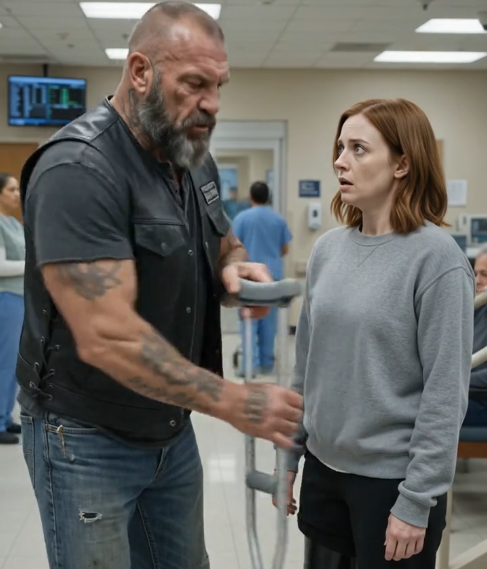
The biker took my disabled sister’s aluminum crutch in both hands and snapped it across his knee inside a crowded hospital, while our mother screamed for security and strangers lifted their phones to record what looked like deliberate cruelty.
I was standing six feet away.
My name is Nora Bennett. I was thirty-four then, a high school librarian in Albuquerque, New Mexico, and the woman staring at the broken crutch was my younger sister, Emma.
Fourteen months earlier, Emma had entered that same hospital with two legs.
She left with one.
At twenty-six, she had survived an interstate collision that killed two people, crushed the front of her Subaru, and damaged her left leg beyond anything the surgeons could repair. She spent eleven weeks in the hospital, four months in a wheelchair, and another five learning how to balance with a prosthetic limb she still hated looking at.
That Tuesday morning, she had come to Presbyterian Hospital for her first attempt at walking an entire flight of rehabilitation stairs without assistance.
Then the biker arrived.
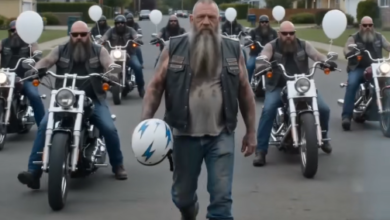
He was impossible to miss—six-foot-four, close to 285 pounds, shaved head, thick black-and-gray beard, scarred knuckles, and tattooed forearms exposed beneath a plain black leather vest. His faded jeans were tucked over heavy boots. A steel chain hung from his wallet, clicking softly whenever he moved.
People watched him before he did anything wrong.
A receptionist lowered her voice. A father pulled his young son closer. A security guard near the elevators straightened as the stranger crossed the rehabilitation lobby carrying a long wooden case beneath one arm.
Outside the glass doors, a midnight-blue Harley sat alone beside the curb. Its V-twin engine had just gone quiet, but I could still feel the last low pulse of it through the tiled floor.
Emma was standing near the stairwell, adjusting the rubber tip of her left crutch.
The biker stopped.
He stared at it.
Not at Emma’s missing leg. Not at her prosthesis. At the crutch.
“You putting your full weight on that?” he asked.
Emma stiffened. She had grown used to strangers staring, offering advice, or asking questions they would never ask an able-bodied woman.
“I know how to use it,” she said.
“Didn’t say you didn’t.”
He stepped closer.
My mother moved between them. “Can we help you?”
The biker ignored her. He crouched, ran one thick thumb along the aluminum shaft beneath Emma’s handgrip, then tapped the tube twice with a silver ring.
Tink.
Tink.
His face changed.
“Give me the crutch.”
Emma pulled it back. “No.”
“You can’t use that.”
“What is wrong with you?” I demanded.
He looked at me only once. His eyes were pale gray, tired rather than angry.
“Ask the metal.”
Before any of us understood what he meant, he closed one hand above the grip and the other below it. Emma tried to stop him. My mother screamed.
The aluminum folded with a dry, violent crack.
One half struck the floor.
The other remained in his hand.
The lobby erupted.
A man near the vending machines shouted, “Hey!” Two nurses rushed from the rehabilitation desk. Phones rose around us. The security guard grabbed the biker’s shoulder while my mother called him a monster and demanded that somebody arrest him.
Emma stood frozen on one leg, humiliation burning across her face.
“You think this is funny?” she asked.
The biker did not resist when security pulled his arms behind him.
“No, ma’am.”
“Then why?”
He slowly turned the broken section toward us.
A jagged silver blade had split from inside the tube directly beneath the handgrip. It was thin as a knife point and angled upward toward the place where Emma’s palm had been pressing moments earlier.
One more hard step could have driven it through her hand.
The lobby went silent.
The biker placed both broken pieces on the floor, beside the wooden case he had carried inside. As security led him toward the doors, the case shifted open just enough for me to glimpse two polished metal crutches resting in dark blue cloth.
Each had a small piece of scarred midnight-blue steel fitted near the grip.
The same color as the Harley outside.
Emma stared at them, then at the biker’s right wrist. Beneath his tattoos was a long white scar, shaped like the injury described in the unidentified motorcyclist’s section of her old accident report.
“Who are you?” she called.
He stopped but did not turn around.
“The man who should’ve checked your crutch yesterday.”
Then the automatic doors opened, and he disappeared into the sunlight before any of us understood why a stranger had already built replacements—or why metal from his damaged Harley carried Emma’s initials.
Part 2 — The Man Who Heard Metal Breaking
The security guards did not arrest him.
That angered my mother almost as much as the broken crutch.
Hospital administrators reviewed three phone recordings, spoke with the rehabilitation staff, and examined the split tube. The biker had touched no one. He had surrendered immediately. Most importantly, the jagged fracture inside the crutch was real.
A biomedical equipment technician later told us the aluminum had probably been damaged weeks earlier. A tiny stress fracture had begun beneath the foam grip, hidden by glue and worn rubber. Each time Emma placed her weight on it, the crack traveled farther around the tube.
The biker had not created the danger.
He had finished what the fracture had already started.
“He could have warned us,” my mother said.
“He tried,” Emma answered.
“He could have given it back.”
“So I could fall on it?”
Mother had no reply.
Emma spent the afternoon in a wheelchair while the hospital found a mismatched loaner pair. The right crutch was blue. The left was gray. One was adjusted an inch too high, and the rubber tip on the other squeaked against every polished floor.
She hated them.
Disability had forced her to borrow too much already—mobility, privacy, rides, money, patience. She had once driven alone from Albuquerque to Santa Fe at midnight because she wanted coffee from a diner she loved. Now six people had to discuss whether she could safely cross a wet parking lot.
The broken crutch felt like one more piece of her life being taken without permission.
Yet she kept asking about the wooden case.
A nurse named Beth remembered seeing the biker in the rehabilitation wing before. He had come on three separate Mondays, always shortly before Emma’s appointment. He never entered the therapy room. He sat near the vending machines, drank burnt coffee, and left when Emma’s session ended.
“That is not comforting,” I said.
Beth frowned. “He wasn’t watching her the way you think.”
“How was he watching?”
“Like he was waiting to see whether she walked out.”
That was worse.
I went outside and found the midnight-blue Harley still parked by the curb. The biker sat on a low concrete wall twenty yards away, speaking to an older Black man in a brown leather cut. The second man had a silver beard, a heavy limp, and an Iron Lantern emblem stitched above his chest pocket.
The biker saw me coming.
He stood.
Up close, he seemed even larger, but there was no threat in the way he held himself. His hands remained visible. The wooden case lay at his boots.
“Your sister okay?” he asked.
“You knew about the crack.”
“I heard it.”
“You heard a fracture inside an aluminum tube from across a hospital lobby?”
“Wasn’t across the lobby yesterday.”
The answer stopped me.
He told me he had passed Emma near the outpatient entrance after her previous appointment. She planted the crutch beside the curb, and the shaft made a faint double click beneath her weight. Most people would have blamed the rubber tip or the tile.
He did not.
His name was Raymond Dawson, though everyone called him Hammer. He had spent thirty-one years rebuilding motorcycle frames, crash bars, handlebars, and suspension components at a small fabrication shop near Central Avenue.
Metal warned before it failed, he said.
Sometimes it bent.
Sometimes it discolored.
Sometimes it whispered.
“You followed her into the hospital because you heard one click yesterday?”
“Two clicks.”
“You could have approached us then.”
“Tried. Your mother’s van pulled out.”
“So you came back today carrying replacement crutches?”
Hammer looked at the case.
“They weren’t finished yesterday.”
I opened my mouth, then closed it.
The older biker introduced himself as Boone Carter, a retired Army medic and one of the Iron Lanterns. Boone explained that Hammer had worked all night completing the pair, then ridden to the hospital without sleeping.
“Why?” I asked.
Hammer’s jaw moved beneath his beard.
“Because the bad one was still under her hand.”
“That doesn’t explain why you had already started building replacements.”
“No.”
“Or why you know my sister.”
He looked toward the hospital doors.
“Don’t know her.”
“You have her initials engraved on those crutches.”
“Know the initials.”
My anger returned. “You sat in this lobby three Mondays in a row. You knew her rehabilitation schedule. You carried a custom pair made for her height. That is not the behavior of a stranger.”
Boone lowered his gaze.
Hammer said nothing.
Then I noticed the Harley more carefully.
Its paint was midnight blue, but the left side of the fuel tank had been restored in a slightly different shade. The front crash bar was new. One saddlebag carried a long scrape beneath its polished surface, and the frame near the footboard had a line of visible welding.
Emma’s accident report had mentioned a damaged motorcycle at the scene.
The rider’s name had been withheld from the public copy because he had been unconscious when police arrived and left the hospital before investigators completed their first interviews.
A witness had described the motorcycle as dark blue.
My voice changed.
“Were you on Interstate 40 fourteen months ago?”
Hammer glanced at Boone.
That was enough.
“You were there.”
“Lot of people were.”
“Did you see the crash?”
“Yes.”
“Did you see my sister?”
His scarred fingers closed around the wooden handle of the case.
“Yes.”
“What happened to your wrist?”
He turned toward the Harley.
“Bike fell on it.”
Mother called me from inside before I could ask more. Emma needed help adjusting the loaner crutches, and a hospital risk manager wanted our statements.
When I looked back through the glass doors, the two bikers were leaving. Boone rode first. Hammer secured the wooden case across his rear seat but did not start the engine immediately.
He pressed his palm once against the repaired section of the fuel tank.
Then the Harley came alive.
The low V-twin rumble rolled along the hospital windows, passed through the lobby, and faded into traffic.
That evening, Emma searched every public photograph from the accident.
In the sixth image, behind an ambulance and two firefighters, we saw a large bearded man sitting against the concrete divider. His right wrist hung at an impossible angle.
Across his lap lay Emma’s bloodstained yellow scarf.
Part 3 — The Part of the Crash Nobody Told Us
Emma remembered almost nothing about the collision.
There were fragments.
Rain on the windshield. A country song playing too quietly. A red toolbox sliding across the back seat when traffic slowed near the Rio Puerco bridge. Then brake lights filled the highway.
She remembered turning the wheel.
She remembered glass.
After that, her memory became sound without pictures—the hiss of a damaged radiator, someone shouting not to move, boots scraping pavement, and a motorcycle engine roaring where no motorcycle should have been moving.
The police report gave us the clean version.
At 4:37 p.m., during a desert thunderstorm, a landscaping truck lost its utility trailer while traveling east on Interstate 40. The trailer crossed two lanes and struck the rear quarter of Emma’s Subaru. Her car spun, hit the concrete divider, and stopped sideways in the left lane.
That first impact crushed the driver’s side and trapped her left leg beneath the dashboard.
It did not cause the amputation.
A delivery van traveling behind the Subaru lost control on the wet pavement. The driver tried to brake but had nowhere to go. According to investigators, the van would have struck Emma’s door almost directly.
It never reached her.
Something hit it first.
Hammer had been riding thirty yards behind the van on his restored 2006 Harley-Davidson Road King. Boone and three Iron Lanterns were farther back, returning from a funeral escort in Gallup.
When Emma’s car spun, Hammer moved toward the shoulder.
Then he saw the van sliding toward her.
“He could’ve kept going,” Boone told us two days later at the Iron Lanterns’ garage. “Would’ve been the smart move. He had maybe three seconds, wet pavement, and six hundred pounds of motorcycle underneath him.”
Hammer did not keep going.
He accelerated.
At the final moment, he turned the Road King across the van’s path and jumped from the seat. The Harley went down on its left side. Its steel crash bar, frame, fuel tank, and rear wheel struck the van at an angle.
The motorcycle could not stop a delivery van.
It did not need to.
The impact altered the van’s direction by several feet. Instead of crushing Emma’s door, the van tore through the Subaru’s front end and shoved it along the divider. The dashboard collapsed around her leg, but the passenger compartment remained intact.
The Harley disappeared beneath both vehicles.
Hammer hit the pavement shoulder-first, slid nearly forty feet, and fractured his wrist in two places. By the time he stopped moving, gasoline was spilling from the motorcycle and steam was rising around Emma’s car.
He stood anyway.
Boone arrived seconds later and found Hammer trying to pull open the Subaru’s passenger door with one hand.
“I told him to get down,” Boone said. “He told me to shut off the fuel.”
That sounded like Hammer.
Boone crawled toward the motorcycle and closed the damaged fuel line. The other riders warned traffic while Hammer climbed through the passenger window. Emma was conscious but disoriented. Her foot was pinned, blood had soaked her jeans, and every movement shifted twisted metal beneath the dashboard.
“You kept calling somebody Michael,” Hammer later told her.
Emma’s face tightened. Michael had been her fiancé.
He ended their engagement seven weeks after the amputation.
“I thought he was with me,” she said.
“He wasn’t.”
“What did you say?”
“Told you I was uglier but available.”
Emma laughed before she meant to.
It was the first time I saw Hammer smile. Barely.
Then his expression hardened again.
The fire department needed seventeen minutes to reach the wreck because traffic had blocked the nearest access point. During that time, Hammer remained inside the Subaru while Boone stabilized him from outside.
Emma’s pulse weakened.
Her skin turned gray.
She kept trying to pull her trapped leg free, which worsened the bleeding. Hammer removed his leather vest, folded it beneath her knee, and used his belt as pressure above the wound.
His broken wrist swelled until he could no longer close his fingers.
So he used his forearm.
At some point, Emma’s yellow scarf became trapped between his palm and the torn metal. That was why it lay across his lap in the photograph.
“Why didn’t we know any of this?” I asked.
Boone leaned against a workbench. “Hammer checked himself out before the family arrived.”
“With a broken wrist?”
“Doctors set it. Wanted him overnight. He hates hospitals.”
Hammer was across the garage, sanding a steel tube. Sparks jumped from the machine in short orange bursts. He wore safety glasses and ignored us.
Mother stared at him. “You saved her.”
He switched off the grinder.
“Paramedics saved her.”
“You redirected that van.”
“Bike did.”
“You went inside the car.”
“Door was open.”
“It was a window,” Emma said.
Hammer studied the tube in his hands. “Big window.”
Emma looked toward the rear of the garage, where a heavy tarp covered the stripped remains of a motorcycle frame.
“Is that the Road King?”
Nobody answered.
She walked toward it using the mismatched hospital crutches. The blue one squeaked. The gray one struck the concrete half a beat later.
Hammer stepped into her path.
“Leave it covered.”
“Why?”
“Nothing useful under there.”
“You used metal from it for the new pair.”
His face did not change, but Boone’s did.
Emma saw.
“So that’s true.”
Hammer set the steel tube on the bench. “Some of it.”
“How long have you been making them?”
“While.”
“How long?”
He pulled off his safety glasses.
“Eleven months.”
The garage became silent except for rain tapping the corrugated roof.
Emma stared at the wooden case resting on a shelf. “You spent eleven months building crutches for a woman you never spoke to?”
“Built four pairs.”
“What happened to the others?”
“Failed.”
“Why didn’t you just buy me a pair?”
“Because bought ones failed too.”
She glanced at the mismatched crutches beneath her arms.
Hammer’s attention moved to the blue loaner. “That one’s an inch short.”
“I know.”
“Grip’s wrong angle.”
“I know.”
“Cuff’s rubbing your forearm.”
“I know.”
His voice softened by a fraction. “Then let me finish.”
Mother folded her arms. “Why should we trust anything you made?”
Hammer’s eyes remained on Emma.
“You shouldn’t.”
He opened the wooden case and lifted out the new pair.
The uprights were brushed silver, shaped to Emma’s height, with dark blue forearm cuffs and grips molded to her hands. Near each handle was a curved brace of scarred midnight-blue metal. The original scratches remained beneath a clear protective finish.
He placed them on the workbench.
“Have the hospital test them,” he said. “Break them if they’re bad.”
Then he covered the ruined Harley before Emma could see what was missing from its frame.
Part 4 — Four Crutches and One Promise
The hospital did test them.
Hammer insisted.
He refused to let Emma use the new crutches until a rehabilitation engineer, prosthetist, and physical therapist had examined every joint. He brought material certificates for the new aerospace-grade aluminum uprights, load calculations for the grips, welding records, and photographs from each stage of construction.
The scarred blue braces were the only pieces salvaged directly from the Road King. They had once formed part of the motorcycle’s rear crash protection. Hammer had cut, heated, straightened, and reshaped them into structural supports near the handgrips.
They were not decorations.
They carried weight.
The first pair had been too heavy. Hammer destroyed them.
The second flexed four millimeters more than he allowed. He drove over them with his truck so nobody could donate or resell them.
The third pair passed his tests but made too much noise on tile. Emma had become sensitive to mechanical clicking after the accident, although she had never told him that.
He scrapped those too.
The pair inside the wooden case was number four.
“How did he know the clicking bothered her?” I asked Boone.
“He heard her mention it to a therapist.”
“So he was watching her.”
“Checking on her.”
“Without permission.”
Boone nodded. “That part was wrong.”
There was no excuse added. I appreciated that.
Hammer’s guilt did not grant him ownership over Emma’s recovery. Saving her life did not give him the right to observe it from behind vending machines. When Emma confronted him, he did not hide behind good intentions.
“I crossed a line,” he said.
“Several.”
“Yeah.”
“You could have introduced yourself.”
“Didn’t know how.”
“You know how to speak.”
“Debatable.”
She almost smiled, but held it back.
Hammer explained that after the crash, he asked Boone to check whether the woman in the Subaru had survived. Boone learned her name from a newspaper report and followed updates shared by our family’s church.
At first, they expected Emma to recover.
Then infection set in.
Doctors amputated above the knee nine days after the collision. When Hammer heard, he locked the garage and disappeared for two days. Boone found him at the impound yard sitting beside the Road King’s crushed frame.
He blamed the motorcycle.
The Harley had diverted the van, but the final collision drove the Subaru’s dashboard into Emma’s leg. Hammer kept replaying different angles in his mind. If he had struck the van earlier. If he had aimed farther right. If he had stayed on the bike longer.
“If he’d done any of that,” Boone said, “he probably would’ve died, and your sister might have died with him.”
Hammer knew the facts.
Guilt did not care.
He bought back the Road King from the insurance company after it was declared a total loss. The adjuster offered salvage value. Hammer paid it, loaded the broken bike onto a trailer, and kept every bent part.
For three months he repaired nothing.
Then he learned Emma was leaving inpatient rehabilitation on crutches.
He began measuring the wreck.
The crash bar had folded without shattering. The rear guard had taken a direct strike and remained structurally intact. Those pieces had absorbed energy that otherwise would have reached the Subaru.
Hammer cut a six-inch section from the scarred blue steel and placed it on his workbench.
“What were you planning?” Emma asked.
“Didn’t know yet.”
“What changed?”
He looked toward her prosthesis.
“Saw you fall.”
It happened outside the rehabilitation hospital seven months after the crash. Emma had been learning to transition from wheelchair to crutches when one rubber tip slipped on wet pavement. Her therapist caught her, but the incident lasted long enough for Hammer to see the panic on her face.
The next week, he contacted a prosthetics fabricator named Dr. Sanjay Patel.
Dr. Patel refused him.
He told Hammer custom mobility equipment was not a motorcycle accessory. A badly designed crutch could damage nerves, injure shoulders, or cause a fall. Salvaged metal created additional risks.
Hammer returned with engineering drawings.
Dr. Patel refused again.
Hammer came back with laboratory testing from a metallurgist.
“No,” Dr. Patel said.
Hammer brought Boone, who explained the accident.
Still no.
Then Hammer placed the scarred blue steel on Dr. Patel’s desk and said, “This already carried her once.”
That sentence earned him ten minutes.
The ten minutes became eleven months.
Dr. Patel designed the geometry. Hammer fabricated test pieces. A rehabilitation engineer evaluated loading. A local upholstery worker shaped the cuffs. An occupational therapist created a mold based on measurements from a standard grip Emma had used during therapy.
No one gave Hammer her private medical records.
He built around publicly available components, then left the final adjustments unfinished until Emma could consent.
The initials near each grip were not Emma’s.
They were E.B.
Eli Boone.
I looked at Boone. “Your son?”
Boone’s face tightened.
“My grandson.”
Eli had been fourteen when a neuromuscular disease took away his ability to walk. Hammer built ramps for the family’s house, modified Boone’s truck, and repaired every wheelchair the insurance company refused to replace quickly.
Eli died at seventeen.
Before he died, he spent hours in Hammer’s garage drawing ideas for better crutch grips—equipment he hoped he might one day use if a new therapy restored enough strength to his legs.
It never did.
The curved support beneath Emma’s palm came from one of Eli’s sketches.
“That is why Hammer kept visiting,” Boone said. “At first, he was checking on the woman the bike hit. Then he saw her fighting with the same equipment Eli hated.”
Emma looked at the initials again.
Two lives had been built into the pair before she ever touched them.
“You made these for him,” she said.
Hammer shook his head. “Made them too late for him.”
“And too early for me.”
“Yeah.”
She ran one finger over the scarred blue brace.
“Then finish them with me.”
Part 5 — The First Step on Blue Steel
The final fitting took place on a Friday morning.
No crowd gathered. No phones were allowed. Emma requested only family, her physical therapist, Dr. Patel, Boone, and Hammer.
Hammer arrived last.
He wore a clean black work shirt instead of his leather vest, but his boots still announced him down the hallway. The wooden case looked smaller beneath his arm than it had the day he broke the old crutch.
He placed it on the therapy table and stepped back.
Dr. Patel adjusted the cuff angle. Emma tested the grips. The right felt perfect. The left pressed against the base of her thumb.
Hammer marked the spot with a white pencil.
“Ten minutes,” he said.
It took forty.
He returned from the hospital maintenance shop carrying a fine file and a replacement grip support. His knuckles were dark with metal dust. Dr. Patel inspected the piece, installed it, and tightened the final fastener.
Emma stood between parallel bars.
Her prosthetic knee locked.
The new crutches took her weight.
Nothing clicked.
She shifted forward. The scarred blue steel beneath her palms remained silent. Her shoulders relaxed for the first time that morning.
One step.
Then another.
At the far end of the room stood the practice staircase she had intended to climb on the day Hammer snapped her old crutch. Fourteen shallow steps led to a small platform and back down the opposite side.
Emma stopped at the bottom.
“You don’t have to do this today,” her therapist said.
“I was supposed to do it Tuesday.”
“Tuesday changed.”
Emma glanced at Hammer. “Did you test these on stairs?”
“Loaded them to three times your body weight.”
“That wasn’t my question.”
He rubbed his beard. “Boone tried them.”
Boone lifted both hands. “Three steps. I have a bad knee.”
Emma smiled.
Then she climbed.
The first step was awkward. The rubber tips landed unevenly. She corrected them.
The second was cleaner.
By the fifth, Mother was crying quietly behind me. By the eighth, my own hands were trembling. Hammer stood near the door, arms folded across his chest, watching the crutches rather than Emma’s face.
At step eleven, her prosthetic knee failed to lock.
Her body dropped.
The left crutch struck the edge of the stair with a sound that snapped every person in the room back to the accident.
Metal hit concrete.
Emma gasped.
Hammer took one step forward, then stopped himself. The therapist caught Emma’s safety belt, but most of her weight landed on the left crutch.
It held.
The blue brace flexed and returned.
Emma looked down at it.
Hammer’s scarred hands were clenched so tightly that his knuckles had turned white.
“You expected it to break,” she said.
“No.”
“You looked like you did.”
“Expected everything to.”
She steadied herself and climbed the remaining steps.
At the platform, Emma turned around. Her face was flushed. Sweat darkened her hairline. She looked exhausted and furious and more alive than she had in months.
She lifted the left crutch.
“This one stays.”
Hammer nodded.
“So does the other one.”
Another nod.
“And you stop sitting behind vending machines.”
“Done.”
“If you want to know whether I walked out, ask me.”
Hammer’s jaw tightened. “All right.”
“Say it.”
“What?”
“Ask.”
The huge biker looked almost embarrassed.
“Did you walk out?”
Emma leaned on the blue steel and smiled.
“Watch me.”
She descended the opposite staircase.
Afterward, Hammer tried to leave before the hospital could photograph the equipment for its adaptive-mobility records. Emma blocked the door with one crutch.
He looked at the polished metal between them.
“That’s a weapon now?”
“Depends. Why were you watching the crutch instead of me?”
His gaze moved toward the floor.
The truth came slowly.
For fourteen months, whenever he closed his eyes, he saw the delivery van sliding toward the Subaru. He heard the Harley’s frame grinding beneath it. He saw Emma trapped behind glass while his own hand failed to hold pressure against her leg.
Building the crutches had given those sounds somewhere to go.
“If they failed,” he said, “then I took something from you twice.”
Emma’s expression softened, but her voice did not.
“You did not take my leg.”
“Bike pushed the van.”
“The bike kept the van out of my chest.”
“Could’ve done better.”
“You had three seconds.”
“Long time.”
“No, Hammer. It isn’t.”
He looked at her then.
Emma tapped the scarred blue brace. “This metal did not fail me. Neither did you.”
Nobody spoke.
Hammer did not cry. He simply reached for the wooden case, found it empty, and closed the lid with both hands.
That empty case seemed heavier than the crutches had been.
Before leaving, he returned the two pieces of Emma’s broken aluminum crutch. Dr. Patel had removed the foam grip and cut open the tube lengthwise.
The hidden fracture ran almost completely around the shaft.
A thin shard had been less than a quarter inch from breaking through.
Mother touched it and went pale.
“You saw this beneath the grip?”
“Heard it first,” Hammer said.
She looked at the man she had called a monster in front of an entire hospital.
“I owe you an apology.”
Hammer shook his head. “You owed her protection.”
“I was protecting her from you.”
“Looked like you had reason.”
That was the nearest he came to forgiving her aloud.
Mother hugged him anyway.
Hammer stood rigid, arms at his sides, like a man being searched by law enforcement. Boone laughed until Hammer threatened to leave him at the hospital.
It was an ordinary joke.
That made it more important than any speech.
Part 6 — What Remained of the Road King
Emma began visiting the Iron Lanterns’ garage every other Saturday.
At first, she went for adjustments. The cuffs needed softer lining. One rubber tip wore faster than the other. Hammer changed the grip angle by two degrees after noticing her left shoulder rising during longer walks.
Later, she went because the garage treated her prosthesis as equipment, not tragedy.
Nobody whispered when she removed it. Nobody told her she was brave for crossing a room. Sparks Ortega found a loose bolt in the knee cover and asked whether he could tighten it. Boone kept a folding chair near the workbench without making a ceremony of placing it there.
Hammer never asked about Michael.
Emma never asked about Eli until Boone was ready.
The ruined Road King remained beneath its tarp for another five months.
One November afternoon, Hammer finally uncovered it.
Most of the motorcycle was gone. He had reused the engine, transmission, wheels, and anything the collision had not compromised. The bent frame sat on a low stand. Its blue paint was scraped to bare steel along the left side.
Two clean sections were missing from the rear guard.
Emma fitted one crutch into each gap.
The blue braces aligned with the empty cuts.
“So this is where they came from,” she said.
Hammer nodded.
The frame looked wounded without them, but not incomplete. The missing steel was still carrying weight. Just somewhere else.
Emma asked whether he would rebuild the Harley.
“Can’t trust that frame.”
“What will you do with it?”
“Keep it.”
“Why?”
Hammer brushed dust from the fuel tank. “Remember what held.”
The following spring, Emma returned to part-time work as an architectural designer. Her first independent project was an accessibility renovation for an Albuquerque community center.
She designed wider ramps, rest areas that did not resemble medical stations, and railings with grips based partly on Eli’s sketches. Near the entrance, she added a small repair cabinet stocked with replacement crutch tips, cane ferrules, hex keys, and emergency mobility parts.
No plaque named Hammer.
He would have removed it.
Instead, Emma painted a thin midnight-blue line along the cabinet door.
Hammer saw it during the opening and ran one thumb over the color. He understood.
On the anniversary of the accident, we drove to the Rio Puerco bridge. Hammer and the Iron Lanterns arrived on six Harleys. They parked on the shoulder where the wreck had ended and killed their engines together.
Traffic continued past us.
For one minute, the only sounds were desert wind, cooling exhaust pipes, and the rubber tips of Emma’s crutches against wet pavement.
She stood beside the place where the blue Road King had gone down.
Then she handed Hammer the yellow scarf from the accident.
He had washed it before returning it, but a dark stain remained near one corner.
“You kept this?” he asked.
“You did first.”
Hammer folded it once and tied it around the empty section of the old crash bar he carried in his saddlebag.
The scarf moved in the highway wind.
Blue steel beneath yellow cloth.
Nothing else needed explaining.
Part 7 — The Crutch He Refused to Break
Two years after Hammer snapped Emma’s damaged crutch, a young veteran named Lucas came into the Iron Lanterns’ garage with a loose carbon-fiber forearm cuff.
He had seen the midnight-blue repair cabinet at the community center and followed the small Iron Lantern symbol inside its door.
Hammer inspected the cuff.
Emma stood beside him, leaning on the crutches they had finished together. Their silver uprights carried scratches now. The dark blue supports had lost some shine where her thumbs rubbed them every day.
Hammer tapped Lucas’s crutch twice.
Tink.
Tink.
Everyone in the garage looked up.
Lucas tightened his grip. “You going to break it?”
Hammer glanced at Emma.
She raised one eyebrow.
“No,” he said. “Got supervision now.”
He repaired the cuff instead.
Emma later became a volunteer adviser for Dr. Patel’s adaptive-mobility program. Hammer built test fixtures but refused all official titles. Boone called him Director of Hitting Things Until They Worked.
Hammer objected to the word director.
Not the rest.
The hospital kept Emma’s old fractured tube in a safety-training display. The viral video of Hammer snapping it circulated for months, usually without the later explanation. Strangers still called him cruel beneath reposts.
He never answered them.
Emma did, once.
She posted a photograph showing only her hands resting on the blue steel grips. Beneath it, she wrote:
He did not break what helped me walk. He broke what was about to make me fall.
Then she logged out.
Every year on the anniversary of the crash, Hammer rides the restored parts of the Road King to the Rio Puerco bridge. The original frame cannot return to the highway, but one piece travels with Emma and another remains tied beneath the faded yellow scarf in his garage.
The rest lives in the choices made afterward.
Last June, Emma climbed the hospital stairs again. No therapist waited behind her. No safety belt circled her waist. Mother and I stood at the bottom while Hammer watched from the same place near the doors.
At the top, Emma turned.
“Did I walk out?” she called.
Hammer struck one scarred fist against his chest.
Then he answered with the only word she needed.
“Yeah.”
Outside, the Harley started. Its V-twin pulse passed through the hospital glass as Emma descended on two lengths of scarred blue steel that had already carried her through one collision.
This time, nobody mistook the sound.
Follow our page for more powerful biker stories about misunderstood riders, hidden sacrifices, and the quiet humanity beneath the leather, scars, and roaring engines.