Left Alone Outside a Late-Night Supermarket — Until a Biker Sat Down and Waited With Him
At nearly midnight, a small boy sat alone on the cold pavement outside a supermarket, crying softly—when a motorcycle rolled in and stopped so close that several shoppers froze.
The parking lot was half-lit, half-forgotten. One flickering streetlight buzzed overhead. A shopping cart rattled in the wind. The automatic doors slid open and closed with a tired hiss, letting out brief bursts of fluorescent light and warm air before sealing the night back in.
The boy couldn’t have been more than six.
He sat with his back against the concrete wall, knees hugged to his chest, a thin hoodie pulled over his head. One sneaker lay on its side a few feet away, the lace torn, as if it had given up. His hands shook as he wiped his face again and again, trying to stop the tears without making noise.
People passed him.
A couple walked by, bags rustling.
A man unlocked his car, glanced once, then looked away.
Someone muttered, “Where’s his mom?” like the question itself was enough to absolve them.
The boy stared at the ground, whispering something only he could hear. Every time the doors opened, he flinched—as if he expected the night to swallow him whole.
Minutes stretched into something heavier. Something dangerous.
Then the sound arrived.
Low. Mechanical. Close.
A motorcycle engine rolled into the parking lot and slowed, its headlight sweeping across asphalt, carts, and finally—
The boy.
The engine cut.
Silence rushed back in.
The biker swung off the seat and removed his helmet.
No one knew who he was.
No one knew why he’d stopped.
Only that he didn’t leave.
The biker didn’t approach the boy right away.
That made people nervous.
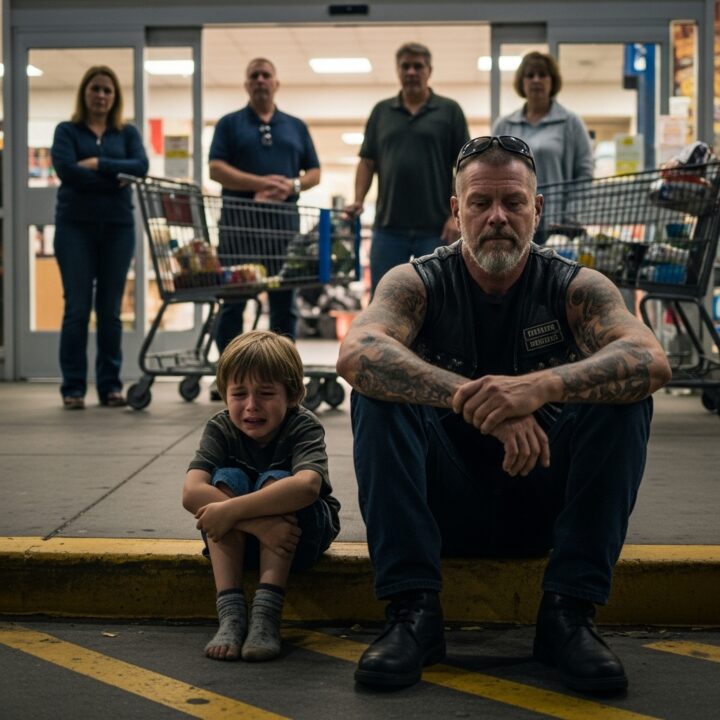
He stood beside his bike for a moment, tall and broad, sleeveless black shirt clinging to his frame, tattoos running down his arms like old maps of places he’d survived. Dark glasses still covered his eyes despite the hour. His boots were scuffed, planted firmly, like he wasn’t in a hurry to be anywhere else.
A woman exiting the store slowed.
A man whispered, “That doesn’t look good.”
The biker finally moved—but instead of reaching for the child, he walked past him and sat down on the curb. Not close. Not touching. Just… there.
The boy looked up, startled.
Their eyes met for half a second.
The boy’s breath hitched, panic flooding his face. He scrambled backward, palms scraping against concrete. “I didn’t do anything,” he said quickly, voice breaking. “I’m just waiting.”
The biker raised one hand, palm open. No sudden movements. No pressure.
“I know,” he said quietly.
That didn’t calm anyone else.
A store employee stepped outside, eyes darting between the biker and the boy. “Sir, you can’t—uh—you shouldn’t—”
Another shopper pulled out a phone.
Someone else said the word “police” under their breath.
The biker didn’t argue. Didn’t explain. He reached into his pocket slowly, deliberately—and pulled out a granola bar. He set it on the ground between them, still keeping his distance.
“You hungry?” he asked.
The boy nodded without thinking.
The biker slid the bar closer with his boot.
To the people watching, it still looked wrong. A biker lingering with a child in the dark. Silence. No witnesses he knew. No explanations offered.
A man shouted from near the carts, “Hey! Back away from him!”
The biker looked up. Calm. Measured.
“I’m sitting,” he said. “So is he.”
Security was called. The manager was notified. Someone dialed 911 “just to be safe.”
The boy’s eyes filled with fresh tears. “Am I in trouble?” he whispered.
The biker shook his head. “No.”
But the crowd didn’t believe him.
And the fear sharpened.
The night tightened around them.
Two store employees stood by the doors now, arms crossed, watching. A patrol car hadn’t arrived yet, but its absence felt temporary. Judgment filled the space where understanding should have been.
The boy chewed the granola bar slowly, hands trembling. “My mom said she’d be right back,” he said suddenly. “She said stay here.”
“How long ago?” the biker asked.
The boy shrugged. “It was still light.”
That answer hit harder than any accusation.
A security guard stepped closer. “Sir, we need you to move away from the child.”
The biker nodded once—and stayed seated.
“I’m not touching him,” he said evenly. “I’m waiting.”
“For what?”
The biker reached into his pocket again.
This time, he pulled out his phone.
That single motion sent a ripple through the onlookers.
“Don’t do anything stupid.”
“Hands where I can see them.”
“Sir—”
He ignored the noise, typed a short message, and hit send.
No explanation.
He looked back at the boy. “What’s your name?”
“Caleb.”
“Caleb,” he said, “we’re gonna sit right here. Okay?”
Caleb nodded, trusting him now in a way that scared the adults more than the biker ever could.
The security guard spoke into his radio. “Yeah. We’ve got a situation.”
The automatic doors opened again.
And this time, the sound wasn’t footsteps.
It was engines.
Plural.
Low. Approaching.
Whatever was coming, no one was ready for it.