The Biker Who Snatched a Child From His Father in a Parking Lot — And Made the Crowd Turn on Him
He tore the little girl from her father’s arms in the middle of a Walmart parking lot, and someone screamed, “He’s kidnapping her!” — but I knew if I hesitated, she might not survive the day.
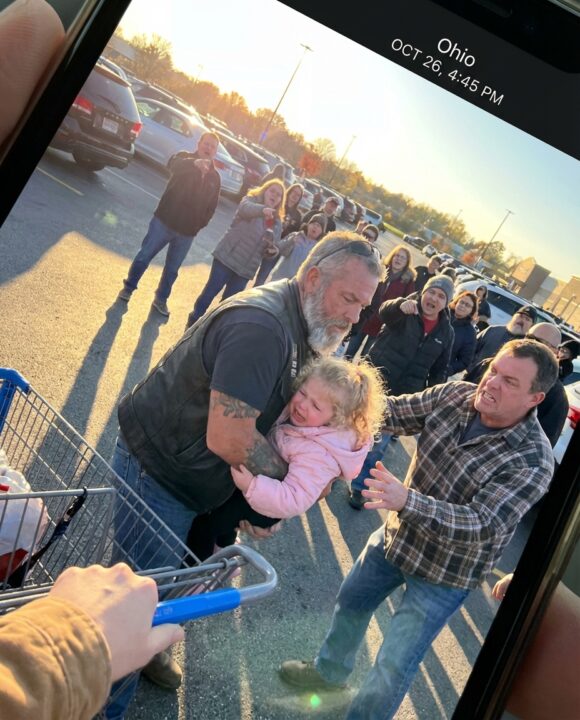
It was 5:42 p.m. on a humid Thursday in late August, just outside Dayton, Ohio. The sun was low, throwing long shadows across rows of cars and shopping carts rattling in the wind.
I heard the crying before I saw them.
A high, panicked sound. Not the kind that comes from a child who wants candy. The kind that comes from pure fear.
A man in his mid-thirties stood beside a dented blue pickup truck, gripping a little girl by the wrist. She couldn’t have been more than four. Blonde curls. Pink sneakers. Tear-streaked cheeks.
“Let me go!” she sobbed, twisting her body away from him.
He tightened his hold.
People noticed — but they did what crowds do best.
They watched.
Some slowed their carts.
Some whispered.
No one stepped forward.
I saw his face when he bent down to her level.
It wasn’t frustration.
It wasn’t embarrassment.
It was something colder. Something that made my stomach turn.
I’d seen that look before.
And I knew the court order in his glove compartment didn’t matter.
I didn’t think.
I moved.
Boots hitting pavement.
Leather vest shifting against my shoulders.
I crossed the lot in seconds and grabbed the child, pulling her into my chest as the man shouted.
And then the screaming started.
“Call 911!”
“He’s stealing her!”
Phones lifted.
Hands pointed.
In less than ten seconds, I wasn’t the man protecting a child.
I was the monster in a leather vest.
And the father was the victim.
The little girl clung to my neck like she’d been waiting for someone to do exactly what I’d just done.
Her fingers dug into the collar of my shirt.
“Don’t let him take me,” she whispered into my ear.
That whisper hit harder than the shouting around us.
The father lunged forward. “Give me my daughter!”
His voice cracked in just the right places. Desperate. Hurt. Convincing.
To everyone else, it looked clean.
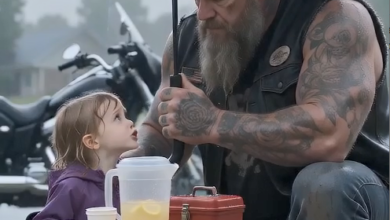
A man in a sleeveless leather vest with tattoos had just ripped a child from her parent in broad daylight.
I could feel the shift in the crowd.
Judgment.
Anger.
Phones recording.
A woman yelled, “Put her down before we tackle you!”
Someone else shouted, “What kind of psycho grabs a kid like that?”
I didn’t answer.
I kept my body angled, shielding her.
The father reached for her again. I stepped back.
“Sir,” I said quietly, “the court suspended your custody.”
Gasps.
He laughed — too loud, too sharp.
“That’s a lie.”
It wasn’t.
Three weeks earlier, a judge had issued an emergency suspension after a hospital report flagged suspicious bruising. The mother had filed for full custody.
But here’s the part that twisted the knife inside me.
Two years ago, I had stood in that same courthouse.
And when asked about his temper — about what I’d seen behind closed doors — I had said, “He’s rough around the edges, but he’d never hurt his kid.”
I believed it then.
Or maybe I wanted to.
He was a mechanic who rode with us sometimes. Quiet. Paid his dues. Showed up.
When the first allegation surfaced, I testified in his favor.
That testimony helped him keep partial custody.
And three months later, the hospital documented injuries.
So when I saw him in the parking lot — when I saw his hand clamp around that tiny wrist — something inside me refused to freeze this time.
The father stepped closer.
“If you don’t hand her over,” he said, “you’re dead.”
The crowd roared.
“There! He threatened him!”
“Sir, police are on their way!” someone yelled at me.
I could hear sirens in the distance now.
My pulse stayed steady.
The little girl was trembling.
Her father reached again, angrier now.
That’s when she screamed.
Not a normal scream.
A scream of recognition.
“No! He lies! He lies!”
The parking lot went silent for half a second.
And then chaos doubled.
He tried to grab her ankle.
I shifted my stance and held her higher.
To everyone watching, it looked violent.
Aggressive.
Possessive.
But the only thing in my mind was this:
I had already failed her once.
I wasn’t going to do it again.
The sirens were getting closer.
The father’s face was changing.
And I knew in the next sixty seconds, this would either destroy me — or finally expose him.
But no one out there knew the truth.
Not yet.
The first patrol car rolled into the lot at 5:47 p.m.
Blue lights bounced off windshields. Sirens cut. Doors opened.
And just like that, the entire scene shifted from public outrage to official scrutiny.
Two officers moved fast, hands hovering near their belts.
“Sir, put the child down!”
The command was sharp. Authoritative. Designed to end chaos.
From their angle, I was a fifty-year-old biker with tattoos, gripping a screaming child while a frantic father reached for her.
I slowly lowered myself to one knee — not surrendering, but steadying.
“She stays with me until you verify the order,” I said calmly.
The father jumped in before they could respond.
“He’s crazy! He attacked me! That’s my daughter!”
His performance was flawless.
Voice cracking. Hands shaking. Eyes wide with indignation.
If I hadn’t known what I knew, I might’ve believed him too.
One officer stepped between us.
“Do you have documentation?” he asked the father.
“Yes! Yes!” The man rushed to his truck, fumbling in the glove compartment. Papers spilled onto the hood.
Temporary visitation schedule.
Expired by twelve days.
The officer scanned it quickly. His brow tightened.
“That’s not current.”
The father’s jaw clenched.
“She’s my kid!”
The little girl’s arms tightened around my neck.
“Don’t let him,” she whispered again.
And that whisper almost broke me.
The crowd kept narrating.
“He’s manipulating her!”
“Kids get confused!”
Someone shouted, “Check the cameras! He grabbed her!”
Phones were still recording. Social media was probably already spinning.
The officer looked at me.
“Why did you intervene?”
There it was.
The moment where everything hinged.
I could’ve shouted the truth. I could’ve pointed fingers. I could’ve tried to justify.
Instead, I reached slowly into my vest.
The crowd gasped again.
“Don’t!”
“Hands up!”
But I pulled out my phone.
Typed one name.
Hit call.
I stepped a few feet away, still holding the child.
When the line picked up, I said only one sentence.
“It’s happening again.”
I didn’t explain who I called.
I didn’t say why.
I just waited.
The father was pacing now, his anger slipping through cracks in the act.
“You don’t get to do this,” he hissed under his breath.
The officer asked dispatch to confirm custody status.
Seconds stretched like minutes.
Sweat rolled down my back.
The little girl’s breathing steadied slightly, but her body stayed tense.
The father took a step forward again.
“Let her go,” he growled.
That’s when his hand twitched — not toward her, but toward me.
A reflex.
And for a flash of a second, I saw it.
That same look from the hospital hallway two years ago.
The one I’d ignored.
The officer caught it too.
His posture shifted.
The radio crackled.
“Confirmed. Emergency suspension in place. Father not authorized unsupervised contact.”
The air changed.
The crowd quieted.
But the father didn’t.
“This is a mistake!”
He lunged.
Not for the child.
For me.
The officers moved fast, intercepting him, pinning his arms before anything escalated further.
And then, before anyone could process what was happening —
I heard it.
Engines.
Low. Controlled. Familiar.
Not racing.
Arriving.
The sound reached us before the bikes appeared.
A steady rumble. Not aggressive. Not chaotic.
Disciplined.
Every head turned toward the entrance of the lot.
Six motorcycles rolled in first. Then four more behind them.
They didn’t rev.
They didn’t shout.
They parked in a straight line along the edge of the scene.
Helmets came off slowly.
Men in leather vests. Sleeveless cuts. Weathered faces.
Not a single one rushed forward.
They stood.
Watching.
Waiting.
The crowd reacted instantly.
“Oh great. More of them.”
“Gang backup.”
Phones lifted higher.
But something about the way they stood — spaced evenly, hands relaxed at their sides — didn’t match the panic narrative.
The lead rider stepped forward.
Gray hair tied back. Late fifties. Calm eyes.
He didn’t look at the father.
He looked at me.
Then at the little girl.
And he nodded once.
That small nod carried ten years of history.
The officer glanced at the formation behind him.
“Sir, who are they?”
“Witnesses,” I replied quietly.
The father strained against the officers.
“You think this makes you powerful?” he shouted at me. “You think bringing your crew changes the law?”
No one responded.
The gray-haired rider spoke instead.
“We’re not here for you.”
His voice wasn’t loud.
It didn’t need to be.
He stepped beside the officer and handed over a sealed envelope.
The officer opened it carefully.
Inside were copies of statements.
Not rumors.
Not accusations.
Sworn affidavits.
Dates. Times. Observations.
My own signature among them.
Two years ago, when I testified in the father’s favor, I had left things out.
Moments I’d dismissed.
Warnings I’d brushed aside.
When the hospital report came back, I went back to the others.
We compared notes.
And we wrote everything down.
Quietly.
Without drama.
The gray-haired rider looked at the officer.
“We filed this last month.”
The officer read.
The father’s face drained of color.
The crowd, once loud and righteous, began to shift uncomfortably.
No one shouted now.
No one filmed commentary.
They just watched.
The little girl finally loosened her grip slightly.
Her father’s voice cracked for real this time.
“You’re ruining me.”
The gray-haired rider’s reply was steady.
“No. You did that.”
The authority dynamic had changed completely.
The officers now stood between him and the child — not between me and suspicion.
The crowd’s energy collapsed inward.
Judgment dissolving.
Uncertainty replacing outrage.
I slowly handed the little girl to a female officer who had arrived from the second cruiser. She knelt to her level, speaking softly.
I stepped back.
The bikes remained silent.
No cheering.
No triumph.
Just presence.
And in that quiet formation, something far heavier than anger filled the lot.
Accountability.
Not revenge.
Not intimidation.
Just the kind of accountability that doesn’t shout.
It simply stands.
And waits.
The parking lot looked smaller once the shouting stopped.
It was 6:03 p.m. when they placed him in the back of the cruiser.
No spectacle. No dramatics. Just procedure.
The little girl sat on the curb beside the female officer, wrapped in a light gray blanket pulled from the patrol car’s trunk. Her curls were damp from tears. Her pink sneakers scraped softly against the concrete as she swung her feet.
I stayed ten steps back.
That felt like the right distance.
Close enough to make sure she was safe.
Far enough to accept what I’d done before.
One of the officers approached me.
“You knew the suspension was active?”
“Yes.”
“And you testified for him two years ago?”
I nodded.
The question wasn’t accusation. It was record.
“I was wrong,” I said simply.
There was no defense in my voice. No excuse.
Just fact.
The officer studied me for a moment, then glanced at the line of bikes still parked in disciplined silence.
“They your group?”
“Yeah.”
“They didn’t escalate.”
“They don’t,” I answered.
Across the lot, people were dispersing.
Phones lowering.
Whispers changing tone.
The same crowd that had called me a kidnapper now avoided eye contact.
No apologies.
Just discomfort.
That was enough.
The gray-haired rider walked up beside me. Didn’t clap my shoulder. Didn’t praise.
He just said, “You fixed it.”
I shook my head.
“No,” I replied. “I corrected part of it.”
There’s a difference.
The little girl looked up when I finally stepped closer.
She didn’t run to me.
She didn’t hug me.
She just held my gaze.
Children don’t romanticize heroes.
They recognize safety.
That’s all.
The female officer stood and spoke quietly to me.
“Her mother’s on the way.”
I exhaled for what felt like the first time in an hour.
The father sat in the cruiser now, staring forward. No more shouting. No more performance.
Just silence.
Consequences have a way of stripping away drama.
Before we left, I walked to my bike.
The leather vest felt heavier than it had earlier that day.
Not because of what people thought.
Because of what I had once said under oath.
I had protected the wrong man.
And today, in front of strangers and cameras and flashing lights, I had chosen differently.
The engines started one by one.
Not loud.
Not triumphant.
Just mechanical.
As we rolled out of the lot, I checked my mirror once.
The little girl was stepping into her mother’s arms.
No fear in her posture.
Just relief.
And that image — small, quiet, almost ordinary — will stay with me longer than the shouting ever could.
We didn’t ride fast.
We didn’t talk much.
There’s no glory in correcting a mistake you helped create.
There’s only responsibility.
If you want to read more stories about misunderstood bikers and the quiet moments that define them, follow the page.