The Biker Who Broke from the Pack at Midnight — and the Choice That Saved a Family
At 1:17 a.m., on a stretch of highway most drivers sped through without slowing down, one quiet decision was about to separate survival from tragedy.
The road was swallowed by darkness, broken only by passing headlights and the distant hum of engines. On the shoulder sat a family sedan, tilted slightly, its hazard lights blinking like a weak distress signal no one wanted to answer.
Inside, panic had already settled in.
The father gripped the steering wheel even though the engine was dead. The mother twisted in her seat, whispering comfort she didn’t believe herself. In the back, their daughter cried softly while their son stared straight ahead, too quiet for a child his age.
Cars passed.
Some slowed for half a second.
Some swerved away.
Most didn’t react at all.
Each passing semi-truck shook the sedan violently, reminding them how exposed they were. The father thought about stepping out to flag someone down—but fear pinned him in place.
Then the sound arrived.
Engines.
Not one.
Many.
A convoy of motorcycles cut through the night, headlights sharp, formation tight, confidence unmistakable. Leather vests. Low exhaust. Movement with purpose.
The mother’s breath caught.
The father felt his stomach drop.
And then—one bike slowed.
A signal flashed.
A rider broke formation.
And rolled toward them.
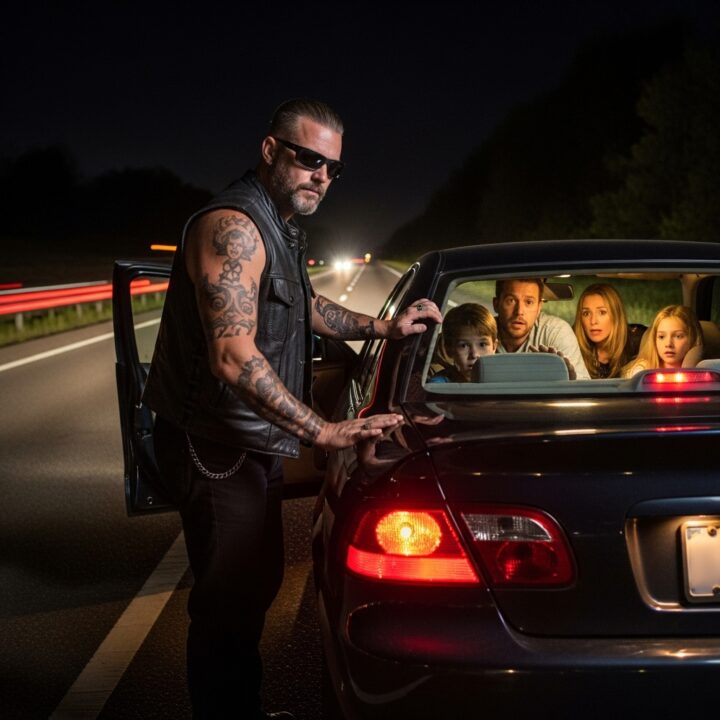
The biker pulled in behind the sedan and shut off his engine.
The silence that followed felt heavy.
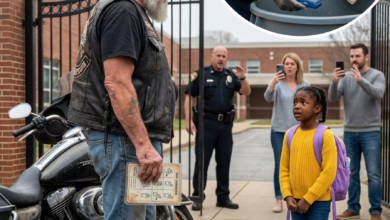
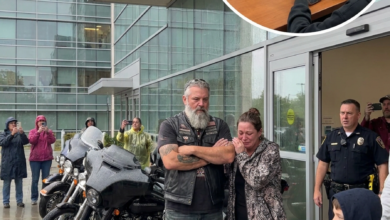
He stepped off the bike slowly. Mid-40s. White. Broad shoulders. Sleeveless leather vest. Tattoos etched deep into his arms like stories that never quite fade. His helmet stayed on longer than necessary.
From inside the car, he looked exactly like trouble.
The father cracked the window an inch. “We’re okay,” he said too fast. “Help’s on the way.”
The biker didn’t back up.
Instead, he moved toward the rear of the car, boots crunching gravel, eyes scanning tires, trunk, the road itself. He circled the vehicle without asking.
The mother raised her phone, pretending to make a call despite no signal. The daughter whimpered.
The father stepped out. “Hey,” he said, heart pounding. “You need to step away.”
The biker lifted his visor. His eyes were calm. Focused. Not apologetic.
“You shouldn’t be stopped here,” he said.
To the father, it sounded like a warning.
To the mother, it sounded like a threat.
A passing driver slowed, staring, unsure whether this was a rescue or the beginning of something worse. Another car honked aggressively, annoyed by the delay.
The biker raised one hand—not in surrender, but in controlled restraint.
“Pop the hood,” he said.
The father didn’t move.
Misunderstanding piled on misunderstanding, tightening the space between them. Down the highway, the rest of the convoy disappeared, unaware one rider had stopped.
Now, everyone here felt exposed.
A semi blasted past far too close.
The wind rocked the sedan violently. The daughter screamed.
The mother stepped forward, hands raised. “Please,” she said, voice breaking. “We have kids.”
Something shifted in the biker’s face—not anger, not frustration—urgency.
He stepped back. Gave space.
Then he reached into his vest.
The father froze.
But again, there was no weapon.
Just a phone.
The biker turned slightly away, typing a short message. No wasted motion. No drama. One action, deliberate and calm.
He looked up and said one sentence.
“Trust me for five minutes.”
Every instinct told the father not to.
But another truck roared past, and the truth hit hard: doing nothing was already dangerous.
The biker crouched by the front end, flashlight sweeping briefly. He exhaled slowly.
“Fuel pump,” he muttered. “You’re not starting this again tonight.”
The mother swallowed. “Then what do we do?”
The biker straightened and looked down the highway, listening.
They waited.
Seconds stretched.
The night felt too quiet to be safe.
The sound came first.
A low rumble.
Then another.
Then several more.
Headlights appeared, slowing, clustering together. Motorcycles peeled off the highway one by one, pulling in behind the first bike with practiced precision.
No shouting.
No rushing.
Just presence.
Men and women dismounted—American and European accents blending softly. Some older. Some younger. All composed. All disciplined.
One rider positioned his bike farther down the shoulder, creating a barrier between traffic and the sedan. Another began signaling cars to slow without being asked.
Authority shifted without a word being spoken.
The father stared, stunned.
The biker who had stopped first said nothing. He simply moved with them.
A rider knelt near the children’s window, helmet off, voice calm. Another wrapped a thermal blanket around the mother’s shoulders.
No violence. No explanations. Just control.
In minutes, the danger receded.
Later, quietly, the family learned the truth.
The biker who broke from the pack had once volunteered as a highway responder. Not officially anymore. Not on duty. Just someone who still noticed the things others drove past.
The convoy hadn’t planned to stop.
He had.
A tow truck arrived, called through a contact who still answered late-night calls. The children sat safely now, fear drained into exhaustion.
The biker stepped back.
He didn’t explain himself.
Didn’t correct the fear.
Didn’t accept thanks.
The father extended his hand.
The biker shook it once—firm, brief.
“Safe travels,” he said.
Then he mounted his bike and merged back into the night, engine sound fading until it was just another echo on the highway.
The family stood longer than necessary, watching empty road.
Because they understood something now.
That help doesn’t always look gentle.
That danger isn’t always what it seems.
And that sometimes, the bravest choice is the quiet decision no one sees.