A Bullied Boy Rode His Rusted Bicycle Between Dozens of Harleys to Ask for One Tiny Repair—Then the Fiercest Biker Recognized the Bike His Son Had Left Behind
The boy came through the row of Harleys with three school bullies chasing him, a broken bicycle bell clicking beneath his thumb, and stopped only when the biggest biker in Dayton slowly rose from his chair.
I was standing outside Miller’s Roadhouse that Saturday afternoon when it happened. My name is Ben Mercer, and I had been riding with the Iron Harbor Motorcycle Club long enough to know that children rarely approached us without an adult pushing them forward first.
We were twenty-seven bikers deep, parked in two rows beside Route 4. Engines ticked as they cooled. Leather creaked. Boots scraped pavement. The air smelled of gasoline, road dust, grilled onions, and the coffee Miller had been burning since sunrise.
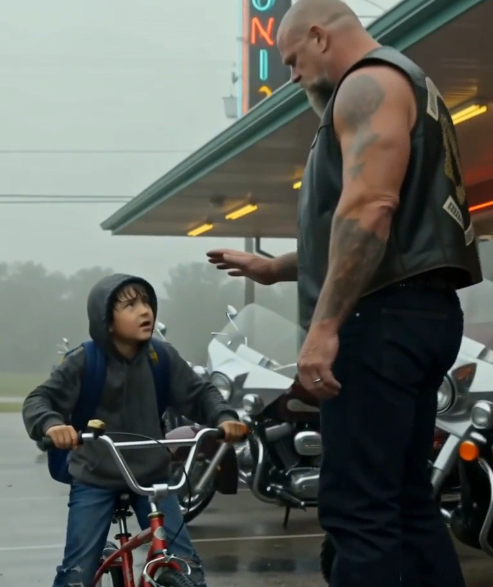
Then that bicycle came wobbling between us.
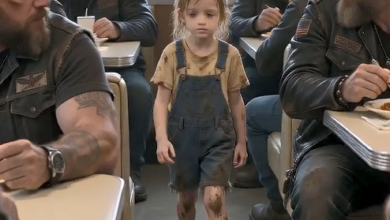
It was an old red Schwinn, too small for the skinny boy riding it and rusted around both fenders. Its rear wheel dragged sideways. One pedal had been wrapped with silver tape, the seat was split open like a tired mouth, and the little brass bell on the handlebar made a weak metallic click instead of ringing.
The boy couldn’t have been older than eleven.
His jeans were wet at the cuffs. His backpack bounced against his shoulders, and one of his shoelaces had come loose, but he kept pedaling while three boys in clean school jackets followed on expensive mountain bikes, laughing and recording him with a phone.
“Keep going, junkyard boy,” one shouted.
The child looked back.
That was when his front tire struck the edge of the curb and sent him directly into the center of our parked motorcycles.
Every biker stood.
The boys behind him stopped laughing.
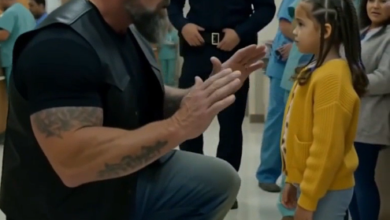
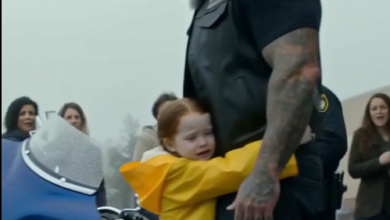
At the center of our group was Ray “Hammer” Dawson, fifty-six years old, six-foot-four, nearly 285 pounds, with a shaved head, a black-and-gray beard, tattooed forearms, and scarred knuckles thick enough to make a coffee mug look like a toy. The faded leather cut over his shoulders carried no loud slogans, but people usually stepped aside when they saw him coming.
The frightened boy did the opposite.
He dragged his bicycle upright, walked straight toward Ray, and held out the broken handlebar.
“Sir,” he said, fighting a stutter, “can you fix my bell?”
Nobody spoke.
The three boys turned their bicycles around, but Ray glanced at them once, and they froze without him saying a word. He did not threaten them. He did not chase them. He simply removed his gloves, lowered himself onto one knee, and examined the damaged bell.
“What’s your name, son?”
“E-Eli.”
“Why the bell?”
Eli swallowed. “They take my backpack sometimes. If the bell worked, maybe a teacher would hear me.”
Ray’s expression did not change, but I saw his left hand tighten around the handlebar.
That hand began to tremble.
Not because of the bullies.
Because of the bicycle.
Ray brushed rust from the bell and turned it over. Beneath the tarnish were three shallow dents arranged like a triangle. He stared at them, then ran one scarred thumb along a crooked solder line under the bell’s base.
I had known Ray for nineteen years. I had watched him pull a rider from beneath a burning touring bike. I had seen him receive news of his father’s death without sitting down. I had never seen the color leave his face that fast.
“Where did you get this?” he asked.
Eli pulled the bicycle closer as though Ray might confiscate it. “My mom bought it at a church sale. It’s mine.”
“I’m not taking it.”
Ray’s voice came out rougher than he intended, and the boy flinched. Ray noticed. He set both hands flat on his knees and softened his tone.
“I promise. I just need to know where.”
Eli told us his mother had paid eighteen dollars for it behind St. Agnes Church. She had scrubbed the frame with kitchen cleaner and adjusted the seat as high as it would go. It was the only bicycle they could afford after moving into their apartment.
One of the bullies muttered, “It belongs in the trash.”
Ray turned toward him.
“No,” he said. “Some things look worn because somebody loved them long enough.”
The parking lot went silent again.
Ray carried the bicycle toward our roadside repair trailer. He ignored the bent wheel, the taped pedal, and the rusty chain. Instead, he removed the seat first.
That made no sense to me.
A bell was broken. Ray was dismantling the seat.
He worked slowly, shielding the underside from Eli’s view. Then his wrench stopped. Beneath the cracked vinyl, pressed into the old steel with a hand punch, were two faded initials.
C.D.
Ray sat back on his heels.
Boone, our road captain, leaned close enough to see them. His breath caught.
“Ray,” he whispered. “Is that—”
“Not here.”
Those three words ended the question.
Eli watched Ray with growing fear. “Did I steal it?”
Ray looked up sharply. “No.”
“But you know it.”
Ray closed his eyes for one second. When he opened them, they were wet, though no tears fell.
“Yeah,” he said. “I knew the kid who rode it.”
Then he reached beneath the rear fender and found something no secondhand buyer would ever notice: a tiny lightning bolt cut into the frame by an unsteady child’s hand.
Ray touched it as if it were warm.
Behind us, the bullies had stopped recording. Around us, twenty-seven bikers stood without moving. Even the road noise seemed to fade beneath the soft clicking of that useless bell.
Ray finally lifted the bicycle onto the repair stand.
“I’ll fix everything,” he told Eli.
“I only asked for the bell.”
“I know.”
Ray looked again at the initials beneath the seat, and his voice dropped until only I could hear him.
“I built this bike for my son.”
But that was not the part that frightened me. The frightening part was that Ray had placed this bicycle in a locked garage nine years earlier—on the morning after his son died—and none of us knew how it had escaped.
Before that bell could ring again, Ray would have to discover who removed the bicycle, why it was given to Eli, and what his son had hidden inside its handlebars.
Part 2 — The Bicycle Hammer Built After Midnight
I met Ray Dawson eighteen years before Eli rode into Miller’s parking lot, back when Hammer still treated every conversation like a door someone might use against him.
He worked days repairing diesel engines at a municipal garage and spent nights in a detached workshop behind his small house in Riverside. Most men went there for beer and motorcycle parts. Ray went there because his son, Caleb Dawson, could not sleep whenever storms rolled through the Miami Valley.
Caleb had been born with a congenital heart defect. He was small for his age, quick with jokes, and stubborn about being treated like every other kid. Doctors had warned Ray and his wife, Nora, that Caleb would need multiple surgeries, but the boy refused to organize his childhood around hospital calendars.
At ten, Caleb wanted a bicycle.
Not a special bicycle. Not a medical-looking tricycle. He wanted a red two-wheeler with a bell loud enough for his father to hear from half a block away.
Money was tight, so Ray found an old Schwinn frame behind a salvage shop and paid twenty-five dollars for it. The wheels came from two different bikes. The seat was cracked. One pedal was missing, and the original bell looked as if it had been stepped on.
“It’s perfect,” Caleb said.
“It’s scrap.”
“Then make the scrap fast.”
For six weeks, Ray worked after midnight. I helped when he allowed it, which was rarely. He stripped the frame, treated the rust, repainted it red, aligned the rear wheel, and rebuilt the hub twice because Caleb said the freewheel sounded “angry.”
The bell caused the most trouble.
Caleb wanted to help, so Ray let him hold the brass casing while he repaired the bracket. The solder went on crooked. Caleb dropped the bell against the vise, leaving three small dents in a triangle.
Ray offered to replace it.
Caleb refused.
“Now it’s ours,” he said.
That bicycle became the center of their evenings. Ray would ride his Harley at walking speed down their street while Caleb pedaled beside him. The V-twin made windows tremble. The brass bell answered in two bright notes.
Rumble. Ring-ring. Rumble. Ring-ring.
Neighbors came outside to watch.
Caleb could not ride far. His lips sometimes lost their color, and he tired faster than he admitted, so Ray developed a rule: one ring meant slow down, two meant stop, three meant Caleb needed help.
The boy almost always rang twice.
He never wanted the third ring.
After Caleb’s final surgery, doctors told the family he would need another long recovery. Ray placed the bicycle in the garage and promised to keep its tires inflated.
Caleb did not come home.
He died at Dayton Children’s Hospital six days later, two months before his eleventh birthday.
Ray returned from the hospital alone. He walked into the garage, saw the red bicycle leaning beside his Harley, and covered it with a moving blanket. For two years, he did not touch it.
Grief turned him quieter and harder. Nora survived differently. She boxed Caleb’s clothes, joined a parents’ support group, and spoke his name whenever she could. Ray could not say it without leaving the room.
Their marriage did not break in one dramatic night. It wore away through hundreds of unfinished sentences.
Nora eventually moved to Kentucky to live near her sister. Ray remained in Riverside, surrounded by tools, unopened mail, and a covered bicycle he could neither repair nor release.
The club became the only place where he still functioned. He organized charity rides, repaired members’ motorcycles without charging, and sat with injured riders through long hospital nights. Yet if anyone mentioned children’s bicycles, he walked away.
Then, nine years after Caleb’s death, Eli arrived.
By the time Ray found the rolled paper in the handlebar, the bullies had left. Boone had memorized their faces, but Ray ordered everyone to remain at Miller’s.
“We’re not frightening children,” he said.
“They were hurting him,” Boone replied.
“And thirty grown men chasing them fixes that?”
Boone looked away.
That was the first test. Our club could have become the threat everyone already assumed we were. Ray refused to give the bullies that excuse.
He brought Eli inside the repair trailer and handed him a bottled soda. Then he checked the brakes, chain, wheel bearings, and cables. The bicycle needed more than a bell spring; it needed time.
Eli watched every movement.
“You work on bicycles too?” he asked.
“Anything with wheels.”
“My mom says people don’t fix old things anymore.”
Ray looked at the red frame. “Your mom’s met the wrong people.”
He placed the rolled note in his shirt pocket without opening it. His fingers lingered over the spot.
I asked quietly, “Why wait?”
“Because the boy’s watching.”
That answer told me everything. Whatever waited inside the paper belonged to Ray’s grief, but Eli would not be forced to carry it merely because he had unknowingly delivered it.
Ray replaced the bell spring first.
When he pressed the lever, the brass dome produced two clear notes.
Ring-ring.
Ray’s eyes closed.
Across the trailer, Eli smiled for the first time.
“That’s perfect,” he said.
Ray opened his eyes and looked at the boy, then at the bicycle.
“No,” he murmured. “Not yet.”
He asked Eli for his mother’s phone number. Eli hesitated until Ray handed him his own phone and told him to make the call himself. Twenty minutes later, a tired-looking Latina woman named Marisol Carter drove into the lot in an aging silver sedan.
She climbed out ready to fight.
“My son said a motorcycle gang has his bicycle.”
“Club,” Boone muttered.
I elbowed him.
Ray walked toward Marisol with both hands visible. He explained the damaged parts, the boys who had followed Eli, and the markings he recognized. He did not mention Caleb yet.
Marisol listened, one arm around her son.
Then she said something none of us expected.
“The woman at St. Agnes told me the bicycle was meant for a boy who needed a reason to keep riding.”
Ray’s face hardened. “What woman?”
“She didn’t give me her name.”
“Describe her.”
Marisol studied him. “Late fifties, maybe. Brown hair going gray. Kentucky plates.”
Ray looked toward the trailer.
For the first time, I understood who might have removed the bicycle from his garage.
Nora.
But that only created a harder question: if Caleb’s mother had given away the bicycle, why had she sent it back to the same town where Ray still lived?
That evening, after Eli and Marisol went home in Boone’s truck while the bicycle remained for repairs, Ray finally sat alone at the workbench.
He removed the blue rubber band.
Then he unrolled his son’s note.
Part 3 — The Note Inside the Handlebar
The paper made a dry cracking sound as Ray opened it.
I stood near the trailer door, uncertain whether I had the right to remain. Boone waited outside with the others. No one started an engine. No one laughed. Twenty-six men who usually filled silence with jokes stood beneath the parking-lot lights and listened to the faint rattle of highway traffic.
Ray read the note once.
Then again.
His shoulders did not shake. Hammer was not built that way. He simply became still, as though every muscle had been ordered to hold a collapsing structure in place.
“What does it say?” I asked.
He handed it to me.
The handwriting wandered uphill across the page. Several letters had been corrected. A greasy child-sized fingerprint marked one corner.
“Dad, if I get too big for this bike, give it to a kid nobody waits for. Fix the bell first so somebody hears him coming. Don’t keep it in the garage because of me. Bikes get lonely too. Caleb.”
There was no date.
Ray sat with his elbows on his knees and stared at the concrete floor.
“He knew,” he said.
“Knew what?”
“That he might not ride it again.”
I returned the paper. “Maybe he wanted you to find this.”
Ray shook his head. “He wanted me to let go. I didn’t.”
Outside, Boone cleared his throat. “Brother, none of us knew about the note.”
“I didn’t know either.”
That was the part that struck deepest. Ray had preserved the bicycle like a grave marker, believing he was protecting Caleb’s memory, while Caleb had left instructions for it to keep moving.
The boy had understood his father better than the father understood himself.
Ray folded the paper along its original lines and placed it in a clean plastic sleeve. Then he stood.
“We finish the bike tonight.”
Every man came inside.
We replaced both tires, straightened the rear wheel, fitted new brake cables, cleaned the chain, rebuilt the pedal, and reinforced the seat without covering Caleb’s initials. Ray insisted that the red paint remain scratched.
“Don’t make it look new,” he said. “Make it safe.”
Boone wanted to install an expensive gear set. Ray refused. Another member suggested chrome handlebars. Ray refused that too.
“It’s Eli’s bike. Not ours.”
By three in the morning, it rolled straight and stopped cleanly. The bell rang. Ray took it outside and rode one slow circle around the lot, knees rising ridiculously high because the frame was built for a child.
Nobody laughed.
At sunrise, we delivered it to Eli’s apartment.
He lived with Marisol above a closed laundromat near East Third Street. Their building had chipped brick, a narrow staircase, and a security light that flickered even after morning arrived.
Eli was waiting at the window.
He ran downstairs in socks.
When Ray uncovered the bicycle, the boy stopped on the last step. His eyes moved across the new tires, repaired pedal, polished chain, and working brakes. Then he pressed the bell.
Ring-ring.
The sound traveled between the buildings.
“You fixed all of it?”
“Mostly.”
“How much?”
Ray held up one finger. “One condition.”
Marisol stiffened.
Ray pointed at the helmet hanging from the handlebar. “You wear that.”
Eli grinned. “Deal.”
That could have been the ending.
For two school days, it almost was.
Eli rode the red bicycle to Jefferson Middle School. The bullies kept their distance, partly because they had seen him enter a line of motorcycles and return unharmed. Rumors spread that he had joined a gang. Eli hated the rumor, but he liked not being kicked.
Then on Wednesday afternoon, Marisol called Ray.
The bicycle was gone.
Someone had cut the lock outside the school gym. A janitor had seen three boys rolling it toward the drainage path behind the football field. By the time Eli reached the rack, only the severed cable remained.
Ray was already on his Harley when he called me.
“Get Boone. No cuts. No club formation.”
“Why?”
“Because we’re going to a school, not a war.”
We met behind Jefferson. Rain had started, turning the drainage path into slick mud. Ray followed a set of narrow tire tracks while the rest of us spread out.
Eli came with Marisol despite Ray’s objection.
“It’s my bike,” he said.
Ray did not argue.
We found it beneath the concrete footbridge.
The frame had been thrown onto the rocks. The front wheel was bent nearly in half. The chain hung loose. The seat had been slashed, exposing the initials beneath it.
The bell was missing.
Eli stood at the edge of the path and made no sound. That frightened me more than crying would have.
Marisol placed her arms around him.
Ray climbed down the bank.
He lifted the frame carefully, mud running from both tires. His face stayed blank until he saw the empty bracket where the bell had been.
Then his hand closed around the handlebar.
Boone climbed down behind him. “We know which kids did it.”
“No,” Ray said.
“We saw them Saturday.”
“No.”
“They destroyed Caleb’s bike.”
Ray turned so quickly that Boone stepped back.
“They destroyed Eli’s bike.”
The distinction mattered.
Caleb’s memory did not give us the right to take ownership away from the living child holding back tears on the bank above us.
Ray carried the damaged bicycle uphill and placed it before Eli.
“I’m sorry,” he said.
Eli stared at the twisted wheel. “You can’t fix that.”
“I can.”
“They’ll do it again.”
That stopped Ray.
The problem was no longer metal. A repaired bicycle could be broken again. A frightened boy could be told to ignore cruelty until he began believing silence was the price of attending school.
Marisol had already contacted the principal twice. She had been told there was insufficient evidence. The school cameras did not cover the bicycle rack, and the three boys denied everything.
Ray looked toward the school building.
“What time does the principal arrive tomorrow?”
“Seven-thirty,” Marisol said.
Boone’s expression sharpened. “Now we’re talking.”
Ray faced him. “Nobody threatens anybody.”
“What are we doing, then?”
Ray looked down at the ruined bicycle and then at Eli.
“We’re making it impossible not to listen.”
The next morning, twenty-seven Harleys entered the school parking lot one at a time.
They did not rev their engines. They did not block traffic. Every rider parked legally, removed his helmet, and stood beside a donated bicycle in need of repair.
Ray had called the principal before we arrived. He requested permission to offer a free safety inspection for every student who rode to school. The principal agreed, likely believing it was easier than arguing with him.
By eight o’clock, our folding worktables stretched along the far edge of the lot. Parents watched nervously. Teachers whispered. Students gathered near the fence.
And then the three bullies arrived.
One of them had Caleb’s brass bell attached to his expensive mountain bike.
Ray saw it.
So did Eli.
Boone took one step forward.
Ray caught his arm.
The boy with the bell smirked, pressed the lever, and let two bright notes ring across the schoolyard.
Ring-ring.
Ray’s grip tightened.
For nine years, he had waited to hear that sound again.
Now the child who had helped destroy his son’s bicycle was using it to mock another boy.
That was the moment everyone expected Hammer to explode.
Instead, Ray released Boone, walked alone toward the bully, and stopped several feet away.
“Son,” he said, “do you know whose voice you’re holding?”
Part 4 — The Boy Who Heard the Bell
The bully’s name was Tyler Bennett.
He was twelve, tall for his age, dressed in a clean varsity-style jacket, and suddenly less certain with twenty-seven bikers and half the school watching him.
Tyler’s father pushed through the crowd.
“Stay away from my kid.”
Ray stepped backward immediately.
“I’m not touching him.”
“Then why are you surrounding a school?”
The principal hurried over with the campus resource officer. Parents raised phones. From a distance, the scene looked exactly as dangerous as people wanted it to look: a giant tattooed biker facing a child while rows of leather-clad men stood behind him.
Ray understood the picture.
He removed his vest and handed it to me.
Then he crouched until he was lower than Tyler.
“I want to buy that bell,” he said.
Tyler glanced at his father. “It’s mine.”
“How much?”
“It’s not for sale.”
Ray nodded. “All right.”
Tyler had expected anger. Courtesy unsettled him more.
The resource officer asked Ray to return to the repair tables. Ray obeyed. Not one biker protested. We went back to adjusting seats, inflating tires, and tightening loose chains while Tyler rode the mountain bike in circles near the fence, ringing the stolen bell whenever he passed Eli.
Each note cut through Ray.
Still, he worked.
At lunchtime, a seventh-grade girl approached our table with a loose brake lever. While Ray tightened it, she whispered that she had seen Tyler and two friends take Eli’s bicycle. She had also filmed part of it, but she was afraid to show anyone because Tyler’s older brother rode her bus.
Ray did not ask for her phone.
He called the principal.
The girl showed the video in the office with her mother present. It captured Tyler cutting the lock, the other boys rolling the bicycle away, and one of them removing the bell beneath the footbridge.
The school contacted their parents.
By two o’clock, the boys were sitting in the conference room. Tyler’s father continued insisting the situation was being exaggerated.
“It’s an old bike,” he said. “I’ll pay for another.”
Ray stood near the door.
“You can replace the steel.”
The man looked at him. “Then what’s the problem?”
Ray placed Caleb’s note on the conference table.
He did not hand it to Tyler. He did not perform his grief for the room. He simply told them about the ten-year-old boy who had helped repair a dented bell, about the red bicycle built from discarded parts, and about the final message hidden inside its handlebar.
“That bike belonged to my son,” he said. “He died nine years ago.”
The room changed.
Tyler stared at the floor. One of the other boys began crying. The principal removed her glasses.
Ray continued before sympathy could make the story about him.
“But Caleb gave it away. That means it belonged to Eli when you took it. You didn’t damage a dead boy’s memorial. You damaged a living boy’s way home.”
Tyler’s father folded his arms. “Kids make mistakes.”
“They do.”
“So let the school handle it.”
“I am.”
Ray looked toward Tyler.
“What happens next is up to him.”
The principal asked what he meant.
Ray proposed something none of us had discussed. Instead of demanding suspension, he offered the boys a place in our Saturday bicycle workshop. They would help repair the red Schwinn under Eli’s supervision. They would also restore three donated bicycles for children at a family shelter.
Tyler’s father laughed. “My son isn’t working for a motorcycle gang.”
“Then he can accept the school’s punishment,” Ray said. “The offer is for the boy. Not you.”
Tyler finally raised his head.
“Will you tell everyone about the dead kid?”
Ray’s jaw tightened, but his voice remained steady. “His name was Caleb.”
“Will you tell everyone I stole his bike?”
“No.”
“Why not?”
“Because being the worst thing you did at twelve is a long sentence.”
Tyler looked at the bell attached to his handlebars.
Then he removed it.
His hands shook as he placed it on the table.
“I didn’t know,” he said.
Eli, who had been waiting with Marisol outside the office, heard him through the open door. He stepped inside.
“You knew it was mine,” he replied.
Tyler could not answer.
That was the deeper truth. He had not known the bicycle’s history, but he had known the person he was hurting. A tragic backstory did not create the wrong. It only made adults pay attention to cruelty they should have noticed already.
Ray slid the bell toward Eli.
Eli did not take it.
“Keep it until the bike works,” he told Ray.
Ray stared at him.
“Why?”
“So it doesn’t get lonely.”
Those were Caleb’s words.
Not exactly, but close enough to stop Ray’s breathing.
Marisol looked confused. I saw Boone turn away and press two fingers against his eyes.
Later, outside the school, Ray called Nora for the first time in almost three years.
She answered on the sixth ring.
“Ray?”
He leaned against his Harley. “You gave away the bike.”
Silence.
“Yes.”
“You found the note?”
“No,” she said. “Caleb told me about it before surgery.”
Ray’s face tightened.
Nora explained that Caleb had asked her to make sure his father eventually passed the bicycle to another child. She waited years, hoping Ray would do it himself. When she learned he still kept it beneath a blanket, she returned to Riverside while he was away on a charity ride.
She took the bicycle to St. Agnes.
“I thought you would hate me,” she said.
“I did.”
“Do you still?”
Ray looked across the parking lot at Eli, who was showing another student how to press the repaired bell bracket into place.
“No.”
Nora began crying softly.
Then she revealed the part none of us knew.
She had not selected Eli. The church had offered the bicycle to several families, but each child rejected it because it looked too old. It remained unsold for months until Marisol arrived with eighteen dollars and an embarrassed son who insisted they should not ask for anything better.
Eli had chosen the bike himself.
According to the church volunteer, he ran his fingers across the scratched red frame and said, “This one already knows how to be left out.”
Ray closed his eyes.
The bicycle had not merely found another child.
It had found the exact child Caleb described.
Part 5 — Repairing More Than the Red Frame
Saturday morning arrived cold and clear.
Ray opened the Iron Harbor workshop at seven. He had already laid the red Schwinn across the central bench, separating each damaged component into labeled metal trays. The bent front wheel hung from a hook. Caleb’s bell rested beside the sleeved note.
At eight, Eli and Marisol arrived.
At eight-fifteen, Tyler entered with his mother.
His father did not come.
The other two boys followed. None wore school jackets. None brought phones. They stood just inside the door while twenty-seven bikers worked around them amid the sounds of ratchets, air compressors, chain tools, and classic rock playing softly from an old radio.
They looked terrified.
Ray handed each boy safety glasses.
“Rules,” he said. “No insults. No grabbing tools without asking. If you break something, say so. If you don’t know, ask.”
Tyler glanced at the motorcycles. “Are we allowed near those?”
“No.”
Boone pointed toward a row of donated bicycles. “You earn trust on the small wheels first.”
Eli was given the final word on the red Schwinn. Ray showed him two replacement frames in case the original could not be straightened safely.
Eli shook his head.
“That one.”
“It’ll carry scars.”
“So do you.”
Ray looked at him for a long second. Then one corner of his mouth lifted.
“Fair enough.”
They began with the front wheel. Tyler loosened the damaged spokes while Eli held the rim. Their hands bumped. Neither apologized, but neither pulled away.
The first hour passed badly. Tyler complained about grease. One boy stripped a bolt and tried to hide it. Boone raised his voice before Ray reminded him that the workshop was supposed to teach repair, not fear.
That correction cost Ray something.
Our club valued loyalty, but we also carried habits shaped by hard roads, military years, prison time, addiction, and homes where mistakes were answered with volume. Teaching children required more than good intentions. It required us to confront the parts of ourselves that children should never have to manage.
The brotherhood was being repaired too.
At noon, Marisol brought sandwiches. Tyler sat apart until Eli pushed a bag of chips toward him.
“You don’t have to,” Tyler said.
“I know.”
“Why are you?”
Eli shrugged. “Ray says we’re fixing stuff.”
The boys ate without speaking.
During the afternoon, Ray taught them how to measure the frame. The main triangle remained true, but the fork needed replacement. We found one with the right dimensions in a storage bin, stripped its blue paint, and prepared it for red enamel.
Tyler worked hardest on the fork.
At one point, he asked Ray about Caleb.
“What was he like?”
Ray continued sanding.
“Loud.”
“Was he good at biking?”
“No.”
Tyler looked surprised.
“He crashed into trash cans,” Ray added. “Hit Mrs. Collins’s mailbox twice. Blamed the wind both times.”
Eli laughed.
So did Tyler.
The sound loosened something in the room. Ray told one more story, then stopped before grief became performance. Caleb was allowed to be a mischievous boy again—not merely a tragedy attached to an old bicycle.
Near closing time, Nora arrived.
She had driven from Kentucky without telling Ray. She stood in the doorway wearing a brown coat and holding a small cardboard box. Ray saw her and went rigid.
Nine years of grief stood between them.
Nora looked older than the woman I remembered. Her hair was streaked with gray. She approached the workbench, saw Eli holding the repaired brass bell, and pressed both hands over her mouth.
“That’s him?” she asked.
Ray nodded.
Eli looked from one adult to the other. “Did this belong to your son too?”
Nora knelt beside him. “It did.”
“I’m taking care of it.”
“I can see that.”
She opened the cardboard box. Inside was Caleb’s old bicycle helmet, covered in faded stickers, and a photograph of him sitting on the red Schwinn while Ray pretended to inspect the rear tire.
Eli studied the photograph.
“He was my size.”
“Almost exactly,” Nora said.
Ray looked at the helmet. “Why bring that?”
“Because I kept something too.”
There was no accusation in her voice. That made it harder.
For years, Ray had believed he alone was trapped by Caleb’s belongings. Nora had simply chosen a smaller object and hidden her grief more successfully.
Eli placed the photograph on the workbench beside Caleb’s note.
Then he asked, “Would it be wrong if I changed something on the bike?”
Ray answered first. “It’s yours.”
“I want to paint one part yellow.”
“Which part?”
“The new fork. So nobody thinks I’m pretending it never got broken.”
Ray glanced at Nora.
She nodded.
The fork became yellow.
Against the scratched red frame, it looked mismatched and impossible to ignore. Exactly right.
By evening, the bicycle stood on both wheels again. Eli installed the bell himself. Tyler tightened the mounting bracket, then stepped aside.
“Try it,” he said.
Eli pressed once.
Ring-ring.
Ray’s eyes filled.
This time, he did not turn away.
Nora slipped her hand into his. They were not becoming husband and wife again; too much life had passed for that simple repair. But for the first time since Caleb’s funeral, they stood beside his bicycle without blaming each other for surviving differently.
Tyler approached Eli with the severed lock cable.
“My mom’s buying you a better one.”
Eli nodded.
“I’m sorry,” Tyler said.
Not I didn’t know.
Not It was a joke.
Not Everybody else did it.
Just I’m sorry.
Eli considered him. “Come next Saturday.”
Tyler blinked. “Why?”
“There are three shelter bikes left.”
That was how the workshop began.
Not through a grant. Not through a speech. Through one bullied boy deciding that accountability could become an invitation without becoming an excuse.
Ray placed Caleb’s note inside a frame above the tool cabinet, but he covered the final line with a strip of plain paper.
I asked why.
“That part was for me,” he said.
“What does it say?”
Ray looked at Eli ringing the bell for a younger child who had entered with a broken scooter.
Then he told me.
Beneath the words about bicycles getting lonely, Caleb had written one last sentence:
“Dad, when another kid rides it, you can ride beside me again.”
Part 6 — Two Rings Every Saturday
The Iron Harbor bicycle workshop opened every Saturday after that.
Ray refused to name it after Caleb. He said children should not have to enter a memorial whenever they needed a tire patched. Instead, Eli painted a small wooden sign for the door.
SECOND BELL GARAGE.
There were no membership fees. No application forms. Children brought bent wheels, loose chains, broken brakes, and bicycles assembled from whatever their families could afford. We repaired them if they could be made safe. If they could not, we found another frame.
Tyler returned the following Saturday.
Then the next.
His father called the work “humiliating,” but Tyler’s mother kept driving him. By summer, he could replace a chain, align a wheel, and explain the difference between repairing damage and hiding it.
He and Eli did not become instant best friends. Real life rarely bends that cleanly. Some days they argued. Eli still stiffened when Tyler approached too quickly. Tyler sometimes became defensive when reminded of the footbridge.
Trust came by inches.
Ray understood inches.
He never asked Eli to call him anything except Ray. He never treated the boy like a replacement for Caleb. When Eli struggled in school, Ray helped him study fractions by measuring spokes. When Marisol’s sedan needed a water pump, the club repaired it while she was at work.
Eli also gave something back.
Every time Ray became too quiet near the red Schwinn, Eli pressed the bell twice.
Not three times.
Never an emergency.
Just ring-ring, the old signal for stop and wait.
Ray would pause, breathe, and answer by tapping the motorcycle horn once.
The ritual spread.
Children leaving the shop rang their bicycle bells twice. Bikers answered with one low engine rumble. On Saturday afternoons, East Third Street carried an odd conversation between tiny bells and heavy V-twins.
People began bringing donations. A teacher supplied helmets. A retired nurse paid for reflective tape. St. Agnes Church delivered twelve used bicycles and finally returned Marisol’s eighteen dollars, though she donated it to the parts jar.
Nora visited monthly.
She and Ray learned to speak about Caleb in full sentences. Some memories hurt. Others were funny. Most were both.
On the first anniversary of Eli’s ride into Miller’s parking lot, we returned to the roadhouse. Twenty-seven Harleys stood in two rows, just as they had that day.
Eli approached on the restored Schwinn.
The frame was scratched red. The fork was bright yellow. The repaired pedal still carried one strip of silver tape because Eli refused to let Ray remove it.
Tyler rode beside him on a shelter bicycle he had restored himself.
When they entered the formation, every biker shut off his engine.
Silence fell.
Eli stopped in front of Ray and pressed the bell.
Ring-ring.
Ray placed one hand over the old lightning bolt beneath the seat. Then he looked at the two boys.
“Need anything fixed?”
Eli smiled. “Not today.”
It was the first time the bicycle had returned to that parking lot without needing rescue.
And for Ray, that mattered more than making it look new.
Part 7 — The Bicycle That Kept Moving
Seven years later, Eli Carter graduated from Jefferson High School.
He arrived at the ceremony in Marisol’s newer sedan, but the red Schwinn traveled in the back. The frame had become too small for him years earlier. He kept it anyway, maintaining the chain and checking the tire pressure every month.
After graduation, Eli brought the bicycle to Second Bell Garage.
Ray was sixty-three by then. His beard had turned almost entirely gray, and arthritis had begun slowing his hands, though he still refused help with simple repairs.
Eli placed the Schwinn on the central stand.
“Something broken?” Ray asked.
“No.”
“Then why’s it here?”
Eli touched the brass bell. “There’s a boy at the shelter. He needs a bike.”
Ray stared at him.
“You sure?”
“It gets lonely standing in my apartment.”
Caleb’s words again.
Eli had never heard the complete note until that morning, when he asked Ray for permission to read it. Now he understood that ownership of the bicycle had never meant keeping it forever. It meant carrying its purpose until someone else needed it.
They cleaned the frame together.
Ray adjusted the seat downward. Eli replaced the worn grips. Tyler—now an apprentice mechanic at our main garage—installed fresh brake pads and painted one thin blue stripe around the yellow fork.
Three histories.
One bicycle.
That afternoon, they delivered it to a nine-year-old boy named Marcus, who had entered foster care carrying everything he owned in a grocery bag. He circled the shelter parking lot cautiously while Ray walked on one side and Eli walked on the other.
Marcus pressed the bell.
Ring-ring.
Ray stopped.
For one breath, I could almost see Caleb beside him again: thin knees, oversized helmet, crooked grin, waiting for his father to slow down.
But Ray did not reach for the past.
He looked at Marcus.
“You want us to wait?”
The boy nodded.
So we waited.
When Marcus felt ready, he pushed the pedal and rode another circle. The red frame rolled forward, its scars uncovered, its yellow fork bright beneath the afternoon sun.
Ray started his Harley.
The V-twin answered the bell with one low rumble.
Then bicycle and motorcycle moved down the lane together—one small, one enormous, neither leaving the other behind.
Follow our page for more unforgettable biker stories about quiet courage, second chances, and the people no one should overlook.