Part 2: A Biker Carried a Child’s Bed Into a Missouri Cemetery and Lay Beside a Young Father’s Grave — Then the Caretaker Learned Who Was Afraid to Sleep Alone
Part 2 — The Carpenter Daniel Found Beneath an Overpass
Wade Rourke had been called Bear since he was seventeen, when he lifted the back of a wrecked pickup high enough for two teenagers to drag their friend from beneath it.
The name sounded heroic.
His life was not.
Bear grew up outside Tulsa with a father who drank through rent money and a mother who disappeared for weeks at a time. By fourteen, he could frame a wall, rebuild a carburetor, and tell from the sound of boots on a porch whether he needed to hide.
At twenty-six, he went to prison for aggravated assault.
He never softened the story. A man struck Bear’s younger brother with a tire iron during a bar fight. Bear took the weapon away and kept swinging after the danger had ended.
Five years.
That was the sentence.
By the time he left prison, his mother was dead, his brother had moved without leaving an address, and every construction company in his hometown had learned how to search court records.
Bear slept beneath an overpass near Springfield.
He repaired broken pallets for cash, washed in a truck-stop sink, and kept his tools chained beneath a tarp. His Harley was not freedom. It was the one object he could not afford to lose because it carried him between day-labor sites.
Daniel Cross found him there during a winter call.
A motorist had reported an unconscious homeless man. Bear was not unconscious. He was lying flat because a slipped disc had locked his back while he tried to lift a timber alone.
Daniel was twenty-seven, newly married, and still green enough to argue with patients who were twice his size.
“Ambulance,” Daniel said.
“No.”
“Hospital.”
“No.”
“You planning to live under this bridge permanently?”
“Rent’s fair.”
Daniel laughed.
Bear did not.
The paramedic stayed anyway. He helped secure the tools, brought coffee, and drove Bear to a clinic that treated uninsured laborers. Two days later, Daniel returned with an address for a cabinet shop willing to consider men with convictions.
Bear thought it was charity.
He nearly refused.
Daniel put the paper into his hand. “I didn’t get you the job. I got you a door. Walk through or don’t.”
Bear walked through.
He worked at the shop for nine years. He became the man assigned to difficult restorations because damaged wood made sense to him. Split grain could be joined. Burned sections could be cut away. A warped board could sometimes be persuaded back into shape if pressure was applied slowly.
People were harder.
Daniel kept trying.
He invited Bear to cookouts, birthday dinners, and the hospital after Noah was born. Bear attended the hospital because Daniel threatened to bring the baby beneath the overpass if he did not.
The first time Bear held Noah, his tattooed hands locked around the blanket like a wooden vise.
“He’s not a transmission,” Daniel said.
“Transmissions come with manuals.”
“Babies scream when you miss a step.”
Noah did.
Bear handed him back.
Still, the child became attached to him. By three, Noah called him Uncle Bear. By five, he could identify Bear’s Harley from two blocks away. By six, he understood that the frightening leather cut belonged to the man who repaired cabinet doors, built birdhouses, and never entered the family home without knocking twice.
Daniel joined the Mercy Road Riders, a loose brotherhood of veterans, mechanics, first responders, warehouse workers, and men who had survived versions of themselves they did not discuss in public.
Bear was already a member.
The club did not wear outlaw colors. Their cuts were plain because several members worked jobs where public attention caused trouble. They escorted funeral processions, repaired porches for injured riders, and carried medical kits in their saddlebags because Daniel insisted.
Daniel and Bear fought like brothers.
Daniel believed every broken person should be offered a door. Bear believed some people would only steal the hinges. Daniel talked too much. Bear answered in sentences that rarely needed a second breath.
But whenever Daniel’s ambulance passed the cabinet shop at night, he tapped the siren twice.
Bear answered by flicking the shop lights.
That was their ritual.
The bed began four months before Daniel died.
Noah had developed night terrors after hearing another child describe death as “going to sleep and never waking up.” He began sleeping on the floor beside his parents’ room. If Rachel carried him back to bed, he woke screaming before dawn.
Daniel asked Bear to build something solid.
“Not store solid,” he said. “Bear solid.”
Bear chose oak for the rails and salvaged pine for the headboard. He rounded every edge, reinforced the joints, and burned small stars into the wood because Noah liked maps of the night sky.
Daniel supplied one unusual request.
A voice recorder beneath the mattress.
His work shifts often kept him away at bedtime, so he recorded stories, jokes, weather reports, and terrible songs. Bear built a button into the lower rail so Noah could hear his father without using a phone.
The first test worked.
Noah slept in the unfinished frame on the workshop floor while Daniel’s voice read about a bear waiting through winter.
Bear watched from the bench until dawn.
The final headboard panel remained empty because Daniel wanted Noah to choose the wood and fit it himself.
“A kid should finish the thing he has to trust,” Bear said.
Daniel agreed.
Then the ambulance crash happened.
A delivery truck crossed the median during freezing rain. Daniel shoved his partner across the cab before the impact. The partner lived.
Daniel did not.
After the funeral, Noah stopped sleeping altogether.
He believed his father had gone beneath the ground awake.
And he believed closing his own eyes would leave Daniel alone.
Part 3 — The Night Noah Disappeared
Rachel tried everything.
She moved Noah’s mattress into her room, slept beside him on the living-room floor, left every light on, and asked a grief counselor to explain that death was not the same as being trapped underground.
Noah listened politely.
Then he stayed awake.
He hid coffee granules beneath his tongue after seeing Rachel drink them before early shifts. He set alarms every twenty minutes. He pinched his arms until small purple marks appeared.
At school, he fell asleep beneath a table and woke fighting.
The unfinished bed remained in Bear’s workshop.
Bear could not look at it.
He covered the frame with a tarp, but Daniel’s voice still lived beneath the mattress. Sometimes a dropped board struck the concealed button, and a muffled bedtime story rose through the shop.
Bear always shut it off.
One evening, Rachel arrived while he was doing that.
She pulled away the tarp.
For weeks, she had believed the bed was merely delayed. When she saw it nearly finished, grief turned sharp.
“You had this?”
Bear kept sanding a drawer front.
“You had his voice in here and never told us?”
“It’s not ready.”
“He isn’t ready.”
“Same thing.”
“No, it isn’t.”
She pressed the button.
Daniel began singing a ridiculous version of “You Are My Sunshine,” changing the words to describe Noah’s missing front tooth. Rachel stopped the recording after six seconds.
Her shoulders shook.
Bear looked at the floor.
“You don’t get to keep him in your shop,” she said.
That sentence struck harder than she knew.
Bear had already lost Daniel on the highway. Now he understood that by hiding the bed, he had also kept part of Daniel away from his family.
He delivered it the following afternoon.
Noah refused to enter the room.
The boy stood in the hall staring at the blue frame as if it were a coffin.
“Dad made those recordings before he died,” he said.
Bear nodded.
“So if I press the button, he talks.”
“Yeah.”
“But he can’t hear me.”
Bear had no answer.
Noah backed away.
That night, he slept under the kitchen table.
The next week, Bear sat through Noah’s grief-counseling session because the boy would not speak unless Bear remained near the door. The counselor asked Noah what he imagined happening while he slept.
The child drew two boxes.
One was his bedroom.
The other was his father’s grave.
Inside the first, Noah drew himself with closed eyes. Inside the second, Daniel stood awake in darkness.
“Who stays with Dad?” Noah asked.
Rachel tried to answer, but her voice broke.
Bear studied the drawing.
“Maybe someone takes first watch.”
The counselor glanced at him.
Noah did too.
“What’s first watch?”
“Somebody stays awake while the other guy rests.”
“Like bikers?”
“Sometimes.”
“Did Dad do that?”
“Plenty.”
Noah considered the unfinished bed.
Then he made a plan that sounded impossible until Bear agreed.
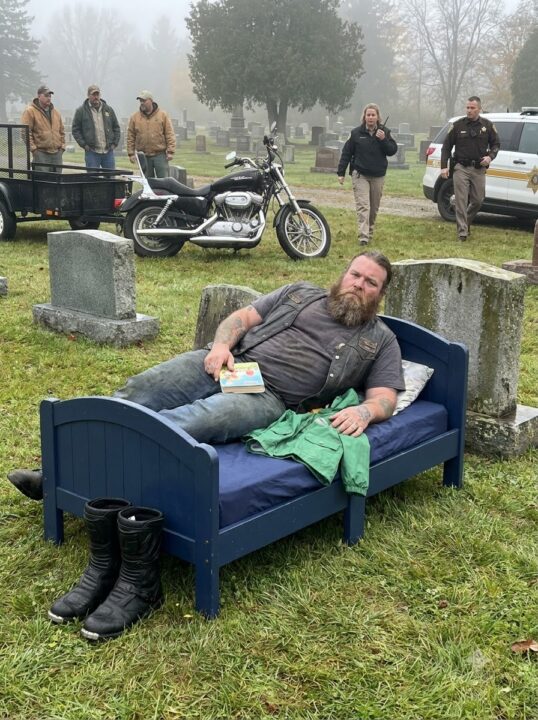
They would take the bed to the cemetery for one sunrise. Daniel would “see” it. Bear would lie on it beside the grave and prove that the frame held, the recorder worked, and someone could sleep while another person kept watch.
Afterward, Noah would finish the headboard.
Then he would try one full night at home.
Rachel refused.
Cemetery rules prohibited it. The weather was cold. The idea might deepen Noah’s fixation. A counselor advised against turning the grave into a bedroom.
Bear accepted every objection.
Noah did not.
The boy began visiting Bear’s workshop after school. He sanded the final headboard space. He listened to the recordings without lying down. Each time Daniel’s voice ended, Bear said the same thing.
“Still here.”
It meant the room remained. Bear remained. Noah remained.
For a while, that was enough.
Then Noah found the last recording.
Daniel had labeled the files with numbers, but one carried no number. Bear had never played it. He believed it was empty because the first thirty seconds contained only ambulance noise.
Noah waited.
At thirty-eight seconds, Daniel spoke.
“If Bear is hearing this, I probably forgot to erase it.”
There was a laugh, then a siren in the distance.
“Noah, if you found the secret button before we finished the bed, you cheated. Your mother will say you got that from me. Bear will say you got it from her because he enjoys living dangerously.”
Noah almost smiled.
Then Daniel’s voice changed.
“I’ve seen enough bad nights to know promises matter most when people are scared. So here’s mine: if I miss bedtime, Bear finishes the bed. You finish the last piece. Nobody does your part for you.”
Another pause.
“And if you ever think you’re alone, ask Bear about first watch. He knows.”
The recording ended.
Bear sat beside the frame with both hands hanging between his knees.
Daniel had recorded it weeks before the crash. It was not a prediction or farewell, only a paramedic talking during a quiet shift.
But Noah heard a command.
Bear finishes the bed.
Noah finishes the final piece.
First watch.
Rachel eventually agreed to a controlled visit. Dawn. Thirty minutes. No sleeping overnight. She would drive Noah. Mara—the cemetery caretaker—would be notified.
Bear called the cemetery office twice.
No answer.
He left a message naming himself, Daniel, Rachel, Noah, and the intended time. A storm had damaged the office line. I never received it.
The night before the visit, Rachel placed Noah’s green raincoat beside his pajamas. She set two alarms.
Noah set a third.
At 4:50 a.m., Rachel woke and found the front door open.
The headboard panel was gone.
So was her son.
Noah had decided he needed to arrive before Bear because first watch, in his mind, meant nobody was allowed to leave Daniel alone between darkness and sunrise.
He walked nearly two miles carrying the wood and flashlight.
Bear reached the cemetery first only because his Harley was faster.
He saw no child at the gate. Assuming Noah was still with Rachel, he unloaded the bed and began testing every joint.
He lay down to find the squeak Noah feared.
That was the shocking scene I discovered.
By the time Noah appeared beyond the east fence, Rachel had called the police, Bear had been mistaken for a vandal, and I was standing between a giant biker and a bed that looked like evidence from a crime.
Then Noah told him he was on the wrong side.
Bear had placed himself nearer the grave, leaving the outer pillow for the child.
Noah climbed onto the mattress and switched them.
“Dad needs the person on that side,” he said, pointing away from the headstone. “So he knows they didn’t leave.”
Bear moved.
He lay on the outer edge, between Noah and the open cemetery.
The boy placed his pillow beside Daniel’s stone.
For the first time in eleven months, Noah closed his eyes without asking who would still be there when he opened them.
The deputy lowered his hand from his belt.
Rachel sat in the wet grass.
I stopped trying to remove the bed.
We believed that was the climax—that one strange sunrise had broken the fear holding the child awake.
Then the recorder beneath the mattress clicked on by itself.
And Daniel said my name.
Part 4 — The Message Beneath the Mattress
“Mara, if you’re hearing this, Bear finally ignored a rule.”
Daniel’s voice rose through the small speaker beneath the mattress.
Every person beside the grave became still.
I had known Daniel as a paramedic who brought coffee and remembered the names of groundskeepers. I had not known he had placed me inside one of his son’s bedtime recordings.
The message continued.
“You once told me cemeteries aren’t for dead people. They’re for living people who need somewhere to put what they can’t carry home.”
I remembered saying it.
Daniel had found me sitting beside my husband’s grave four years earlier, after my shift had ended. I was ashamed to be caught crying in the cemetery I managed. He had left the coffee beside me and pretended not to notice.
Now his recorded voice filled the cold air.
“If Noah ever brings the bed there, don’t throw Bear out too fast. He’ll look guilty. That’s just his face.”
The deputy coughed to hide a laugh.
Bear did not.
Daniel explained the original plan. On Noah’s ninth birthday, they were supposed to bring the completed headboard panel to the cemetery for ten minutes—not because Daniel expected to die, but because Noah wanted his grandparents, buried two rows away, to “see his big-boy bed.”
The visit was meant to be harmless.
Daniel had added my name because he knew I enforced cemetery rules.
“Bear has permission to be strange for half an hour,” the recording said. “After that, charge him rent.”
Noah opened his eyes.
“Dad knew?”
“Not this,” Rachel whispered. “He knew about the birthday plan.”
Bear stared at the recorder as if Daniel had reached through eleven months and struck his chest.
But the greater twist waited inside the unfinished headboard panel.
Noah handed it to Bear again.
This time, I saw that the wood was not a single board. Two thin layers had been screwed together. On the back, beneath dirt from Noah’s walk, someone had written measurements in Daniel’s handwriting.
Bear removed four small screws.
A photograph slid out.
It showed Daniel, Bear, and five Mercy Road Riders standing beside the remains of a burned house. Bear held a little girl wrapped in his leather cut. Daniel was kneeling beside them with an oxygen mask.
The girl was me.
Not as a child. As an adult.
The photograph had been taken six years earlier on the night my house burned.
Smoke inhalation had erased pieces of my memory. I remembered crawling from a bedroom window. I remembered Daniel’s ambulance. I remembered a huge stranger carrying me across frozen grass, then disappearing before I learned his name.
Bear had been that stranger.
He had entered through the back porch after hearing me inside. Daniel treated both of us. Bear refused transport because he was on probation and feared being blamed for trespassing.
Daniel kept the photograph.
“Mara,” Rachel said, “did you know?”
I shook my head.
Bear looked uncomfortable, almost angry.
“Wasn’t part of this.”
It was exactly like him to treat saving a life as an irrelevant detail.
The second layer of the panel held a folded sheet of paper. It was not a letter to Noah.
It was a contract.
Daniel had written it after Bear refused to accept payment for the bed. The language was half serious, half joke:
In exchange for one Bear-proof bed, Daniel Cross agrees to remain Wade Rourke’s emergency contact until Noah Cross is old enough to inherit the position.
Beneath it were two signatures.
Daniel Cross.
Noah Cross, written in oversized crooked letters.
Noah had signed months before the crash without understanding what “emergency contact” meant.
Bear had hidden the document because the joke hurt too much after Daniel died.
“You put it in Dad’s ambulance wood?” Noah asked.
Bear nodded.
“Why?”
“Needed something of his in the part you finished.”
The panel had not actually come from the ambulance in which Daniel died. That was what Rachel had believed when she saw the scorched edge.
The truth was stranger.
It came from an older ambulance door damaged during the house fire that nearly killed me. Daniel had salvaged the interior panel when the vehicle was retired. He planned to use it because he said a piece of wood that had already carried people home should become part of Noah’s bed.
The burn mark belonged to my fire.
The photograph proved it.
The missing piece connected all four of us: Daniel, the child who feared sleep, the biker who believed he owed every kindness back, and the caretaker preparing to have him arrested.
That should have ended the conflict.
It did not.
The cemetery board arrived before eight.
One of the grounds workers had posted a photograph online: Bear lying in the child’s bed beside Daniel’s grave. The image spread without context. People accused him of desecrating graves, staging a publicity stunt, exploiting a grieving boy, and performing some bizarre biker ritual.
The board president, Harold Vance, demanded the bed be removed.
Rachel explained.
Noah played the recording.
Harold listened, then pointed toward the gate.
“Rules cannot change because a story is sad.”
Bear stood.
The quiet in him changed.
Brick, Tomás, and eleven Mercy Road Riders had gathered outside the cemetery after hearing that police were involved. Their Harleys idled beyond the fence, engines striking the morning like heavy drums.
Bear could have called them in.
He did not.
He removed his cut, folded it over the footboard, and began disassembling the bed.
Noah grabbed the rail.
“You promised sunrise.”
“Sun’s up.”
“I didn’t finish it.”
Bear placed a scarred hand over the boy’s fingers.
“Then we finish somewhere else.”
Harold ordered me to document the violation.
I looked at Daniel’s grave, the photograph from my fire, and the child holding a piece of the bed as if someone were trying to bury his father a second time.
Then I made the first reckless decision of my career.
“No violation occurred,” I said.
Harold stared at me.
“The bed was part of an approved grief visit supervised by cemetery staff.”
“I did not approve it.”
“I’m senior caretaker. I just did.”
“You’ll lose your job.”
“Maybe.”
Bear looked at me.
I expected thanks.
He said, “Don’t.”
One word.
Heavy as stone.
He did not want another person risking a livelihood for him. Daniel had opened one door; Bear had spent years trying not to owe the world another.
I signed the approval form anyway.
Noah fitted the final panel into the headboard beside his father’s grave.
Bear guided the drill but never touched the trigger.
The child drove the final screw.
When it seated, the recorder played Daniel’s last message again.
“If you ever think you’re alone, ask Bear about first watch.”
Noah looked up.
“Are you my emergency contact now?”
Bear’s beard moved once.
“Looks that way.”
That was the moment the bed became more than a memorial.
It became a transfer of duty.
A dead father had not asked Bear to replace him.
He had asked him to stay.
Part 5 — The First Night at Home
The cemetery board suspended me for two weeks.
Harold called it unauthorized use of a burial plot. The local newspaper called it bureaucratic punishment. Strangers who had seen the photograph began mailing angry letters, though half still believed Bear had hauled the bed there for attention.
Bear disliked all of it.
He refused interviews. He told the Mercy Road Riders not to threaten Harold, contact his family, park outside his house, or turn the cemetery meeting into a motorcycle rally.
Brick disagreed.
“So he gets to call you sick in public?”
“Yep.”
“And we do nothing?”
“We build.”
That was Bear’s answer to most damage.
While I was suspended, fourteen bikers came to Willow Creek without their motorcycles. They repaired storm fencing, reset leaning veteran markers, cleared a clogged drainage ditch, and rebuilt a wheelchair ramp the board had postponed replacing.
They wore ordinary work shirts.
Bear did not come.
He stayed at Rachel’s house preparing Noah’s bedroom.
The cemetery visit had allowed Noah to close his eyes for eleven minutes. At home, fear returned as soon as darkness touched the windows.
The bed felt different away from Daniel’s grave.
Noah pressed the recorder button repeatedly. Daniel’s stories ended. Each silence became proof that the dead could speak only until a battery failed.
On the first night, he lasted eight minutes.
On the second, twelve.
On the third, he dragged the mattress into the hallway.
Bear never told him to be brave.
He brought a folding chair and sat outside the bedroom door.
“First watch,” he said.
Noah lay down.
“Will you leave?”
“Eventually.”
“When?”
“When you don’t need me.”
“What if that’s never?”
“Then my back’s in trouble.”
The boy almost laughed.
Bear stayed until dawn.
The next night, Noah demanded that he sit farther away. Bear moved to the stairs. On the fifth night, he waited in the living room. On the seventh, he remained on the front porch.
Progress did not move cleanly.
A thunderstorm returned Noah to the floor. The anniversary of Daniel’s crash brought three nights without sleep. When a schoolmate’s mother died, Noah dismantled the headboard panel because he believed the photograph and contract had somehow caused death to return.
Bear found every screw arranged in a straight line.
He did not scold him.
He sat beside Noah and rebuilt the panel one piece at a time.
“Wood remembers holes,” Noah said.
“Yep.”
“Does that make it weaker?”
“Sometimes.”
“Then why use the same holes?”
Bear placed the final screw into the child’s palm.
“Because we know where they are.”
Noah drove it in.
The recorder eventually became less important. Rachel replaced Daniel’s messages with blank space after the final track, refusing to add anyone else’s voice. She wanted Noah to learn that silence did not always mean abandonment.
Bear added one mechanical feature.
A small wooden switch beside the mattress lit a lamp in his workshop garage three blocks away. Noah could press it once at night. If Bear was there, he answered by switching the light off and on.
No phones.
No words.
One signal.
One answer.
The first month, Noah pressed it nearly every night. Bear sometimes rode across town just to be near the garage before bedtime.
The V-twin warned the neighborhood at 10:00 p.m. that the large tattooed biker was reporting for a duty nobody had assigned him.
Then the signals became less frequent.
Twice a week.
Once a week.
Eventually, only on Daniel’s birthday.
The burned ambulance panel in the headboard revealed another secret. Beneath the photograph, Daniel had etched a list of names—patients, friends, and strangers who had helped him after difficult calls.
Bear’s name appeared first.
Mine appeared fourth.
At the bottom, Daniel had written:
People who carried me when I could still walk.
Rachel had never seen that sentence.
Bear read it once and walked outside.
He did not cry where we could see him. He stood beside his Harley with both hands on the handlebars, head lowered, while the engine remained cold.
Brick joined him.
No speech.
Just two men beside a machine that made no sound.
When my suspension ended, Harold offered to let me return if I signed a statement saying the cemetery visit had been a misunderstanding.
I refused.
“It was understood perfectly,” I told him.
The board voted three to two to reinstate me anyway. The photograph of Bear on the bed had brought donations, but that was not what changed the final vote.
The grounds crew had found something beneath Daniel’s grave decoration.
A sealed envelope.
Daniel had left it months before his death and asked us to place it beneath the toy dinosaur if anything happened to him. A temporary employee logged it incorrectly, and nobody notified Rachel.
Inside was a short note granting permission for Noah to bring “one ridiculous blue bed” to the grave on his ninth birthday.
Daniel had planned the visit.
Bear had fulfilled it.
Harold read the note twice.
Then he walked to Bear’s workshop.
He did not apologize elegantly. Men like Harold and Bear rarely did anything elegantly when shame was involved.
He placed a cemetery key on the workbench.
“For supervised visits,” he said.
Bear looked at it.
“Give it to Mara.”
“She already has one.”
“Then give her two.”
Harold left the key.
Bear later shaped it into a small metal star and set it into Noah’s headboard beside the burned ambulance wood.
Every strange detail from the cemetery returned with a meaning.
The bubble bath in Bear’s saddlebag had been wood-safe cleaner Rachel used on Noah’s old furniture.
The second pillow belonged to Bear, not Daniel. Noah needed to see that someone living could sleep while Daniel remained silent.
The counting was Bear timing the recorder delay.
The carpenter’s pencil marked each joint after testing.
The green raincoat was not bait or evidence of secret contact. Noah had left it in Bear’s shop after a counseling session.
And Bear’s shaking hands were not anger.
The final panel carried a photograph of the worst night of his life after prison—the night he entered a burning house and feared everyone would assume he had started the fire.
Daniel had been the first responder who believed him.
Bear spent years repaying that belief.
But Noah did something Daniel had not planned.
He stopped calling the biker Uncle Bear.
One morning, while fitting a drawer beneath the bed, he looked up and said, “Wade?”
Bear froze.
Noah had heard Rachel explain that emergency contacts needed legal names.
“If I call at night, do I ask for Wade Rourke?”
“Probably.”
“What if I need Bear?”
Bear tightened the drawer slide.
“Same man.”
Noah considered that.
Then he wrote WADE “BEAR” ROURKE beneath Daniel’s name on the emergency form.
Not father.
Not replacement.
The man who stayed.
Part 6 — The Light Above the Garage
Noah slept through an entire night three months after the cemetery visit.
Bear did not.
He sat in the workshop watching the small signal lamp above his bench. At midnight, it remained dark. At two, still dark. By four, he had convinced himself the wiring had failed.
He rode to Rachel’s house before sunrise.
The Harley’s low rumble woke three neighbors. Rachel opened the door holding a baseball bat.
“What happened?”
“Light didn’t work.”
She stared at him.
Then she looked toward Noah’s room.
The boy was asleep.
Bear stood on the porch with rain on his shoulders and understood that success could feel exactly like being dismissed.
Rachel lowered the bat.
“Coffee?”
He stayed until Noah woke at seven.
The child wandered into the kitchen, saw Bear, and frowned.
“I didn’t call.”
“Know that.”
“Then why are you here?”
“Bad wiring.”
Noah smiled.
The wiring was fine.
Over the next several years, the blue bed changed with him. Bear extended the rails, replaced the child’s mattress, and built a desk beneath the headboard when Noah entered middle school.
He never painted over the burn mark.
The hidden recorder stayed.
Noah stopped playing it every night, then every week. Eventually, he listened only on Daniel’s birthday and the anniversary of the crash.
The Mercy Road Riders adopted “first watch” as a quiet club ritual. When a member lost a spouse, child, parent, or brother, someone remained outside the house through the first night after the funeral.
No revving.
No speeches.
One motorcycle at the curb. One porch light left on.
The cemetery allowed one supervised bed visit each year. Noah did not always bring the whole frame. Sometimes he carried only the final headboard panel and sat beside Daniel’s grave while Bear read from the battered winter-bear book.
I watched from a distance.
Bear’s beard turned silver. His knees stiffened. The STAY tattoo faded until the letters looked like smoke beneath his skin.
But he stayed.
Harold eventually retired. At his farewell, he gave Bear the original violation form I had signed that morning. Across the bottom, Harold had written:
No damage found. One promise completed.
Bear placed it beneath the bed’s drawer.
He told nobody.
I found it years later when Noah asked me to help move the frame one final time.
By then, the signal lamp above Bear’s garage had been dark for almost two years.
Noah no longer needed to press it.
Bear still checked.
Part 7 — First Watch
Noah was seventeen when Bear suffered a heart attack in the workshop.
The boy found him because the signal lamp came on at 1:14 a.m.
Bear had rewired the switch months earlier so it worked both ways.
He had never told anyone.
Noah saw the light blink from his bedroom window, pulled on his father’s old paramedic jacket, and ran three blocks through the rain. He found Bear conscious but unable to stand, one hand gripping the workbench while the other pointed toward Daniel’s medical kit.
Noah called 911.
Then he sat on the concrete floor and held Bear’s wrist.
“First watch,” he said.
Bear tried to answer.
Noah shook his head.
“Don’t talk. Stay.”
The word on Bear’s knuckles rested against the boy’s palm.
He survived.
Six weeks later, Noah moved the blue bed from Rachel’s house into Bear’s workshop apartment. It no longer fit him, even with the extended rails, but he refused to throw it away.
Together, they removed the mattress and converted the frame into a bench.
The two pillows remained.
On Daniel’s birthday, they loaded the bench onto the same scratched utility trailer and carried it into Willow Creek Cemetery. Bear moved slowly now, one hand on Noah’s shoulder, while I opened the eastern gate.
They placed it beside Daniel’s grave.
Bear sat on the outer side.
Noah sat beside the headstone.
“You had it backward the first time,” Noah said.
Bear looked at him. “You were eight.”
“You were supposed to know.”
“Didn’t.”
They stayed until sunrise.
No recording played. The batteries had been removed years earlier, and Noah no longer needed his father’s voice to prove the promise had existed.
Before leaving, he pressed one hand against the burned panel.
He had graduated from high school and been accepted into an emergency medical program in Kansas City. Daniel’s old partner had offered him a place to stay.
Bear had already rebuilt a used touring Harley for the day Noah became old enough and trained enough to ride it.
The motorcycle waited beneath a canvas cover in the workshop.
Noah stood and returned the battered winter-bear book to Bear’s saddlebag.
“Who takes first watch when I leave?”
Bear glanced toward Daniel’s grave.
“Old man’s still here.”
Noah nodded.
Bear started the Harley. The V-twin rolled through the cemetery, deep but restrained. Before climbing onto the passenger seat, Noah looked back at the blue bench between the graves.
Two pillows.
One empty place.
No fear.
Bear lifted the kickstand.
They rode through the gate together.
Follow the page for more powerful biker stories, and drop BEAR below if you want the next full Mercy Road story.