An Old Dog Was Left Outside a Nursing Home — A Biker Stopped Longer Than He Planned
The dog didn’t bark when the car drove away.
He just sat there.
Tied to the cold metal bench outside the nursing home, his gray muzzle resting against his chest, ribs rising and falling in shallow, uneven breaths. His legs trembled—not from fear, but from the kind of weakness that comes after years of being loyal for too long.
A nurse stepped out for a smoke and paused. She frowned.
“Someone’s dog?” she asked the air.
No answer.
Visitors walked past the old dog without slowing. Some assumed he belonged to a patient. Others thought animal control would handle it. A few avoided eye contact altogether.
The dog lifted his head once, ears perking weakly as if hoping the sound of footsteps meant something familiar.
They didn’t.
Then the low rumble of a motorcycle rolled into the parking lot.
The dog’s ears twitched again.
A biker pulled in, cut the engine, and stayed seated longer than necessary.
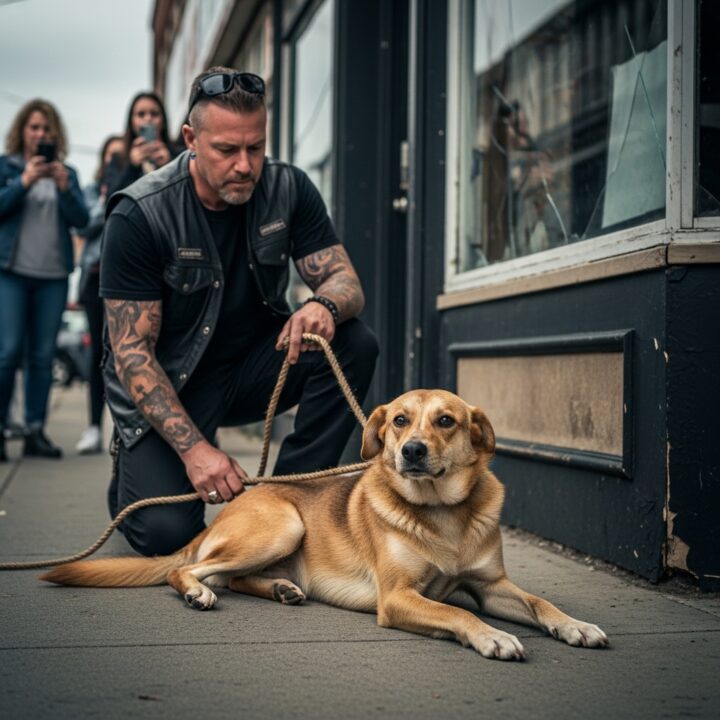
The biker didn’t rush over.
He removed his helmet slowly. Mid-40s. Broad shoulders. Sleeveless black shirt clinging to arms marked with faded tattoos. His face was calm, unreadable. The kind of man people watched before deciding whether to trust.
When he finally stood and walked toward the dog, a security guard near the entrance stiffened.
“Hey,” the guard called. “You can’t just take that dog.”
The biker stopped a few feet away from the bench. The dog looked up at him, tail thumping once against the concrete. Just once.
“I’m not taking him,” the biker said quietly.
From the glass doors, a few staff members watched. Someone whispered, “Is that safe?” Another muttered that bikers were always trouble.
The biker crouched slowly.
Phones appeared.
A woman shook her head.
Someone said they should call animal control.
From a distance, it looked wrong. A biker kneeling beside an old, tied-up dog. Blocking the view. Not explaining himself. Hands near the knot.
The guard stepped closer. “Sir, I need you to back away.”
The biker didn’t argue. He didn’t touch the rope.
He just held out his hand and let the dog sniff his fingers.
The dog leaned forward, pressed his head into the biker’s palm, and sighed.
That only made the tension worse.
“Do you know whose dog that is?” the guard demanded.
The biker shook his head. “No.”
“Then you need to step away.”
The dog whimpered softly, as if he understood the conversation was about to go badly.
The biker glanced at the dog’s collar. Faded. Cracked. A name barely legible. No phone number.
He reached into his pocket.
Someone gasped.
Another voice snapped, “Don’t touch him!”
The biker pulled out his phone.
Typed a short message.
Put it away.
Then he did something unexpected.
He sat down on the concrete, back against the bench, placing his body between the dog and the crowd. Not blocking aggressively. Just… being there.
The guard hesitated. This wasn’t in the training manual.
“Sir,” he said more quietly now. “We have procedures.”
The biker nodded. “So do I.”
He rested one arm loosely across his knee. The dog shifted closer, leaning his weight against the biker’s leg like he’d done it a thousand times before—with someone else.
Minutes passed.
The dog’s breathing steadied.
From down the road, engines began to hum.
One motorcycle rolled in.
Then another.
They parked in an orderly line, engines cutting off one by one. Men and women dismounted calmly. No raised voices. No dramatic gestures.
Just presence.
A woman in her late 30s knelt near the dog. “Hey, old man,” she said softly. “You’ve had a long day, huh?”
The staff fell silent.
A nurse stepped closer. “Wait,” she said suddenly. “I think I know that dog.”
Everyone turned.
“He belonged to Mr. Halvorsen,” she continued. “Room 214. He passed this morning. His family came earlier.”
The realization hit like a weight.
The rope.
The timing.
The dog waiting where he’d last been told to stay.
The biker closed his eyes for a brief moment. When he opened them, his jaw tightened—not in anger, but in resolve.
“Can he come inside?” he asked.
The nurse nodded immediately. “Of course.”
No one objected.
The guard stepped back.
The dog was gently untied. His legs wobbled, but he stood. Barely.
The biker slipped off his vest and draped it over the dog’s back against the chill.
Later, much later, after paperwork and phone calls and quiet conversations, the truth settled in.
The biker hadn’t planned to stop. He was on his way through town, passing time before meeting friends. He’d seen the dog and stayed because something felt unfinished.
He didn’t give interviews. Didn’t post about it. When asked his name, he waved it off.
The dog spent the night inside, curled at the foot of an empty bed in Room 214. The nurses said he slept deeper than they’d ever seen.
In the morning, the biker came back.
No speech. No announcement.
He clipped a new leash onto the old collar and waited patiently while the dog stood, steadying himself.
As they walked toward the motorcycle, someone asked, “Are you adopting him?”
The biker paused.
“I think,” he said quietly, “he already decided.”
He rode away slowly, the dog secured safely behind him, gray ears flapping gently in the wind.
Outside the nursing home, the bench sat empty again.
But the space felt different now.
And for those who’d watched a biker sit on cold concrete instead of walking away, one small truth lingered:
Sometimes the kindest thing you can do
is stop longer than you planned.