When a Biker Crew Came to Take a Little Girl From Her Mother — The Entire Neighborhood Called the Police
When twelve leather-clad bikers pulled up in front of a small blue house and a terrified little girl clung to the porch railing, the neighborhood was certain they were witnessing a kidnapping—until the sirens started.
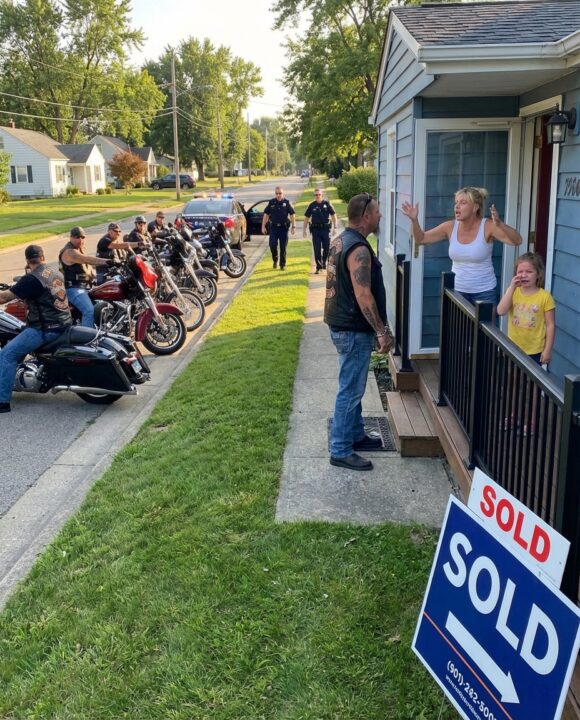
It was 4:18 p.m. on a humid Thursday in early June, in a quiet subdivision outside Columbus, Ohio. Lawns were trimmed. Flags hung from porches. Children rode scooters in slow circles near the cul-de-sac.
Then the engines rolled in.
Deep. Heavy. Unmistakable.
One bike. Two. Five. A full line of them turning onto Maple Ridge Drive, chrome catching the late afternoon light. Windows slid open. Curtains twitched.
On the porch of the blue house stood eight-year-old Lily Harper, barefoot, clutching the wooden railing with both hands. Her face was streaked with tears. Behind her, inside the doorway, her mother—Amanda—shouted something no one could clearly hear.
The first biker cut his engine.
Silence dropped hard.
He removed his helmet slowly. Mid-forties. Weathered face. Black sleeveless leather vest over a gray shirt. Tattoos along his forearms. He didn’t smile. He didn’t wave.
He stepped toward the walkway.
Amanda’s voice broke through now. “You can’t just take her!”
That was all the neighborhood needed.
Phones came out instantly.
“Call 911.”
“Those are bikers.”
“They’re taking that little girl.”
Lily backed toward the door, shaking her head, confusion written all over her face. A child caught in the middle of adult decisions she didn’t understand.
The lead biker stopped halfway up the path.
He didn’t raise his voice.
He didn’t rush forward.
He simply said, calm and firm, “We’re here for Lily.”
To everyone watching, it sounded like a threat.
And then, from somewhere down the street, the first police siren began to wail.
No one on Maple Ridge Drive knew yet that the men in leather weren’t stealing a child.
They were there because the court had already decided where she belonged.
The second siren joined the first before the police cruisers even turned onto the street.
Neighbors stood in clusters on their lawns, some protective, some curious, all convinced they were watching something dangerous unfold.
Amanda stepped fully onto the porch now, one arm stretched protectively across Lily’s shoulders. Her voice was sharp, frantic. “You have no right! You think showing up like this makes you strong?”
The lead biker—his name was Cole Bennett—remained at the edge of the walkway. He kept his hands visible at his sides. No sudden movements. No aggression. But from a distance, all anyone saw was leather, ink, and a line of motorcycles.
Lily looked between the adults, eyes wide. “Mom?”
Amanda crouched quickly. “It’s okay. They can’t take you.”
The word take carried across the street like gasoline on a spark.
One neighbor, an older man in a baseball cap, muttered loudly, “This is how those groups operate. Intimidation.”
Cole exhaled slowly. “Ma’am, we’re not here to fight.”
“You brought twelve men!” Amanda shot back.
A second biker stepped off his bike—taller, shaved head, dark beard. He removed his helmet carefully and rested it on the seat. His posture was rigid but controlled. To the onlookers, it looked coordinated. Like muscle backing a claim.
The first cruiser pulled up sharply. Doors opened. Two officers stepped out, hands resting near their belts.
“What’s going on here?” one officer demanded.
“Attempted abduction!” someone yelled from across the street.
Amanda pointed toward the bikers. “They’re trying to take my daughter!”
The officers shifted their attention to Cole.
“Sir, step back from the property.”
Cole obeyed immediately. Two steps backward. Slow. Deliberate.
But the tension didn’t ease.
Lily’s small hands trembled against the porch railing.
The officer glanced at the lineup of bikes, then back at Cole. “You’re aware we can detain you if this is interference with parental custody.”
Cole nodded once. “Yes, sir.”
He reached into his vest pocket.
Three neighbors gasped audibly.
The officer’s voice sharpened. “Hands where I can see them.”
Cole stopped mid-motion and raised both palms calmly. “It’s paperwork.”
“Don’t move,” the officer said.
From the outside, it looked exactly like escalation.
A biker reaching inside his vest.
Police bracing for a confrontation.
Amanda shaking with fury and fear.
Lily crying openly now.
And the rest of the bikers? They didn’t argue. They didn’t speak.
They simply stood there, engines cooling, boots planted evenly along the curb. A wall of silent presence that made the scene feel heavier by the second.
The officer finally motioned carefully. “Slowly.”
Cole withdrew a thick envelope.
“Family Court of Franklin County,” he said quietly. “Guardianship order.”
The word guardianship barely registered in the chaos.
Because Amanda’s voice was louder.
“This is harassment!”
The officer took the envelope cautiously.
He hadn’t opened it yet.
And until he did, Maple Ridge Drive was convinced it was watching a crime in progress.
The officer didn’t open the envelope immediately.
He held it in one hand while scanning the street, reading the energy more than the paper. Neighbors stood frozen in place. Phones were still recording. Lily’s crying had softened into shaky breaths.
Amanda stepped down one porch stair, jaw set. “You don’t get to decide this with a piece of paper.”
Cole didn’t argue.
He didn’t even look at her.
He kept his eyes level with the officer’s.
“Sir,” he said evenly, “the hearing was Tuesday. Judge Henderson. We were instructed to retrieve her today at four.”
The officer finally broke the seal.
Pages unfolded.
Official stamps. Signatures. Case number.
The second cruiser arrived. A third officer stepped out, scanning the row of motorcycles.
The tension shifted—but not enough.
Amanda’s voice cracked now, somewhere between anger and disbelief. “They can’t just show up like this. With all of them.”
One neighbor whispered loudly, “Why would you need that many unless you’re forcing something?”
That question hung heavy.
Cole inhaled slowly. “We were asked to come as witnesses.”
“Witnesses to what?” Amanda snapped.
Cole didn’t answer.
Not yet.
Because this wasn’t about winning an argument on a sidewalk. This was about not letting the situation spiral further.
The second officer approached Amanda gently. “Ma’am, the paperwork appears valid. We’ll verify with dispatch.”
The words valid made the street go quiet in a different way.
Not calmer.
Just stunned.
Lily looked up at her mother. “What’s happening?”
Amanda knelt quickly and hugged her tight. “I’m fighting this.”
The officers stepped aside to radio in the case number. Neighbors leaned closer. No one wanted to miss what came next.
Cole reached into his pocket again—this time slowly, clearly—and pulled out his phone.
The first officer stiffened slightly. “Who are you calling?”
“Just confirming timing,” Cole replied.
He stepped away from the porch, speaking quietly into the phone. “We’re here.”
He didn’t say who he was talking to.
He didn’t explain anything further.
But something in his tone changed.
Less defensive.
More resolved.
Meanwhile, dispatch crackled back over the officer’s radio.
“Guardianship order confirmed. Transfer effective today, 1600 hours.”
The officer’s shoulders lowered a fraction.
Amanda froze.
“What does that mean?” a neighbor asked.
The officer approached her carefully. “Ma’am, the court granted guardianship to the child’s aunt. Effective immediately.”
“Aunt?” someone repeated.
Amanda’s face drained of color.
“This isn’t over,” she whispered.
But legally, in that moment, it was.
The street that had been ready for a confrontation was now suspended in disbelief.
Cole stepped closer again—but not onto the porch. He stopped at the base of the steps.
“Lily,” he said gently.
She looked down at him, tears still clinging to her lashes.
“You don’t have to be scared.”
From the outside, it still looked wrong.
A biker addressing a crying child while police stood nearby.
To anyone watching, it felt like something powerful taking something fragile.
But none of them knew why the court had made that decision.
None of them knew who was waiting just a few houses away.
And none of them yet understood that this wasn’t about taking Lily from her mother.
It was about keeping a promise made years ago.
Before anyone saw her, they heard her.
Not an engine.
Footsteps.
Slow. Measured. Familiar to the bikers but not to the neighborhood.
A woman in her late thirties walked down the sidewalk from the corner house. She wore simple jeans and a light denim jacket. No dramatic entrance. No raised voice.
Her name was Rebecca Lawson.
She stopped beside Cole.
The officers looked between them. “Ma’am, are you the petitioner?”
“Yes,” she said quietly.
Amanda stared at her as if she’d materialized from nowhere. “You did this?”
Rebecca’s expression didn’t hold triumph.
It held grief.
“I filed after the third incident report,” she said softly.
The neighbors shifted again. Incident report?
Rebecca crouched slowly at the bottom step, eye level with Lily.
“Hey, sweetheart.”
Lily blinked through tears. Recognition flickered.
“Aunt Becca?”
That single word altered the street.
The officer glanced back at the paperwork, then at Rebecca. “You’re the legal guardian as of today.”
Rebecca nodded.
The bikers remained behind Cole, still and silent. They weren’t forming a wall now. They looked more like witnesses at a ceremony no one had expected.
Amanda’s voice wavered. “You brought them.”
Rebecca glanced back at the line of leather vests. Her gaze lingered for a moment.
“They were family,” she said.
That confused everyone.
Cole finally spoke again, not loudly, not dramatically.
“Her husband was one of ours.”
The street went quiet in a new way.
“Was?” a neighbor asked under his breath.
Rebecca swallowed.
“Five years ago,” she said, voice steady despite the tremor underneath, “there was a fire.”
Some of the bikers lowered their eyes.
Cole didn’t.
“He went in after Lily,” Rebecca continued.
Amanda’s breath hitched.
“He got her out.”
Silence thickened.
“He didn’t make it back out.”
The weight of that sentence settled over Maple Ridge Drive like ash.
Neighbors who had been filming lowered their phones.
The officers exchanged a brief look.
Lily stared at Rebecca, confusion blending with memory.
Amanda’s anger faltered. Just slightly.
Rebecca stood slowly.
“The court reviewed everything,” she said. “The history. The reports. The evaluations.”
Cole added quietly, “We’re not here to take anything.”
Rebecca reached her hand up the final porch step.
“We’re here to keep her safe.”
The bikers didn’t step forward.
They didn’t claim anything.
They simply stood there, present but restrained.
The narrative that had looked like an abduction began to crack.
But not fully.
Not yet.
Because the hardest part still hadn’t happened.
Lily had to decide whether to walk down those steps.
And the entire neighborhood, once certain it was watching a crime, now watched in complete silence—waiting to see which way she would move.
For a long moment, no one spoke.
The police radios had gone quiet. The engines had cooled. Even the cicadas seemed to pause in the thick Ohio air.
Lily stood at the top of the porch steps, barefoot, small fingers still curled around the railing. Her world had just been rearranged by adults holding paperwork and memories she barely understood.
Rebecca didn’t rush her.
She kept her hand extended—steady, patient.
Cole and the other bikers stayed where they were. No one advanced. No one insisted. Whatever happened next had to belong to Lily.
Amanda’s breathing was uneven. “You don’t have to go,” she whispered, though her voice lacked the certainty it carried minutes earlier.
The officer stepped slightly to the side, creating space instead of authority.
Lily looked at her mother first.
Then at Rebecca.
Then at the line of bikers.
Her eyes lingered on the leather vests for a second longer than expected—not with fear, but with curiosity. Something familiar in the stitching. In the patches.
Rebecca noticed.
She reached into her jacket pocket slowly and pulled out a small, worn photograph.
“Your Uncle Mark kept this in his wallet,” she said softly.
She didn’t step closer.
She held it up where Lily could see.
A snapshot of a little girl wrapped in a firefighter’s blanket, soot on her cheeks, a tall biker crouched beside her, helmet off, smiling through smoke.
Recognition arrived quietly.
“That’s… me,” Lily whispered.
Amanda covered her mouth.
Cole lowered his gaze.
Rebecca nodded. “He called you his brave girl.”
The street felt smaller somehow. Like the entire neighborhood had been drawn into something sacred and unfinished.
Lily took one step down.
Then another.
No cheers.
No applause.
Just the sound of her bare feet against wood.
Halfway down, she stopped and looked back at her mother. Not accusing. Not angry. Just unsure.
Amanda’s face crumpled in a way that wasn’t theatrical. It was human. Complicated.
She didn’t chase her.
She didn’t scream.
She simply said, “I love you.”
Lily nodded once.
And finished the walk.
Rebecca knelt immediately, wrapping her in a careful embrace—not possessive, not triumphant. Protective, but gentle.
The bikers turned away slightly, giving the moment privacy even though they stood in full view of the street.
Cole finally spoke to the officers. “We’re done here.”
And that was true.
No confrontation.
No drama.
No spectacle.
Just paperwork honored and a promise kept.
As the motorcycles started one by one—quietly, respectfully—neighbors stepped back onto their lawns with different expressions than before.
Phones lowered.
Assumptions softened.
The men they had labeled dangerous had arrived not to take a child—but to escort her toward a home tied to a sacrifice most of them had never known about.
Rebecca led Lily toward her car.
Before getting in, Lily turned once more and looked at the bikers.
Cole gave a small nod.
Nothing more.
No speeches about loyalty.
No claims of heroism.
Just a quiet procession pulling away from Maple Ridge Drive.
And later that evening, when the street settled back into its usual rhythm, one detail lingered heavier than the sirens ever had:
Sometimes what looks like force is actually protection. Sometimes leather carries grief instead of threat.
If you want to read more stories about bikers misunderstood—and the quiet courage behind them—follow the page.