They Threw Beer Cans at the Homeless Biker Sleeping Beside a Montana Gas Station — Then One Burned Metal Tag Revealed Who Had Saved Their Families
The third beer can struck the homeless biker’s ribs while he slept beside my gas station, but he only moved when one laughing boy raised his boot over a faded blue bag.
I was thirty-eight years old and managing the night shift at Junction Fuel outside Elk River, Montana, when four local boys decided a sleeping man would make good entertainment. It was 11:46 on a Friday night, the highway was empty except for moths circling our canopy lights, and the smell of gasoline sat heavy in the warm August air.
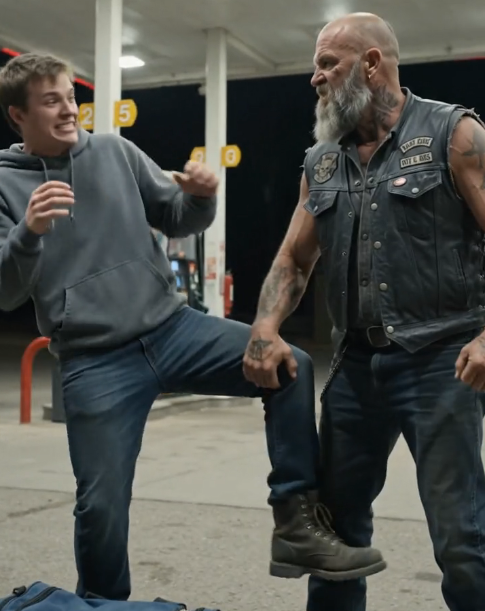
The biker had been beside pump seven since sunset.
He looked close to sixty, perhaps older, with a shaved head, a long gray beard, and faded tattoos running from his neck to both scarred hands. His black leather vest had no readable club patch. His jeans were stained at the knees, one boot was bound with silver tape, and his old Harley sat ten feet away beneath a layer of road dust.
He had bought one black coffee with coins.
Then he asked me a strange question.
“Your emergency fuel shutoff work?”
I pointed to the red switch beside the office door and told him it had passed inspection that spring. He nodded, walked the perimeter of the building twice, and settled against the concrete wall with a faded blue canvas bag beneath his head.
I assumed he was homeless.
I was right.
I also assumed that was the most important thing about him.
I was wrong.
The boys arrived in a lifted pickup with music shaking its doors. Mason Pike was driving. He was nineteen, broad-shouldered, loud, and accustomed to having people forgive him because his father owned Pike Construction and donated money to every football fundraiser in town.
His three friends climbed out carrying beer they were too young to possess. They saw the biker before they saw me behind the register.
“Hey, Grandpa,” Mason called. “Campground’s six miles west.”
The man did not answer.
A silver can rolled across the pavement and tapped his boot. The boys laughed. Mason threw another. It struck the wall above the biker’s shoulder and sprayed warm beer across his vest.
Still nothing.
The third can hit his ribs.
That was when I left the register.
“Get back in your truck,” I said through the open doorway.
Mason grinned at me. “We’re helping you clear the trash, Maya.”
The biker opened his eyes. They were pale blue, sharp, and completely sober. He did not look at the can near his leg or the beer dripping from his beard.
He looked toward the blue bag.
One of Mason’s friends, Troy Keller, nudged it with his sneaker. Something metal shifted inside with a dull clatter.
The biker rose.
He was taller than I had guessed—at least six-foot-four, leaner than his leather made him appear, but still wide through the shoulders. His knees seemed stiff. One hand pressed briefly against the wall before he steadied himself.
The boys took one step backward.
Then Mason noticed they had moved and became embarrassed.
He kicked the bag.
Not hard enough to injure anyone. Hard enough to send it skidding beneath the fluorescent lights.
The biker crossed the distance in two strides, caught Mason’s ankle, and stopped the second kick before it landed. He did not twist. He did not strike. He simply held the boy’s boot six inches above the pavement.
“Don’t touch that bag.”
His voice was low and worn.
Mason’s face changed. For one second he looked frightened. Then his friends raised their phones, and fear turned into performance.
“Get your hands off me!”
The biker released him immediately.
Mason staggered backward and began shouting that the old man had attacked him. Troy kept filming. Another boy laughed and suggested they dump the bag into the trash compactor.
I stepped between them.
“That’s enough.”
But Mason was looking at the biker’s vest, at the patched boot, at the blanket folded beside the wall. He had found the kind of person he believed could be humiliated without consequence.
“Why?” he asked. “What’s in there? Your liquor?”
The biker picked up the bag and held it against his chest. Through a tear near the zipper, I saw the blackened corner of a photograph, a small brass bell, and several flat pieces of scorched metal strung together on wire.
One of those pieces slipped free.
It struck the pavement between Mason’s boots.
Mason bent first and picked it up. The object was an old oval address tag, burned nearly black around its edges. He rubbed it against his shirt until four numbers appeared.
417.
His smile disappeared.
“That’s my house number.”
The biker took the tag from him.
“It was,” he said.
Before Mason could ask what that meant, a red pickup stopped at the highway entrance. Elk River’s retired fire chief climbed out, stared across the forecourt, and let his truck door remain open.
Chief Daniel Harlan was seventy-two, heavy around the middle, and walked with a steel brace on his left leg. I had known him since childhood. I had never seen him move quickly.
That night, he did.
He crossed the pavement, stopped three feet from the homeless biker, and looked at the burned tag in his hand.
Then the retired chief removed his cap.
“Rook?”
The biker’s jaw tightened.
Chief Harlan’s voice broke on the second attempt.
“Silas Barrett?”
The four boys went silent.
I knew that name. Every family in Elk River knew it. It appeared on a memorial plaque outside our firehouse, beneath the date of the Black Pine Fire eighteen years earlier.
Silas Barrett had ridden through the flames when the town siren failed. He had carried children from burning homes, led an evacuation down a road everyone else believed was blocked, and disappeared before sunrise.
Most of Elk River believed he had died.
The man beside pump seven looked at the retired chief, then toward Mason.
“You should call Dale,” he said. “Tell him his boy found house 417.”
Mason’s father lived at 417 Alder Street.
He had been seven years old on the night Elk River burned.
And while we stood beneath the gas station lights, none of us yet understood why the man credited with saving our town had returned homeless—or why he had spent eighteen years carrying the addresses of every house he had failed to reach.
Part 2 — The Man Beside Pump Seven
Chief Harlan asked the boys to put away their phones. Troy obeyed first. Mason did not, but his arm slowly dropped until the camera pointed at the concrete.
Silas Barrett kept the blue bag against his chest.
Up close, I could see a puckered burn scar disappearing beneath the left side of his beard. Two fingertips on his right hand were missing above the first knuckle. A thin hospital bracelet, yellowed with age, had been tied around the zipper of the bag.
“Everyone thinks you’re dead,” Harlan said.
“Made some mornings easier.”
“That’s your answer?”
“It’s the one I’ve got.”
Harlan looked as if he wanted to hit him and embrace him with the same pair of hands. He did neither. Old men from fire departments understand that some reunions have to begin with anger because tenderness would break too much at once.
I brought Silas another coffee. He tried to pay with two quarters and a dime. I pushed the coins back.
“You already bought one.”
“That one’s gone.”
“So is my patience.”
A small crease appeared beside his eye. It was not quite a smile, but it was the first sign that the man beneath the road grime had once known how.
Mason was still staring at the metal tag.
Elk River used oval brass address markers before the county installed reflective street numbers. During the Black Pine Fire, some markers had melted off mailboxes, fences, and front porches. Most had been bulldozed with the ruins.
Silas carried twenty-three of them.
He placed the blue bag on the hood of my car and opened it carefully. The boys leaned closer despite themselves. Inside were the scorched tags, a folded firefighter’s hood, a cracked compass, a child’s red mitten, two unopened letters, and a black-and-white photograph of eight volunteer firefighters standing beside an engine.
Silas was in the center.
He had dark hair then, a shorter beard, and one arm around a woman wearing an emergency-dispatch headset. She was laughing at something outside the frame.
“That’s Claire,” Harlan said.
Silas closed the bag.
Mason finally lowered his phone. “Who’s Claire?”
“My wife.”
“Where is she?”
Silas looked toward the highway.
Harlan answered for him. “She was the dispatcher the night of the fire.”
Mason waited.
No one completed the sentence.
The old chief picked up the tag marked 417 and held it beneath the canopy light. “Silas pulled your father out of that house.”
Mason shook his head. “My grandfather saved him.”
“Your grandfather was unconscious in the yard. Rook went upstairs.”
“My dad never said that.”
“Your dad was seven. Smoke took most of what he remembered.”
Silas zipped the bag and lifted it from the hood. “Kid doesn’t owe me anything.”
“That isn’t the point,” Harlan said.
“It’s always the point once a name gets put on a plaque.”
He returned to the wall, picked up his blanket, and began rolling it. The conversation was over as far as he was concerned.
I noticed something I had missed earlier. The place where he had chosen to sleep was not protected from the wind, the highway noise, or the canopy lights. It was beside the steel cover of our underground fuel manifold.
“You were watching the tanks,” I said.
Silas stopped rolling the blanket.
He had walked around the station twice after dark. He had asked about the emergency shutoff. Earlier, I had watched him crouch near the storm drain, touch the pavement, then smell his fingertips.
“What did you find?”
“Nothing I can prove.”
“Tell me anyway.”
He glanced toward Mason’s truck. A dark stain spread beneath the rear axle, but it was only water dripping from the air conditioner.
“Your premium pump has been cycling when nobody’s using it,” Silas said. “Seven seconds every eleven minutes.”
I looked through the window at the pump display. “That’s impossible.”
“Could be pressure testing. Could be a bad sensor.”
“Could be?”
“A line leaking beneath the slab.”
The boys stopped smiling.
I called our maintenance number. It rolled to voicemail. Then I called the owner, who told me the pumps had been serviced in May and that a homeless man was not qualified to diagnose buried fuel lines from the sidewalk.
Silas listened without reacting.
“Shut down pump six and seven,” he said.
“I can’t close half the forecourt because you heard a motor.”
“Then close all of it.”
Mason snorted, encouraged by the owner’s dismissal. “He wants the place shut because he needs a quieter bedroom.”
Harlan turned on him. “Go home.”
“This is public property.”
“It’s private property, and you’re holding beer at nineteen.”
Mason’s confidence weakened. His father’s name had entered the night, and in Elk River that mattered more than the law.
I pressed the emergency shutoff.
The canopy lights remained on, but every pump display went dark. The sudden quiet exposed a faint mechanical ticking beneath the concrete.
Silas knelt.
Tick.
Pause.
Tick.
He put his scarred palm flat against the ground.
Then he looked toward the storm drain fifteen feet away.
“Call the fire department.”
Mason rolled his eyes, but Harlan already had his phone out.
The responding crew found no liquid fuel aboveground and no dangerous vapor reading around the pumps. Lieutenant Ben Crowley, who had been a toddler during the Black Pine Fire, recognized Harlan but not Silas.
He examined the old biker’s clothes, blanket, and road-dusty Harley.
“Who reported the leak?”
“I did,” I said.
“Based on?”
I pointed to Silas.
Crowley’s expression hardened. “Sir, have you consumed alcohol tonight?”
Silas held out both hands.
“Smell them.”
Crowley did. All he smelled was coffee, leather, and old engine oil.
The crew opened the inspection port beside pump seven. One firefighter shone a light inside, checked the monitor, and shook his head.
“No vapor. Line’s dry.”
My owner called again and ordered me to reopen.
Silas did not argue. He returned to the blue bag, threaded the 417 tag back onto the wire, and sat beside the wall.
But he did not sleep.
Every eleven minutes, his head lifted.
Every eleven minutes, he listened.
Part 3 — What the Phones Recorded
Dale Pike arrived twelve minutes after midnight in work boots and a white company pickup. Mason’s father was forty-three, tall, red-faced, and still wearing the polo shirt from a Chamber of Commerce dinner.
He stepped from the truck ready to defend his son.
Then he saw Silas.
Whatever speech he had prepared vanished.
Dale looked toward Chief Harlan, received a small nod, and crossed the forecourt slowly. Mason tried to explain that the biker had grabbed his ankle. Dale walked past him.
“You carried me down the stairs,” he said.
Silas kept his eyes on pump seven.
“That’s what they tell me.”
“My mother said there was a man with a wet bandanna over his face.”
“Lot of wet bandannas that night.”
“She said you broke the bedroom window with your helmet.”
Silas touched the old scar beneath his beard. “Might’ve been me.”
Dale’s voice became smaller. “I thought you died.”
“Not for lack of trying.”
Mason glanced at his friends, but no one laughed.
Dale crouched and examined the burned address marker in Silas’s bag. House 417 had stood on Alder Street before the fire. His parents rebuilt on the same foundation and kept the old number.
“What do you want?” Dale asked.
Silas finally looked at him. “For your boy to stop kicking things that belong to people who can’t replace them.”
Dale turned.
Mason’s jaw locked. He expected a public defense or a private punishment. He received neither.
“Pick up the cans,” his father said.
“Dad—”
“Every one.”
Mason began collecting them.
Troy and the other boys helped. Their phones disappeared into their pockets, though Troy’s recording had already uploaded automatically to a group chat. By morning, half of Elk River would see Silas catching Mason’s boot without hearing what happened before it.
That mattered sooner than we expected.
A woman in a minivan stopped for gas and found the pumps disabled. When I explained there might be a leak, she became angry and recorded me. Two truckers pulled in, complained, then drove thirty miles east. The owner called a third time and threatened to fire me if I did not restore service.
I looked at Silas.
He shook his head once.
I kept the pumps off.
At 12:31, the fire department packed its equipment. Lieutenant Crowley left one engine near the edge of the lot as a precaution, but he was clearly unconvinced.
“That system’s showing normal pressure,” he told me.
Silas stood. “Because the leak’s after the test valve.”
Crowley turned back. “You worked petroleum systems?”
“Long ago.”
“Where?”
Silas did not answer.
Harlan did. “He spent eleven years on our volunteer department and nine maintaining county fuel depots.”
The lieutenant’s posture changed, but only slightly. “Eighteen years ago.”
“Steel doesn’t care how long you’ve been gone,” Silas said.
A warm gust moved across the station. I smelled dust, hot weeds, and gasoline.
Not the faint odor every station carries.
Fresh gasoline.
Silas smelled it too.
His head snapped toward the south edge of the forecourt, where the pavement sloped into a narrow drainage ditch thick with dry grass. Something glistened between the stones.
He ran.
His stiff knee nearly folded on the first step, but he caught himself against pump six and kept moving. Crowley followed. I grabbed the fire extinguisher beside the door without knowing what I intended to do with it.
A thin stream of fuel was seeping through a crack near the curb.
It had traveled beneath the pavement, bypassed the inspection port, and surfaced thirty feet from where the crew had tested. From there it entered the storm drain leading beneath the highway.
The fire engine came alive behind us. Boots struck pavement. Radios snapped with clipped orders.
Crowley shouted for everyone to move uphill.
Mason’s friends backed toward their pickup. Mason remained near the trash bin, staring at the wet line creeping through the dust.
Then one of the cans rolled from his arms.
It bounced against the curb and dropped into the ditch.
The can was empty. It could not ignite anything. But its metallic strike startled Mason, who stepped backward into the path of a car entering from the highway.
Silas hit him from the side.
Both men went down. The car braked so hard its front tires smoked, stopping a few feet from Silas’s boot.
Dale ran toward his son.
Silas rolled onto one elbow, grimacing, and pointed beneath the vehicle.
“Turn it off.”
The driver killed the engine. Firefighters pushed the car away by hand. Crowley ordered foam on the ditch and called the county hazmat team.
The crisis seemed contained.
Then the station lost power.
The canopy went black. Our backup lights flickered red inside the store. Somewhere beneath us, a valve began knocking in rapid succession.
Silas’s face changed.
“What?” Crowley asked.
“The backup generator.”
“It’s behind the building.”
“The drain runs under it.”
Crowley swore.
Fuel vapor was moving through the buried drainage line toward an automatic generator designed to start when grid power failed. If the generator ignited, the fire could travel back through the ditch toward the station’s underground tanks.
The firefighters moved fast.
Silas moved first.
He crossed behind the store, reached the generator enclosure, and tore open a rusted access panel with his bare hands. Crowley shouted for him to stop. Silas reached through the gap, found the fuel cutoff, and twisted.
Nothing happened.
The valve was frozen.
A starter clicked.
Once.
Twice.
Silas wrapped both hands around the corroded handle. The leather of his vest creaked. Blood opened across one knuckle.
The starter clicked again.
He pulled until the missing ends of his fingers turned white.
The valve shifted.
The generator coughed but did not start.
Crowley reached him and shut down the battery disconnect. Two firefighters dragged them both away from the enclosure.
No explosion came.
Only darkness.
Only the distant ticking of hot engines and Silas’s breathing as he sat against the wall, holding his injured hand inside his vest.
Mason stood across the lot with his father’s arms around him. The boy’s face was gray.
Silas had saved him from the car.
Then he had prevented a fuel vapor ignition.
Phones appeared again, but this time no one laughed.
By 2:00 a.m., the county team had confirmed a cracked underground connector near pump seven. The leak was smaller than Silas feared, but the vapor had reached the generator enclosure. Crowley said ignition was possible, though no one could say whether it would have spread to the main tanks.
The owner arrived furious.
He blamed the maintenance contractor, the weather, the old concrete, and finally me. He did not thank Silas.
Silas did not wait for thanks.
While the adults argued, he returned to the front wall, lifted his blanket, and began tying the blue bag to his Harley.
He intended to leave before sunrise.
Chief Harlan stood in front of the motorcycle.
“No.”
Silas tightened the strap. “Move.”
“You disappeared once.”
“That worked out fine.”
“For who?”
Silas’s hand stopped.
At the highway entrance, headlights approached in a long line. Pickups. Cars. An ambulance. Two motorcycles. More vehicles followed behind them, turning silently into the closed station.
Troy’s video had reached the town.
But someone had added an old photograph beneath it.
The photograph showed Silas Barrett eighteen years younger, riding a black Harley through a sky filled with embers while the first buildings of Elk River burned behind him.
Part 4 — The Night the Siren Failed
By three in the morning, nearly sixty people had gathered beyond the fire tape. Some came because they recognized Silas. Others came because their parents had told stories about a biker who rode door to door during the Black Pine Fire.
Silas hated every second of it.
He sat on the curb with gauze wrapped around his hand while paramedic Lena Ortiz cleaned the scrape on his temple. Each time someone tried to approach, his shoulders tightened.
“Tell them to go home,” he told Harlan.
“They spent eighteen years thinking you didn’t have one.”
“That doesn’t make this one.”
Harlan lowered himself beside him. His steel leg brace clicked against the curb.
“You want them to believe the plaque?”
Silas looked toward the crowd. “Plaques don’t ask questions.”
The Black Pine Fire began on September 4, eighteen years earlier, after dry lightning struck national forest west of Elk River. High winds pushed flames across twelve miles of timber in less than two hours.
The county evacuation plan depended on three things: a radio repeater above Black Pine Ridge, an electric siren beside the courthouse, and Highway 18.
The repeater burned first.
A falling power line disabled the siren.
Then a logging truck overturned across Highway 18.
Elk River lost its voice and its only marked road out.
Claire Barrett was alone at the dispatch desk when calls began arriving. Silas was repairing a county diesel tank twelve miles north. The volunteer department had eight firefighters, one aging engine, and no reliable radio communication.
Claire contacted Silas through an old maintenance channel that the fire had not yet interrupted.
Harlan remembered her exact words.
“Rook, the town can’t hear me.”
Silas rode back on his Harley because the roads were already too crowded for the county truck. He reached Elk River beneath a sky the color of rust. Burning needles fell onto rooftops. Families stood in driveways waiting for a siren that would never sound.
He did not wait for orders.
Silas rode every residential street, striking a brass hand bell tied to his handlebars and shouting for people to evacuate east. When smoke swallowed one block, he used house numbers to mark which homes had been cleared. He pulled the oval tags from mailboxes and threaded them onto electrical wire.
That was why the tags were in the bag.
Each one meant someone had come out.
At house 417, Dale Pike’s mother was unconscious in the yard. His grandfather had dragged her through the front door before collapsing beside her.
Dale was still upstairs.
Silas wrapped his face in a wet bandanna, broke the window with his helmet, and crawled through smoke thick enough to hide his own hands. He found the boy beneath a bed, holding a plastic fire truck.
The staircase was gone.
Silas lowered Dale from the window using a bedsheet, then jumped after him. Broken glass cut his neck. The porch roof collapsed seconds later.
Dale survived.
Silas kept moving.
The first major turn came when Highway 18 closed. Families began circling back toward the burning town, trapped between the overturned logging truck and the fire front.
Silas knew an abandoned mine-service road crossed the river north of Elk River. The bridge was narrow, unmarked, and officially condemned, but he had driven county fuel trucks across it during inspections.
He returned to the center of town, found Harlan, and told him to form a convoy behind the school buses.
“Bridge won’t hold the engine,” Harlan warned.
“It doesn’t need to.”
“What are you doing?”
“Making sure they see the turn.”
Silas rode ahead through smoke with the brass bell striking against his handlebar. People followed its sound when they could no longer see his taillight.
One hundred eighty-seven residents crossed the bridge.
The fire engine remained behind.
So did Silas, Harlan, Claire, and five other volunteers.
They still had twelve patients inside Pine Ridge Nursing Home, three families unaccounted for, and a twelve-thousand-gallon propane delivery truck parked beside the gas station.
That station stood exactly where Junction Fuel stood now.
Different building. Same ground.
Wind drove the fire toward the propane truck. If its tank ruptured, Harlan believed the blast and secondary fires would destroy the remaining downtown blocks, including the shelter where evacuated residents were waiting.
The truck keys were missing.
Silas broke the cab window, hot-wired the ignition, and drove it east while flames crossed the road behind him. He took it into an abandoned gravel pit, aimed the vehicle downhill, and jumped before it reached the bottom.
The propane tank vented there.
The blast cracked windows two miles away.
But downtown remained standing.
That was the story on the plaque.
It was not the whole story.
While the town followed Silas’s bell toward the mine road, Claire stayed at dispatch. She kept answering calls even after smoke entered the building. She directed firefighters to the nursing home and told parents which bus held their children.
Silas believed Harlan had taken her out.
Harlan believed Silas had.
Neither man learned the truth until dawn.
Claire was found alive beneath a collapsed desk. Her lungs were burned, but she was conscious. She spent six weeks in a hospital in Billings.
Silas never visited.
That was the piece Elk River had buried beneath its heroic version of him.
He had saved hundreds of people, then abandoned his own wife.
“Why?” I asked.
Silas stared at the photograph in the blue bag. “Because I couldn’t walk into that room.”
Harlan’s voice sharpened. “That’s not an answer.”
“I heard her last call.”
Claire’s final transmission had reached the old maintenance radio attached to Silas’s Harley. She begged him to return to dispatch. He was two blocks away, loading nursing-home patients into the fire engine.
He chose the patients.
Then the roof fell on her.
Silas reached the building eleven minutes later. By then, he could hear Claire through the wall but could not reach her. He dug until both hands blistered and two fingers were crushed beneath a steel beam.
The rescue crew found her hours later.
She survived the fire.
She did not forgive him for choosing strangers.
At least, that was what Silas believed.
When he finally went to the hospital, Claire’s sister met him in the corridor and said Claire never wanted to see him again. Silas accepted the message because it matched what he already thought he deserved.
He signed over their house, left his department cut on Harlan’s porch, and rode east.
Six months later, a letter reached the fire station.
Harlan placed it in the blue bag without opening it.
“I thought you’d come back,” he said.
Silas pulled out one of the two sealed envelopes.
The front carried Claire’s handwriting.
The postmark was eighteen years old.
“You had this?”
“Every September fourth, I sat at this station from sunset to sunrise waiting for you.”
Silas looked at the envelope as if it might burn him.
“Why didn’t you find me?”
“We tried.”
“Not hard enough.”
Harlan accepted that.
Silas turned the envelope over but did not break the seal. His scarred thumb rested beneath the flap.
“Claire died fourteen years ago,” Harlan said.
The crowd beyond the tape had gone quiet.
“How?”
“Her lungs never recovered.”
Silas lowered his head.
“And she never said she hated you.”
The old biker’s fingers tightened around the letter.
“She said your wife told her—”
“She lied.”
Harlan’s answer was immediate.
“Claire’s sister blamed you for the fire, for the hospital, for everything that came after. She kept you apart until Claire was too sick to fight her.”
Silas closed his eyes.
For eighteen years, he had carried the addresses of the people he saved.
He had never opened the words of the woman he believed he failed.
Part 5 — Twenty-Three Tags and One Missing Address
Silas refused to read Claire’s letter in front of the crowd. He put it inside his vest and walked behind the station, where the eastern sky had begun to turn gray.
I followed far enough to bring him coffee, then stopped near the corner.
“Leave it,” he said.
I placed the cup on the concrete barrier.
He sat beside the disabled generator, turned the envelope over several times, and finally opened it with the blunt edge of his motorcycle key.
The letter was four pages.
Silas read the first one standing. He read the second sitting on the ground. Halfway through the third, he removed his glasses and pressed the heel of his scarred hand against his eyes.
He did not make a sound.
When he returned, he handed the letter to Harlan.
“Read the last paragraph.”
The retired chief hesitated.
“Out loud.”
Harlan unfolded the page.
Claire had written that she remembered asking Silas to return. She also remembered hearing nursing-home residents over the radio, coughing while firefighters searched for a way through the flames.
She knew what he had chosen.
She wrote that she would have made the same choice.
Then came the sentence that bent Silas more deeply than blame ever could:
You didn’t leave me in that building, Rook. You left yourself there afterward.
Claire had asked him to come home.
The second unopened envelope was from her.
Its postmark was four years later, mailed two weeks before she died.
Silas could not open that one yet.
No one asked him to.
As daylight reached the mountains, Harlan examined the wire of scorched house markers. There were twenty-three tags, but one short length of wire ended in an empty twist.
“Which one’s missing?” I asked.
Silas looked toward the station foundation.
“Number 206.”
Harlan’s face changed.
The old dispatch building had stood at 206 River Road.
Claire’s address.
Silas had marked every house he cleared, but he never took the tag from dispatch because he had not been the one to bring her out. The empty place on the wire was not an accident.
It was a punishment he carried.
Mason heard this from beside his father. The boy had not spoken for nearly an hour. He held the crushed beer cans inside a garbage bag and kept looking at the blue canvas bag he had kicked.
“Mr. Barrett,” he said.
Silas did not answer.
“I’m sorry.”
Still nothing.
Mason swallowed. “I didn’t know who you were.”
Silas looked at him then.
“That shouldn’t matter.”
The words struck harder than shouting would have.
Mason glanced down at Silas’s patched boot, the rolled blanket, and the coffee purchased with coins. “No, sir.”
“You thought I was nobody.”
“Yes, sir.”
Silas nodded toward the trash bin. “Remember how easy that felt.”
Dale placed a hand on his son’s shoulder, but Silas shook his head.
“Don’t rescue him from this.”
Dale let his hand fall.
The videos of the night spread across Montana by noon. At first, the clip showed only a homeless biker catching a teenager’s raised boot. Then Troy posted the earlier footage—the cans, the laughter, the kick to the bag—and the public judgment changed direction.
Silas wanted none of it.
He refused interviews. He refused the hotel room offered by the mayor. He refused money raised through an online fund and asked that it be returned.
The town council held an emergency meeting anyway.
That evening, they removed the memorial plaque from outside the firehouse. Silas heard about it and rode there furious, believing they had finally decided he did not belong on it.
The council had removed the plaque because it said:
IN MEMORY OF SILAS “ROOK” BARRETT, PRESUMED LOST IN SERVICE.
They replaced it with:
SILAS “ROOK” BARRETT AND THE VOLUNTEERS OF ELK RIVER — WHO KEPT THE ROAD OPEN WHEN THE SIREN FAILED.
Silas stared at the new words.
“Should’ve left my name off.”
Harlan stood beside him. “Tried that eighteen years ago.”
The town wanted a ceremony. Silas refused that too.
What he accepted was a shower at the fire station and a clean set of clothes from Dale. He shaved the lower edge of his beard, trimmed his nails, and allowed Lena Ortiz to examine the old damage in his right knee.
He still would not take a bed.
Instead, he slept on a cot beside the engine bay.
At 2:17 the next morning, Mason found him awake, polishing the scorched address tags with an old shop rag.
The boy had come alone.
He placed something on the workbench.
It was the brass marker from 206 River Road.
Mason had found it in a glass display case at the Elk River Historical Museum, labeled as an unidentified artifact from the ruins of the dispatch building. He had asked the museum director for permission before removing it.
Silas did not touch the tag.
“How’d you know?”
Mason pointed to an old map hanging inside the station. “The address was circled.”
“Put it back.”
“I will, if you want.”
Silas stared at the burned brass.
“Claire never made it out because of me.”
Mason shook his head. “Chief Harlan says she did make it out.”
“Not because of me.”
“No.” Mason’s voice trembled, but he kept going. “Someone else carried her. Like you carried my dad.”
Silas’s eyes lifted.
Mason slid the tag closer.
“Maybe it doesn’t mean you cleared the building. Maybe it means somebody did.”
The room went still except for the refrigerator motor and the soft clink of the metal tags against the workbench.
Silas picked up 206.
He threaded it onto the empty place in the wire.
That was the first thing he accepted from Elk River.
The second was breakfast.
The third came from Dale.
Dale had restored an abandoned two-bay repair shop behind his construction yard. It had electricity, water, a small upstairs room, and enough floor space for three motorcycles.
“I need someone who knows diesel systems,” Dale said.
Silas shook his head. “You don’t owe me a job.”
“I know.”
“Then why offer?”
“Because you heard a fuel pump cycle from forty feet away, and my mechanics can’t hear me shouting from ten.”
Silas looked suspiciously at him.
Dale shrugged. “Also, my son needs somewhere useful to spend Saturdays.”
Mason did not protest.
Silas accepted one week.
He stayed three.
Then six.
But the largest revelation came when Harlan contacted the veterans’ outreach team that had been searching for Silas under a different surname. His homelessness had not begun immediately after the fire.
For nine years, Silas worked seasonal repair jobs across Wyoming, Idaho, Oregon, and Nevada. He slept in motels, sent cash anonymously to Claire’s medical fund, and never stayed long enough to be known.
Then a truck struck his motorcycle outside Winnemucca.
His knee shattered. The hospital prescribed pain medication. Silas became dependent on it, lost his job, sold his trailer, and spent three years moving between shelters and encampments.
The man who had ridden into fire was not defeated by flames.
He was worn down by a bottle with his name printed legally on the side.
Four years before reaching Elk River, he entered a recovery program in Spokane. He had been sober ever since.
The coins he used for coffee were not his last money. They were sobriety medallions he refused to spend. I had mistaken the brass edges in his palm for quarters.
When I told him, he gave me that almost-smile again.
“Coffee was free at the meeting.”
“Then why put coins on my counter?”
“Wanted to see if you’d notice.”
“I didn’t.”
“You noticed eventually.”
That was Silas’s way. He never gave a full answer when a smaller one could protect him.
By the end of September, the blanket disappeared from beside pump seven.
The blue bag remained.
Part 6 — The Work No Camera Saw
The internet moved on within two weeks. A bear wandered into a grocery store in Idaho, and Silas Barrett’s name dropped from the feeds as quickly as it had risen.
Elk River did not move on.
Mason began reporting to Dale’s repair shop every Saturday at seven. Silas gave him the worst jobs first: sweeping metal filings, sorting rusted bolts, draining waste oil, and cleaning the restroom.
Mason complained once.
Silas pointed toward the door.
The boy picked up the mop.
After a month, Silas taught him to rebuild a carburetor. After two months, he allowed him to polish the Harley’s fuel tank. After three, he handed him the keys but made it clear the motorcycle was not leaving the stand.
“Why trust me with it?” Mason asked.
“I don’t.”
“Then why give me the keys?”
“Trust needs somewhere to start.”
Mason kept them in his closed fist until Silas asked for them back.
The other boys returned too. Troy apologized without recording himself. One helped repaint the repair-shop door. Another donated his gaming console to pay for new tires on Silas’s bike, though Silas made him retrieve it and work off the cost instead.
No one called it redemption.
They worked.
Chief Harlan established a night class at the firehouse for young volunteers. Silas refused to teach until Harlan placed an old brass bell on the table.
It was the same bell Claire had tied to Silas’s Harley during the Black Pine Fire.
Harlan had found it inside the blue bag.
“You carried this eighteen years,” he said. “Make it useful.”
Silas taught the first class without notes. He showed twelve teenagers how fuel vapor moves, why a dry drain can still hold danger, and how panic makes people follow the loudest person rather than the safest path.
He did not tell them to be brave.
He told them to count doors.
Every September fourth, Elk River now tested the emergency siren at 7:10 p.m., the minute Claire made her first evacuation call. Then the siren stopped, and the fire department rang the brass bell twenty-three times.
The twenty-fourth ring belonged to address 206.
Silas never rang that one.
Mason did.
Silas eventually opened Claire’s second letter alone in the upstairs room above the repair shop. He never showed it to anyone, but the next morning he removed his old department vest from the blue bag.
The leather was cracked and scorched. Its back patch had burned away, leaving only pale stitch marks. Inside the lining, Claire had written a message in permanent marker years before the fire:
COME HOME WITH ALL YOUR PARTS.
Silas hung the vest beside the workbench.
Not hidden.
Not worn.
Present.
In winter, Dale helped him replace the upstairs heater. The town offered furniture, but Silas accepted only a secondhand table, one chair, and a narrow bed. He kept the room spare enough to leave quickly.
Then people began leaving small things at the shop.
A framed photograph of the mine-road convoy. A plastic fire truck from Dale. A new thermos from me. A smoke detector from Harlan with the installation date written on the back.
Mason brought a blue canvas tool bag to replace the one he had kicked.
Silas transferred everything except the address tags.
Those remained in the torn bag.
“Why keep the old one?” Mason asked.
“Because you apologized to it.”
“It’s a bag.”
“Exactly.”
Some lessons from Silas made sense immediately.
Others needed time.
The repair shop became a place where stranded riders could get help even when they had no money. Silas kept a coffee can near the door. Customers who could pay dropped cash inside. People who could not took what they needed and signed their first name on a ledger.
No amounts.
No debts.
Only names.
One February night, a young mother’s minivan failed outside town during a snowstorm. Silas rode nowhere; even he knew better than to take a Harley onto black ice. He drove Dale’s service truck, brought the woman and her children to the firehouse, repaired the alternator, and left before they woke.
When she asked who had helped, Harlan said, “A mechanic.”
That answer pleased Silas.
He did not become friendly in the way Elk River wanted. He still left crowded rooms early. He still stiffened when someone approached from behind. He never attended the annual awards dinner.
But he stopped sleeping against walls.
Once each week, he came to Junction Fuel after closing. He bought coffee, checked the pump sounds, and sat beside the concrete barrier where he had opened Claire’s first letter.
Sometimes I joined him.
Mostly we listened to the highway.
Part 7 — When the Bell Rang Again
A year after the boys threw those cans, Mason turned twenty.
He did not celebrate at a bar. He spent the morning at the fire academy’s physical test, passed by eleven seconds, and returned to Dale’s shop carrying the acceptance letter.
Silas read it twice.
“Eleven seconds is ugly.”
“I passed.”
“Ugly still passes.”
Mason waited for something more.
Silas opened a drawer and removed the brass bell from the Black Pine Fire. Harlan had given it back after the anniversary ceremony.
He placed it in Mason’s hands.
“I can’t take this.”
“You’re not taking it.”
“What am I doing?”
“Carrying it until someone else needs to hear it.”
That evening, we gathered at Junction Fuel without cameras or speeches. Dale brought food. Harlan brought burnt station coffee. Troy and the other boys arrived in clean work shirts, older in the small ways that matter.
Silas came last on his restored Harley.
The V-twin settled into a low pulse beneath the canopy. He wore his plain black leather vest, faded jeans, and the same repaired boots. The blue bag was strapped behind him.
Mason walked over holding the bell.
“I owe you more than an apology,” he said.
Silas shut off the engine.
“No.”
“I threw beer at you.”
“You were stupid.”
“I kicked your bag.”
“Still stupid.”
“You saved my father. Then you saved me.”
Silas removed his gloves and looked at the boy he had once pulled from an approaching car.
“You owe the next man.”
Mason glanced toward the wall where Silas had slept.
“What if I don’t know who he is?”
“That’s the point.”
No one clapped. Silas would have left if we had.
Mason tied the bell beneath his academy gear bag. It made a soft sound when he lifted it.
Before Silas rode away, he removed the wire of twenty-four address tags from the blue bag. He carried them into the station and hung them beside the emergency fuel shutoff.
House 417 rested near the center.
Address 206 hung last.
“What if someone steals them?” I asked.
Silas looked through the glass toward Elk River’s dark roofs.
“They’re home.”
He started the Harley. The engine rolled across the empty pumps, rough and steady, then softened as he turned toward Highway 18.
The blue bag remained tied behind him, lighter than before.
The brass bell stayed with Mason.
And this time, everyone heard him leave.
Follow our page for more biker stories about misunderstood men, quiet courage, second chances, and the lives hidden beneath worn leather and roaring engines.