A Boy Was Bullied in the Schoolyard — A Biker Stepped Off His Bike and Parents Panicked
The boy stood frozen in the schoolyard, surrounded by laughter and phones, when a biker’s engine suddenly cut through the noise and changed everything.
Recess had already gone wrong.
It started the way it always did—small, almost invisible. A backpack knocked to the ground. A shoe kicked just far enough away to be funny. A circle tightening without anyone officially joining it.
The boy was ten. Thin. Quiet. The kind of kid teachers described as “well-behaved” because he never caused trouble. His silence made him easy.
“Say it,” one of the other boys laughed, holding up a phone.
“Say you’re scared.”
The boy shook his head. His face burned. Fear crawled up his throat, thick and bitter. He glanced toward the teachers on duty, but they were distracted—one tying a shoelace, another talking to a parent by the gate.
Parents waited nearby, checking watches, sipping coffee, half-present.
The laughter grew louder.
Someone shoved him lightly. Not enough to leave a mark. Just enough to prove they could.
The boy stumbled and caught himself. His eyes filled, but he refused to cry. Crying only made it worse.
That’s when the sound rolled across the playground.
A motorcycle.
Low. Heavy. Unmistakable.
Heads turned.
And a biker pulled up outside the school fence.
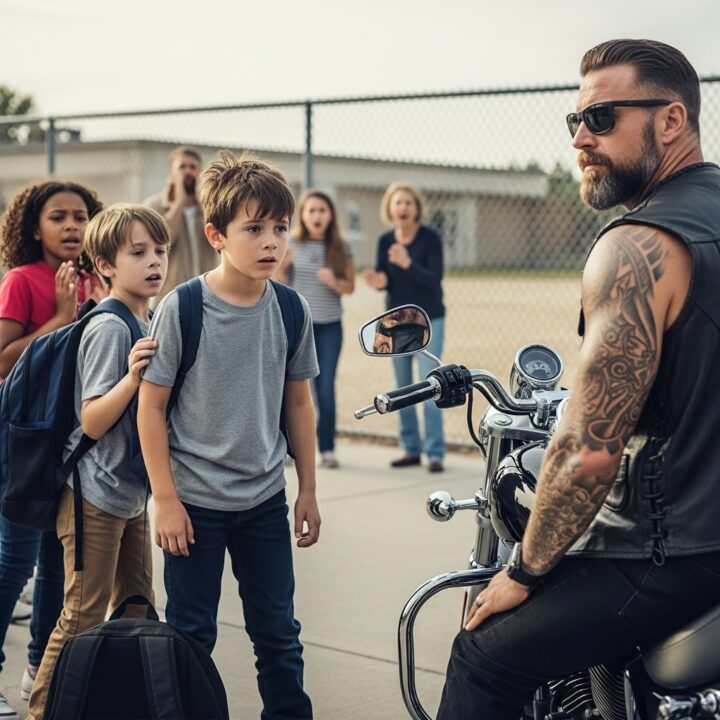
The biker shut off the engine and swung his leg down in one smooth motion.
He was tall. Broad-shouldered. Sleeveless black vest. Tattoos winding down his arms. Dark sunglasses hid his eyes. His boots hit the pavement with a sound that didn’t belong anywhere near a school.
Parents stiffened instantly.
“Why is he here?” someone whispered.
“Is that allowed?” another muttered.
The biker unlatched his helmet and clipped it to the bike. He looked through the fence toward the playground.
He saw the circle.
He saw the phone.
He saw a child being cornered in plain sight.
The biker opened the gate.
That’s when panic hit.
“Hey!” a parent shouted.
“You can’t come in here!”
The biker didn’t answer.
He walked toward the group of kids, calm and steady, his presence cutting through the noise like a shadow. The boys stopped laughing, suddenly unsure.
To the adults watching, it looked terrifying.
A biker approaching children.
A stranger ignoring warnings.
Every instinct screamed danger.
Phones came out. Someone yelled they were calling the police. Another parent ran toward the nearest teacher.
The biker stopped a few feet from the boy.
The boy looked up at him, eyes wide.
The biker didn’t raise his voice. He didn’t touch anyone.
“Hey,” he said quietly. “You okay?”
The silence that followed felt wrong—too heavy, too charged.
The boys backed away a step.
That’s when a parent grabbed the biker’s arm.
“Don’t touch him!” she shouted. “What do you think you’re doing?”
The biker turned slowly.
“I’m checking on him,” he said.
The parent’s face flushed.
“You have no right to be here!”
The tension spiked fast.
A teacher ran over, breathless.
“What’s going on?” she demanded.
Before the boy could speak, voices piled on.
“He came out of nowhere.”
“He walked straight up to the kids.”
“He scared them.”
The biker stood alone now, ringed by adults who had already decided what he was.
The boy shrank behind him without realizing it, small hands clutching the back of the biker’s vest.
The teacher noticed.
Her expression changed slightly.
“Sir,” she said carefully, “I need you to step back.”
The biker nodded once and took a half step away—but he didn’t leave.
One of the boys smirked again, emboldened.
“He’s lying,” the boy said loudly. “We were just joking.”
The teacher looked at the boy who’d been targeted.
“Is that true?” she asked.
The boy opened his mouth.
Nothing came out.
Words failed him when he needed them most.
The biker exhaled slowly and reached into his vest.
Several parents gasped.
Instead of anything threatening, he pulled out his phone.
He typed a short message. Then he made a call.
“Yeah,” he said quietly. “I’m here.”
He ended the call and slipped the phone away.
The teacher crossed her arms.
“Sir, if you don’t leave, I will call security.”
The biker met her eyes.
“You should,” he said. “And so should I.”
The playground felt suspended in time.
Something was about to tip, one way or another.
The sound came first.
Engines.
More than one.
Not loud. Not aggressive. Just measured, controlled, unmistakably intentional.
Parents turned toward the gate.
Motorcycles rolled up along the curb—five, then six—parking neatly. Riders dismounted calmly. Sleeveless vests. Helmets tucked under arms. Faces serious, not angry.
The schoolyard went silent.
A school security officer arrived at the same time, radio crackling. He stopped short when he saw the bikers.
The first biker stepped slightly aside as another man approached—a man in jeans and a jacket, carrying a folded document.
“Afternoon,” the man said to the teacher. “We’re here about an ongoing bullying report.”
The teacher blinked.
“What report?”
The man opened the document.
“Multiple incidents,” he said. “Recorded. Submitted by parents. By students. And by him.”
He nodded toward the biker.
The teacher looked down at the paper.
Her face changed.
The man continued, voice calm.
“The boy here is listed as the victim. Repeatedly.”
The teacher swallowed.
The parents who had shouted earlier fell quiet.
The boy’s bullies stared at the ground now.
The biker crouched slightly, bringing himself eye-level with the boy.
“You didn’t do anything wrong,” he said softly.
The boy’s shoulders shook. Relief hit him all at once, too big to control.
The teacher knelt beside them, her voice different now.
“I’m sorry,” she said.
Power had shifted—not with force, but with proof.
The truth came out in pieces.
The biker wasn’t just passing by. He was the boy’s uncle—his mother’s older brother—who’d been picking him up early for a doctor’s appointment. He’d arrived to see what the reports hadn’t captured clearly enough.
The school had known about the bullying. Complaints had been filed. Meetings postponed. Time had been used as a shield.
The biker hadn’t planned to step in. He hadn’t planned anything at all. He’d just seen the moment tipping the wrong way and refused to let it pass.
The boys were separated. Phones confiscated. Parents called.
No one shouted now.
The biker stood back as the adults took over, already pulling on his gloves.
A parent approached him hesitantly.
“I thought…” she started, then stopped.
The biker nodded once.
“Yeah,” he said. “Most people do.”
The boy walked over and wrapped his arms around the biker’s waist, holding on tight.
The biker rested a hand on the boy’s shoulder, steady and sure.
“You good?” he asked.
The boy nodded.
As the bikers started their engines, the sound felt different now—protective instead of threatening.
The schoolyard slowly returned to noise. Kids ran. Parents talked.
But something had changed.
People watched more closely.
They stepped in sooner.
The biker rode away without looking back.
The boy stood at the fence, waving until the bikes disappeared down the street.
He wasn’t smiling.
But he wasn’t shrinking anymore.
And for the first time in a long while, the schoolyard felt like a place where someone would notice—before it went too far.