A 280-Pound Biker With a Long Gray Beard Carried a Tiny Casket Down Our Church Aisle—But the Baby Inside Wasn’t His Child
The biggest man in our church lifted my daughter’s tiny casket against his chest, and every person in the room turned to watch a stranger carry the weight my husband and I could no longer hold.
He wore a plain black leather vest over a clean shirt. His gray beard reached the middle of his chest, and there were tattoos disappearing beneath the sleeves he had buttoned at his wrists. Someone had asked him to remove his motorcycle gloves before coming inside.
He already had.
They were tucked into his back pocket.
My name is Claire Mercer. I was twenty-nine that February, living outside Knoxville, working the morning shift at a grocery store. My husband, Daniel, installed flooring whenever a contractor had enough work to call him.
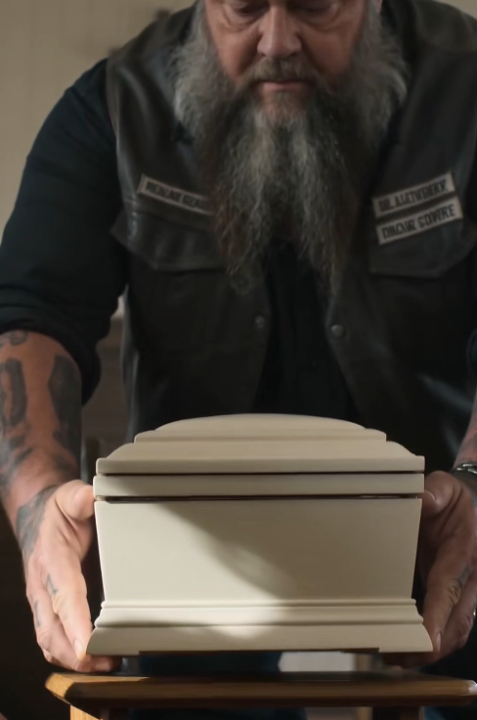
Our daughter, Lucy, had been alive for six months.
That morning, I kept thinking about a jar of pears in our refrigerator. I had opened it two days before she died. There was a clean spoon beside it, wrapped in a paper towel because I had intended to use it again after her nap.
I could understand the spoon.
I could not understand the casket.
The man carrying it had introduced himself less than an hour earlier.
“Ray Dawson,” he said.
Then he had waited, as though I was allowed to decide whether his name belonged in our day.
I knew him only from a message beneath a Facebook post I had written at two seventeen in the morning. He had not asked what happened to Lucy. He had not asked whether our family went to church.
He had asked, “What time do you need me?”
Now his boots moved slowly over the old wooden floor. The chapel smelled of furniture polish, wet wool, and lilies somebody from the church had brought in a glass pitcher.
Daniel stood beside me with his hands open.
He had carried Lucy through this same doorway once, when she was three months old and furious about a hat my mother had knitted. He had held her against his shoulder while I searched the diaper bag for something I never found.
Today, he could not make his arms work.
Ray had understood that without making him say it twice.
At the front of the church, the funeral director indicated where to place the casket. Ray followed his direction carefully. His movements were slow, almost painfully deliberate.
Then he stepped back.
For a moment, I thought he would return to the rear of the room and leave us to the service.
Instead, he looked at me.
“May I?”
I did not know what he meant. Perhaps I should have asked. But his face was so different from the rest of him—so uncertain beneath all that size—that I nodded.
He knelt beside the casket.
The floor gave a faint complaint under his weight.
From the inside pocket of his vest, he took a tiny knitted mitten.
Pale yellow. One narrow ribbon at the wrist.
The size of Lucy’s hand.
A woman behind me drew in a breath. Daniel turned toward the aisle. I stared at the mitten as Ray placed it gently on the closed lid.
There was no matching mitten in his other hand.
“Where did you get that?” I asked.
He looked down before answering.
“My little girl.”
Something tightened so sharply inside me that I almost sat down. I thought I understood him then. The careful way he carried Lucy. The long silence before he entered. The hand he had kept pressed against his vest pocket.
“You lost a daughter?”
Ray shook his head.
“No, ma’am.”
Across the church, his phone vibrated once. He did not reach for it.
“My daughter’s six months old.”
I looked at the yellow mitten again.
That morning, I thought nothing could hurt worse than the fact that my child was gone. Then this stranger knelt beside her with something borrowed from a child who was still warm—and I needed to know why he had brought it.
Part 2 — The Post I Almost Deleted
People imagine grief making a house quiet.
For the first few days, ours was full of sound. The refrigerator clicked. Neighbors knocked. My phone vibrated across the kitchen table until I turned it facedown and put a folded towel beneath it.
Someone brought a casserole.
Someone brought paper plates.
Someone asked where we kept the trash bags.
I answered that question immediately. Second drawer beside the stove. Finally, a thing I knew.
Lucy’s room stayed exactly as it was.
There were socks on the changing table, a small damp stain beneath the rocking chair where her bottle had spilled, and a fabric book she liked to chew. I kept passing the doorway with something in my hands, finding a reason not to enter and another reason not to close it.
Daniel stopped sleeping in our bed.
Not because he wanted distance from me. He slept in a chair near the hallway because he said he couldn’t stand waking without knowing which room he was in.
We had begun protecting each other from different silences.
The hospital had given us information, names, numbers, and explanations that arrived in pieces. Lucy had become critically ill, and despite treatment, she had died. I will not turn those hours into a series of details for someone else to examine.
What mattered afterward was that we had been parents on a Tuesday morning, and by Thursday people were asking what arrangements we wanted.
We wanted our daughter.
That was not one of the arrangements available.
Money entered the room anyway.
It came in apologetically, carried by kind voices and printed forms. Daniel had missed work. I had missed work. We had rent due, groceries bought for a week that no longer existed, and a bank balance I checked with a strange resentment toward the numbers for remaining ordinary.
The funeral home helped us find a modest service. Our church covered part of the cost. A woman I barely knew paid for the flowers.
Nobody at the funeral home refused to help carry Lucy.
I want that understood.
But the arrangement we could manage was small, with limited staff and no money for anything additional. Most of the people we knew worked hourly jobs. Daniel’s father had a bad back. My brother was several states away and trying to find a ride.
Daniel had said he would carry her himself.
He said it on Monday.
He said it again on Tuesday.
On Wednesday evening, he stood in our kitchen holding one of her blankets and whispered, “Claire, I don’t think I can.”
He looked ashamed.
That hurt almost as much as the words.
I took the blanket from him because he was twisting the corner so tightly the fabric had begun to stretch.
“You don’t have to.”
“Somebody does.”
“I know.”
“We should have people.”
I wanted to tell him we did. We had people bringing casseroles and calling from parked cars because they didn’t know what to say. We had people who loved us and still had jobs to keep, children to collect, bodies that hurt, miles they couldn’t cross.
But at that moment, Daniel meant something else.
He meant that when a person’s strength ended, there should be another person standing close enough to take the weight.
We did not know whom to ask.
That night, I opened Facebook.
I typed a post, deleted it, and typed another.
I hated explaining that we didn’t have money. I hated worrying that strangers would think we had failed Lucy in death because we couldn’t afford every service someone else might buy.
Eventually, I wrote what was true.
Our six-month-old daughter had died. We were holding a small service Friday morning. My husband had hoped to carry her casket into the chapel but was struggling. We could not pay anyone. Was there someone nearby willing to help us?
I added the church town but not our home address.
Then I posted it and put the phone down.
For twelve minutes, nothing happened.
A woman shared it. A man wrote that he would pray. Somebody sent a link to an organization that did not serve our county.
Then a message arrived from Ray Dawson.
His profile photograph showed a motorcycle beside a repair shop. There was no inspirational quotation, no posed picture of him holding a child.
“What time do you need me?”
I checked his page before answering.
I was a grieving mother, not a woman who had stopped understanding strangers. I found photographs of charity rides, arguments about engine parts, and a woman named Beth correcting his spelling beneath a picture of a birthday cake.
I gave him the funeral director’s number.
He said he would call.
The following morning, the director confirmed that they had spoken and that he understood the plan. Ray had asked practical questions. Where to arrive. Whom to report to. Whether the family wanted him in the service afterward.
“He sounds respectful,” the director said.
I didn’t know what respectful looked like on a man that large.
I would learn.
Ray sent one more message Thursday evening.
I’ll be there early. No need to answer.
I read the last four words several times.
No need to answer.
By then, nearly every kindness came with a small task attached. Tell us what you need. Let us know how you are. Call if there’s anything.
He had given me something without asking me to manage it.
I showed Daniel.
He stared at the message, then handed the phone back.
“Tell him thank you.”
I began typing.
Then I stopped.
For once, somebody had said we didn’t have to.
Part 3 — The Man at the Back Door
Ray arrived forty minutes early.
The church secretary saw him through the side window and came to find me. She said there was a man outside asking for the funeral director.
She didn’t say biker.
She didn’t have to. Her expression supplied it.
Daniel and I were sitting in a small room off the chapel, surrounded by spare hymnals and a folding table with a coffee stain shaped like a map. I had not taken off my coat.
Through the open doorway, I saw him.
Six-foot-four, close to two hundred eighty pounds, with a long gray beard, broad shoulders, and the sort of hands I associated with lifting engines. His leather vest was plain. His shirt was clean.
He held his hat between both hands.
He looked as if he was afraid of taking up too much room.
The funeral director brought him over.
Ray introduced himself and stopped a few feet away. He did not open his arms. He did not tell me Lucy was in a better place.
He asked, “Would you like me to stay back here until they’re ready?”
I nodded.
“All right.”
Daniel stood.
For a moment, the two men looked at each other. My husband was thirty-two and had not shaved in four days. Ray had almost twenty years on him and seemed built from things that did not break.
Daniel said, “I was supposed to do it.”
Ray looked at the little blanket folded over my husband’s arm.
“You’re her dad,” he said. “You don’t have to prove it by carrying everything.”
Daniel lowered his head.
Ray stayed where he was.
He gave my husband the privacy of not touching him until Daniel reached out.
Then they shook hands.
I learned later that Ray’s decision to come had caused an argument at his shop.
He was president of a small riding club. The men met there for coffee, work, and the kind of conversation that wandered from a broken transmission to somebody’s divorce without changing volume.
When Ray told them about the post, Travis, one of the younger members, said they ought to bring everybody.
A full escort.
Motorcycles outside the church.
Something to show the family they were not alone.
Ray said he would ask us first.
One man wanted to share the post again with the club’s name attached. Another suggested collecting money at their next ride. A third, Boone, asked whether Ray had told Beth.
That question stopped him.
Ray and Beth had a daughter at home.
Six months old.
Her name was Annie.
She had been born eight days before Lucy.
He had not told Beth yet.
Boone told him to go home and talk to his wife before making a promise he expected her to carry with him.
Ray bristled. He admitted that later.
He had spent years becoming the kind of man who could be counted on, and he disliked hearing that showing up for strangers might still require him to answer to somebody.
But Boone was right.
Beth found him standing beside Annie’s crib after supper.
He told her about our post.
She listened.
Then she asked the question he had hoped she wouldn’t.
“Can you do this?”
He said yes too quickly.
She waited.
Finally, he said, “I don’t know. But I can get there.”
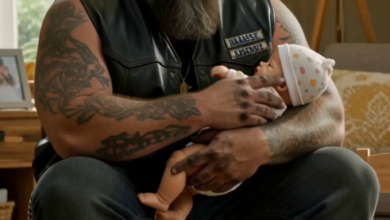
Beth sat in the rocking chair while he stood beside the crib. Annie slept with one fist near her cheek.
They had married later in life. Ray had a grown son from an earlier marriage, and Beth had spent years believing she would never have a child. Annie had arrived into a house already full of plans to protect her.
Now Ray was preparing to hold someone else’s baby in the only way that family had left.
Beth didn’t tell him not to go.
She told him, “Don’t make them take care of you.”
That became the rule he carried into our church.
He could be shaken.
He could go home afterward and fall apart.
But he would not stand before us and ask our loss to explain his love for his own daughter.
He also told the club there would be no procession unless we wanted one.
I had said no.
The idea of engines outside the church exhausted me. I wanted to hear the service. I wanted fewer things happening.
He accepted it without persuading me.
Boone drove him in a pickup because rain was forecast, and because Ray admitted he might not want to ride afterward. Boone waited outside until invited in.
Their help arrived without an entrance.
When it was time, the funeral director spoke quietly with Ray. They reviewed what would happen and where he would place the casket.
Daniel stood beside me.
Ray came toward us once more before taking his position.
“If you change your mind about anything,” he said, “tell me.”
I almost laughed.
Not because it was funny. Because the world had taken the one thing I wanted to change and left us choosing who stood where.
Still, I understood what he offered.
A small choice.
One that remained ours.
The chapel doors opened.
Ray lifted Lucy.
Daniel’s hand found mine so hard it hurt.
I held on.
The room rose around us in a blur of coats and faces, but I could see Ray clearly. He was looking where he walked, shoulders steady, jaw clenched above that long gray beard.
He did not look noble.
He looked like a man doing something he wished no one had to do.
That was the first reason I trusted him.
Part 4 — The Mitten That Still Had a Match
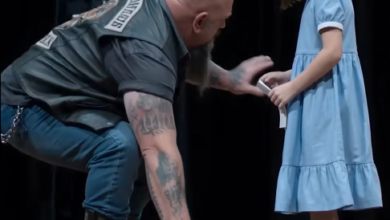
At the front of the church, Ray set the casket down as directed.
He kept his hands near it for one extra second, as though his body needed permission to release what his mind already understood.
Then he stepped back and asked whether he could place something there.
I nodded.
The mitten came from inside his vest.
It was pale yellow, knitted in a soft yarn, with a narrow ribbon threaded around the wrist. Small enough that I could have closed my hand around it.
I knew exactly how it would feel to pull it over Lucy’s fingers.
That was the cruelty of it.
Grief had made some things distant. Her last hospital room already seemed to belong to a person I had watched from somewhere above the ceiling.
But a mitten was immediate.
A mitten meant a thumb missing the opening. A baby pulling one hand away. Me laughing and saying, “Give me that little paw.”
My body remembered a task it could no longer perform.
When Ray said the mitten belonged to his six-month-old daughter, something angry flashed through me.
I am not proud or ashamed of that.
It happened.
I thought of his child breathing somewhere, of a warm room and a bottle waiting, of him leaving our church and going back to an ordinary problem.
I thought, Why would you bring that here?
He seemed to understand from my face that tenderness could arrive badly.
He did not begin explaining over me.
I asked, “Why?”
Ray looked at the mitten.
“Beth made them,” he said. “There’s another one at home.”
I waited.
He swallowed.
“We didn’t want to bring you something that said we understood. We don’t.”
The room behind us had gone quiet, but I barely noticed.
“Beth said maybe Lucy could have one. If you wanted her to.”
I looked at the yellow wool.
Not a symbol purchased for a funeral.
Something made for a child who would outgrow it.
Something still attached, by its matching half, to a house where tomorrow had not stopped.
Ray’s voice became rough.
“My girl’s got the other one. I thought… maybe a little warmth from our house could stay with yours.”
Then he shook his head slightly.
“I know it doesn’t work like that.”
That sentence let me breathe.
He wasn’t asking me to believe wool could reach a dead child. He wasn’t telling me the babies had become sisters in heaven or that his daughter could replace mine.
He knew the mitten could not fix anything.
He had brought it anyway.
I stepped toward him.
He began to rise, but I put my arms around his shoulders before he was fully standing. His beard brushed my cheek. The leather was cool beneath my hands.
For a second, he did not move.
Then he held me carefully.
I cried in a way I had not cried in the hospital. There, I had been surrounded by alarms, explanations, decisions. Here, there was a man who had carried my daughter because my husband couldn’t, and a tiny piece of another child’s life resting beside her.
Daniel came close.
Ray shifted so my husband could put his arms around me, too.
He did not keep me to himself.
People later described it as a half-hour embrace. Perhaps it was close to that, counting the time we stood together and then sat in the front pew while the service waited.
I did not watch a clock.
What I remember is nobody hurrying us toward the next thing.
The pastor waited.
The funeral director waited.
Boone stood near the back with his head lowered.
At some point, Ray asked whether I wanted the mitten left where it was.
“Yes,” I said.
Daniel nodded.
The funeral director helped us make the arrangements we wanted for it. Nothing was done without asking.
The service began.
I heard parts.
Our daughter’s name.
A prayer my grandmother used to say.
The phrase six months, which sounded impossibly small when measured against the way Lucy had filled our house.
Ray sat near the back. He kept both feet flat on the floor and his hands folded between his knees.
When his phone vibrated, he silenced it without looking.
I found out later that Beth had sent a photograph.
Annie was awake.
There was cereal on her chin, and she had kicked one sock off.
Beth had written, We’re here when you’re ready.
Ray did not open the photograph until we were at the cemetery and he was alone beside Boone’s truck.
He told me, much later, that he sat looking at his daughter’s face and felt guilty for the relief that went through him.
Then Boone said, “Loving yours doesn’t insult theirs.”
Ray put the phone away.
He had needed to hear it.
At the cemetery, the ground was soft from the previous night’s rain. People moved carefully between stones. Somebody held an umbrella over me, though the rain had stopped.
Ray asked if there was anything else he could do.
Daniel shook his head.
“You already did it.”
Ray nodded.
He did not promise we would be all right.
He gave Daniel his number and told him he could call without having a reason prepared.
Then he turned to leave.
I stopped him.
“Will you remember her name?”
The question surprised me as much as it did him.
I had heard so many promises that week. Prayers. Meals. Calls. Offers that depended on me having enough strength to activate them.
What frightened me suddenly was not the empty house.
It was the possibility that the world would finish being kind and Lucy would become something only Daniel and I could still see.
Ray looked back.
“Lucy,” he said.
He said it normally.
Not in a funeral voice.
Like she was somebody he expected to keep knowing.
“Yes,” he said. “I will.”
Part 5 — After the Cars Stopped Coming
For two weeks, our refrigerator was full.
Then the foil-covered dishes became empty containers waiting to be returned. The paper plates ran out. People began checking whether we were back at work.
They did not mean harm.
Life resumed around us with the confidence of a machine that had never stopped.
Daniel returned to flooring jobs because the rent did not recognize bereavement. I went back to the grocery store and discovered that customers could ask where the canned tomatoes were while my mind was still standing beside a small grave.
One woman said, “At least you know you can have children.”
I went into the stockroom and counted boxes until I could speak again.
Another woman simply squeezed my hand and kept moving.
I remembered that kindness longer.
At home, Daniel and I began grieving in opposite directions.
I wanted to say Lucy’s name.
He wanted to survive an hour without hearing something that broke him.
I kept her clothes in the drawers. He asked whether leaving them there made it harder. I heard that as wanting her gone. He heard my answer as an accusation that he didn’t love her enough.
We apologized.
Then we did it again.
There were nights I watched him sleep and felt furious that he could. There were mornings he left for work early because sitting at the kitchen table while I stared at Lucy’s empty chair frightened him.
Neither of us was the villain.
We were two parents trying to find each other in a room with someone missing.
Ray sent one message the week after the funeral.
Thinking of Lucy today. No need to answer.
I did not answer.
A month after the funeral, I went to the cemetery on my lunch break.
There were fresh flowers.
Nothing elaborate. A small bunch of white daisies in the holder beside Lucy’s name.
I assumed my mother had brought them.
She hadn’t.
Daniel hadn’t.
Two days later, Ray sent another message.
I stopped by Friday. I hope the flowers were all right.
I stared at it.
He had not asked us to come. He had not taken a photograph of himself beside the grave. He had gone when there was nobody to thank him.
I called.
He answered from what sounded like a workshop.
“Claire?”
“You went?”
“Yes.”
“Why?”
There was a pause.
“You asked me to remember her.”
I sat down on the edge of our bed.
There were people I had known for twenty years who had stopped using Lucy’s name because they feared upsetting me. This man, who had met her only through the task of carrying her casket, had driven out on an ordinary Friday and brought flowers.
“Thank you,” I said.
“You’re welcome.”
We had very little else to say.
That was enough.
The next month, I found yellow flowers.
Then white again.
Ray asked what we preferred. I told him nothing expensive. He said he could manage that.
He also asked whether we wanted him to let us know before he visited.
I said no.
I didn’t want another appointment built around our daughter’s death.
He understood.
His remembering did not become homework for us.
Not everyone understood him.
He told me about that gradually.
One man in the club asked how long he intended to keep going. Another said he might be making it harder for us to move on. Someone else worried Beth would resent time spent at another family’s grave.
Ray took those questions home instead of deciding concern made the men heartless.
Beth answered honestly.
Some days, she was frightened by it.
Not jealous.
Frightened.
She had watched her husband carry a casket the size their own daughter could have fit inside. Sometimes, after he visited the cemetery, he came home and stood too long beside Annie’s crib, checking what did not need checking again.
Beth told him that his fear could not become a burden their daughter had to grow up under.
He listened.
There was help he needed that our family could not provide. He found people to talk to. He learned to come home, pick up his child, and let her be alive without treating every breath as borrowed time.
His daughter was allowed to have an ordinary father.
That mattered to me.
I did not want our loss living like a warning sign over another child’s bed.
When Annie turned one, Beth invited us to her birthday.
The message was careful.
They would understand if we couldn’t come.
I cried after reading it.
Then I said no.
Beth answered, Of course. We love you.
She did not send photographs afterward without asking.
Ray still brought flowers that month.
That was when I understood his visits were not a trade. We did not have to celebrate his child before he would remember ours.
Later that summer, Daniel met him for coffee.
I knew because Daniel came home carrying a small box of screws Ray had given him for a repair at our apartment. They had talked about work for most of the hour.
Near the end, Daniel asked what it felt like to carry Lucy.
Ray told him the truth.
“I was scared.”
“Of dropping her?”
“Of doing anything wrong.”
Daniel nodded.
Then Ray said, “You let me help with one thing. That’s all. I didn’t carry what you carry.”
My husband cried in the truck afterward.
He told me that night.
It was the first time we had cried together in weeks.
Part 6 — The Years Nobody Applauded
The first anniversary came with grocery-store balloons.
Not at the cemetery.
At work.
Someone was setting up a display for spring birthdays, and the sound of the helium tank made me suddenly unable to stand beside it. I went outside and called Daniel.
He came during his lunch break.
We sat in his truck without driving anywhere.
That evening, we went to Lucy’s grave.
There were flowers already there.
A small bunch. White and yellow.
Ray had left no note that time. He knew we knew.
The monthly visits continued.
Sometimes he went on the first Friday. Sometimes work moved it to the second weekend. Rain changed plans. Once, a winter storm meant he waited until the roads were safe.
He never turned a calendar into something worth getting killed over.
But every month, he found a day.
Remembering became something he scheduled and kept.
In the second year, the shop lost a major customer.
Ray worked longer hours. Beth returned to more shifts. The club canceled a ride because too many men were watching fuel costs.
That month, the flowers were smaller.
I know because I happened to arrive while he was placing them.
He looked embarrassed to be caught.
“Couldn’t get the usual ones.”
I stared at him.
“Ray.”
“I know. It’s not—”
“Ray.”
He stopped.
“You came.”
He looked down at the flowers.
“Yes.”
“That’s what I see.”
We stood together for a while.
He told me Annie had begun calling every motorcycle Daddy, including a bright green sportbike parked outside the pharmacy. I laughed.
It surprised both of us.
For a moment, I wanted to apologize to Lucy for laughing near her name.
Then the feeling passed.
Ray had not forced a happy ending into my grief. He had told me something funny about a child, and my body had remembered what laughter was for.
It did not mean I had forgotten.
In the third year, Daniel and I moved.
Not far. A small rented house with a porch and enough storage that Lucy’s things did not have to remain in the center of every room.
Packing brought arguments.
I wanted to keep the rocking chair.
Daniel said we had nowhere useful to put it.
We stood over it for twenty minutes discussing furniture while actually discussing whether changing our lives meant agreeing to a world without her.
Eventually, he said, “I don’t need you to get rid of it. I need you to believe I remember even when I can’t look at it.”
I sat in the chair.
He sat on the floor.
We kept it.
Later, with help from a grief counselor, we began finding ways to say things before they became accusations.
Ray did not repair our marriage.
He did not tell Daniel to be stronger or me to be patient.
He came with Boone and moved the chair.
Some help should remain exactly that practical.
The fourth year was quieter.
That was difficult in its own way.
People remembered us as a couple who had lost a baby a while back. A while back could hold a great deal of distance if you were standing outside it.
Lucy remained six months old.
Annie turned four.
She had opinions about cereal and an elaborate dislike of socks. She asked questions Ray could not answer and corrected his understanding of dinosaurs.
We began seeing her occasionally.
Slowly.
Not because we owed it to anyone.
Because one afternoon I realized I wanted to know the little girl whose mitten had been beside Lucy all those years.
The first time she climbed into my lap, she asked whether my necklace opened.
It did.
There was a photograph of Lucy inside.
“Who’s that?”
“Lucy.”
“Is she your baby?”
“Yes.”
Annie examined the picture.
“She has little eyebrows.”
I laughed, then cried.
She looked alarmed.
I told her she hadn’t done anything wrong.
Ray started to move toward us, and I shook my head.
Annie touched the necklace gently, then asked if we had crackers.
A child could visit grief without moving in.
We let her.
I never called her the daughter I should have had. Daniel never asked her to fill a place at our table that belonged to someone else.
She was Annie.
That was enough.
Ray still went to the cemetery once a month.
Sometimes Beth joined him. Usually he went alone.
He would check the flower holder, clear a leaf if one covered Lucy’s name, and stand for a few minutes. He didn’t describe long conversations with her. He didn’t claim signs.
He remembered.
In a world that kept asking us whether we were better, there was a man willing to do the same small thing again without demanding progress in return.
Part 7 — The Other Mitten
On the fifth anniversary, I found Ray at the cemetery before I found the flowers.
His beard was almost completely white by then. He moved more carefully when he knelt, and one hand rested on his thigh as he stood.
Beside him was Annie.
Five years old, wearing a purple coat and boots with bright yellow soles.
Beth stood a few steps away.
Ray had asked us earlier whether Annie could come. We had said yes. She knew Lucy’s name from the photograph in my necklace and from the way adults sometimes spoke of a baby who had not grown up.
She did not understand five years.
Some days, neither did I.
Daniel put an arm around my shoulders as we approached.
Annie held a small envelope.
She waited until Beth nodded, then offered it to me.
“Mom said this is yours if you want it.”
Inside was a knitted mitten.
Pale yellow.
One narrow ribbon at the wrist.
For a moment, I couldn’t hear anything except the movement of my own breathing.
The matching mitten.
Beth had kept it all those years.
Not hidden like a relic.
Saved in a small box with Annie’s first hospital bracelet, a lock of hair, and other things parents keep because children refuse to remain the size their hands remember.
“We didn’t know whether you’d want it,” she said.
I took it out.
The yarn had softened with age. One edge was slightly stretched. It had belonged to a living hand, then to a drawer, and now it rested in mine.
Annie looked at it.
“That used to fit me.”
“Yes,” I said.
“Not anymore.”
“No.”
She studied Lucy’s name.
“Does hers still fit?”
Ray closed his eyes.
Beth drew a breath, but I answered before she had to.
“Yes, sweetheart.”
Annie nodded.
Then she went to stand beside her father.
I held the mitten against my palm.
For years, I had thought of the one we left with Lucy as something that came from Ray’s family to ours. Standing there with its match, I understood that they had been carrying the other half of the gesture the entire time.
Neither mitten had been forgotten.
Daniel touched the ribbon.
He was crying openly now, without trying to look toward the road or pretend the wind had done it.
Ray watched us.
“I never meant—” he began.
“I know,” I said.
He stopped.
There was no explanation we needed from him.
Annie asked whether she could put one flower in the holder. Beth helped her choose a stem.
She placed it carefully, then stepped back to inspect her work.
The adults stayed quiet.
After a while, Ray asked if we wanted breakfast.
Such an ordinary question.
Five years earlier, ordinary questions had felt insulting. How do you want your eggs? Do you need gas? What time does the store close?
That morning, breakfast sounded like somewhere we could go together while still loving our daughter.
We said yes.
At the diner, Annie ordered pancakes and informed Ray that his beard would get syrup in it if he wasn’t careful.
Daniel laughed.
Beth passed me coffee.
The mitten stayed in my coat pocket, its small shape resting against my wrist whenever I moved.
I thought about the question people sometimes asked Ray.
Why keep going?
Why a baby he never knew?
Why flowers after five years?
He had answered it once, quietly, when somebody suggested he had already done more than enough.
“My daughter gets older,” he said. “Theirs doesn’t. I can remember both.”
I understood what he meant.
He wasn’t sharing ownership of his child with us. He wasn’t asking Annie to live for Lucy.
He was allowing his family’s happiness to make room for another family’s love.
There was no deadline on that room.
At home, I placed the yellow mitten beside Lucy’s photograph.
The rocking chair stood near the window. Daniel had repaired one loose joint, and sometimes I sat there with coffee or a book.
I could do that now.
I could also cry there.
Five years had not turned Lucy into less of my daughter. They had given me more ways to carry being her mother.
The following month, I stopped at the cemetery after work.
White daisies.
Fresh water.
One small leaf moved away from her name.
He had been there again.
Follow our page for more biker stories about families, quiet kindness, and the people who keep showing up after everyone else goes home.