They Thought the Biker Was Attacking a Blind Man — Until the Bridge Began to Crack
A biker swerved his motorcycle straight into a blind man’s car, blocking it completely — and seconds later, the wooden bridge beneath them began to collapse.
Everything stopped at once.
The sound of the engine dying echoed over the river.
Birds scattered from the trees.
A long, unnatural creak rose from the bridge planks beneath their feet.
Drivers slammed their brakes.
A woman screamed from her truck.
Phones were already up, recording.
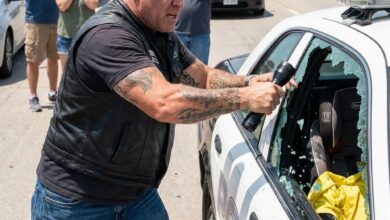
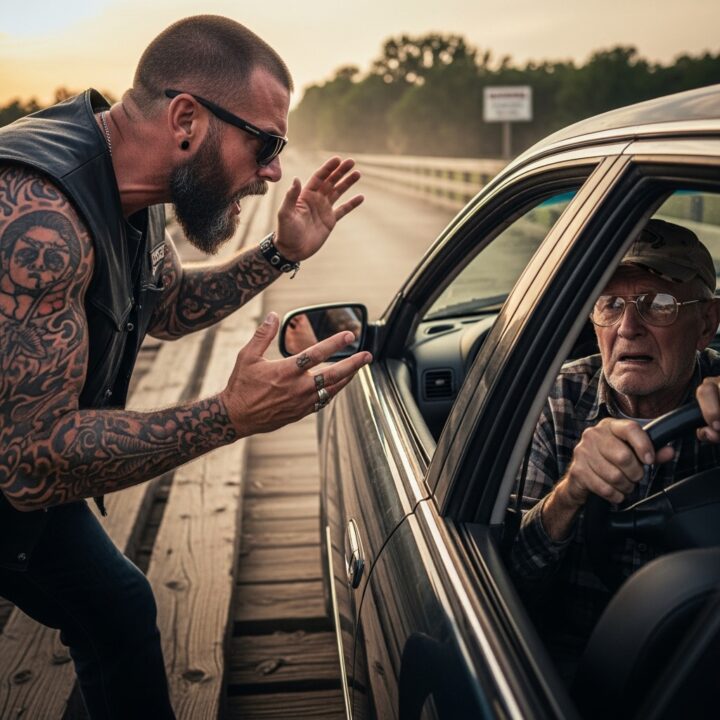
The biker stood in front of the car, breathing hard.
He looked dangerous in every way people feared.
Early 40s.
Tall.
Broad shoulders stretching a sleeveless black shirt.
Arms wrapped in faded tattoos.
Dark sunglasses hiding his eyes.
The sharp smell of alcohol — or maybe just oil and sweat — hung around him.
His fists were clenched.
Inside the car, the driver sat frozen.
Late 60s.
Gray hair tucked under a worn baseball cap.
Dark glasses hiding unseeing eyes.
His hands trembled on the steering wheel.
“Get away from my car,” the old man said, voice tight but steady.
The bridge groaned again.
The driver’s name was Walter Hayes.
He hadn’t always been blind.
Thirty years earlier, Walter had worked construction across the state. Bridges. Roads. The kind of work that built America quietly, without applause.
Then came the accident.
A collapsed scaffold.
A blinding flash.
And darkness that never lifted.
He lost his sight.
Then his job.
Then, slowly, his wife to illness he couldn’t see coming.
But Walter never lost his independence.
He learned routes by memory.
Counted steps.
Measured turns by sound and vibration.
He drove only short distances now — roads he’d known for decades, including this old wooden bridge the county kept promising to replace.
It started with something small.
A sign.
“BRIDGE CLOSED – WEIGHT LIMIT EXCEEDED.”
The paint was faded.
The letters barely readable.
Walter never saw it.
The biker did.
He was riding behind the car when he felt it first — the strange vibration through the handlebars. The hollow sound of tires rolling over wood that should’ve been replaced years ago.
He saw a plank dip.
Then another.
The biker revved his engine and honked hard.
Walter flinched but kept driving.
“Sir! Stop the car!” the biker shouted.
No response.
To the cars behind them, it looked like road rage.
A biker harassing an elderly man.
The biker accelerated.
He pulled alongside the car, gesturing wildly.
Walter shook his head, heart pounding.
“Go around,” he muttered.
The biker shook his head violently and cut in front of him — blocking the road completely.
Brakes screeched.
Someone yelled, “What the hell is wrong with you?!”
The biker jumped off his motorcycle and ran to the driver’s door.
He yanked it open.
People gasped.
The biker grabbed Walter’s arm.
Hard.
“You need to get out. NOW.”
Walter pulled back. “Don’t touch me!”
The bridge creaked louder this time.
Sharp.
Angry.
The biker released Walter and pulled out his phone.
He dialed one number.
Spoke quietly.
“Yeah. It’s happening. Old bridge on Route 17. He’s still on it.”
A pause.
Then: “Bring everyone.”
He hung up.
No explanation.
Just urgency.
A loud crack split the air.
The bridge dropped an inch.
Screams erupted from the cars behind them.
Police sirens wailed in the distance.
Then more engines — motorcycles this time.
A group of bikers stormed onto the road, surrounding the bridge, blocking all traffic.
A sheriff’s cruiser slid to a stop.
An officer stepped out, shouting, “Everyone stay where you are!”
The biker turned to Walter, voice calmer now.
“Sir,” he said, “this bridge is failing.”
Walter froze.
“What… what did you say?”
Before the biker could answer, another plank snapped.
The bridge tilted.
The truth hit everyone at once.
A man from the crowd rushed forward, furious.
“You don’t manhandle a blind man!” he shouted, pulling a knife from his pocket.
Before he could take two steps, two bikers tackled him to the ground.
The sheriff drew his weapon. “Drop it!”
The knife hit the wood.
Justice moved fast.
Controlled.
Necessary.
Emergency crews arrived.
The bridge was closed immediately.
Engineers confirmed it later: ten more seconds, and the center would’ve collapsed into the river.
The sheriff approached the biker.
“You saved his life,” he said.
Then he turned to the crowd.
“And he did it the only way he could.”
Phones lowered.
Silence replaced outrage.
The biker helped Walter out of the car.
Carefully.
Respectfully.
Walter’s hands shook as he stood on solid ground.
“I thought you were attacking me,” he said softly.
The biker nodded. “I know.”
Walter reached out, found the biker’s arm, and held it.
“Thank you… for not giving up on me.”
Sunlight spilled through the trees.
The river flowed quietly below.
The bridge rested, broken but still.
Sometimes the most frightening moments hide acts of pure courage. If you had been there, what would you have thought first? Share your thoughts in the comments.