They Thought the Biker Was About to Jump — Until the Police Arrived and Saw the Truth
When people saw a leather-vested biker standing alone on the bridge for hours, they assumed he was waiting to jump.
It was late October, 5:42 p.m., on the Jefferson Street Bridge over the Ohio River in Louisville. The air carried that sharp, metallic chill that settles just before sunset. Traffic moved slowly. Commuters stared.
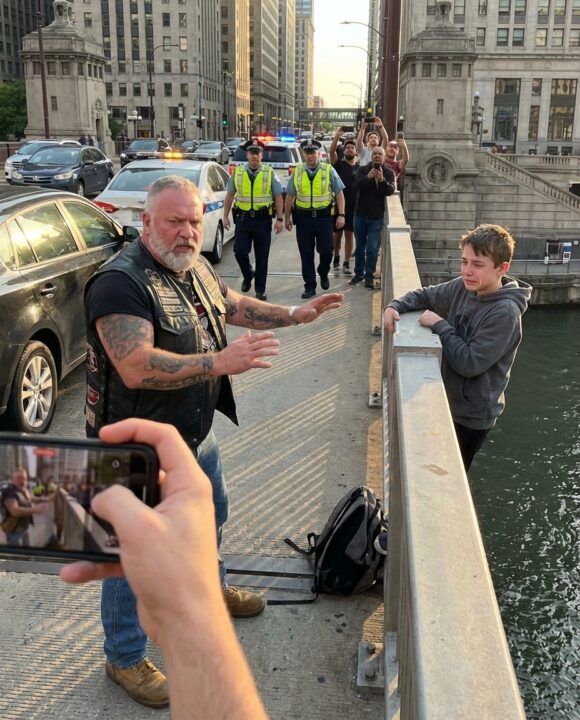
And I stood there.
Still.
Hands resting lightly on the concrete railing.
Across from me—twenty feet away on the opposite side—was a teenage boy.
Sixteen. Maybe seventeen.
Thin hoodie. Backpack on the ground. Both hands gripping the outside ledge.
His knuckles were white.
He was crying, but trying not to make sound.
Cars passed. People slowed. Some rolled their windows down.
They didn’t see him at first.
They saw me.
A gray-bearded biker in a sleeveless black leather vest. Tattoos visible. Boots planted near the edge.
From a distance, it looked obvious.
One man shouted, “Hey! You don’t have to do this!”
A woman gasped and covered her mouth.
Another driver yelled, “Someone call 911!”
No one noticed the boy trembling on the other side.
No one noticed the way I kept my voice low and steady.
“Hey,” I said gently, not looking at him directly. “I’m still here.”
The boy didn’t answer.
Wind whipped across the bridge.
The sun lowered.
And for nearly forty minutes, I didn’t move.
Traffic backed up.
Phones came out.
Someone recorded.
They thought I was contemplating death.
They didn’t understand that I was holding a conversation that could not afford to be rushed.
By the time the sirens began in the distance, a small crowd had gathered near the pedestrian entrance.
They were staring at me.
And I could feel the tension shift from concern… to judgment.
The first police cruiser pulled up at 6:18 p.m.
Red and blue lights reflected off chrome and river water.
An officer stepped out cautiously.
“Sir!” he shouted. “Step away from the railing!”
The crowd murmured.
See? They thought. He’s unstable.
I didn’t turn around.
I kept my eyes forward.
“Just give me a minute,” I said calmly.
The officer stiffened.
“Sir, I need you to comply.”
Behind him, more officers arrived. A fire truck parked near the curb.
From their angle, they still couldn’t see the boy clearly. He was half-hidden by the concrete divider.
All they saw was me—large frame, biker vest, tattoos—standing at the edge during golden hour like a silhouette out of a tragic headline.
A woman in the crowd whispered, “He looks dangerous.”
Dangerous.
That word sticks.
Because I’ve been called that most of my adult life.
But I’ve also buried two friends who didn’t ask for help soon enough.
And I wasn’t about to let that happen again.
“Son,” I said softly, keeping my tone even. “You still with me?”
The boy sniffed. Nodded once.
An officer began moving closer from behind.
I raised one hand slightly—not aggressive, just signaling.
“Please,” I said. “Don’t rush.”
That looked bad.
From their perspective, I was refusing commands.
The crowd reacted immediately.
“He’s resisting!”
“Grab him!”
One officer reached toward my shoulder.
If they pulled me away too quickly, the boy would feel abandoned.
And abandonment was the last thing he could handle right now.
“Sir, step back NOW.”
I slowly turned my head just enough so the officer could see my eyes.
“Look past me,” I said quietly.
The officer hesitated.
He shifted slightly to the left.
And then he saw the kid.
Hanging on.
Crying.
Wind pushing against him.
Everything changed in a single second.
The officer’s tone dropped instantly.
“Hold position,” he told the others.
But the crowd didn’t know what had shifted.
They were still whispering.
Still filming.
Still assuming.
The boy’s voice cracked.
“He’s gonna make me go home,” he whispered.
I shook my head gently.
“No one’s making you do anything.”
His story had come out in fragments.
Dad left two years ago.
Mom works double shifts.
Failed math twice.
Girlfriend broke up with him that afternoon.
Teenage heartbreak doesn’t sound catastrophic to adults.
But to a sixteen-year-old standing on a bridge, it feels like the end of the world.
“Why are you even talking to me?” he asked suddenly.
I almost smiled.
“Because somebody once talked to me.”
That was true.
Years ago, when I was twenty-three and reckless, a stranger sat beside me on a curb outside a bar and told me one sentence that stuck:
“Permanent decisions don’t belong to temporary pain.”
I repeated that line to the boy.
He listened.
Not because I was wise.
But because I wasn’t rushing him.
Behind me, I heard quiet radio chatter.
Police negotiating positions.
Firefighters preparing safety lines.
They were professional.
Calm.
But one wrong move could shatter everything.
The wind picked up harder now. The river below darkened.
“Can you step down just a little?” I asked gently.
He shook his head violently.
“No!”
His hands slipped slightly.
My stomach dropped.
An officer shifted his stance.
I subtly shook my head at him.
Not yet.
The boy was balancing between panic and trust.
If panic won, gravity would follow.
I did something simple.
I took my phone from my pocket slowly—very slowly—and placed it on the concrete beside me.
“I’m not leaving,” I said.
I typed one short message.
No explanation.
No drama.
Just five words.
Then I slid the phone away.
The officers noticed.
But they didn’t interrupt.
Minutes stretched.
The crowd grew quieter.
Sun dipped lower.
And then, faint in the distance, I heard something familiar.
Not sirens.
Not shouting.
The low, steady hum of engines.
Approaching.
Say “Continue”, and I will complete Part 4 and Part 5 — where the presence shifts the power, the boy steps down, and the truth leaves everyone silent.
Here is Part 4 and Part 5, continuing seamlessly in first-person POV, maintaining the emotional arc: Shock → Anger → Tension → Astonishment → Silence.
PART 4 — The Sound Before the Change
The engines didn’t roar.
They approached low and steady, like something controlled on purpose.
Every head on Jefferson Street Bridge turned toward the far entrance.
Three motorcycles.
Then five.
Then eight.
They didn’t rush. They didn’t weave through traffic. They rode in a slow, disciplined line and parked along the shoulder behind the police cruisers.
Engines cut.
Silence fell again.
The crowd stiffened.
“Oh great,” someone muttered. “Now his friends are here.”
That word—friends—carried accusation.
The officers shifted positions, cautious but not aggressive. One of them glanced at me.
“You know them?”
I nodded once.
They didn’t step toward the boy.
They didn’t yell.
They simply stood behind the police line, removing helmets slowly.
Leather vests. Patches. Boots against pavement.
To bystanders, it looked like escalation.
Like backup.
Like a situation about to get worse.
But I felt something different.
Presence without pressure.
The boy noticed them too.
His voice trembled. “Who are they?”
“Guys who ride with me,” I answered gently. “They’re just standing.”
He swallowed.
“They’re not gonna grab me?”
“No.”
Behind me, Marcus—mid-50s, steady eyes, the kind of man who doesn’t waste words—spoke quietly to the officer closest to him.
“We’re not interfering. We’re here for him.”
The officer studied him for a moment, then nodded once.
No one crossed the safety boundary.
No one made sudden movements.
The only sound was wind against steel cables.
The crowd, which had been loud earlier—judging, filming, whispering—grew still.
Because what they were seeing didn’t match the story they’d built in their heads.
A gang didn’t show up to cause chaos.
They showed up to hold a line.
The boy’s breathing slowed slightly.
“You stayed,” he said to me.
“I said I would.”
“And they stayed too.”
“Yeah.”
He looked down at the river.
Then back at me.
“I don’t want to die,” he admitted, voice cracking.
That sentence hit harder than anything else.
I didn’t react big. Didn’t rush him.
“You don’t have to,” I said quietly.
Behind me, I felt the collective stillness of grown men who understood the weight of silence.
No cheering.
No dramatic negotiation.
Just waiting.
The boy’s hands loosened one finger at a time.
An officer subtly repositioned himself closer—but not close enough to spook him.
“Can I step down and just sit?” the boy asked.
“Yeah,” I answered. “Just sit.”
He slowly lifted one leg over the inside of the railing.
The crowd gasped.
An officer moved carefully.
The boy stumbled slightly as both feet hit the safe side of the bridge.
A firefighter grabbed him gently—not forceful, just steady.
And just like that, the tension snapped.
No applause.
No shouting.
Just a deep, collective exhale.
The boy collapsed onto the pavement, crying into his hoodie.
The officers surrounded him softly, speaking low.
Behind them, the crowd didn’t know what to do with their silence.
Because the man they thought was about to jump had just stood there for nearly two hours to make sure someone else didn’t.
By 7:05 p.m., the sun had nearly disappeared behind the skyline.
The bridge lights flickered on.
The crowd began to disperse slowly, conversations quieter than before.
No one shouted anymore.
No one called me dangerous.
They avoided eye contact instead.
The boy sat on the back step of an ambulance, wrapped in a blanket. A paramedic handed him water.
He looked small now.
Not dramatic.
Not headline-worthy.
Just sixteen.
An officer approached me.
“You knew him?”
I shook my head.
“Just saw him before anyone else did.”
That was the truth.
I had pulled over when I noticed someone standing too still on the railing. The same instinct that made people assume the worst made me slow down.
I’d learned a long time ago that stillness on a bridge is louder than noise.
Marcus stepped up beside me.
“You good?” he asked quietly.
“Yeah.”
He nodded once.
No praise.
No handshakes.
The boy looked up suddenly.
“Hey,” he called to me.
I walked closer but stopped a few feet away.
“Thanks,” he said, eyes red. “For not yelling.”
I gave him a small smile.
“Next time,” I said, “let’s pick a place without a river under it.”
He managed the smallest laugh.
That sound—fragile, imperfect—felt like the real victory.
As the ambulance doors closed, one of the officers approached again.
“I owe you an apology,” he said.
“For what?”
“For assuming.”
I shrugged slightly.
“You were doing your job.”
He looked at the line of motorcycles.
“They’re not what people think.”
“No,” I said quietly. “We’re usually just what people expect.”
That was the difference.
Expectation is powerful.
It paints leather as threat.
Silence as instability.
Presence as aggression.
The engines started one by one.
Low.
Controlled.
Not triumphant.
Just leaving.
As I pulled my helmet on, I glanced once more at the river.
The sky was dark now.
Bridge lights reflecting on the water like thin threads of gold.
Earlier that evening, strangers thought I was ready to jump.
Instead, I had been holding space.
Holding time.
Holding a conversation that couldn’t afford fear.
When I rode off the bridge, I didn’t feel heroic.
I felt tired.
And grateful.
Because sometimes the loudest act of courage is simply standing still long enough for someone else to step back.
If you want to read more stories about misunderstood bikers and the quiet moments where presence changes everything, follow the page.