They Refused to Let the Biker Into a Luxury Restaurant — Until One Breathless Moment Silenced the Entire Room
“Someone help him—he can’t breathe!” a woman screamed as silverware crashed and guests froze—while the man they’d just thrown out stood at the doorway, watching… and I was already moving.
It was 7:18 p.m. on a warm Saturday in early May, downtown Scottsdale, Arizona. The kind of evening when the sky turns soft gold and the sidewalks glow under patio lights. Valets in pressed uniforms jogged between luxury cars. Laughter drifted out of open doors. Wine glasses chimed like quiet applause.
Inside Lumière, everything felt curated—white linen, low jazz, the soft perfume of rosemary and butter. Conversations stayed polite. Movements stayed measured. People dressed like they belonged to a better version of the city.
I didn’t.
My boots carried dust from the highway. My black sleeveless leather vest hung open over a plain gray tee. Ink traced both my forearms—old stories in faded lines. I kept my shoulders square and my voice low. I’ve learned how to take up less space than I fill.
“I’m meeting someone,” I told the hostess.
She didn’t look up right away. “Reservation?”
“No, ma’am.”
That pause did more than words. Her eyes moved from my boots to my vest, then back to her screen. A decision made in silence.
“I’m sorry,” she said. “We’re fully booked.”
Through the dining room, I spotted her—dark hair tied back, black apron crisp against a white shirt. She moved quickly between tables, professional smile in place, eyes focused, posture practiced.
My daughter.
She didn’t see me.
“Sir,” the floor manager stepped in smoothly. “We have a dress code.”
I nodded. “I won’t stay long.”
“We can’t make exceptions.”
Around us, forks paused mid-air. A couple glanced over with thin smiles. Someone whispered, “Figures.”
I stepped back. No scene. No raised voice. Dignity travels quieter than anger.
The doors opened behind me, letting in a ribbon of warm desert air. I stood just outside the threshold, hands loosely folded, watching through the glass like a man separated by more than a door.
Inside, a table near the center erupted.
A man clutched his throat.
Chair legs scraped hard. A woman stood abruptly. A glass shattered. Panic doesn’t ask permission—it spreads.
“Is he choking?”
“Call 911!”
“Do something!”
Guests half-rose. Half-froze. The staff looked stunned, caught between training and fear. My daughter turned, eyes wide, tray trembling.
And before anyone decided who should act—
I was already moving.
I pushed through the door without waiting for it to be held.
“Sir—” the manager snapped, reaching for my arm.
I slipped past him, not rough, not slow. Urgency without noise.
The man at the table had gone pale. His wife kept saying his name like it might anchor him. A server hovered helplessly, hands half-raised, unsure where to place them.
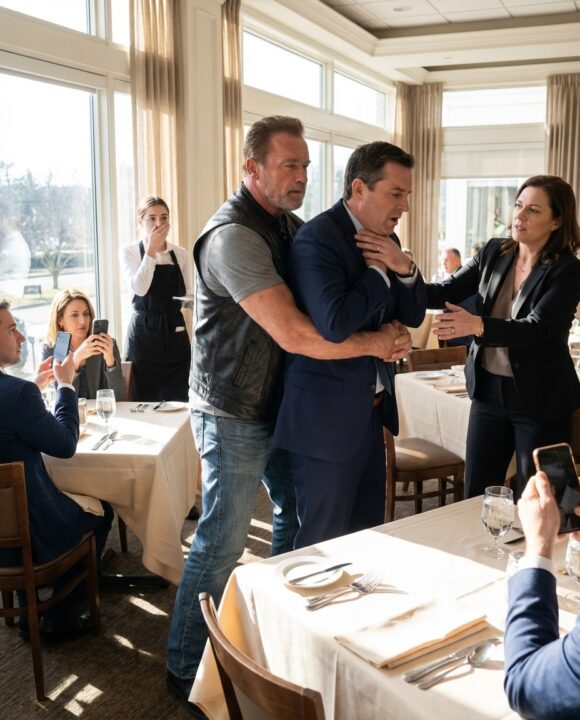
“I’ve got you,” I said, kneeling beside the chair.
From the outside, it must’ve looked wrong.
Leather. Tattoos. A stranger touching a wealthy guest in a room that had just refused him entry.
“Hey—what are you doing?” someone shouted.
I positioned my hands, firm and careful. One quick pull. Nothing. Another, sharper.
A gasp rippled through the dining room.
The manager grabbed my shoulder. “You can’t just—”
“Back up,” I said, steady. “Give him air.”
Phones appeared like reflex. A woman whispered, “Is this legal?” Another muttered, “Get security.”
I adjusted my stance and tried again. Controlled. Precise. Training doesn’t announce itself—it shows up when needed.
The man’s body jerked. A hard cough. Still blocked.
My daughter stood frozen a few steps away. Eyes locked on me. Recognition flickered—then panic drowned it. She shook her head slightly, almost pleading.
Not here. Not like this.
Security rushed in from the lobby. Hands on radios. Posture ready.
“Sir, step away!”
I didn’t argue. Didn’t look up. Focus narrows when seconds matter.
Another pull.
A wet, choking sound. Then—
Something dislodged. A piece of steak hit the tablecloth.
Air rushed back into the man’s lungs with a violent gasp. The kind that sounds like life returning from far away.
Applause didn’t come.
Relief did—but tangled with suspicion.
Security tightened their circle anyway.
“On your feet,” one said.
I stood slowly, palms visible. Not defensive. Not proud. Just breathing.
The wife hugged her husband, crying. A guest pointed at me. “He could’ve hurt him!”
The manager stepped forward, jaw set. “You were told to leave.”
“I know.”
“Then why come back?”
I glanced at my daughter.
She looked away.
“I came for someone,” I said.
It wasn’t enough.
Murmurs rose. Words like liability, assault, lawsuit floated across white linen and crystal.
Security reached for my arm again.
And the room, still shaking from crisis, mistook the quietest man there for the biggest threat.
Security’s grip wasn’t violent, but it was firm enough to send a message.
Not welcome.
Not trusted.
Not one of us.
“Sir, you need to come with us,” the taller guard said.
I didn’t resist. Didn’t pull away. Compliance is sometimes louder than protest. I let them guide me a few steps from the table, the polished floor reflecting fragments of faces—concern, irritation, curiosity dressed as civility.
Behind us, the man I’d helped kept coughing, each breath rough but real. His wife held his shoulders like she was afraid oxygen might disappear again. A server wiped the table with trembling hands. Someone righted a fallen chair. Silverware lay scattered like the aftermath of a quiet storm.
The manager moved in front of me. “You can’t just force your way in and put hands on a guest.”
“I didn’t force anything,” I said evenly.
“You were removed. That’s trespassing.”
A few diners nodded. A woman whispered, “He looks like trouble.” Another murmured, “These situations escalate fast.”
I kept my eyes steady. Silence can be mistaken for guilt when people expect noise.
Across the room, my daughter stood near the service station, tray still in her hands. Her posture was perfect. Professional. Controlled. But her knuckles were white around the metal edge. She wouldn’t look at me.
“Sir,” the guard tried again, softer now. “Let’s take this outside.”
The man I’d helped attempted to speak. “He—” Cough. “He helped me.”
But relief is fragile. And doubt, once lit, spreads fast.
“Paramedics will handle it,” the manager replied. “We have protocols.”
Protocols.
I nodded once. Order has its place. So does timing.
They walked me toward the entrance. Conversations followed like drifting smoke. Phones lowered, then rose again. Some guests leaned back into their seats, relieved the disruption was being escorted away.
At the doorway, warm night air slipped inside. Valet lights flickered on chrome and glass. The city hummed, unaware of small human verdicts being handed down inside.
I stepped just beyond the threshold and stopped.
“Wait,” I said quietly.
The guard tensed. “What now?”
I reached into my vest slowly. Careful. Visible. No sudden moves. A few guests near the host stand stiffened anyway.
I pulled out my phone.
Old model. Scratched screen. Functional.
Typed a short message.
Sent.
“Who are you calling?” the guard asked.
“Someone who should be here,” I replied.
No name. No explanation. A sentence placed like a marker on a map.
Inside, my daughter finally looked up. Our eyes met through the glass. For a second, time folded—years of missed birthdays, quiet pride, unsaid words. She shook her head slightly. Not anger. Not fear.
Shame.
I exhaled once. Not loud. Not dramatic. Just air leaving tired lungs.
Then we waited.
Minutes stretched thin. A siren wailed somewhere far off. Cutlery clinked again as the dining room tried to return to normal. But normal doesn’t come back easily once a room has judged someone.
The guard checked his watch. “If this is about making a scene—”
A low vibration rolled across the pavement.
Soft. Distant.
Not traffic.
Engines.
More than one.
Approaching in steady rhythm.
The guard glanced toward the street.
Inside, a few heads turned.
And the night began to gather itself.
The sound grew fuller. Layered. Controlled.
Not revving. Not reckless.
Engines moving with measured discipline.
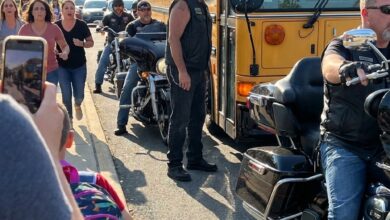
Headlights appeared at the end of the block—one, then several, then a slow procession gliding past palm trees and storefront reflections. Chrome caught the streetlamps. Helmets mirrored city light.
Motorcycles.
A lot of them.
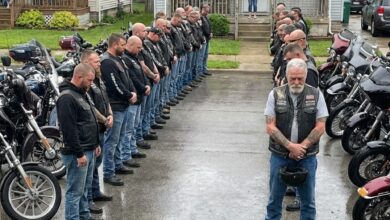
They rolled to the curb in staggered formation. No sudden stops. No noise for attention. Engines cut almost in unison, leaving behind a silence that felt intentional.
Valets paused mid-step. Pedestrians slowed. A couple near the patio stopped filming their dessert and turned their phones toward the street.
Riders dismounted.
Men and women. Different ages. Different builds. Same stillness. Same quiet confidence. Black leather worn without performance.
They didn’t rush the doors.
They walked.
Bootsteps steady against the sidewalk. Shoulders squared. Faces calm. No chants. No spectacle.
The guard beside me straightened. “You expecting them?”
I didn’t answer.
The first rider reached the entrance and gave me a simple nod. Respectful. Familiar. Nothing theatrical.
More followed, forming no line, no show of force—just a quiet presence along the windows and patio rail. They left space for staff. For guests. For dignity.
Inside, conversations thinned. Forks lowered. Even the jazz seemed softer.
“Is this… a group?” someone whispered.
The manager stepped forward, uncertainty replacing authority. “Can I help you?”
A woman rider spoke gently. “We’re here to wait.”
That was all.
No demands. No threats.
Just presence.
My daughter stood frozen, eyes moving from me to the riders, to the guests who had watched me escorted out minutes earlier. The story in the room began to tilt—slowly, visibly.
The man I’d helped was on his feet now, supported by his wife. He looked toward the entrance, confusion giving way to recognition of something he couldn’t name yet.
Security’s posture shifted—not alarmed, just aware. The power in the space rearranged itself without anyone announcing it.
Respect entered quietly and changed the temperature of the room.
One rider opened the door and held it—not for me, not for staff, but for the paramedics arriving with a stretcher. Small gesture. Clear priority.
Human first.
Always.
My phone buzzed once in my palm. I glanced down. A single reply.
On my way.
I slipped the phone back into my vest.
Inside, eyes followed me. No longer certain. No longer comfortable with the first judgment.
My daughter took one step forward.
Then stopped.
The space between us felt heavier than the street outside.
And in that suspended moment—between who I was assumed to be and who I’d always been—
The truth waited just out of sight.
The paramedics moved with clean efficiency.
Oxygen. Vitals. Calm voices.
The man who’d choked was breathing on his own now, color slowly returning to his face. His wife kept one hand on his chest like she needed proof of every inhale.
“I’m okay,” he rasped. “Because of him.”
He pointed at me.
Not dramatically. Just certain.
The room followed his finger.
Conversations thinned into something fragile. Crystal glasses sat untouched. Linen napkins remained twisted in nervous hands. Judgment, once loud, turned cautious.
The manager cleared his throat. “Sir… we still need to document—”
“Later,” the man said hoarsely. “Let me thank him.”
He stepped toward me, unsteady but determined. “You knew what to do.”
“I’ve seen it before,” I replied.
No details. No spotlight. Help doesn’t need a résumé.
Then my phone buzzed again.
Footsteps approached from the sidewalk—quick, purposeful, familiar.
“Dad?”
Her voice landed soft and sharp at the same time.
My daughter stood just inside the doorway, apron still on, eyes glassy but steady. The dining room saw it all at once—the resemblance, the history, the distance.
“You came,” she said.
“I said I would.”
A pause. Long enough to hold years.
“I told them you couldn’t make it,” she admitted quietly. “I didn’t want… questions.”
About my vest. My bike. My hands that carried grease under the nails. The life that didn’t fit linen and reservations.
“I get it,” I said.
She shook her head. “No. You deserved better than that.”
Around us, the riders kept their distance. No crowding. No claiming. Just a circle of quiet loyalty.
The manager’s posture softened. “Sir, I… misread the situation.”
“It happens,” I replied.
Security stepped back without being asked.
The man I’d helped extended his hand. I took it. Firm. Brief. Human.
“Thank you,” he said. “You saved my life.”
I let the words pass through without catching. Gratitude is lighter when you don’t hold onto it.
My daughter reached for my sleeve—hesitant, then sure. “Will you come in? Please.”
I glanced at the room. The white tablecloths. The polished silver. The eyes that had measured me by the cut of my clothes.
“I’ll wait outside,” I said gently. “You’re working.”
She almost argued. Then understood. A small nod.
I stepped back through the doorway into the warm Arizona night. Engines ticked softly as they cooled. Neon reflected on chrome. Somewhere, laughter returned to its normal volume.
Behind the glass, she stood a little taller.
Not hiding. Not apologizing.
Just herself.
I sat on the low stone ledge near the valet stand, hands resting on my knees. The city breathed. Traffic moved. Life continued in its ordinary rhythm.
Inside, a place setting near the window remained empty.
Reserved.
Not for status.
For understanding that arrived late—but stayed.
If you want to read more powerful biker stories like this, follow the page.