The Woman Left in a Police Station — Until a Biker Posted Her Bail
They left her sitting on a hard metal bench inside a police station, like something forgotten in a lost-and-found bin.
The fluorescent lights hummed overhead. The clock on the wall ticked too loudly. Every sound in the room felt exaggerated—the scrape of a chair, the crackle of a police radio, the distant buzz of a vending machine.
She sat with her hands folded tight in her lap, knuckles white. Thirty-two, hair pulled into a messy knot that had come undone hours ago. A cardigan slipping from one shoulder. Mascara streaked faintly beneath her eyes, not from vanity—but from exhaustion.
Her name was Lila Moreno.
She hadn’t yelled. Hadn’t resisted. Hadn’t cursed at anyone. She had only kept saying the same sentence, over and over, in a voice that grew thinner each time:
“I just need to call my sister.”
But her sister hadn’t answered.
Her phone had died.
And the officer behind the desk had already moved on to paperwork, treating her like just another file number, just another “disturbance at a grocery store.”
Outside, through the glass doors, the town went on as usual. Pickup trucks idled. People walked past without looking in. Life continuing, unbothered.
Inside, Lila looked smaller by the minute.
When the front door opened again, the draft carried in the scent of leather and gasoline.
Boots stepped across the tiled floor. Heavy. Measured.
No one noticed at first.
Until he stopped in the center of the room.
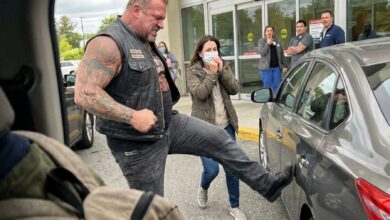
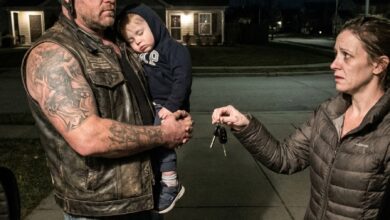
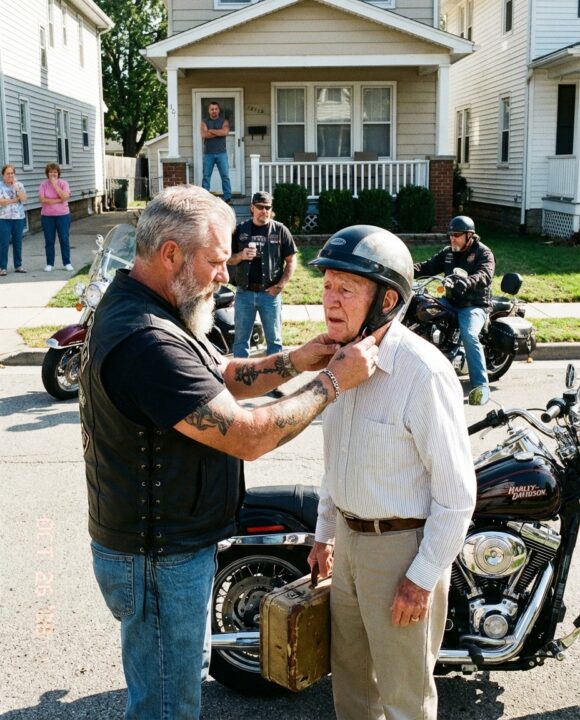
A tall man. Broad shoulders. Faded jeans. A black leather vest over a plain gray T-shirt. Silver streaks in his beard. Tattoos crawling down both forearms, not flashy—just old. Earned.
He didn’t look angry.
He didn’t look friendly.
He simply looked at Lila.
And for the first time that night, someone did.
The officer behind the desk stiffened the moment he saw the vest.
A patch. Not a loud one. No skulls. No flames. Just a small embroidered emblem stitched over the heart.
But in a town like this, that was enough.
“Can I help you?” the officer asked, already defensive.
The biker didn’t answer right away. He stepped closer to the desk, slow enough to feel deliberate.
“I’m here about her,” he said, nodding once toward Lila.
Three other people in the lobby turned to look.
An elderly couple waiting to file a report. A teenage boy scrolling on his phone. A woman holding a toddler. Their eyes moved from Lila to the biker, and something shifted in the room.
Suspicion.
“What’s your relationship to the detainee?” the officer asked.
“None,” the biker said.
The word landed heavy.
Lila looked up, confused. She didn’t recognize him. Her lips parted slightly, but she didn’t speak.
“You know her?” the officer pressed.
“No.”
The officer’s hand hovered closer to his belt.
“Then why are you here?”
The biker leaned one hand on the counter. Not slamming. Not aggressive. Just firm.
“I want to know why she’s still sitting there.”
The officer’s voice sharpened. “Sir, that’s not your concern.”
The room tightened.
The elderly woman whispered something to her husband. The teenage boy stopped scrolling. The toddler began to fuss.
The biker’s jaw flexed once.
“She can’t afford bail,” the officer said flatly. “Public disturbance. Refused to leave private property.”
“I didn’t refuse,” Lila whispered suddenly. “I just—”
The officer cut her off with a glance.
The biker didn’t raise his voice.
Didn’t step forward.
Didn’t threaten.
But when he slid his wallet onto the counter with a quiet thud, it sounded louder than shouting.
“I’ll post it.”
The officer blinked. “You don’t even know her.”
The biker’s eyes didn’t move from Lila.
“Doesn’t matter.”
That was when the whispers grew louder.
“Who is he?”
“This isn’t right.”
“He looks like trouble.”
The woman with the toddler stepped back instinctively.
The officer’s tone hardened. “Sir, you understand what you’re doing? You’re financially responsible if she doesn’t show up to court.”
The biker nodded once.
No hesitation.
“You think this is some kind of stunt?” the officer said.
The biker didn’t answer.
He simply signed the form.
And somehow, that silence felt more confrontational than yelling ever could.
The officer picked up the phone.
“I need a supervisor up front.”
Now it escalated.
The door behind the counter opened. Another officer stepped out. Then another.
Three uniforms.
Facing one man in a leather vest.
The air felt thinner.
Lila’s breathing grew shallow.
The teenage boy raised his phone slightly, ready to record.
“Sir,” the supervisor said carefully, “are you trying to interfere with police procedure?”
The biker finally looked up at him.
“No.”
“Then what exactly are you doing?”
The biker’s voice stayed level.
“Paying.”
The supervisor studied him longer than necessary.
“You affiliated with a club?”
The pause was deliberate.
“Yes.”
“And you expect me to just let you walk in here and bail out a stranger?”
The biker met his eyes.
“Yes.”
The supervisor’s lips tightened.
“On what grounds?”
The biker looked back at Lila.
“She doesn’t belong here.”
The words weren’t loud.
But they carried.
And suddenly, the entire lobby felt like it was holding its breath.
The supervisor stepped closer.
“Sir, I’m going to need you to step outside.”
The biker didn’t move.
“I’m not causing a problem.”
“You’re making people uncomfortable.”
A flicker passed across his face. Not anger. Not fear.
Something steadier.
“Uncomfortable isn’t illegal.”
One of the officers shifted position, subtly blocking the exit.
The message was clear.
This could turn.
Lila’s eyes darted between them. “Please,” she whispered. “You don’t have to do this.”
The biker glanced at her briefly.
“I know.”
He reached into his pocket.
Three officers stiffened instantly.
Hands hovered over holsters.
The teenage boy started filming.
The woman with the toddler gasped.
The biker pulled out—
A phone.
He didn’t wave it around. Didn’t posture.
He dialed.
Put it on speaker.
Rang once.
Twice.
“Yeah,” a voice answered.
“I need you here,” the biker said.
Silence.
“Now.”
He ended the call.
That was it.
No explanation.
No threats.
The supervisor exhaled sharply. “Who did you just call?”
The biker slid the phone back into his pocket.
“Help.”
The room seemed to vibrate.
“Backup?” one officer muttered.
The supervisor’s tone sharpened. “Sir, if this becomes a public safety issue—”
“It won’t,” the biker said calmly.
But his calm didn’t reassure anyone.
Minutes passed like hours.
Outside, through the glass doors, headlights flickered at the edge of the parking lot.
One engine.
Then another.
Low.
Steady.
Not revving.
Just present.
Lila’s fingers trembled against her knees.
The supervisor’s jaw tightened.
The sound grew louder—not chaotic, not reckless—just controlled.
Disciplined.
The first motorcycle rolled into view.
Then another.
Then five more.
All stopping in a neat line.
Engines cut almost simultaneously.
The silence afterward was heavier than the noise.
The door opened.
Boots stepped inside.
One.
Two.
Six.
All wearing the same understated patch.
No shouting.
No threats.
They removed their helmets calmly.
And stood behind the first biker.
Not crowding him.
Not surrounding anyone.
Just standing.
Together.
The power in the room shifted.
Not because of force.
But because of presence.
And no one in that lobby could ignore it.
For a few seconds, no one spoke.
The silence was no longer awkward — it was charged.
The six men who had walked in did not spread out. They did not crowd the officers. They didn’t even look at Lila.
They simply stood.
Boots aligned. Shoulders squared. Hands relaxed at their sides.
No one raised a voice.
No one made a threat.
And yet the temperature in the room seemed to change.
The supervisor studied them carefully. “This isn’t a rally,” he said. “This is a police station.”
The first biker — the one who had signed the bail form — nodded once. “That’s why we’re quiet.”
One of the elderly men in the waiting area shifted uncomfortably. The teenage boy lowered his phone halfway. The woman with the toddler stopped backing away.
The bikers didn’t stare at anyone.
They stared at the desk.
At the paperwork.
At the process.
And that, somehow, felt heavier than confrontation.
The supervisor looked toward the officer behind the counter. “Is the bail valid?”
The officer flipped through the paperwork. “Funds are sufficient.”
“Clean record?” the supervisor asked.
The officer checked the screen. “No prior arrests.”
The supervisor’s lips pressed into a thin line.
Outside, another engine passed slowly on the street, then faded.
The supervisor stepped closer to the first biker.
“You understand,” he said quietly, “if she doesn’t show for court, it’s on you.”
The biker met his eyes.
“I understand.”
“Why?” the supervisor asked.
The question wasn’t hostile anymore.
It was confused.
The biker didn’t answer right away.
Instead, he reached into his back pocket — slow, deliberate.
No one flinched this time.
He pulled out a folded, worn envelope.
He placed it on the counter.
Inside was a crumpled receipt.
Grocery store.
Dated earlier that evening.
The supervisor frowned. “What is this?”
“She paid for my groceries,” the biker said.
The words were simple.
But the room shifted again.
The officer behind the desk blinked. “What?”
The biker continued.
“My card got declined. Machine froze. Line behind me got loud.” His jaw tightened faintly at the memory. “She stepped up. Swiped her card. Didn’t say a word.”
Lila’s breath caught.
She remembered now.
The man ahead of her at checkout. His card failing twice. The cashier impatient. People sighing.
She had seen the embarrassment in his shoulders.
So she paid.
It had cost her almost everything in her checking account.
But she hadn’t thought twice.
“I was going to pay her back,” the biker said quietly. “By the time I stepped outside, two officers were putting her in the back of a cruiser.”
The supervisor turned slowly toward Lila.
“Why were you arrested?” he asked.
The officer at the desk cleared his throat. “Store manager reported she refused to leave after an argument.”
Lila’s voice was barely audible. “I asked for a receipt copy. They said I was holding up the line.”
The elderly woman in the lobby shook her head faintly.
The supervisor looked back at the biker.
“You followed the cruiser?”
The biker nodded once.
“I didn’t know her name,” he said. “But I knew she didn’t belong here.”
The words weren’t dramatic.
They weren’t heroic.
They were factual.
The supervisor looked at the lineup of silent men behind him.
“You all came for this?”
One of them answered, calm and even. “We come when one of us calls.”
The supervisor exhaled slowly.
The power dynamic had changed — not because of intimidation, but because the truth had weight.
Real weight.
He turned back to the desk officer.
“Process the bail.”
The keys jingled louder than they should have.
The metal door clicked open.
Lila stood carefully, legs stiff from hours on the bench.
No applause.
No dramatic music.
Just paperwork sliding across a counter.
The supervisor handed her the release form.
“You’re free to go.”
The words felt fragile in the air.
She stepped toward the exit — hesitant.
The first biker stepped aside so she could pass first.
Not ahead of her.
Behind her.
The lobby parted silently.
Outside, the night air felt cooler.
Cleaner.
But the story wasn’t finished.
Not yet.
They stood on the sidewalk under the dim parking lot lights.
Lila hugged her cardigan around herself.
“I don’t have the money to pay you back,” she said softly.
The biker shook his head once.
“That’s not why I did it.”
She looked at the line of motorcycles — all idling softly now.
“You don’t even know me.”
He gave the smallest shrug.
“You paid when no one else would.”
The words weren’t sentimental.
They were steady.
Matter-of-fact.
One of the other bikers handed her a folded card.
Not a business card.
A phone number written in pen.
“If you need a ride to court,” he said. “Call.”
No speeches.
No advice.
No lectures about kindness.
The police station door opened briefly behind them. Someone stepped out, then stopped, watching.
But no one interrupted.
Lila looked back at the man who had first walked in.
“What’s your name?” she asked.
He hesitated — just a second.
“Cal.”
“That’s it?”
“That’s enough.”
She nodded slowly.
A police cruiser pulled into the lot, headlights sweeping across the group.
The officers inside paused when they saw the line of motorcycles.
Not afraid.
Just aware.
Cal put on his helmet.
The other bikers followed.
Engines came to life again — low, synchronized.
Before he mounted his bike, Cal reached into his vest pocket and placed something into Lila’s hand.
It was the grocery receipt.
Folded carefully.
“You dropped this,” he said.
She looked down at the total printed at the bottom.
$82.47.
Almost everything she had.
When she looked back up, he was already turning away.
The motorcycles pulled out one by one.
Not racing.
Not roaring.
Just leaving.
Orderly.
Disciplined.
Gone within seconds.
The parking lot felt too quiet afterward.
The fluorescent lights inside the station still buzzed.
The town still moved.
But something had shifted.
The elderly couple came out moments later, walking past Lila.
The woman paused.
“We’re sorry,” she said quietly. “We thought…”
She didn’t finish.
She didn’t need to.
Lila watched the red taillights fade at the end of the street.
She didn’t cry.
Didn’t wave.
She just stood there, holding the receipt in her hand, feeling the weight of it.
Not the money.
Not the bail.
But the moment.
Inside the station, the supervisor stood by the window a little longer than necessary.
He had expected trouble.
Instead, he had witnessed something quieter.
Something harder to explain.
A stranger stepping forward when it cost him something.
No spotlight.
No reward.
Just action.
The next morning, Lila would show up to court.
She would stand straight.
She would tell her side calmly.
And someone would sit quietly in the back row — not in leather this time, just a plain shirt — watching without needing recognition.
Because sometimes the loudest statement in a room is not a shout.
It’s a man who doesn’t belong there — choosing to stand anyway.
And long after the engines faded into the night, the memory of those boots crossing the tile floor remained.
Not as fear.
But as a reminder.
Presence can protect.
And courage doesn’t always announce itself.
Sometimes, it simply signs the paper… and waits.
Here are two completely different Facebook hook posts, each around 300 words, cinematic, emotionally tense, and ending right at the turning point.