The Old Man Weeping Inside the Courthouse — While a Biker Waited Outside
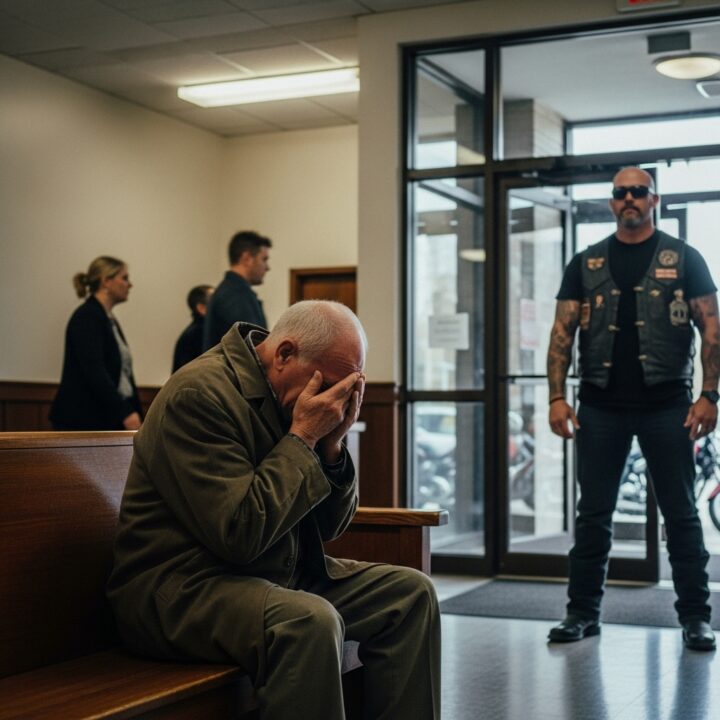
He was crying alone on a wooden bench inside the courthouse, hands shaking, face buried in shame, while strangers stepped around him as if he were invisible.
The courthouse smelled like disinfectant and old paper. Shoes echoed on tile. Doors opened and closed with mechanical indifference. For most people, it was just another weekday—another hearing, another verdict, another life moved along a conveyor belt of procedure.
For the old man, it felt like the end.
He sat hunched forward, coat too thin for winter, shoulders collapsing inward as though he were trying to fold himself smaller than the trouble he was in. His knuckles were swollen and red, fingers locked together in a grip that suggested he was holding on to something he couldn’t afford to lose.
A clerk called names.
A lawyer scrolled on his phone.
A security guard glanced, then looked away.
No one asked why the old man was crying.
He had just been told to wait. That was all. Wait while papers were processed. Wait while decisions were made without him. Wait while time—something he no longer had much of—slipped quietly through his hands.
Outside, beyond the courthouse doors, an engine cut off.
The sound was low. Heavy. Intentional.
A biker dismounted and leaned against his motorcycle, eyes on the entrance, waiting without pacing, without checking the time, as if patience itself were part of the plan.
No one inside noticed him yet.
The old man stood when his name was called, wiping his face with the sleeve of his coat, trying to look steady when he wasn’t. He walked toward the window, head down, voice barely audible.
Outside, the biker stepped closer to the doors.
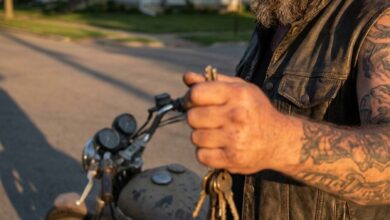
He was a big man—late forties, maybe early fifties. Short-sleeve leather vest despite the cold. Arms marked with old tattoos that looked faded rather than aggressive. His posture was upright, disciplined, the kind of stillness that made people uneasy because it didn’t ask permission.
A security guard noticed him and shifted his stance.
“Sir, you can’t loiter here,” the guard said.
“I’m waiting,” the biker replied.
“For who?”
The biker didn’t answer.
Inside, the clerk shook her head. “These documents aren’t complete,” she told the old man. “You’ll need to reschedule. Possibly face penalties.”
The old man’s breath caught. His knees bent slightly, as if the floor had tilted.
Outside, voices rose.
“Is he with you?” someone asked the guard, nodding toward the biker.
The guard frowned. “I don’t know.”
A woman pulling her coat tighter whispered, “Why is he just standing there like that?”
The biker took one step closer to the door.
That was enough.
Hands moved toward radios.
Eyes hardened.
Assumptions bloomed.
To the onlookers, it looked like a confrontation waiting to happen. A biker. A courthouse. An elderly man inside. The pieces arranged themselves into a story that felt familiar—and dangerous.
The biker didn’t argue.
Didn’t raise his voice.
Didn’t explain.
He just waited.
And the tension grew teeth.
Inside, the old man’s voice cracked. “Please,” he said. “I don’t understand the forms. I just—”
The clerk sighed, already tired. “Sir, step aside.”
That was when the old man broke.
Not loudly.
Not dramatically.
Just a quiet, helpless sound—the noise of someone realizing they are alone in a system that no longer sees them.
Outside, a patrol car slowed at the curb.
The security guard squared his shoulders. “Sir, I need you to move away from the entrance.”
The biker looked at him calmly.
“I will,” he said. “In a minute.”
That minute felt dangerous.
People paused mid-step.
Phones hovered uncertainly.
The old man inside leaned against the counter, breathing like each inhale cost him something.
The biker reached into his vest pocket.
The guard stiffened.
Whatever this was about to become, it was seconds from tipping over.
The biker pulled out his phone.
Typed one message.
Sent it.
Then he slipped the phone back into his pocket and said only one thing—quiet, level, unmistakably firm.
“He’s not leaving alone.”
No one knew what that meant.
They just knew they didn’t like the certainty in his voice.
And then everyone waited.
The sound came first.
Engines—but not revving.
Footsteps—but not rushed.
A voice—but familiar.
Two more motorcycles pulled in and parked neatly beside the first. Their riders dismounted in unison, movements precise, restrained. Not a show. A formation born of habit, not intimidation.
Behind them came a man in a pressed jacket, carrying a folder thick with documents. He walked straight past the guard, nodded politely, and entered the courthouse.
Inside, murmurs rippled.
The man approached the counter. “I’m here for Mr. Harris,” he said.
The clerk blinked. “Excuse me?”
“For the hearing,” he continued. “And the paperwork.”
He set the folder down. It was labeled. Signed. Complete.
The old man looked up slowly, disbelief written across every line of his face.
Outside, the guard lowered his hand from his radio.
Inside, the clerk cleared her throat and said, “Everything appears to be in order.”
The shift was almost physical.
A room that had felt heavy suddenly breathed again.
The old man sat down, stunned. Papers moved. Stamps landed. The machine resumed—but this time, it worked for him.
No one clapped.
No one spoke.
They just watched as the balance quietly corrected itself.
When the old man finally stepped outside, his eyes searched the courtyard like he was afraid of waking up.
The biker straightened.
For a moment, neither spoke.
Then the old man laughed—a small, broken sound—and wiped his eyes again.
“I thought I was done,” he said.
The biker shook his head. “You weren’t.”
It turned out the biker was his grandson’s friend. Not family by blood. Just someone who had listened once. Someone who had noticed how pride kept the old man from asking for help.
He hadn’t stormed the courthouse.
Hadn’t threatened anyone.
Hadn’t needed to.
He had simply refused to let the old man face it alone.
The bikers mounted up again, engines humming low. The man with the folder shook the old man’s hand and left without ceremony.
People who had watched earlier looked away now.
The guard stepped back.
The biker nodded once to the old man, then rode off.
The old man stood there a long time, clutching his papers, watching the empty space where the motorcycles had been.
He didn’t wave.
He didn’t chase after them.
He just stood a little straighter.
And inside the courthouse, the echo of his quiet crying was replaced by something else—a reminder that dignity sometimes arrives not with noise, but with someone willing to wait outside the door.
No speeches were given.
No lessons explained.
Only this remained:
Judgment is fast.
Help is quiet.
And courage doesn’t always look the way people expect.