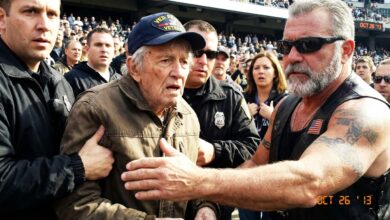
The Homeless Old Man Was Mocked in a Diner — Then a Biker Set His Helmet on the Table
They laughed at the old man’s hands first—cracked, trembling, wrapped around a chipped coffee cup—long before anyone noticed the biker standing just inside the diner door.
It was a small roadside diner in the American Midwest, the kind where everyone knew the regulars and strangers stood out immediately.
The lunchtime rush was loud. Plates clattered. A country song hummed through tired speakers.
The old man sat alone in a corner booth.
His coat was too thin for the season. His beard uneven. His eyes downcast, as if apologizing for existing. He hadn’t asked for money. Hadn’t bothered anyone. He just ordered a coffee and stared at the table like it might disappear if he looked away.
That didn’t stop the whispers.
A group of younger men near the counter snickered.
A waitress sighed, irritation flickering across her face.
Someone muttered, “He smells.”
The old man’s shoulders tightened.
His fingers shook harder.
When a napkin fell to the floor, he hesitated—then bent slowly to pick it up, every movement heavy with embarrassment.
That’s when the biker walked in.
Leather vest. Sleeveless shirt. Weathered boots.
A helmet tucked under one arm.
No one knew who he was.
No one knew why he stopped.
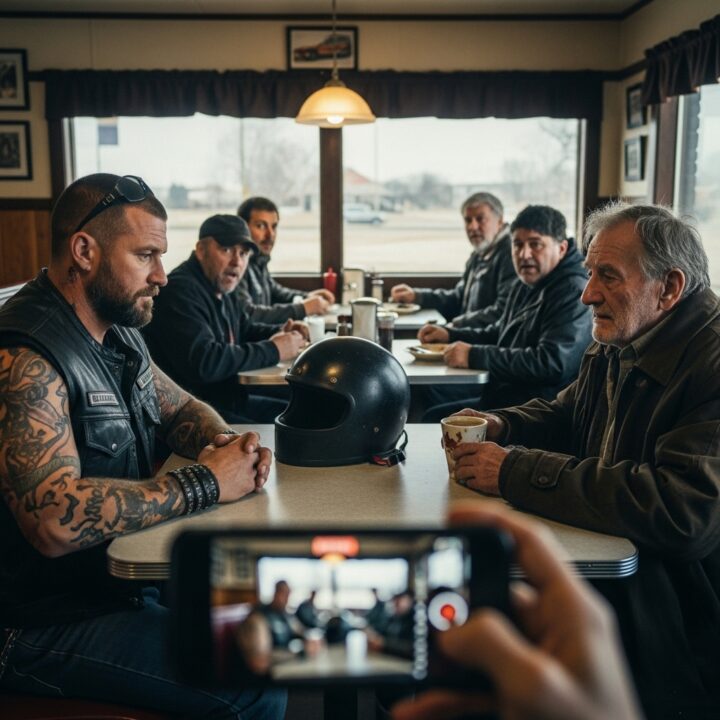
The biker didn’t sit down.
He walked straight to the old man’s booth and stood there, silent.
Immediately, heads turned.
A biker.
Standing over a homeless man.
In a crowded diner.
From the outside, it looked bad.
The biker’s arms were thick, inked with faded tattoos that told stories no one asked about. His jaw was set. His eyes hidden behind dark lenses.
The waitress froze mid-step.
Someone whispered, “This is about to get violent.”
One of the men at the counter laughed nervously. “Hey buddy, you got a problem?”
The biker didn’t respond.
Instead, he slowly pulled the helmet from under his arm and placed it gently on the table, right beside the old man’s coffee cup.
The sound was soft.
But the room went quiet.
The old man flinched.
People leaned back in their seats, ready for a confrontation. A manager appeared from the kitchen, already dialing his phone.
The biker still said nothing.
No threats.
No gestures.
No explanations.
Just his presence—solid, unmoving, impossible to ignore.
Tension crawled through the diner like static before a storm.
The manager stepped closer. “Sir, you need to take your business elsewhere.”
The biker didn’t look at him.
Instead, he reached into his pocket, pulled out his phone, and typed a single message.
The old man stared at the table, breathing shallow, as if bracing for something worse than mockery.
One of the younger men stood up. “You trying to scare him or something?”
Still no answer.
The biker slid into the booth—across from the old man.
That was enough.
Chairs scraped back.
Someone cursed under their breath.
The manager raised his voice.
“This is your last warning.”
The biker finally spoke.
Just five words.
Low. Calm. Certain.
“Let him finish his coffee.”
The diner held its breath.
No one knew why those words carried weight—but they did.
Outside, the faint sound of engines rolled in.
Not loud.
Not aggressive.
Just… present.
The biker glanced toward the window.
And waited.
The engines stopped.
One by one, more bikers walked in.
Not rushing.
Not posturing.
Men and women. Different ages. Same quiet discipline.
They didn’t block exits. Didn’t stare anyone down.
They simply stood.
The room shifted.
The laughter was gone.
The whispers died.
Someone recognized a vest patch and swallowed hard.
Someone else suddenly found the floor very interesting.
The biker at the booth stood up.
He took off his sunglasses.
And finally, people saw his eyes.
Not angry.
Not cruel.
Tired. Focused. Human.
He reached into his wallet and placed a folded photograph on the table.
The old man’s breath caught.
The biker spoke again—soft enough that only those nearby could hear.
“You saved my brother. Thirty-two years ago. Winter storm. Highway pileup.”
The old man looked up.
Recognition flickered.
The biker nodded once.
“He never forgot. Neither did I.”
No speeches.
No applause.
Just silence.
The biker paid the old man’s bill.
Then everyone else’s.
Not to make a point.
Not for gratitude.
Just because he could.
The manager apologized, voice unsteady.
The men who laughed earlier couldn’t meet anyone’s eyes.
The bikers left the diner exactly as they entered—quietly.
Outside, the old man stood on the sidewalk, holding the photo with shaking hands.
The biker paused beside him.
“You don’t owe me anything,” he said.
The old man shook his head. “I never thought anyone remembered.”
The biker smiled—small, almost sad.
“We do.”
Then he put his helmet back on and walked away.
Inside the diner, no one spoke for a long time.
A coffee cup sat cooling on the table.
And everyone there knew—judgment is loud, but dignity often arrives without a sound..