The Homeless Boy Begged for Help in a Crowd — Until One Biker Finally Stopped
The boy’s voice cracked before anyone noticed him.
It was barely louder than the traffic. Just a thin sound, swallowed by footsteps, conversations, and engines idling at a downtown intersection. He stood near the curb with his hands shaking, dirt under his fingernails, a hoodie two sizes too big hanging off his narrow shoulders.
“Please,” he said again. “I just need help.”
People passed him like he was invisible.
Some looked away quickly. Others stared for a second too long, then moved on. A woman clutched her purse tighter. A man pretended to be on his phone. No one stopped.
The boy was maybe ten. Eleven at most. His face was pale beneath smudges of grime. One shoe had a hole in the toe. The other was held together with tape. His stomach growled loudly enough that he wrapped his arms around himself in embarrassment.
He wasn’t asking for money anymore.
He was asking for help.
A city bus hissed as it pulled away. A delivery truck honked. The crowd shifted, impatient, irritated, uncomfortable.
And then—cutting through the noise—came the low rumble of a motorcycle.
Heads turned.
A biker rolled up slowly and stopped at the edge of the crosswalk. The engine didn’t shut off. He stayed seated, helmet still on, leather vest creaking as he leaned slightly forward.
No one knew who he was.
No one knew why he stopped.
But suddenly, the boy wasn’t invisible anymore.
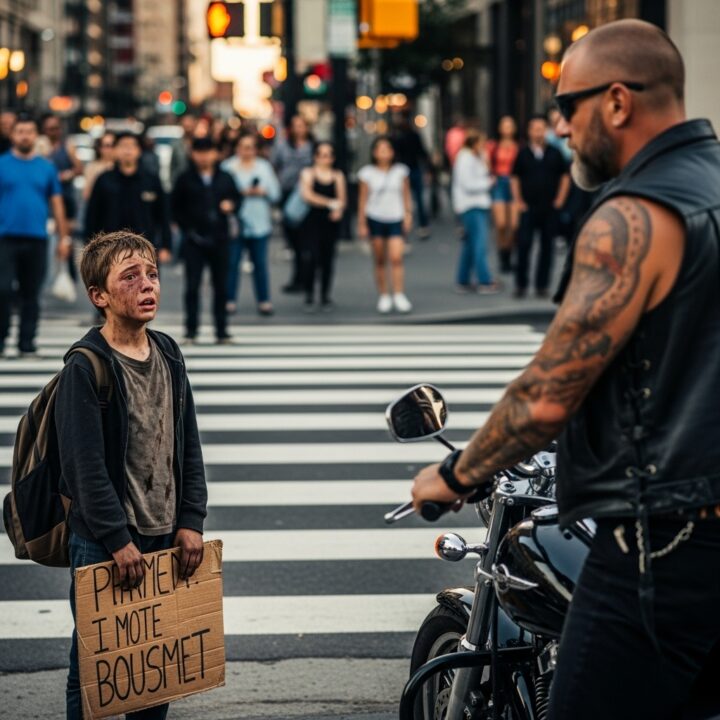
The biker swung his leg off the bike.
That’s when the tension started.
He was big. Late forties, maybe. Broad shoulders. Sleeveless vest. Tattooed arms. Dark sunglasses hiding his eyes even though the sun was already low. He took one step toward the boy.
People reacted immediately.
A man shouted, “Hey, back off!”
Someone else muttered, “This is getting dangerous.”
A woman grabbed her child’s hand and pulled them closer.
From the outside, it looked wrong.
A biker approaching a homeless kid in the middle of a crowded street. No uniform. No badge. No explanation.
The boy flinched.
Not because the biker was loud.
But because adults always were.
The biker didn’t rush him. Didn’t raise his voice. He stopped a few feet away, hands visible at his sides.
Still, the crowd closed in—not to protect the boy, but to watch. To judge. To be ready to intervene if things “went bad.”
Someone dialed their phone.
Security was mentioned.
Police, too.
The biker said nothing.
That silence made people angrier.
“Say something!” someone yelled.
“You can’t just do this!” another voice snapped.
The biker didn’t respond. He crouched slightly, lowering himself closer to the boy’s height—but from where everyone stood, it looked like intimidation.
The boy’s lip trembled. He glanced at the crowd, then back at the biker, unsure who was more dangerous.
The air felt tight. Like a single wrong move could shatter everything.
The situation was seconds from exploding.
The crowd pressed closer. Phones were out now. Accusations flew freely. People filled the silence with their own fear.
The boy backed away until his heel hit the curb and he stumbled.
The biker reacted instantly—not toward the boy, but toward the space around him. He raised one hand. Just one.
“Easy,” he said. One word. Calm. Controlled.
It didn’t help.
Someone shouted that he was trying to lure the kid. Another yelled that he should leave before the cops arrived. The boy’s breathing turned shallow, panic flashing across his face.
This was worse than being ignored.
The biker exhaled slowly. Then he reached into his vest pocket and pulled out his phone.
That made everything worse.
“What are you doing?”
“Who are you calling?”
“This isn’t your business!”
He typed something quickly. No explanation. No justification.
Then he looked at the boy and said quietly, “You don’t have to say anything. Just stay right here.”
The boy froze.
The biker straightened and stepped back half a pace, placing himself—not in front of the boy—but between him and the crowd.
No one knew what he’d done.
No one knew what was coming.
They only knew something had shifted.
And everyone waited.
The first sound wasn’t a siren.
It was another engine.
Then another.
The deep, familiar rumble rolled down the street, echoing off buildings. Heads turned again. Conversations died mid-sentence.
A line of motorcycles appeared at the far end of the block. Not speeding. Not aggressive. Just… arriving.
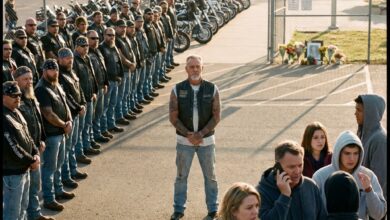
They parked in an orderly row along the curb.
Men and women dismounted. Different ages. Same quiet presence. Same leather vests. Same calm discipline.
No shouting.
No threats.
No confrontation.
Just presence.
The crowd went silent.
The biker who had stopped first nodded once toward the group. Then he knelt again—this time clearly, intentionally—at the boy’s level.
One of the newcomers approached the edge of the gathering and spoke to the crowd, not loudly, but firmly. “We’re not here to cause trouble.”
No one argued.
Power shifted without a single raised voice.
The boy looked around, confused. For the first time all evening, no one was yelling. No one was accusing. No one was rushing him.
The biker took off his sunglasses.
His eyes were tired. Kind. Human.
The truth came out slowly. Naturally. Without speeches.
The boy hadn’t run away.
He hadn’t been begging for money.
He’d been separated from his mother hours earlier after she was taken to the hospital. He didn’t know where she was. He didn’t have a phone. He didn’t know who to trust anymore.
The biker hadn’t stopped because he was brave.
He stopped because years ago, someone like him hadn’t stopped for someone like the boy.
One of the bikers made a call—not to friends, but to a social worker they’d worked with before. Another quietly bought food and water from a nearby store. Someone draped a clean jacket over the boy’s shoulders without a word.
No one filmed anymore.
The crowd that had judged, shouted, and threatened now stood back—silent. Ashamed.
When authorities finally arrived, everything was already calm. Handled. Human.
The biker didn’t stay for praise. He didn’t give his name. He put his sunglasses back on and walked toward his bike.
Before leaving, he looked once more at the boy and said softly, “You did the right thing asking for help.”
Then he rode away.
The street returned to normal. Traffic resumed. People moved on.
But the boy didn’t forget.
And neither did the few who realized how close they’d come to walking past someone who needed them most.
Some moments don’t end with applause.
They end with silence—and a question that stays long after the engines fade.