The Day the Bikers Removed Their Vests at a Young Firefighter’s Funeral
When the bikers stood up during the funeral and removed their vests all at once, the entire church froze — and I thought we were about to witness something ugly.
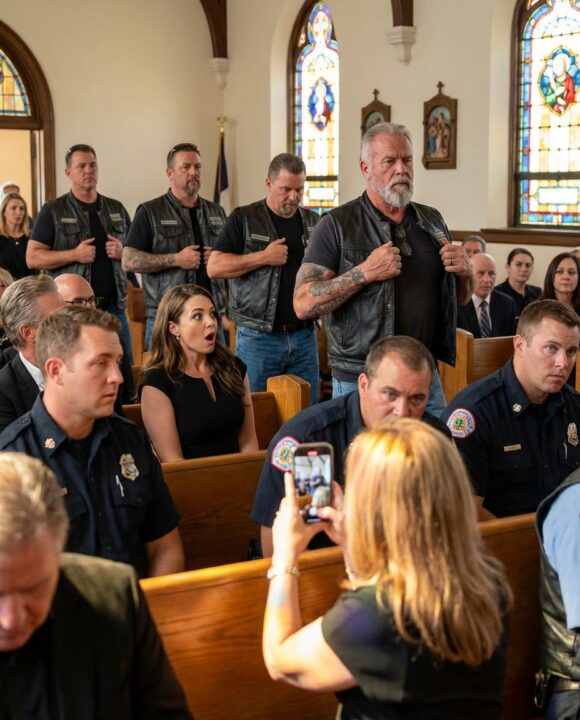
It was a gray Saturday morning in Columbus, Ohio. The kind of sky that feels appropriate for loss. The sanctuary at St. Matthew’s was filled beyond capacity — firefighters in full dress uniform, polished boots reflecting stained-glass light. Flags folded. Helmets resting quietly near the altar.
My cousin, Daniel Reyes, was twenty-eight.
He died three days earlier after running back into a burning apartment building to pull out two children. He made it out with them.
He didn’t make it back out himself.
The service had been heavy but controlled. Fire department chaplain. The mayor. Words like hero, sacrifice, brotherhood echoed through the pews.
Then I heard it.
Boots.
Not running.
Measured.
Heavy.
I turned.
About twelve men had just entered the back of the church.
Leather vests.
Sleeveless cuts with patches stitched across their backs. Tattoos. Weathered faces. They didn’t remove their sunglasses at first.
Whispers spread like dry leaves catching flame.
“What are they doing here?”
“I thought the family banned them.”
“They better not start anything.”
My aunt — Daniel’s mother — stiffened in her pew. She had publicly told anyone who would listen that those men were not welcome. That they were bad influence. That they lived outside the law.
And now they were here.
They didn’t speak.
They didn’t rev engines outside.
They just stood at the back.
Watching.
And then, during the final hymn, they did something none of us expected.
They reached for their vests.
And began unbuttoning them in silence.
I felt my chest tighten.
Because in that moment, I was certain this funeral was about to explode.
The first vest came off slowly.
Then the second.
Then all of them.
At once.
The sound of leather sliding against cotton echoed faintly in the otherwise silent church.
Gasps rose from the pews.
Someone behind me whispered sharply, “This is disrespectful.”
One of the firefighters in uniform shifted, shoulders tensing. A city councilman leaned toward an usher. I saw two off-duty officers standing along the wall straighten instinctively.
It looked like a statement.
A protest.
A disruption.
And at a funeral for a fallen firefighter, that felt unforgivable.
My aunt half-turned in her seat, her face pale. “Not today,” she whispered under her breath.
I knew the history.
Daniel’s father had been a biker. Not reckless, not criminal — just part of a club that rode hard and kept tight circles. He died when Daniel was twelve.
After that, my aunt cut all contact.
“No more of that life,” she used to say.
When Daniel joined the fire department at nineteen, she told everyone it was proof he’d chosen the right path. The respectable path.
But those men in leather? They were ghosts from a chapter she had tried to bury.
Now they stood at the back of the church, removing the very vests that symbolized their identity.
One by one, they folded them carefully.
Not tossed.
Not dramatic.
Careful.
Still, the tension in the room was sharp enough to slice.
The fire chief paused mid-sentence. Even the organist faltered for a beat.
“Should we call security?” someone murmured near the aisle.
One of the bikers — older, gray beard, posture straight — stepped forward half a pace. My heart jumped.
This was it.
This was where they’d make some statement about loyalty or brotherhood or territory. Something loud. Something divisive.
Instead, he stopped.
And bowed his head.
No speech.
No explanation.
Just twelve men standing at the back of the church holding folded leather vests against their chests like something sacred.
I felt anger rising anyway.
Because it felt like intrusion.
Like they were claiming something that wasn’t theirs.
Daniel was a firefighter.
A hero.
He had nothing to do with them anymore.
Or at least that’s what we all believed.
The hymn ended.
The silence stretched longer than it should have.
And then I noticed something that made my stomach turn.
They weren’t holding the vests protectively.
They were preparing to set them down.
And none of us yet understood why.
When the first vest touched the wooden pew, the air in the church shifted.
Not softer.
Sharper.
The leather made a low, heavy sound against the polished wood. One by one, the others followed. Twelve vests, each folded with care, placed in a single line across the back row — the row directly behind Daniel’s family.
It looked intentional.
Territorial.
Like a claim.
A firefighter two rows ahead of me turned halfway in his seat. “What are they doing?” he muttered, jaw tight.
My aunt’s shoulders stiffened. Her fingers gripped the folded program in her lap so tightly it bent in half. She didn’t look back. She refused to.
I felt heat rise in my chest.
This was Daniel’s day. His service. His honor.
And these men — men she had publicly told to stay away — were now placing symbols of their club inside the church.
The fire chief cleared his throat and resumed speaking, but the rhythm was broken. Every word now competed with the tension in the room.
One of the ushers leaned toward the gray-bearded biker. “Sir, this isn’t appropriate.”
The man nodded once.
“We’re not staying,” he said quietly.
Not defensive.
Not challenging.
Just steady.
That somehow made it worse.
If they weren’t staying, then what was this?
A statement?
A protest against the family?
A reminder that Daniel “belonged” to them too?
Whispers thickened.
“They’re disrespecting the uniform.”
“This is exactly why she didn’t want them here.”
Someone near the aisle began to stand, ready to confront them.
I thought it might turn physical. Not because the bikers looked aggressive — they didn’t — but because grief makes people protective. Grief makes people irrational.
And Daniel had died pulling two children out of an inferno. The department had already declared him a line-of-duty hero.
No one wanted that moment diluted.
The gray-bearded biker reached slowly into the inside pocket of his folded vest.
I felt my pulse spike.
Security from the church entrance shifted forward.
He withdrew something small.
A worn photograph.
He didn’t hold it up dramatically. He didn’t address the room. He simply placed it on top of the first vest and stepped back.
From where I sat, I couldn’t see it clearly.
But I saw my aunt notice.
Her eyes narrowed.
The service moved forward — prayers, eulogies, bagpipes waiting outside for the procession — yet half the congregation was no longer listening.
We were watching the back row.
Waiting.
The bikers stood still, heads bowed.
No crossed arms.
No raised chins.
Just stillness.
But the danger now wasn’t violence.
It was exposure.
If they had brought something from Daniel’s past, something my aunt had tried to sever, then the story we’d been telling about him — about clean lines and clear divisions — might not hold.
And when the final prayer ended and people began to rise, I saw my aunt do something none of us expected.
She stood.
And turned toward the vests.
Before my aunt could reach the back row, the church doors opened again.
No engines.
No roaring.
Just the sound of boots on stone steps outside.
The fire department honor guard entered first, preparing to escort Daniel’s casket out for the procession. Their white gloves were bright against dark uniforms. Medals glinted under the stained glass.
The timing was almost cruel.
Two worlds converging in one aisle.
My aunt stopped halfway down the row.
Her face was pale but composed. She walked toward the folded leather like someone approaching something fragile and dangerous at the same time.
The gray-bearded biker stepped aside without a word.
No argument.
No resistance.
He gave her space.
The entire church had gone silent now. Even the restless children in the back seemed to sense it.
My aunt reached the first vest.
Her hands hovered.
Then she picked up the photograph.
I saw her body go still.
She didn’t gasp.
She didn’t cry.
She just stared.
I stood up instinctively, trying to see.
The image was old. Faded at the edges. Daniel at maybe fourteen — thinner, angrier-looking, standing awkwardly between two leather-clad men. One of them was the same gray-bearded biker now standing in our church.
Daniel was smiling in that photo.
Not the polished smile from his fire academy graduation portrait.
Not the solemn smile from last year’s department banquet.
This was younger.
Unfiltered.
There was writing on the back. My aunt turned it slowly.
Her fingers trembled.
She read it once.
Then again.
I saw her lips move silently over the words.
“One day, I’ll wear the vest with honor.”
The phrase seemed to echo in the air without sound.
The meaning shifted in my chest.
Not rebellion.
Not defiance.
Honor.
She looked up at the gray-bearded biker.
For the first time, not as an intruder.
As someone who had known her son when she hadn’t.
“You kept this?” she asked quietly.
He nodded once.
“He carried the other copy,” he replied.
Confusion rippled through the pews.
“What copy?” someone whispered.
The biker reached into his pocket again — slow, deliberate — and handed her something else.
A wallet.
Scorched at the edges.
Recovered from Daniel’s personal effects.
The room seemed to lean forward as one.
My aunt opened it.
Inside, tucked behind his driver’s license, was the same photograph.
Folded soft from years of being carried.
And the same line in Daniel’s handwriting.
I felt the anger drain out of me like water leaving a cracked glass.
This wasn’t a claim.
This was a memory.
The vests weren’t being displayed.
They were being surrendered.
And when the gray-bearded biker spoke again, it was barely above a whisper.
“We never asked him to choose,” he said. “He chose service.”
The honor guard stood waiting, uncertain whether to proceed.
The power in the room had shifted completely.
No confrontation.
No rebellion.
Just a truth none of us had known.
And my aunt — who had once barred these men from our porch — slowly placed the photograph back on top of the vest.
Then she did something that stunned the entire church.
She stepped aside.
And let them stand there.
The honor guard finally moved.
White gloves lifted the flag-draped casket with precise, practiced care. The bagpipes outside began their low, aching cry, the sound rolling through the sanctuary like distant thunder.
But no one was looking at the aisle anymore.
We were looking at the back row.
At twelve folded leather vests resting against polished wood.
At a photograph that had outlived a childhood none of us fully understood.
My aunt didn’t return to her seat right away.
She stood there for several long seconds, holding Daniel’s burned wallet in her hand. I watched her shoulders rise and fall once, steadying herself.
Then she turned toward the gray-bearded biker.
“Did he ever tell you,” she asked quietly, “that I asked him to choose?”
The man didn’t hesitate.
“He told us you wanted him safe.”
Her jaw tightened. A small nod. Not defensive. Just honest.
“He was,” the biker continued. “Safer than most of us ever were.”
There was no pride in his voice. No attempt to claim Daniel. Just fact.
The truth had settled over the room like dust after collapse — not loud, not dramatic, just undeniable.
Daniel hadn’t rejected them.
He hadn’t rebelled in secret.
He had carried both worlds with him.
Leather and turnout gear. Engines and sirens. Brotherhood and service.
He had chosen his own version of honor.
Outside, the casket was carried down the church steps beneath a gray Ohio sky. Fire trucks lined the street, ladders raised in silent salute. The crowd followed.
The bikers didn’t rush forward.
They didn’t try to walk beside the firefighters.
Instead, they stepped back to the edge of the sidewalk and stood in a line, hands clasped in front of them.
When the procession passed, they bowed their heads.
No engines started.
No patches displayed.
Just stillness.
After the vehicles disappeared down the road, the gray-bearded biker walked over to my aunt one final time.
He didn’t offer a handshake.
He didn’t apologize.
He simply said, “He wore it already.”
She understood.
The vest Daniel had dreamed of wasn’t leather.
It was the uniform folded in the casket.
And somehow, that realization didn’t divide us anymore.
One by one, the bikers returned to the church entrance. They picked up their folded vests from the back row — not reclaiming territory, but retrieving something they had laid down in respect.
Before leaving, the gray-bearded man placed the original photograph in my aunt’s hands.
“We kept our copy,” he said.
That was all.
No speeches.
No redemption arcs.
Just men walking quietly toward parked motorcycles, starting engines only after they had rolled down the hill and out of earshot.
I stood there watching them disappear.
I had spent years believing they were the wrong chapter in Daniel’s life.
Now I understood they had been the bridge that carried him through it.
Grief doesn’t always divide.
Sometimes it reveals what was always there.
If you want to read more stories about misunderstood bikers and the quiet courage people overlook, follow our page.