The Boy Forced Out of His Motel for Being Poor — And the Biker Who Gave Him a Bed
The motel manager dragged the boy’s backpack across the gravel and told him to “sleep somewhere cheaper.”
It was 6:40 a.m. on a humid Tuesday in rural Oklahoma, and Route 17 already shimmered with heat. The Sunrise Motor Lodge had peeling paint, a broken neon sign, and a reputation for being “temporary.”
Temporary jobs. Temporary rooms. Temporary lives.
The boy standing barefoot on the cracked pavement was anything but temporary.
His name was Mason Turner. Seventeen. Thin frame. Sunburned neck. He wore the same hoodie he’d slept in, clutching a wrinkled envelope of cash that wasn’t enough.
“I just need two more days,” he said quietly.
The manager, a thick-armed man in his fifties with a coffee stain down his polo shirt, shook his head. “You’re short again. I told you last week. No pay, no stay.”
The other guests watched from doorways.
A woman smoking near Room 12 muttered, “Kids these days.”
A truck driver leaned against his rig but didn’t intervene.
Mason swallowed hard. “I start work tomorrow. Construction. I can pay Friday.”
The manager grabbed the room key from his hand and tossed it back toward the office. “You should’ve thought about that.”
Mason’s backpack hit the ground. His clothes spilled into the dust. A geometry textbook slid out.
No one moved to help.
The morning felt heavy with indifference that stung worse than cruelty.
And then—
a low engine rumbled into the parking lot.
Slow. Steady.
A black Harley rolled in like it had somewhere specific to be.
The rider killed the engine and removed his helmet.
Sleeveless leather vest. Salt-and-pepper beard. Eyes that didn’t blink quickly.
He didn’t say anything.
He just watched.
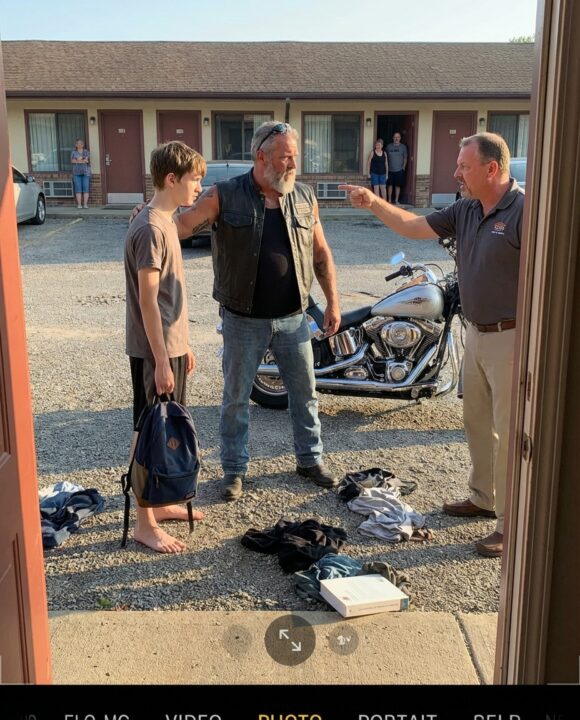
The biker dismounted slowly, boots crunching over gravel.
He wasn’t smiling.
He wasn’t frowning.
He simply walked toward the scene like he had a right to stand there.
The motel manager straightened defensively. “Private business.”
The biker didn’t respond.
He bent down and picked up Mason’s geometry book, brushing off the dust carefully.
“You in school?” he asked.
Mason hesitated. “Yeah.”
The manager scoffed. “Not my problem.”
The biker looked at him now.
Not aggressively.
Just directly.
“How much?”
The manager blinked. “What?”
“How much does he owe?”
A small crowd began forming. Curiosity replacing indifference.
The manager folded his arms. “Two nights and deposit. And he’s late.”
The biker nodded once.
“Policy’s policy,” the manager added loudly, glancing at the onlookers for validation.
The biker reached into his vest.
Phones lifted.
A woman whispered, “This is about to go bad.”
The manager stepped back half a step.
The biker pulled out a wallet.
Not a weapon.
But tension didn’t drop.
It thickened.
Because he didn’t immediately hand over cash.
Instead, he placed the wallet back inside his vest.
“Doesn’t work that way,” he said quietly.
The manager’s face hardened. “You threatening me?”
The crowd shifted.
One man muttered, “Don’t start something.”
Mason stood frozen, unsure whether this stranger was about to make things worse.
The biker stepped closer—not invading, not shouting—just closing space.
“You’re putting a minor on the road,” he said calmly.
“He’s seventeen,” the manager snapped. “Old enough.”
The biker’s jaw flexed.
“Old enough to finish school,” he replied.
That didn’t land well.
The manager’s voice rose. “I run this place. You don’t tell me how to—”
The biker reached into his pocket again.
Gasps.
The manager’s hand twitched toward his office door.
But again—no weapon.
Just a phone.
He typed something short.
Sent it.
Then he looked back at Mason.
“You got ID?”
Mason nodded slowly.
The manager laughed sharply. “What, you gonna adopt him?”
The biker didn’t react to the sarcasm.
He simply said one sentence.
“He’s not sleeping on gravel.”
Police sirens were faint in the distance now—someone had already called.
The tension sharpened.
From the outside, it looked like escalation.
A biker confronting a business owner. A kid caught in the middle.
No one knew what the message on that phone meant.
No one knew who he had contacted.
But the biker stood his ground like someone who had already decided how this would end.
And the gravel beneath Mason’s bare feet suddenly felt like the edge of something much bigger.
The police cruiser rolled into the lot just as the humidity thickened.
Two officers stepped out.
Hands near belts.
Eyes scanning the scene.
“What’s going on?” one asked.
The manager pointed immediately. “He’s interfering with my property and harassing me.”
The biker didn’t flinch.
The officer turned to him. “Sir?”
The biker gestured calmly toward Mason.
“Seventeen. No guardian. No transport. No safe placement.”
The officer looked at Mason. “Is that accurate?”
Mason nodded. “My mom passed last year. I’ve been… working.”
The manager cut in sharply. “He’s not my responsibility.”
“No,” the biker said evenly. “But he’s not disposable either.”
That word hung in the air.
Disposable.
The officer shifted his stance.
“You family?” he asked the biker.
“No.”
“Then why are you involved?”
The biker didn’t answer immediately.
He looked at Mason’s hands—still trembling.
Then he said quietly, “Because no one else stepped in.”
The officer sighed.
“We can’t force the motel to keep him.”
“I’m not asking you to,” the biker replied.
He stepped back slightly, pulling his phone out again.
Typed.
Waited.
The manager crossed his arms tighter.
“You don’t get to bully me into charity.”
The biker looked at him, almost tired now.
“This isn’t charity.”
Another engine echoed faintly down Route 17.
Low. Familiar.
The officer glanced toward the highway.
Mason’s heart began racing.
Was this turning into something bigger?
More confrontation?
More pressure?
The manager muttered, “Great. Now he’s calling backup.”
The biker didn’t confirm or deny.
He simply stood beside Mason—not touching him, not looming—just present.
The cruiser’s radio crackled softly.
The air felt charged with a waiting that made people uneasy.
From across the lot, the woman from Room 12 stubbed out her cigarette and whispered, “What’s he planning?”
The biker said nothing.
But his shoulders relaxed slightly as the distant engine grew louder.
And Mason realized something strange.
For the first time that morning—
he didn’t feel alone.
The second motorcycle turned into the parking lot.
Then a third.
Not roaring.
Not chaotic.
Measured.
Intentional.
The manager’s expression changed.
The officer adjusted his stance.
The gravel seemed to shift underfoot.
And the story everyone thought they understood—
was about to turn.
The second motorcycle rolled in quietly.
Then the third.
Then the fourth.
They didn’t roar or circle dramatically. They didn’t rev engines in intimidation. They simply parked in a loose semicircle along the edge of the Sunrise Motor Lodge parking lot, chrome catching the early light.
Men and women stepped off in sleeveless leather vests. Some older. Some younger. All calm.
The motel manager swallowed.
“You called a gang?” he snapped.
The first biker—the one who had picked up Mason’s geometry book—didn’t react to the word.
“They’re not here for you,” he said evenly.
The officers exchanged a look. Not alarmed. Just alert.
One of the new arrivals, a woman in her late forties with a braided ponytail and steady posture, approached the group with a small folder in her hand. She nodded at the lead biker, then at the officers.
“Morning.”
It didn’t feel like escalation.
It felt organized.
“What is this?” the manager demanded.
The braided woman looked at Mason first. Not the manager. Not the police.
“You Mason Turner?”
He nodded cautiously.
She handed a folded paper to the officer. “Youth transitional housing request filed yesterday. Verified.”
The officer skimmed the document. His eyebrows lifted slightly.
The lead biker spoke quietly. “He’s been on a waiting list. It moved faster than expected.”
The manager blinked. “Housing?”
The braided woman nodded. “Two rooms available above the Iron Haven garage. Temporary, supervised. Education continuation required.”
The words sounded official without being flashy.
Mason looked confused. “Garage?”
The lead biker finally allowed himself a faint, almost reluctant smile. “We run a repair shop. Upstairs has beds.”
The manager scoffed. “So what, you’re running a shelter now?”
The biker didn’t take the bait.
“We’re running responsibility,” he said calmly.
One of the other bikers walked toward Mason’s scattered belongings and began packing them neatly into the backpack without a word. Another picked up the geometry book and tucked it carefully inside.
No threats.
No raised voices.
Just quiet action.
The officers relaxed incrementally.
“You’re aware this needs to stay lawful,” one of them said.
“It is,” the braided woman replied. “We coordinate with county services.”
The manager’s anger deflated into something smaller—less righteous, more uncertain.
“You can’t just—”
“We’re not,” the lead biker interrupted gently. “We’re offering him a ride.”
The gravel felt different now.
Less like an edge.
More like a bridge.
The bikers didn’t surround Mason tightly. They didn’t crowd him. They simply created space around him where before there had been none.
From a distance, it might have looked like intimidation.
Up close—
it felt like structure.
The officer handed the paperwork back and gave Mason a measured look. “You comfortable with this?”
Mason glanced at the motel office, then at the line of quiet riders.
“I… I don’t want trouble.”
The lead biker shook his head. “You’re not trouble.”
The engines started one by one.
Controlled.
Patient.
And the motel manager, who had stood so firm minutes earlier, now stood silent in the doorway of his office.
Power hadn’t shifted through force.
It had shifted through coordination.
Through presence.
Through a plan no one in that parking lot had seen coming.
The lead biker handed Mason a spare helmet.
“Let’s get you somewhere steady.”
And for the first time that morning, Mason’s shoulders dropped.
Just a little.
The ride to Iron Haven took twelve minutes.
Twelve quiet minutes behind a line of motorcycles that didn’t speed, didn’t show off, didn’t draw unnecessary attention.
They rode like men and women who understood weight.
When they pulled into the modest garage lot, Mason expected chaos.
He found order.
The repair shop doors were already open. Inside, two older bikers were finishing a tune-up on a customer’s bike. A faded sign above the entrance read: Iron Haven Repair & Restoration.
Above the garage, a narrow staircase led to a small second-floor apartment.
Not luxurious.
But clean.
Two twin beds. A small desk. A shelf stacked with donated textbooks. A corkboard with job listings pinned neatly in rows.
“Temporary,” the braided woman reminded him gently. “But structured.”
Mason set his backpack down slowly.
“You don’t have to—”
The lead biker cut him off softly. “We already decided.”
He removed his vest and hung it on a hook by the stairs. Without the leather, he looked less imposing. More tired.
“School comes first,” he added. “Work second. We’ll help you with both.”
Mason hesitated. “Why?”
The biker leaned against the railing, thinking for a moment before answering.
“When I was seventeen,” he said quietly, “no one stepped in.”
He didn’t elaborate.
He didn’t dramatize.
He simply let the sentence sit.
Downstairs, someone laughed softly at a joke. Tools clinked. Life continued.
This wasn’t a dramatic rescue.
It was infrastructure.
Later that evening, Mason sat at the small desk upstairs, flipping through his geometry book.
The window was open. He could hear the low hum of engines being tuned below.
Not threatening.
Steady.
Across town, the Sunrise Motor Lodge resumed its normal routine.
Guests checked in. The manager filed paperwork.
But the image of a barefoot boy on gravel lingered longer than he expected.
A few days later, Mason returned to the motel—not to stay—but to collect mail that had been forwarded.
He stood straighter now.
Not transformed.
Just anchored.
The manager avoided his eyes.
Mason didn’t gloat.
He simply said, “I got a place.”
The manager nodded stiffly.
As Mason walked away, a low engine idled at the curb.
The lead biker waited without leaning on the horn.
Just present.
Mason climbed onto the back seat, helmet secure.
The motorcycle pulled away smoothly.
Not in triumph.
Not in spectacle.
Just forward.
Sometimes rescue doesn’t look dramatic.
Sometimes it looks like a quiet room above a garage.
A desk.
A second chance.
And a man in a leather vest who understood that the line between falling and standing can be one person willing to show up.
The Sunrise Motor Lodge sign flickered behind them.
Ahead—
the road stayed open.