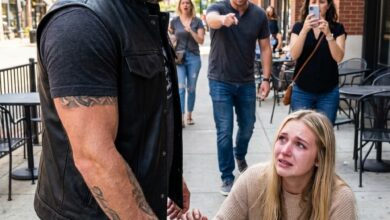
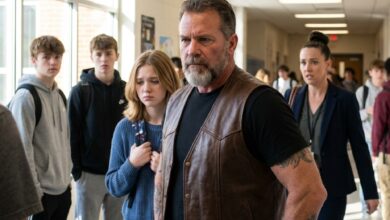
The Biker Who Threw a Bucket of Water in a Woman’s Face — And the Silence That Followed
The bucket hit her face before anyone had time to shout.
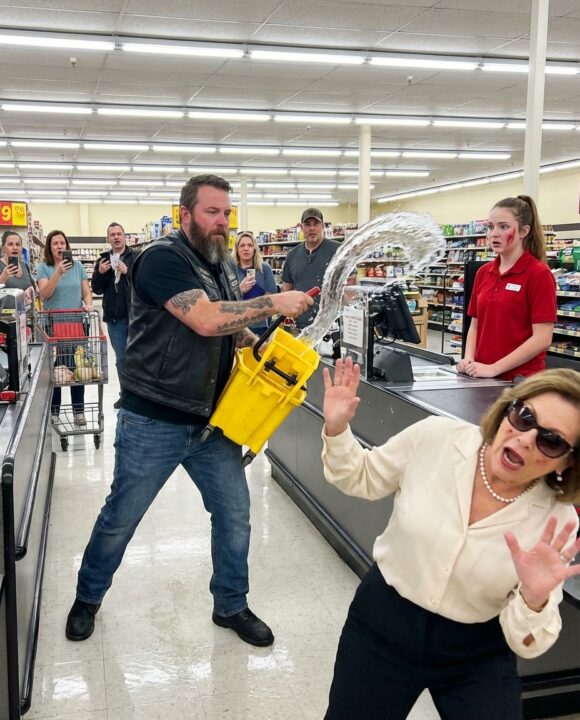
Water exploded across the checkout lane — splashing over designer sunglasses, dripping down a pearl necklace, soaking a silk blouse that probably cost more than the cashier’s monthly rent.
For a split second, the entire grocery store froze.
The woman — mid-40s, manicured nails, high heels clicking against tile — stood stunned in front of register six. Her credit card lay on the counter. The screen blinked red.
DECLINED.
“This is ridiculous,” she had been yelling moments earlier. “Run it again!”
The cashier, barely nineteen, name tag reading “Emily,” kept her voice low. “Ma’am, I’ve tried three times.”
The line behind them grew restless.
“Call your manager.”
“I already did.”
The woman’s voice sharpened. “You think I can’t pay? Is that it?”
Emily swallowed.
The store manager hurried over, flustered, apologetic.
The card failed again.
The woman leaned across the counter.
“Don’t you dare look at me like that.”
Emily hadn’t realized she was even looking.
Then—
A sharp crack.
The sound cut through the fluorescent hum of the store.
The woman’s hand struck the cashier’s cheek.
Gasps.
Someone whispered, “Oh my God.”
Emily staggered back, eyes wide, hand pressed to her face.
No one moved.
Not the manager.
Not the shoppers clutching carts.
Phones lifted, but feet stayed planted.
And then the water hit.
A large yellow mop bucket had tipped forward, sending a cold cascade straight into the woman’s face.
She shrieked.
“What the hell is wrong with you?!”
Standing beside the spill — steady, silent, holding the mop handle — was a man in a sleeveless leather vest.
Gray at his temples. Tattooed forearms. Broad shoulders. Weathered expression.
He didn’t apologize.
He didn’t shout.
He just looked at her.
And the entire store shifted its focus from the slap… to him.
No one knew yet who he was.
Or why he had stepped in.
The outrage came fast.
“You assaulted her!”
“Are you insane?”
The soaked woman sputtered, mascara streaking down her cheeks. “He attacked me!”
The manager rushed forward. “Sir, you cannot—”
The biker leaned the mop against the wall and set the bucket upright with deliberate calm.
“You hit her,” he said evenly.
The woman wiped water from her eyes, fury returning stronger than embarrassment.
“She disrespected me!”
“She ran your card,” the biker replied.
The store felt smaller now. Tighter.
Shoppers stepped back, creating a circle.
From a distance, it looked ugly.
A biker throwing water at a woman in public.
Aggressive.
Uncontrolled.
“Call security,” someone muttered.
“I’m calling the police.”
Emily stood behind the counter, still shaking, hand pressed against her cheek where a red mark bloomed.
The biker glanced at her once.
Just once.
“Did she touch you?” he asked quietly.
Emily hesitated.
The woman snapped, “Don’t answer him!”
The manager stammered, “Sir, you need to leave.”
The biker didn’t move.
Didn’t raise his voice.
But he didn’t step back either.
The soaked woman stepped toward him, finger pointing at his chest.
“You have no right—”
He held up one hand.
Not threatening.
Just firm.
“You don’t get to hit people.”
The crowd murmured.
Some nodded.
Others shook their heads.
“He still threw water.”
“That’s assault too.”
Security finally appeared from the back — two employees in navy polos.
“Sir, we need you to come with us.”
The biker nodded once.
“I’m not running.”
He didn’t resist as they positioned themselves beside him.
The woman grabbed her purse, dripping, still furious.
“You’re going to jail,” she spat.
The biker’s expression didn’t change.
He looked toward the checkout counter again.
At Emily.
Then he reached into his vest.
Gasps.
Security stiffened.
Phones zoomed closer.
But he only pulled out his phone.
Typed something.
Pressed send.
No explanation.
No defense.
Just one short message.
And then he waited.
The tension hung thick between wet tile and fluorescent lights.
And somewhere in the store’s ceiling, a small security camera had captured everything.
But no one had replayed it yet.
The police arrived within minutes.
Two officers stepped through the automatic doors, scanning the scene — puddled floor, shaken cashier, soaked customer.
The woman spoke first.
“He assaulted me with that filthy water!”
The officers turned to the biker.
He stood calmly near the cleaning aisle, hands visible.
“She struck her,” he said simply, nodding toward Emily.
The woman scoffed.
“She’s lying!”
Emily looked down.
The manager shifted uncomfortably.
The first officer asked, “Did she hit you?”
Emily’s voice was barely audible. “Yes.”
The woman snapped, “I barely touched her.”
Phones recorded everything now.
The second officer gestured toward the mop bucket.
“You threw that?”
“Yes.”
The admission hung in the air.
“Why?”
The biker glanced toward the ceiling.
“Check the cameras.”
The officers exchanged a look.
The woman laughed sharply. “He thinks that justifies assault?”
The biker didn’t respond.
He stepped back slightly, giving space.
Not defensive.
Not aggressive.
Just… steady.
From across the store, an older man whispered, “He shouldn’t have done that.”
A young mother replied softly, “She shouldn’t have slapped her.”
The officers asked for footage.
The manager hurried to the back office.
The woman paced, dripping water onto the tile.
“You think you’re some hero?” she hissed at the biker.
He shook his head once.
“No.”
The officers moved to cuff him while waiting.
He didn’t resist.
The metal clicked around his wrists.
Emily’s eyes widened.
“I’m sorry,” she whispered to him.
He looked at her calmly.
“Don’t be.”
Minutes later, the manager returned with a tablet.
The footage began to play.
Regular speed.
The card declined.
The shouting.
The lean across the counter.
The slap.
Clear.
Undeniable.
But the officers didn’t stop there.
“Rewind,” one said.
They slowed it down.
Frame by frame.
The woman’s hand raised high.
Emily flinching before impact.
The manager frozen.
The biker stepping forward — not immediately.
He hesitated.
Watching.
Assessing.
Then reaching for the mop bucket.
Not aiming at her face directly.
A quick upward splash.
Cold water.
Shock.
De-escalation.
The slap echoed louder in replay than the splash.
The store went quiet.
The officers paused the video.
The woman stopped pacing.
And the certainty in her voice evaporated.
But the biker remained cuffed.
Still waiting.
Because the truth was there now.
And it was only a matter of seconds before someone said it out loud.
The store didn’t explode into applause.
It went quiet.
The kind of quiet that feels heavier than shouting.
The tablet screen froze on the exact frame: the woman’s hand mid-air, fingers stretched, Emily’s cheek about to take the blow. In slow motion, the impact looked worse than it had in real time. A sharp arc of entitlement meeting bare skin.
No one defended her now.
No one rushed to comfort her.
The officers replayed the footage again.
Regular speed.
Slap.
Beat.
Splash.
Not rage.
Not chaos.
Interruption.
The first officer uncuffed the biker without ceremony.
The metal clicked open, almost apologetically.
“You escalated,” the officer said, but his tone had softened.
The biker flexed his wrists once. “She escalated first.”
It wasn’t defiance.
It was fact.
The soaked woman stood near the end of the checkout lane, blouse clinging awkwardly to her shoulders. The anger that had filled her voice earlier had drained into something smaller. Colder.
“You’re all ridiculous,” she muttered.
But even that sounded thin.
The store manager cleared his throat.
“Ma’am, we’ll need to ask you to leave.”
Gasps — softer this time.
The woman stared at him.
“Excuse me?”
The manager didn’t raise his voice. “You struck an employee.”
She looked around for backup.
There was none.
The crowd that had once turned on the biker now watched her.
Not shouting.
Just watching.
Power had shifted without anyone announcing it.
At the far end of the aisle, the automatic doors opened again.
A low engine hum drifted in from the parking lot.
Heads turned instinctively.
Three motorcycles idled just outside the entrance. Not roaring. Not revving. Just present.
Two riders removed their helmets and stepped inside, boots deliberate on tile.
Older men. Sleeveless leather vests. Clean posture. Quiet eyes.
They didn’t storm in.
They didn’t shout.
They simply walked to the cleaning aisle and stood a few feet behind the biker.
“Everything good?” one of them asked calmly.
“Yeah,” the biker replied.
Nothing more.
The officers glanced at the additional riders, then at the tablet still paused on the frame of the slap.
The message was clear.
Not intimidation.
Support.
The soaked woman shifted uncomfortably under the fluorescent lights. The spectacle she had created no longer belonged to her.
Emily stood behind the counter, still pale, but steadier now.
The first officer turned to her gently. “Do you want to press charges?”
The question landed differently than the shouting had earlier.
Emily hesitated.
The biker didn’t look at her.
Didn’t signal.
Didn’t nod.
He just stood there.
Waiting.
The woman opened her mouth to protest — but stopped.
For the first time since she had walked into the store, she looked uncertain.
The mop water pooled around her heels.
The engines outside idled steadily.
And the fluorescent hum of the store returned, slowly replacing tension with something else.
Not victory.
Not celebration.
Just equilibrium.
Emily lowered her eyes.
“Yes,” she said softly.
The woman inhaled sharply.
“You can’t be serious.”
The officer didn’t react to her tone.
He stepped toward her with the same procedural calm he had shown the biker earlier.
“Ma’am, please place your hands behind your back.”
The store watched in silence as the cuffs clicked shut around manicured wrists.
No one cheered.
No one filmed now.
Phones lowered.
The spectacle had ended.
The soaked blouse no longer looked expensive.
It looked heavy.
As the officers guided her toward the exit, the biker stepped aside, giving them space.
He didn’t smirk.
Didn’t nod.
Didn’t claim anything.
The woman passed him with wet mascara streaked down her cheeks.
For a split second, their eyes met.
He didn’t say a word.
Outside, the patrol car door shut with a dull thud.
The motorcycles idled a moment longer, then cut off.
The store returned to movement — carts rolling, scanners beeping, conversations restarting in hushed tones.
The manager approached Emily.
“You okay?”
She nodded.
The red mark on her cheek had already begun to fade into something less visible.
The biker walked back toward the mop bucket.
He picked it up, wrung the mop slowly, and began pushing water toward the drain.
One steady stroke at a time.
As if cleaning up was always part of the job.
One of the other riders clapped him lightly on the shoulder.
“You done?”
“Yeah.”
Emily stepped around the counter.
“Thank you,” she said, voice steadier now.
The biker paused.
“You don’t let people hit you,” he replied.
It wasn’t advice.
It wasn’t a lecture.
Just a boundary.
He placed the mop back against the wall and walked toward the exit.
The automatic doors opened.
Sunlight flooded the entrance.
Outside, the afternoon traffic moved like nothing had happened.
Before putting on his helmet, he glanced back through the glass.
Emily had returned to her register.
Head up.
Posture straighter.
The line moved forward again.
He didn’t wave.
He didn’t wait for acknowledgment.
He mounted the bike and started the engine.
The low rumble rolled across the parking lot and faded into traffic.
Inside the store, someone finally whispered, “I thought he was the bad guy.”
Another replied quietly, “Me too.”
The mop water dried.
The red mark faded.
But the memory lingered.
Not of the splash.
Not of the spectacle.
Of the moment a raised hand was interrupted.
And of a man in leather who chose to step forward — not perfectly, not politely — but precisely when someone else wouldn’t.
The fluorescent lights buzzed overhead.
The registers beeped.
And the store carried on.
But something small had shifted.
A reminder that sometimes silence protects the wrong person, and sometimes it takes an unexpected disruption to make the room look again.
He didn’t leave a speech behind.
Just a wet floor.
And a line no one crossed again that day.