The Biker Who Snatched a Letter From a Boy’s Hands at the Cemetery
He grabbed the letter from the boy’s hands in the middle of the cemetery, and the child screamed, “Give it back!” — but no one knew what was written inside.
It was a gray Thursday afternoon in late October at Greenlawn Cemetery outside Columbus, Ohio. Wind moved through rows of small American flags planted near fresh graves. The sky hung low, heavy, like it understood something the people didn’t.
A funeral had ended less than twenty minutes earlier.
Mourners were drifting back to their cars, murmuring polite condolences, avoiding eye contact with the rawest grief. At the center of the thinning crowd stood a ten-year-old boy named Caleb Harper, clutching a folded sheet of paper with trembling fingers.
His mother’s casket had just been lowered into the ground.
Caleb wasn’t crying loudly. That was worse. He stood stiff, jaw tight, eyes glassy — the kind of silence that feels too big for a child.
His father, Mark Harper, stood a few steps away, staring at the fresh dirt. He looked hollow. Thirty-eight years old. Unshaven. Shoulders caved in as if someone had quietly removed his spine.
A woman whispered, “He hasn’t said a word all day.”
Another murmured, “Men don’t handle this well.”
Caleb suddenly stepped forward and pressed the letter against the headstone. “You weren’t supposed to leave,” he choked out.
Mark flinched.
And then—
A motorcycle engine cut sharply through the wind.
Heads turned.
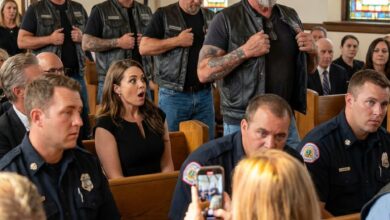
A single Harley rolled slowly along the cemetery path and stopped near the gathering. The rider removed his helmet. Mid-40s. Weathered face. Leather vest. Inked forearms. Eyes that didn’t look curious — they looked focused.
Before anyone could process it, he strode forward.
And in one swift motion, he took the letter from Caleb’s hands.
The boy screamed.
Gasps rippled across the graves.
And for one charged second, it looked like a grown man had just bullied a grieving child in front of his mother’s grave.
No one yet understood why.
“What the hell are you doing?”
The words came from a man in a navy suit near the back — an uncle, maybe. Or just someone who felt morally obligated to intervene.
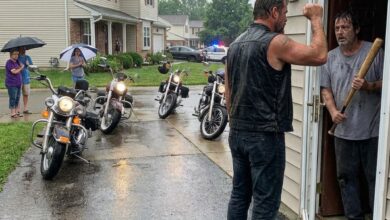
Caleb lunged forward, small hands grabbing at the biker’s leather vest. “Give it back! That’s mine!”
The biker didn’t shove him.
Didn’t yell.
But he didn’t return the letter either.
He stepped back once, creating space, holding the folded paper firmly but not cruelly. His jaw was tight, eyes scanning the page quickly.
Mark finally reacted.
“Sir,” he said hoarsely, voice raw from hours of silence. “That belongs to my son.”
The biker glanced up.
And for a split second, something unreadable crossed his face.
Regret?
Recognition?
No one could tell.
A woman near the front whispered loudly, “This is disgusting.”
Someone else said, “Call cemetery security.”
Phones came out.
The mood shifted from grief to fury in seconds.
A cemetery is sacred ground. You don’t start fights here. You don’t confront children here. You certainly don’t rip paper from their hands at their mother’s grave.
Caleb was sobbing now. “Dad, make him stop!”
Mark stepped forward, fists clenched. “Give it back,” he said again — louder this time.
The biker didn’t move.
He finished scanning the letter.
Folded it once more.
Then looked directly at Mark.
“You wrote this?” he asked quietly.
The question sounded wrong.
Accusing.
Mark stiffened. “That’s none of your business.”
But his voice cracked.
The biker’s eyes didn’t leave him.
Around them, murmurs grew sharper.
“This guy needs to leave.”
“Where did he even come from?”
“He’s intimidating them.”
A cemetery groundskeeper began walking quickly toward the group, radio in hand. In the distance, someone had already dialed local police.
The biker still hadn’t raised his voice.
Hadn’t threatened anyone.
Hadn’t explained himself.
That silence felt deliberate — and dangerous.
Caleb reached for the letter again, but the biker held it just out of reach, not mocking, not aggressive — just firm.
Mark’s breathing grew uneven. His face drained of color.
“You have no right,” Mark said.
The biker took one slow step closer.
Close enough that Mark could see the fine lines around his eyes. The small scar near his jaw. The steady rise and fall of his chest.
“Actually,” the biker said softly, “I do.”
The words detonated.
Gasps. Shouts. A woman screamed, “Who do you think you are?”
The groundskeeper reached them. “Sir, I’m going to have to ask you to leave the premises.”
The biker didn’t argue.
He didn’t apologize.
He simply reached into his vest pocket.
The crowd tensed instantly.
Someone shouted, “Don’t you dare!”
Mark instinctively stepped in front of Caleb.
The wind lifted dry leaves across the fresh grave.
And in that charged moment — grief, anger, suspicion tangled together — it looked exactly like a volatile confrontation about to explode in the middle of sacred ground.
No one yet realized that the real danger had nothing to do with the biker.
And everything to do with what was written in that letter.
The groundskeeper’s voice cut through the air. “Sir, step away. Now.”
Two cemetery staff members moved in closer. A patrol car siren wailed faintly somewhere beyond the gates. The tension that had started as grief was now sharpening into confrontation.
Caleb clung to his father’s leg, crying openly. “Dad, tell him to give it back!”
Mark’s hands shook. Not with rage.
With exposure.
The biker still held the letter.
He didn’t crush it.
Didn’t wave it around.
He simply looked at Mark with a steadiness that felt like a mirror being held up.
“You were going to leave him,” the biker said quietly.
The accusation landed like a slap.
Mark’s face drained completely. “You don’t know what you’re talking about.”
The crowd exploded.
“How dare you!”
“Get him out of here!”
“Call the police!”
Phones were raised higher now. Someone stepped between the biker and the Harpers, as if shielding them from a physical threat. The cemetery felt smaller by the second — rows of headstones watching silently while the living unraveled.
The biker didn’t back away.
But he didn’t advance either.
He unfolded the letter just enough for Mark to see the handwriting.
Caleb, I’m sorry. I can’t carry this pain anymore…
Mark’s breathing turned shallow.
“Stop,” he whispered.
No one else caught it.
Only the biker did.
The groundskeeper reached for the biker’s arm. “Sir, that’s enough.”
The biker gently stepped aside, avoiding contact. “You might want to read the rest,” he said — not to the crowd.
To Mark.
Officer Daniels arrived then, walking briskly through the cemetery path. “What’s going on?”
Voices overlapped. Accusations. Outrage. A grown man humiliating a grieving family. A biker causing a scene.
Officer Daniels approached the biker first. “Sir, I’m going to need you to hand that over.”
The biker’s jaw tightened slightly.
He handed the letter to the officer without resistance.
The officer skimmed it.
His expression changed.
Subtle.
But real.
He looked at Mark.
“Sir… did you write this?”
Mark couldn’t answer.
Caleb stared up at his father, confusion mixing with fear.
The wind shifted, lifting fallen leaves over the fresh mound of earth where Sarah Harper lay buried. The headstone wasn’t even installed yet. Just a temporary marker.
Grief has weight. But guilt has gravity.
Mark suddenly turned as if to walk away — toward the parking lot, toward the trees beyond the cemetery fence.
The biker saw it first.
He pulled out his phone.
One quick message.
No explanation.
No raised voice.
Just three words spoken low enough that only Mark heard them:
“Don’t do this.”
Mark froze.
Officer Daniels watched carefully now, the dynamic no longer clear-cut. The crowd’s anger had begun to fray into uncertainty.
“What’s in that letter?” someone demanded.
No one answered.
In the distance, another sound began to grow.
Low.
Rhythmic.
More engines.
Not loud.
Not aggressive.
But unmistakable.
And as that sound rolled closer through the cemetery gates, the space between outrage and understanding became a thin line stretched to breaking.
PART 4 – THE TURN (≈600 words)
The engines came first.
Not revving.
Not roaring.
Just steady.
Measured.
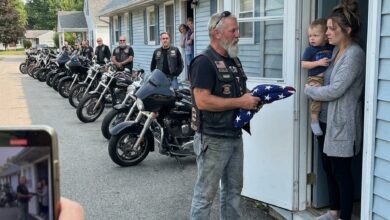
Three motorcycles rolled slowly through the cemetery entrance and parked near the path. Then two more. Then four.
Boots touched gravel in quiet succession.
The crowd shifted uneasily. “Oh great,” someone muttered. “Now there’s more of them.”
But the newcomers didn’t spread out.
They didn’t posture.
They removed their helmets and stood in a loose line behind the first biker.
Disciplined.
Silent.
The lead newcomer — older, early 60s, white beard trimmed close, leather vest worn and faded — walked forward with slow, deliberate steps.
Officer Daniels straightened. “Sir, this is a funeral site.”
“We know,” the older biker replied calmly.
He looked at Mark.
Then at Caleb.
Then at the fresh grave.
Recognition passed across his face.
“You came,” he said quietly to the first biker.
The first biker gave a single nod.
The older man turned to Officer Daniels. “We’re not here to cause trouble.”
“That’s not how it looks,” someone from the crowd shot back.
The older biker ignored the comment. He faced Mark directly.
“You wrote the letter,” he said.
Mark’s shoulders sagged.
Caleb looked between them, confused. “Dad… what letter?”
Silence pressed heavy over the cemetery.
The older biker reached into his vest and pulled out something small — a folded photograph.
He handed it to Caleb.
The boy opened it slowly.
It was a picture of his father, smiling beside a motorcycle, standing next to the very biker who had taken the letter.
Caleb blinked. “Dad?”
Mark’s voice cracked open for the first time that day.
“It was before you were born,” he said hoarsely.
The older biker stepped forward just enough to be heard by Mark — not the crowd.
“Your wife called us last month,” he said quietly. “She was worried.”
Mark’s head snapped up.
“We told her we’d check on you,” the older biker continued. “She knew you were carrying more than you let on.”
Gasps rippled faintly through the onlookers.
The narrative was shifting.
Not dramatically.
But undeniably.
Officer Daniels lowered his radio.
The first biker finally spoke again, voice steady, not loud.
“He found the letter,” he said, nodding toward Caleb.
Caleb looked down at his shoes.
“I didn’t want him to leave me too,” the boy whispered.
The words cut deeper than any accusation.
The crowd went quiet.
Not because they were convinced.
But because something human had stepped into the center of the scene.
No threats.
No violence.
Just truth.
The older biker looked at Mark.
“You don’t get to check out,” he said firmly — not angrily. “Not on him.”
Mark’s knees buckled slightly.
The cemetery felt different now.
Less like a confrontation.
More like a reckoning.
The power dynamic had shifted without force.
And the men who had arrived looking like outsiders now stood between a broken father and a decision that could not be undone.
But no one yet knew how close that decision had been.
Or what would happen next.
For a long moment, no one spoke.
The wind moved through the cemetery trees, brushing over headstones and lifting the corners of fresh funeral programs that had fallen to the ground. The crowd that had come ready to defend a grieving family now stood in an uncomfortable, shifting quiet.
Mark looked at his son.
Really looked at him.
Caleb’s small hand still held the photograph. His eyes were red, not just from losing his mother — but from something else. Fear. The kind children feel when they sense a parent slipping away.
“You found it?” Mark asked softly.
Caleb nodded. “In your desk. I thought… I thought you were leaving me too.”
The words didn’t echo.
They sank.
Mark’s shoulders, already bent from grief, seemed to fold in on themselves. He stepped back toward the fresh mound of earth where Sarah Harper rested beneath new soil.
“I didn’t know how to breathe without her,” he said, barely audible. “Every room feels empty.”
The first biker — the one who had taken the letter — didn’t step closer. He didn’t offer a speech. He didn’t even remove his gloves.
He just stood there.
Steady.
Present.
The older biker spoke instead, voice calm and firm. “You don’t get to make permanent decisions on temporary pain.”
It wasn’t shouted.
It wasn’t dramatic.
It landed like truth does — heavy, simple, unavoidable.
Officer Daniels shifted his stance, no longer guarding against a disturbance but witnessing something fragile and real. The groundskeeper lowered his radio. The anger that had flared earlier now felt misplaced.
The villain everyone thought they saw had quietly stepped aside.
Mark dropped to one knee in front of Caleb. “I’m sorry,” he whispered, and it was the first honest sound he had made all day. “I wasn’t thinking straight.”
Caleb threw his arms around his father’s neck.
The cemetery, moments earlier a battleground of accusation, now held only the soft sound of a child crying into his father’s shoulder.
The first biker finally stepped forward.
He held out the letter.
Not to Caleb.
To Mark.
“You keep it,” he said.
Mark hesitated before taking it. His hands shook.
“You could’ve just called someone,” Mark muttered.
The biker gave a small nod. “We did.”
In the distance, a plain white pickup truck pulled into the lot. A middle-aged woman stepped out — grief counselor badge clipped to her jacket. She walked quietly toward them, guided by a subtle wave from the older biker.
No one had noticed the text message earlier.
No one had known who it was for.
The biker didn’t claim credit.
Didn’t explain further.
He simply adjusted his helmet and took a step back toward his motorcycle.
Mark looked up at him. “Why?” he asked. “Why show up?”
The biker paused.
“Your wife came to one of our open meetings last month,” he said. “Said you used to ride. Said you’d been drowning since the diagnosis.”
Mark’s breath caught.
“She asked us to keep an eye on you,” the older biker added. “Just in case.”
Love had reached further than despair.
The engines started one by one — not loud, not theatrical. Just mechanical necessity.
The crowd parted quietly.
No applause.
No cheering.
Only understanding.
As the motorcycles rolled slowly toward the cemetery gates, Caleb watched them go. He lifted the photograph slightly, almost like a salute.
The first biker glanced back once.
Not heroic.
Not triumphant.
Just making sure the boy was still standing.
The wind carried the sound of engines away until it became part of the distance.
At the gravesite, father and son stood together.
The letter remained in Mark’s hand.
Unread again.
Unsent.
Sometimes the people who look the hardest to trust are the ones who refuse to let you fall when you’re too tired to fight.
If you want to read more true-to-life stories about bikers and quiet courage, follow our page.