The Biker Who Refused to Remove His Helmet — As the Judge Prepared to Rule
“Remove your helmet. This is a court of law.”
The judge’s voice was calm. Measured. Final.
The biker did not move.
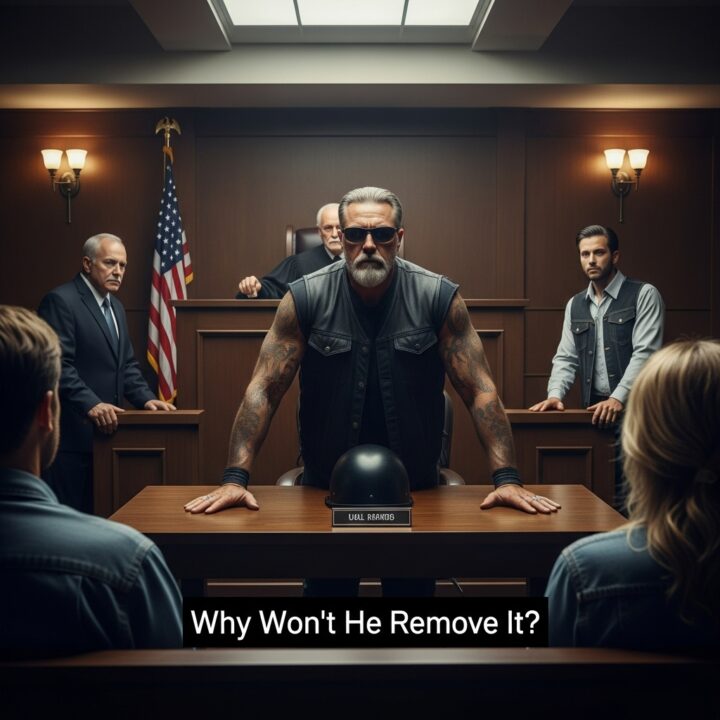
He stood at the defense table, hands resting flat on the polished wood, helmet still on his head. Black. Scuffed. Scratched by years of road and weather. The kind of helmet that had seen more miles than words.
The courtroom stilled.
A bailiff shifted his weight. A woman in the gallery whispered sharply. Someone behind her sucked in a breath.
The judge waited a moment. Then repeated himself, slower this time. “You will remove your helmet. Now.”
The biker’s shoulders rose and fell once.
“I can’t,” he said.
Two words. Quiet. Unemotional.
The sound landed like a dropped gavel.
To the people watching, it looked like open defiance. Disrespect. A deliberate challenge to authority in a room where authority was everything.
The judge’s eyes hardened.
The prosecutor straightened in his chair.
The bailiff took one step closer.
The biker did not flinch.
Helmet still on. Chin forward. Silent again.
In that frozen moment—before anger turned into consequence—the courtroom held its breath.
Murmurs rippled through the benches.
“Figures,” someone whispered.
“They’re all the same,” another muttered.
Leather vest. Heavy boots. The faint smell of oil and road dust clinging to him. In a town that prized clean lines and quiet order, the biker looked like a disruption given human shape.
The judge leaned forward. “You understand that refusing a lawful order may result in contempt of court.”
The biker nodded once.
“I understand,” he said.
No explanation followed.
That silence unsettled people more than shouting ever could. It invited judgment. Filled the gaps with assumptions.
The prosecutor seized the opening. “Your Honor, this behavior speaks volumes about the defendant’s attitude toward the law.”
Heads nodded in agreement.
The biker’s attorney shifted uncomfortably but said nothing. He glanced at his client, searching for some sign—any sign—that this was part of a plan.
There was none.
The biker stood alone, helmeted, unmoving.
The judge’s voice sharpened. “This court will not be mocked.”
Still, the biker did not respond.
To everyone watching, he looked exactly like what they expected him to be: stubborn, reckless, and convinced the rules didn’t apply to him.
And the room grew tense with the certainty that punishment was coming.
The bailiff stepped closer now.
“Sir,” he said quietly, hand hovering near the biker’s shoulder, “this is your last warning.”
The biker inhaled slowly. Deep. Controlled.
He reached into his jacket.
The movement was small—but it changed everything.
Several people stiffened.
The bailiff’s posture shifted.
The judge’s hand paused above the bench.
The biker withdrew his phone. Old. Cracked screen. He tapped out a brief message, eyes never leaving the floor. Then he slid the phone back into his pocket.
“I won’t cause trouble,” he said. “I’ll stand right here.”
The judge stared at him. “That is not compliance.”
The biker lifted his head slightly. The visor of the helmet reflected the courtroom lights, hiding his eyes.
“I know,” he said.
The prosecutor scoffed softly. The gallery buzzed with restrained outrage.
The judge drew a breath, clearly preparing to issue a ruling that would end the matter decisively.
No one in the room knew who the biker had contacted.
No one knew why.
They only knew something was about to break.
The sound came first.
Not inside the courtroom—but outside the building.
Low. Distant. A vibration felt more than heard.
Engines.
The bailiff glanced toward the door. So did the judge, frowning.
The rumble grew steadier. Closer. Then stopped.
Moments later, the courtroom doors opened.
Not violently. Not abruptly.
They opened, and several men stepped inside—quietly, respectfully.
Bikers.
Older men, mostly. Gray at the temples. Jackets removed. Helmets carried at their sides. They filled the back row without a word, sitting straight, hands folded, eyes forward.
No disorder.
No intimidation.
Just presence.
The judge studied them, then returned his gaze to the man at the defense table. “Explain,” he said.
The biker finally moved.
Slowly, carefully, he reached up and removed his helmet.
The reason became immediately clear.
A deep bandage wrapped around his head. Fresh. Clean. Medical. One side of his face was swollen. Bruised.
The courtroom fell silent.
“I was instructed not to remove it,” the biker said quietly. “Not until the stitches set.”
He paused.
“And I didn’t want the jury seeing this,” he added. “Didn’t want sympathy. Just fairness.”
One of the bikers in the back stood briefly. “He showed up anyway,” the man said. “Didn’t ask for a delay.”
The judge leaned back, studying the defendant anew.
Understanding began to replace irritation.
The truth unfolded without drama.
The biker had been injured pulling a stranger from a roadside wreck—the same incident that had led to the charges now before the court. A misunderstanding. A rushed report. An assumption made in the chaos.
Witness statements were revisited. Evidence reexamined.
The judge listened. Carefully.
When he finally spoke, his voice was quieter than before. “This court recognizes restraint,” he said. “And respect—for the process.”
He dismissed the charge.
No applause followed.
No celebration.
The biker nodded once. Put his helmet back on.
As he turned to leave, the judge added, “Next time, explain sooner.”
The biker stopped. Looked back. “Yes, sir,” he said.
Outside, the bikers waited. Engines silent. No revving. No show.
They rode away in small groups, disappearing into the afternoon.
Inside the courthouse, people lingered.
Some avoided eye contact. Others sat with an unfamiliar discomfort—the kind that comes from realizing how quickly judgment forms, and how rarely it waits for truth.
And the image stayed with them:
A man standing alone before the law, choosing silence over advantage, dignity over convenience.
Sometimes justice isn’t loud.
Sometimes it wears a helmet, waits its turn, and trusts that the truth will speak when the time is right.