The Biker Slapped the Young Man — And What Happened Next Left the Crowd Speechless
The slap echoed across the sidewalk before anyone realized the biker wasn’t the villain.
It happened outside a discount grocery store in Dayton, Ohio. Late afternoon. Parking lot half full. People pushing carts, checking phones, pretending not to hear things that felt inconvenient.
Maria Delgado was kneeling on the pavement when the crowd finally froze.
She couldn’t have been more than thirty-five. Thin jacket. Worn sneakers. A small paper bag of groceries spilled beside her — rice, canned beans, a carton of eggs cracked open against the asphalt.
Her son, maybe six years old, stood behind her, wide-eyed, clutching the strap of her purse.
“I told you I don’t have it,” Maria had said moments earlier.
The young man in front of her didn’t look older than twenty-two. Hoodie pulled tight. Jaw clenched with impatience that didn’t belong to hunger — it belonged to pride.
“You lying,” he snapped.
“I swear—”
He shoved her.
Not hard enough to look dramatic.
Hard enough to knock her balance.
She fell sideways. Hands scraping concrete.
The eggs burst.
Someone gasped.
Someone else said, “Hey…”
But no one moved.
The young man stepped closer, hand out again. “Just give me something.”
Maria’s son tried to pull her up. She whispered, “It’s okay,” even though it wasn’t.
And then it happened.
A figure stepped between them.
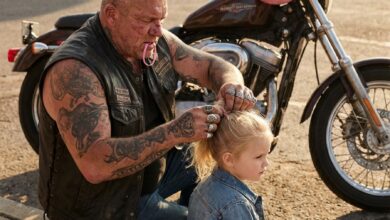
Leather vest. Faded jeans. Heavy boots planted firmly on the pavement.
Mid-50s. Broad shoulders. Short gray beard. Tattoos running down both arms like faded history.
He didn’t shout.
He didn’t ask questions.
He simply raised his hand—
And slapped the young man across the face.
The sound cracked sharp in the air.
The parking lot went silent.
For a split second, everyone saw the same thing:
A biker hitting a kid.
And they all decided who the bad guy was.

“What the hell is wrong with you?” someone yelled.
Phones came out instantly.
“Call the police!”
The young man staggered back, stunned more by humiliation than pain.
“You hit me!” he shouted, voice cracking.
The biker didn’t answer.
He didn’t posture.
He didn’t threaten.
He simply stood there, body positioned between Maria and the young man like a wall that wasn’t asking permission to exist.
The young man’s hand flew to his cheek.
“You can’t just assault me!”
The biker’s voice stayed even.
“You pushed her.”
“That’s none of your business!”
The biker glanced down briefly at Maria.
She was still on her knees.
Groceries scattered.
Her son crying quietly now.
“It is now,” he said.
But the crowd didn’t see that part.
They saw leather.
Tattoos.
A slap.
A man twice the kid’s size.
It looked wrong.
It looked excessive.
It looked like escalation.
Two store employees rushed outside.
“What’s happening?”
“He just attacked him!”
Maria tried to speak. “He—”
But her voice drowned under louder ones.
The young man found his anger again.
“You think you’re tough?” he snapped.
The biker didn’t move.
Didn’t lift his hands.
Just watched.
The tension tightened.
Security stepped in.
“Sir, you need to step back.”
The biker didn’t.
Not yet.
He reached into his pocket.
The movement made three people flinch.
The young man stepped back instinctively.
“See? He’s armed!” someone whispered.
The biker pulled out—
A phone.
Tapped once.
Turned the screen toward security.
A short clip.
Helmet camera footage from moments earlier.
Clear.
The shove.
The fall.
The child’s cry.
Security’s expression changed.
The young man’s bravado flickered.
“You were recording?” he asked, voice smaller now.
The biker slid the phone back into his pocket.
He still hadn’t raised his voice.
But the atmosphere had shifted from outrage to something else.
Uneasy.
Because the story wasn’t lining up the way the crowd expected.
And that’s when the young man did something that made the situation worse.
He lunged forward.
Not at Maria.
At the biker.
The lunge wasn’t skilled.
It was reckless.
Anger outrunning logic.
The biker didn’t swing.
Didn’t retaliate with fists.
He stepped aside.
One precise movement.
The young man stumbled forward and nearly fell.
Humiliation flooded his face.
Now it looked like a fight was about to break out.
Security moved closer.
Maria struggled to stand.
Her son clung tighter.
The crowd edged in but stayed just far enough away to avoid involvement.
“You think you can embarrass me?” the young man hissed.
The biker’s eyes stayed steady.
“You embarrassed yourself.”
The words landed heavy.
That could’ve been the end.
But pride is louder than pain.
“You don’t know me,” the young man snapped.
“You’re right,” the biker said.
Then, quietly—
“But I know what I saw.”
The young man’s fists clenched.
“Back up,” security ordered.
The biker didn’t move.
He reached into his pocket again.
Slower this time.
Intentional.
He typed something.
Sent it.
The young man laughed nervously. “Calling your gang?”
The biker didn’t answer.
He looked at Maria instead.
“You okay?”
She nodded faintly, though tears streaked her cheeks.
The boy wiped his eyes with the sleeve of his shirt.
Sirens echoed faintly in the distance.
Police were coming.
The crowd whispered.
“Great. Now this is turning into a scene.”
The biker finally took one small step back.
Not surrender.
Space.
Then he said something so quiet only the young man heard it.
“Stay.”
The young man scoffed.
“Or what?”
The biker didn’t respond.
But somewhere down the street—
Engines began to hum.
Low.
Disciplined.
Approaching.
And suddenly, the parking lot didn’t feel the same anymore.
The engines didn’t roar.
They arrived like a decision already made.
Three motorcycles turned into the lot first. Then two more behind them. Not speeding. Not weaving. Just gliding in with the kind of control that makes noise unnecessary.
They parked in a straight line beside the first bike.
Helmets came off.
Men in their late 40s and 50s. One woman in her early 40s. Sleeveless leather vests. Faded denim. Arms marked with ink that had long ago stopped trying to impress anyone.
They didn’t surround the young man.
They didn’t shout.
They simply walked forward and stopped a few feet behind the first biker.
Even spacing.
Hands relaxed.
Eyes steady.
The crowd that had been loud minutes ago grew quiet.
The police cruiser rolled in next, lights flashing but siren cut. Two officers stepped out, scanning the scene.
“What’s going on?” one asked sharply.
Voices overlapped.
“He hit him!”
“That kid shoved her!”
“They’re ganging up!”
Maria tried to speak, but her voice trembled too much.
The first biker stepped aside slightly so the officers could see her clearly — still shaken, still brushing dust off her jacket, her son clinging to her waist.
He didn’t argue.
He didn’t explain himself first.
He reached into his pocket and handed one officer his phone.
“Watch it,” he said.
The officer frowned but took it.
The clip played.
Clear footage from a helmet cam mounted near the handlebars.
The shove.
Maria falling.
The eggs cracking.
The boy’s cry.
Then the slap.
A single, sharp strike.
Nothing more.
The officer’s expression shifted.
He looked at the young man. “Is this accurate?”
The young man swallowed.
“He— he didn’t have to hit me.”
The officer glanced at the biker. “Why did you?”
The biker didn’t flinch.
“He needed to stop.”
It wasn’t pride.
It wasn’t anger.
It was fact.
The second officer approached Maria gently. “Ma’am, do you want to press charges?”
She hesitated.
Her son looked up at her.
The young man stared at the ground now, bravado draining out like air from a tire.
The bikers remained still behind their friend — not crowding, not intimidating — but unmistakably present.
The first officer handed the phone back.
“You intervened to stop an assault,” he said carefully.
The young man tried once more. “He can’t just—”
The officer cut him off. “You shoved her.”
Silence.
The crowd, once so certain of who the villain was, no longer looked comfortable.
One of the bikers quietly stepped forward and picked up the spilled groceries from the pavement.
Another crouched to gather the broken egg carton.
No one made a show of it.
No applause.
Just action.
The officers separated the young man from the scene, speaking firmly but without escalation.
The parking lot air changed.
Not electric.
Settled.
And when the sirens stopped flashing and the cruiser door closed, the power had already shifted.
Maria sat on the curb now, breathing steadier.
The first biker crouched a few feet away — not too close.
“Are you hurt?” he asked.
She shook her head.
“Just shaken.”
Her son looked at the biker cautiously.
“You’re not mad?” the boy asked.
The biker’s mouth twitched slightly — almost a smile.
“Not at you.”
The boy nodded.
One of the other bikers handed Maria a fresh carton of eggs from inside the store. Another brought out a new bag of rice.
No speeches.
No lectures about standing up for yourself.
Just replacement.
The young man sat in the back of the patrol car, staring at his hands.
Not cuffed aggressively.
Not humiliated.
Just confronted.
The crowd began to disperse.
Phones lowered.
Whispers softened.
A woman who had shouted earlier avoided eye contact as she walked past the biker.
“Thought he was the problem,” someone murmured quietly.
The first biker stood.
He adjusted his gloves.
Maria stepped closer. “Thank you,” she said softly.
He nodded once.
“That’s enough.”
No handshake.
No dramatic farewell.
Just a man who had stepped in because someone needed to.
As the motorcycles started again — low, disciplined — the sound felt different now.
Not threatening.
Grounded.
Before mounting his bike, the biker looked at the young man through the patrol car window.
Not with hatred.
Not with triumph.
Just steady.
A reminder.
Then he put his helmet on.
The engines rolled out of the lot one by one.
The parking lot returned to ordinary noise — carts rolling, car doors slamming, traffic moving again.
But something lingered.
Maria stood a little straighter.
Her son held her hand tighter.
And long after the bikes disappeared down the road, the echo of that slap remained — not as violence, but as a line drawn in the asphalt.
Sometimes courage doesn’t look polite.
Sometimes it looks misunderstood for a few seconds.
And sometimes, it takes one sharp sound to stop something worse from happening.