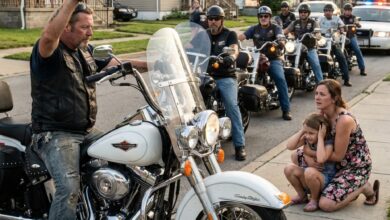
The Bank Manager Threw a Biker Out — But When the Vault Door Opened, the Room Froze
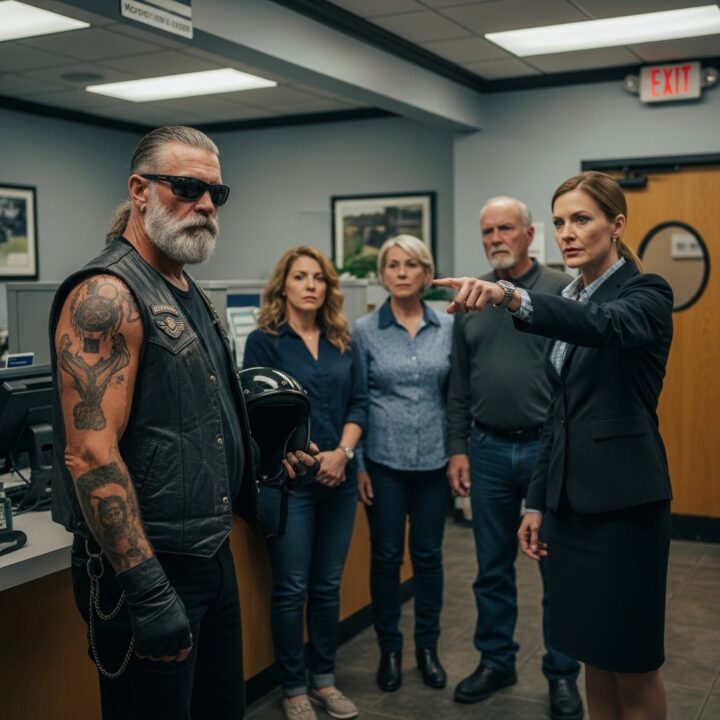
“You don’t belong in here.” The words were sharp, loud enough to cut through the quiet hum of the bank lobby.
The biker stood at the counter, one gloved hand resting on the worn leather strap of his helmet. He hadn’t raised his voice. He hadn’t argued. He had simply asked a question.
Now every eye in the room was on him.
The bank manager—pressed suit, tight smile, practiced authority—pointed toward the glass doors. Her finger didn’t shake.
“This is a financial institution,” she said. “Not a clubhouse. You need to leave.”
The room seemed to hold its breath.
Customers froze mid-step. Pens stopped scratching paper. A teller lowered her eyes, pretending to check a screen that hadn’t changed.
The biker didn’t move.
Sleeveless black shirt. Faded tattoos climbing his arms. Gray threaded through his beard. Boots that had clearly walked more miles than this polished floor had ever seen.
From the outside, it looked wrong.
It looked dangerous.
It looked like trouble waiting to happen.
And the silence afterward felt heavier than the insult itself.
People shifted away from him.
A man near the chairs tightened his grip on his briefcase. An older woman whispered something to her husband, eyes flicking nervously toward the biker’s hands.
The manager straightened her shoulders.
“We can’t help you,” she said, her tone colder now. “And if you don’t leave, I’ll have security escort you out.”
The word security landed like a warning shot.
The biker finally looked up. His eyes were calm. Not defiant. Not angry.
Just tired.
“I’m here to access something,” he said quietly. “It’s already arranged.”
That only made things worse.
Arranged by whom?
For what?
In a place built on trust and numbers, he didn’t fit either.
The teller behind the counter avoided his gaze. Another employee subtly reached under the desk, fingers hovering near a silent alarm.
No one asked for details.
They had already decided who he was.
The manager exhaled sharply.
“Sir, I’m asking you one last time to leave.”
The biker glanced around the lobby once, slowly, taking in the faces. Fear. Discomfort. Judgment. A few flashes of something else—uncertainty, maybe even shame.
He reached into his vest.
Several people stiffened.
But instead of anything threatening, he pulled out his phone, typed a brief message, and slipped it back where it came from.
“I’ll wait,” he said.
“That won’t be necessary,” the manager snapped. “You’re done here.”
She nodded toward the guard near the entrance.
The biker didn’t argue. He didn’t plead.
He simply stayed where he was, as if rooted to the floor.
For a moment, it felt like something might break. Like one wrong move could shatter the fragile calm of the room.
Then a soft mechanical sound echoed from behind the counter.
A low, unfamiliar click.
The manager frowned and turned halfway toward the back offices.
“No one authorized—” she began.
And then the vault door started to open.
The sound was unmistakable.
Heavy steel unlocking. Slow. Deliberate.
The room fell completely silent.
Employees stared at the vault as if it had moved on its own. The manager’s face drained of color.
Outside, through the tall glass windows, a distant rumble rolled down the street.
Motorcycles.
Not loud. Not aggressive.
Controlled.
One by one, bikes pulled up along the curb, parking with quiet precision. Men and women dismounted—mostly in their 50s and 60s. Leather vests. Short sleeves. Calm faces.
They didn’t enter the bank.
They didn’t need to.
The presence alone shifted the air.
The biker in the lobby removed his gloves slowly, then his helmet. He set it on the counter with care, as if respecting the space despite how he’d been treated.
The vault door was fully open now.
Inside, several sealed deposit boxes sat neatly arranged.
The manager swallowed hard.
“What… is this?” she asked, her voice barely steady.
The biker finally spoke again.
“My brother’s box,” he said. “I’m the executor.”
The truth came out in fragments.
A long-term client.
A decorated veteran.
A man who had quietly invested for decades, trusting this small-town bank with everything he’d built.
He had passed away two months earlier.
The biker had been listed in the documents from the beginning. The paperwork was flawless. The signatures undeniable.
The manager’s authority collapsed under the weight of facts she had never bothered to check.
Inside the box were letters. Trust documents. A modest fortune earmarked for scholarships, medical bills, and community funds—most of it designated for people who would never sit in this lobby.
People like the biker.
No one spoke for a long time.
The guard stepped back. The teller wiped her eyes discreetly. Customers stared at the floor, suddenly aware of how quickly they had chosen sides.
The biker took the box, nodded once to the staff, and turned toward the door.
He didn’t gloat.
Didn’t lecture.
Didn’t demand an apology.
Outside, the riders waited, engines silent.
As he stepped back onto the sidewalk, the manager called out softly.
“I’m sorry.”
He paused, just long enough to be heard.
“Most people are,” he said. “After.”
Then he put on his helmet and rode away with the others, leaving behind a room that would never quite feel the same.
Because some lessons don’t come with interest rates or signatures.
They come when assumptions crack open—
and reveal what was inside all along.