Part 2: A Waitress Dumped an Entire Pot of Coffee Over a Biker’s Leather Cut in a West Virginia Diner — Then the Room Saw the Flame Crawling Up His Back
Part 2 — The Man Who Returned for a Second Cup
The first newspaper story about Black Ridge Tunnel described Flint as a reckless biker who had entered a closed lane and complicated a rescue.
My father kept that clipping in his toolbox.
He had circled the word reckless so deeply the pen tore the paper.
I found it after his death, along with photographs, medical reports, and an unsigned statement that began, The motorcyclist did not cause the collision.
I never understood why he had not submitted it.
Flint did.
He explained three days after the diner fire, when the hospital released him with fresh dressings across his back and instructions not to ride until the gasoline burns healed. He arrived at the Bluebird in an old pickup driven by Abraham “Brick” Lawson, president of the Mercy Road Riders.
Flint’s burned cut lay inside a cardboard box between them.
He carried the box into Booth Seven and asked for black coffee.
“One cup?” I said.
“Two.”
The second cup went across from him.
Again.
Flint had been thirty-five when the Black Ridge fire happened. He and his younger brother Owen worked demolition during the week and rode with the Iron Vale Brotherhood on weekends. Their club had a rough reputation then, deserved in parts and exaggerated in others.
Flint did not polish his past.
He had served eighteen months for breaking a man’s jaw during a bar fight. He drank until mornings disappeared. He mistook loyalty for agreeing with whoever stood closest.
Owen was different.
He repaired generators, remembered birthdays, and carried dog biscuits in his saddlebag because strays approached him at gas stations. He had a six-year-old daughter named Leah who believed every motorcycle sounded like her father coming home.
On August 19, the brothers were riding through Black Ridge Tunnel behind a fuel tanker when a support bracket beneath the tanker failed. A metal valve struck the pavement. Gasoline sprayed across both lanes.
The driver lost control.
The trailer folded sideways.
Vehicles collided behind it.
Flint remembered the sound before the flames: tires screaming, steel collapsing, Owen shouting his name through the V-twin thunder.
Then the tunnel became orange.
Flint’s motorcycle slid beneath a pickup. Owen remained upright long enough to drag a teenage passenger from a sedan before fire crossed the pavement.
My father’s volunteer unit entered from the southern portal.
Jack found Flint unconscious beneath the pickup and pulled him clear by his leather cut. That part of the official account was true. What happened next was omitted.
Flint regained consciousness outside the tunnel.
He asked for Owen.
Nobody answered.
Then he heard my father’s alarm sounding inside the smoke.
Every firefighter carried a motion alarm. If the wearer stopped moving, it screamed.
Jack’s was screaming.
Flint went back.
He had no mask, no helmet, and no protective coat. He wrapped a wet moving blanket around his head and followed the alarm through smoke thick enough to erase his hands.
He found my father pinned beneath a collapsed equipment rack.
Owen was ten feet away.
Still conscious.
Flint reached his brother first. Owen looked toward Jack and said, “Get the fireman. He’s got kids.”
Flint argued.
Owen used the last strength in his body to shove him away.
“Go.”
One word.
Flint lifted my father.
He carried Jack toward the tunnel entrance while gasoline burned across the back of his leather cut. The fire destroyed nerve endings along his right side. Smoke and chemical exposure permanently damaged most of his sense of smell.
Another rescue crew reached Owen.
Too late.
The town credited Jack with saving Flint because Jack had, at the beginning. The department omitted Flint’s return because civilians were prohibited from reentering the tunnel and because the fire chief feared the revelation would encourage copycat rescues.
My father accepted the medal.
Flint disappeared.
“I thought you blamed him,” I said.
Flint rotated his cup.
“For living?”
“For accepting credit.”
“He had two broken ribs, a crushed ankle, and smoke in his head. By the time he could argue, the department had built a parade around him.”
“Why didn’t you tell anyone?”
“Owen told me to get him out. Didn’t tell me to make a speech.”
After the tunnel fire, Flint spent four months in a burn unit. Owen’s club raised money for treatment, but Flint refused most of it and sold his motorcycle instead.
He stopped drinking.
That was not a clean transformation. He relapsed twice, slept beneath a bridge once, and came close to prison again after attacking a reporter who called Owen a gang member killed during “biker misconduct.”
Brick was the man who restrained him.
Then Brick gave him a wrench and a job.
Mercy Road began as six men repairing motorcycles in a cinder-block garage. They kept the brotherhood but abandoned the bar fights, intimidation, and territorial nonsense that had made their old club dangerous.
Their rule was simple.
If you wore the patch, your hands had to repair more than they damaged.
Flint became their road captain. He escorted funeral processions, delivered generators after storms, and inspected every motorcycle before charity rides because he no longer trusted machines—or people—to announce danger in time.
That made the fuel leak harder to understand.
Flint checked his Harley every morning.
But Tyler had serviced it late Monday night after Flint heard a faint vibration near the tank. The younger mechanic replaced a clamp, ran the engine, wiped the line, and declared it safe.
Flint trusted him.
Tyler was Owen’s son in everything but blood—the child of Owen’s closest friend, Caleb Cade, who died from an overdose when Tyler was twelve. Flint had promised Caleb’s widow that the boy would always have a place in the garage.
Tyler grew up sweeping Mercy Road’s floor.
He also grew up believing mistakes were another name for abandonment.
When the second cut appeared in Flint’s fuel line, the older members suspected Tyler. He had access. He had installed the clamp. He had once been caught selling shop parts to pay gambling debts.
Brick wanted his patch removed until the investigation ended.
Flint refused.
“Evidence first,” he said.
“What if the evidence is the kid?”
“Then evidence first.”
The repaired cut inside the cardboard box held another clue. Its inner lining had been replaced with a section of yellow fire-resistant fabric.
My father’s name was written across it.
JACK NOLAN.
Flint had been wearing part of my father’s turnout coat when I soaked him with coffee.
“You cut up his coat?” I asked.
“He did.”
“When?”
“The year before he died.”
That was when Flint told me he had not spent twenty-three years trying to find my father.
They had been meeting in secret.
Once each year.
At Booth Seven.
And my father had made Flint promise never to tell me why.
Part 3 — The Video That Made the Wrong Woman Guilty
By noon, the video had crossed three million views.
It lasted eleven seconds.
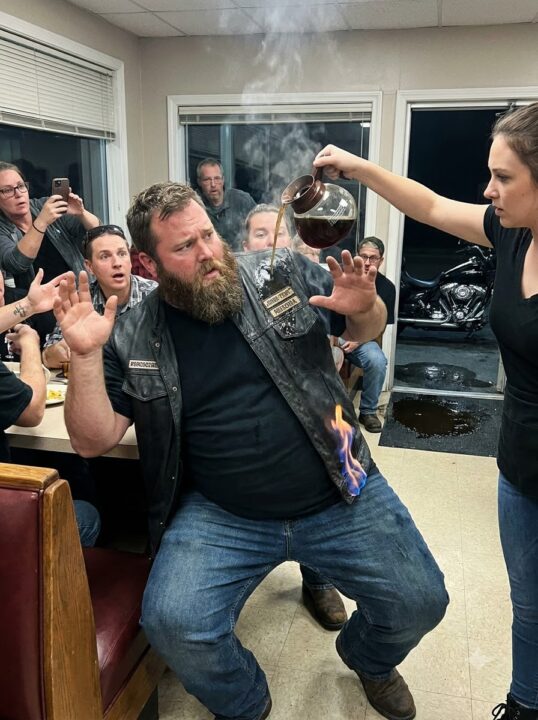
A truck driver named Wade Parsons had recorded from near the entrance. His clip began after I saw the flame but before anyone else did. It showed me raising the coffee pot, Flint turning, and the liquid striking his face and leather.
Then it ended.
No fire.
No smoke.
No blanket.
The caption called me an angry waitress attacking a biker because she disliked his appearance.
People believed it because the video gave them everything except the truth.
The Bluebird’s owner, Dale Rusk, watched it from his home and called before lunch.
“You’re suspended.”
“I stopped him from burning.”
“The video doesn’t show that.”
“The security cameras will.”
The camera above Booth Seven had been broken for six weeks.
Dale knew because I had submitted three repair requests.
He suspended me anyway.
By evening, my name, address, and old divorce records were circulating online. Strangers called the diner demanding my arrest. Someone taped a sign to my apartment door that said BIKER HATER.
The Mercy Road Riders did not threaten me.
That surprised people.
Brick posted one sentence through the club’s account:
Flint is alive because Claire Nolan moved first. Leave her alone.
It should have ended the harassment.
It did not.
Some accused Flint of defending me because the club had been paid. Others said the fire had been invented after the assault. A local radio host claimed coffee could not extinguish gasoline and called the incident staged.
Flint hated publicity, yet he walked into the station during a live broadcast wearing hospital gauze beneath a work shirt.
He placed the burned leather cut on the host’s desk.
A blackened seam ran from the waist to the ribs. The yellow piece of my father’s turnout coat had charred around the edges but had not burned through.
Flint said six words.
“Coffee slowed it. The blanket stopped it.”
Then he left.
The clip changed public opinion within hours.
Dale still refused to reinstate me.
“Customers are nervous,” he said.
“About me or the fire?”
“About all of it.”
I asked whether he had repaired the outlet beside Booth Seven.
He hung up.
While the town argued about the coffee, Mercy Road investigated the motorcycle.
Brick removed the tank and laid every component across a clean bench. The loose clamp was Tyler’s error. He had tightened it with the wrong tool, damaging the screw head before convincing himself it would hold.
That could explain the leak.
It did not explain the straight cut.
The cut ran halfway through the fuel line, shallow enough to remain sealed while the bike stood upright. Each time Flint leaned right, the opening widened and sprayed gasoline toward his jacket.
Someone understood motorcycles.
Someone wanted the leak to begin on the road.
Tyler admitted he had left the garage unlocked for eleven minutes while buying cigarettes. He had lied about it because Mercy Road prohibited him from smoking near the shop.
Brick removed Tyler’s prospect patch and placed it on the workbench.
“Until we know,” he said.
Tyler stared at Flint.
“You think I did it?”
Flint was sanding the burned edge of his cut.
“Think you lied.”
“About cigarettes.”
“Lie’s a lie.”
Tyler’s face tightened. “Caleb lied. You kept giving him chances.”
The garage fell quiet.
Caleb Cade had been Flint’s closest friend after Owen died. He was also the man whose addiction had almost destroyed Mercy Road. He stole tools, pawned donated generators, disappeared during a flood-relief run, and eventually died alone in a motel.
Flint had protected him longer than he should have.
The club remembered.
Tyler had inherited the shame.
“I’m not my father,” he said.
“No,” Flint answered. “You’re making your own mistakes.”
Tyler tore off the remaining name strip and threw it onto the bench.
Brick moved between them, but Flint did not rise.
“Door’s open,” Flint said.
“You kicking me out?”
“Giving you a choice.”
Tyler left.
That appeared to be the crisis. The young mechanic had made an error, hidden the unlocked garage, and lost the only brotherhood he had known.
Then the state fire investigator called.
The fuel line had not been sliced by a knife.
The damage came from a sharpened strip of metal fastened inside the Harley’s frame. Each vibration pulled the line across it until the rubber split.
It was a crude trap.
But it had not been installed Monday night.
Rust beneath the strip showed it had been there for months.
Someone had planted it long before Tyler serviced the bike.
Flint had survived only because the line took longer than expected to fail.
Brick searched club security footage. The garage archive held thirty days, not several months. No answer.
Flint remained calm.
Too calm.
I recognized that silence from my father. It was the silence he used when pain had found a room he refused to enter.
“Who expected you to ride this motorcycle today?” I asked.
“Everybody.”
“Who knew you were coming to the Bluebird?”
His hand stopped on the leather.
“Nobody.”
“What about my father?”
“Dead three years.”
“Then why today?”
Flint looked at Booth Seven through the diner window across the road.
“Jack left instructions.”
The envelope soaked by coffee contained a key and an address. My father had asked Flint to open a storage unit on the twenty-third anniversary of Black Ridge.
We drove there with Brick.
Inside were three boxes, Jack’s damaged fire helmet, a retired department radio, and a steel cabinet marked with Flint’s legal name.
The cabinet contained every annual receipt from Booth Seven.
Twenty-two receipts.
Each had two black coffees.
Each had been signed by my father.
The final receipt had no date.
Beside it sat an audio recorder.
My father’s voice began after a long breath.
“Flint, if Claire is hearing this with you, then either you finally told her the truth or one of you made a mess too large to hide.”
Flint glanced at the coffee stains across my uniform.
Even Brick nearly smiled.
The recording continued.
“I didn’t keep the tunnel secret to protect the department.”
Flint leaned closer.
“I kept it because Owen was alive when I left him.”
Flint’s face emptied.
For twenty-three years, he had believed his brother died before the second crew arrived.
My father said otherwise.
Owen had survived another fourteen minutes.
And during those fourteen minutes, he had told Jack something about the tanker, the road, and a man wearing the Iron Vale patch.
Something dangerous enough that my father hid the truth until after his own death.
Part 4 — What Owen Saw Before the Tunnel Burned
My father’s recording was twenty-eight minutes long.
For the first nine, he described smoke, heat, and confusion. His voice shook whenever he said Owen’s name.
Jack had regained consciousness after Flint carried him outside. Against orders, he crawled back toward the southern portal to guide the second rescue crew.
They found Owen behind a concrete barrier.
His burns were severe, but he was speaking.
He asked whether Flint had escaped.
Jack said yes.
Owen smiled.
Then he grabbed the front of my father’s turnout coat and said the tanker’s support bracket had not simply failed.
Someone had removed two locking bolts.
Owen knew because he had worked on the same fleet months earlier.
The carrier company, Harlan Fuel Logistics, had ignored repeated reports of cracked brackets and leaking valves. A shop supervisor ordered mechanics to reuse damaged hardware to keep trucks moving.
Owen photographed the missing bolts at a rest stop before the crash.
He intended to report the company after the ride.
The photographs were on a disposable camera inside his saddlebag.
That saddlebag vanished from the tunnel.
The official investigation blamed heat damage for the missing bolts. Harlan Fuel paid a modest settlement without admitting fault. The driver, who survived, took the public blame and disappeared from West Virginia.
My father believed the saddlebag had been removed by another biker.
A member of Iron Vale named Russell Vane.
Russell rode with Flint and Owen that morning. He stopped at the tunnel entrance, helped direct traffic, and left before investigators interviewed him.
Three months later, Russell bought a motorcycle shop with cash.
Flint knew the name.
“Rusty,” he said.
Brick’s mouth hardened.
Russell Vane had become Mercy Road’s first treasurer. He helped Flint rebuild his life, visited him in the burn unit, and organized the fundraiser Flint refused.
He had also been Caleb Cade’s sponsor.
The brotherhood’s clean beginning suddenly rested on rotten ground.
My father tried to investigate privately. Harlan Fuel threatened his pension and accused him of altering evidence. The fire chief warned that reopening the case could destroy the department.
Jack backed away.
But once a year, he met Flint at Booth Seven to decide whether to tell him.
“Why didn’t he?” I asked the recorder.
My father answered as if he heard me.
“Because Russell was helping raise Owen’s daughter.”
Leah.
After Owen died, Russell paid school fees, repaired her mother’s roof, and eventually helped her earn a nursing degree. Exposing him would not only reopen the tunnel case. It would tell Leah that the man she called Uncle Rusty might have profited from evidence connected to her father’s death.
Jack waited.
Then Russell developed pancreatic cancer.
He died five years before my father.
Flint’s shoulders lowered, but the recording was not finished.
“Russell came to me before he died,” Jack said. “He admitted taking the camera. Harlan Fuel paid him to make it disappear. He claimed he never touched the tanker.”
The disposable camera was inside the storage cabinet.
So was Russell’s confession.
He had removed Owen’s saddlebag after the fire, sold the photographs, and used part of the money to open his shop. Guilt made him help Owen’s family, then help Flint establish Mercy Road.
His redemption had been built with money earned from betrayal.
Brick sat down hard on a wooden crate.
Flint remained standing.
He picked up the camera but did not open the evidence bag.
“Did Russell cut your fuel line?” I asked.
“No. Dead men don’t use tools.”
“Someone might be protecting what he hid.”
Brick looked at the cabinet.
“Or trying to stop Flint from opening this.”
Only four people knew my father had left a timed message: the attorney who prepared his estate instructions, the storage manager, me, and Dale Rusk—the Bluebird’s owner, who had witnessed the document.
Dale’s father had owned a maintenance company contracted by Harlan Fuel.
That connection sent the police to the diner.
Dale denied everything. He said he suspended me because of publicity, not because I had accidentally kept Flint alive long enough to open the cabinet.
Then investigators searched the Bluebird’s basement.
They found old Harlan maintenance ledgers beneath stacks of tax records. Dale’s father had kept copies of work orders proving the tanker was unsafe.
Dale had discovered them after inheriting the diner.
He feared lawsuits would take the building, his home, and everything his father left him. When he learned Flint intended to meet me on August 19, he assumed my father’s evidence would surface.
But Dale had never touched Flint’s motorcycle.
The diner’s damaged security system provided the answer. Although the Booth Seven camera was dead, a storage drive retained one corrupted clip from four months earlier.
It showed a gray-haired man entering Mercy Road’s garage during a charity breakfast. He wore no club cut, only a Harlan Fuel cap.
The man was the tanker driver.
Samuel Pike.
He had not disappeared. He had lived under his middle name in Kentucky for two decades, following Flint from a distance and blaming him for the renewed investigation that destroyed his career.
Pike admitted placing the metal strip in the Harley’s frame.
He did not intend the motorcycle to explode, he claimed. He wanted a slow leak, a roadside breakdown, and enough fear to stop Flint from returning to the Bluebird.
No one believed the first part.
Flint listened to the confession without interrupting.
Then he asked one question.
“Why now?”
Pike’s answer changed the story again.
My father had contacted him before dying.
Jack told Pike the truth would be released on the twenty-third anniversary unless everyone involved came forward first. The date was not a sentimental reunion.
It was a deadline.
Flint’s yearly second cup had never been only about gratitude. My father had spent twenty-two years building a path for the truth to survive him.
He chose the anniversary because Leah had finally completed her nursing program, paid off her home, and become strong enough to hear what Russell had done without losing everything Russell’s guilt had helped provide.
My father had waited for the child Owen left behind.
Flint understood.
Brick did not.
“Jack let you sit beside a liar for twenty years.”
“Russell built this club,” Brick said. “He gave half these men jobs.”
Flint picked up Russell’s confession.
“He sold my brother.”
“He spent the rest of his life trying to pay it back.”
“Can’t.”
The word struck the room.
Brick reached for the confession, but Flint held it away.
“What are you going to do?” I asked.
Flint looked at the evidence that could stain a dead brother’s memory, collapse a company, and fracture Mercy Road.
“Tell Leah.”
“No club vote?” Brick asked.
“Not club business.”
“Russell was our treasurer.”
“Owen was her father.”
That was how the brotherhood was tested—not by a fight, a rescue, or a row of motorcycles filling a courthouse parking lot.
It was tested by whether men who called themselves brothers could let a daughter own the ugliest truth about the people they loved.
Leah arrived the following morning.
She listened to Russell’s confession in Booth Seven.
Flint sat across from her.
Two coffees cooled between them.
When the recording ended, Leah did not cry. She removed the small Iron Vale pin Russell had given her at graduation and placed it beside my father’s final receipt.
“Did he love us?” she asked.
Flint’s burned hands closed around his cup.
“Yeah.”
“Did he betray Dad?”
“Yeah.”
“Both are true?”
Flint nodded.
Leah stared toward the window.
Outside, Tyler was kneeling beside Flint’s Harley, examining the damaged fuel line under police supervision.
Then she asked the question Flint had avoided for twenty-three years.
“Why did my father tell you to save Jack instead of him?”
Flint looked at me.
The answer was hidden in the yellow lining sewn inside his cut.
And it was addressed to both of us.
Part 5 — The Names Beneath the Yellow Lining
My father’s turnout coat had been retired after Black Ridge.
Fire weakened the outer shell. The department returned it to him in a plastic bag with instructions never to use it again.
Jack kept it for eighteen years.
Then he cut out the yellow inner panel bearing his name and mailed it to Flint with no explanation.
Flint stitched it into his cut himself.
I used a seam ripper to open that lining after Leah asked why Owen had chosen my father.
Inside were three folded pages protected by waxed paper.
The first came from Owen.
Jack had written down his words in the ambulance.
Tell Flint I chose the fireman because I heard him talking about Claire. He kept saying his girl was waiting at the diner. Flint would come back for me. A father might not get another chance to come back for his kid.
I read the sentence twice.
At the time of the tunnel fire, I was twenty, pregnant, and working the Bluebird’s night shift. My mother had died two years earlier. Jack was the only family I had left.
Owen knew none of that.
He heard a semi-conscious firefighter repeating his daughter’s name and made a decision.
Flint obeyed.
My father survived to meet my son. He drove me to the hospital, held my hand through my divorce, and sat in Booth Seven every morning until cancer made coffee taste like metal.
Those years existed because Owen gave away his final chance.
The second page was from Jack.
Flint, your brother did not die because you left him. He died after making the only choice that allowed both of us to remain who he believed we were. Don’t turn his choice into your sentence.
Flint stood and walked outside.
He placed both palms on the roof of Brick’s pickup.
His shoulders shook once.
No sound followed.
The third page contained names.
Not victims.
People saved after Black Ridge.
My name appeared first because my father came home.
Leah’s name came second because Flint stopped drinking and helped raise her after Owen died.
Brick’s name came third because Mercy Road gave him work after prison.
Tyler’s name appeared near the bottom.
My father had met him during one of the secret anniversary coffees. Jack knew Tyler was Caleb’s son. He knew the boy struggled with gambling and lied when frightened.
Beside Tyler’s name, Jack had written:
Not finished yet.
Tyler read it alone.
Then he returned to Mercy Road and placed his prospect patch on Flint’s workbench.
“I loosened the clamp,” he said. “Not the line. But if I had done my job right, I would’ve seen the metal strip.”
Flint said nothing.
“I lied about locking the garage. I blamed my tools. I blamed the part. I blamed my father before anybody could compare me to him.”
Still nothing.
Tyler swallowed.
“I’m not asking for the patch.”
“Good.”
“I’m asking to fix the bike.”
Flint pushed the damaged fuel line across the bench.
Tyler replaced every hose, clamp, and seal. Brick inspected the work. Then Tyler spent six weekends examining motorcycles for older riders who could no longer crouch beside their machines.
He did not wear a patch.
By winter, Flint handed it back.
“Earned?” Tyler asked.
“No.”
Tyler’s face fell.
Flint tapped the white coffee-cup emblem on his repaired cut.
“Earning ain’t finished.”
Tyler understood.
The Bluebird’s owner faced no criminal charge related to the motorcycle, but the maintenance ledgers exposed decades of concealed safety failures. Harlan Fuel settled with surviving families, including Leah.
Dale sold the diner.
Before leaving, he offered me my job back.
I declined.
Leah and I bought the Bluebird together using a small portion of the settlement and a loan guaranteed anonymously by Mercy Road. Flint denied arranging it. Brick denied knowing anything.
The loan paperwork carried a coffee-cup stamp.
We repaired the cameras, replaced the outlet beside Booth Seven, installed a fuel-safe motorcycle parking area, and mounted a fire blanket within three steps of every section.
I did not frame the viral photograph of me pouring coffee.
Instead, I framed the burned receipt.
Beneath it, I placed a small card:
FIRST CUP — JACK NOLAN
SECOND CUP — JONAH “FLINT” MERCER
People came from three states to see the booth. Some wanted photographs. Flint refused to pose. If a phone appeared while he was drinking, he turned his back.
The strange details from that morning finally made sense.
The second cup was for my father.
The white cup patch marked Flint’s promise to return.
He kept touching the right side of his cut because damaged nerves produced pressure without pain. His body sensed something wrong but could not tell him what.
He missed the gasoline because Black Ridge had taken most of his smell.
The yellow lining resisted the flame because it came from my father’s turnout coat.
The old receipt survived because Flint had sealed it with wax.
Even my pot of stale coffee mattered. The warmer pot sat near the register, but I had grabbed the one left cooling beside Booth Seven. It was hot enough to wet and slow the small flame, not hot enough to cause serious scalding.
Chance had narrowed itself to inches.
Flint rejected that word.
“Jack put the blanket there,” he said.
The diner had always kept a wool blanket beneath the register because my father insisted after a kitchen fire years earlier.
He had trained me to look for reflections because direct smoke can disappear against dark clothing.
He taught me not to wait for certainty when fire was moving.
My father had not been present that morning.
His habits were.
Flint’s cut could not be restored completely. A burned section near the right hip remained black and stiff.
Tyler offered to replace it.
Flint refused.
He asked him to stitch one narrow brown strip across the damage instead.
The strip came from my coffee-stained apron.
“Why keep that?” I asked.
Flint pulled the repaired leather over his shoulders.
“Proof the waitress had good aim.”
That was the closest he came to a joke.
Then he sat in Booth Seven and finally drank the second cup.
Part 6 — Every Motorcycle Before Sunrise
The ritual began the following August.
At 4:45 a.m., Tyler opened Mercy Road’s garage. Brick rolled each motorcycle into the light. Every rider inspected the machine beside him instead of checking his own.
Fuel lines.
Brakes.
Tires.
Cables.
No one rushed.
Flint’s Harley came last. Tyler crouched beside it with a flashlight while Flint stood silently over him. When the inspection ended, Tyler tapped the tank twice.
“Clean.”
Flint did not start the engine yet.
He removed his cut and checked the yellow lining, the brown apron strip, and the coffee-cup patch. Then he looked at the names Jack had hidden there.
Only after that did the V-twin turn over.
Thirty-one motorcycles rode toward the Bluebird without revving. The sound reached us before their headlights crossed the hill—a low, measured rumble filling the predawn dark.
Leah unlocked Booth Seven.
I poured two black coffees.
Flint placed one across from him.
The second cup remained untouched until sunrise. Then he divided it among small paper cups and carried them outside to the riders inspecting motorcycles in the parking lot.
Nobody gave a speech.
The following year, a teenage dishwasher smelled gasoline near an elderly rider’s bike. He shut off the engine before the man left.
The year after that, Tyler found a cracked hose on Brick’s touring Harley.
Mercy Road began offering free safety checks every August 19. They called it Second Cup Morning, though no banners carried the name.
Flint still could not smell gasoline.
He kept a detector clipped inside his saddlebag. I kept another beneath Booth Seven.
Whenever he entered the diner, I watched his right side.
Whenever I carried a full coffee pot near him, he raised one eyebrow.
One winter morning he found me sitting alone with Jack’s chipped mug. Grief had returned without warning, as it sometimes did when the grill hissed the same way my father’s radio once had.
Flint sat across from me.
I asked whether he still heard Owen telling him to leave.
“Sometimes.”
“What do you say back?”
He looked toward the window where Tyler was checking a fuel line.
“Still working.”
That was all.
Outside, snow gathered on the motorcycles.
Inside, two cups cooled between us.
Part 7 — The Cup He Finally Carried Home
Flint stopped riding at seventy-one.
His right leg had weakened, and the nerves damaged at Black Ridge began affecting his balance. He could still control the Harley on an empty road.
Traffic was different.
He handed the keys to Tyler.
“Keep it running,” he said.
“For you?”
“For whoever needs it.”
Tyler rebuilt the passenger seat and used the motorcycle to escort burn survivors from the rehabilitation hospital. He never removed Flint’s scratches from the tank.
On the final August morning Flint could visit the Bluebird, Leah drove him in Brick’s old pickup.
He wore the repaired cut.
The burned seam remained visible. So did the narrow strip from my apron and the yellow lining carrying my father’s name.
I brought two coffees to Booth Seven.
Flint pushed one toward Jack’s empty seat.
Then he changed his mind.
He lifted it carefully, walked outside, and poured the coffee into my father’s chipped white mug, which we had placed beneath a small memorial plaque near the parking lot.
After twenty-three years of carrying the second cup, he finally left it there.
Tyler started the Harley.
The V-twin rolled across the morning, deep and steady. Flint stood beside the motorcycle with one scarred hand resting on the seat, feeling its vibration through skin that could still recognize pressure even when it could not recognize pain.
“Fuel line?” he asked.
“Checked twice.”
“Once right is enough.”
“You taught me twice.”
Flint nodded.
Before climbing into the pickup, he looked at me.
“You still throw coffee at customers?”
“Only the ones on fire.”
“Fair.”
Leah laughed. Brick stared at the pavement. Tyler turned his face toward the highway.
The pickup carried Flint away while his old Harley remained beside Booth Seven, ticking gently in the sun.
Two cups had waited there for decades.
That morning, neither was empty.
Follow the page for more powerful biker stories, and drop FLINT below if you want the next full story from Mercy Road.