They Mocked a One-Legged Veteran — Then a Biker’s Voice Behind Them Changed Everything
They laughed at the way he struggled to stand, unaware that the missing leg wasn’t weakness—it was the cost of a war they’d never understand.
The bus stop sat beside a strip mall on the edge of town, the kind of place people passed without noticing. A broken bench. A faded ad peeling from the glass. Afternoon heat pressing down like a hand on the back of your neck.
The old man stood near the pole, gripping a metal cane. One pant leg was pinned neatly above the knee. The prosthetic lay exposed, scuffed and worn from years of use.
Every movement took effort. Balance came slowly now, measured and cautious.
Three young men leaned against the convenience store wall nearby. Loud. Restless. Bored in that dangerous way boredom turns into cruelty.
“Hey, man,” one of them called out. “You forget something?”
The old man didn’t respond. He stared down the road, jaw clenched.
Another laughed. “Guess the other leg stayed back in Iraq.”
The words landed hard.
A couple of people nearby shifted uncomfortably. A woman looked at her phone. A man pretended to tie his shoe. No one stepped forward.
The old man adjusted his grip on the cane. His hand trembled—not from fear, but from the strain of standing too long.
“Careful,” a third voice mocked. “You gonna tip over like that?”
Laughter followed.
Humiliation burned quietly, the kind that doesn’t explode but settles deep in the chest. The old man said nothing. Silence had become armor long ago.
That’s when a motorcycle engine rolled in behind them.
Low. Steady. Close.
And a biker stopped just a few feet away.
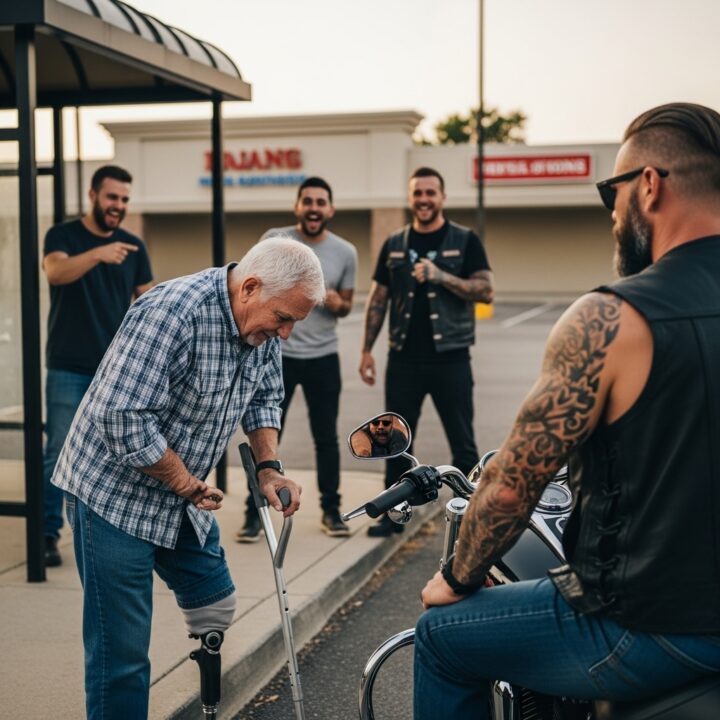
The biker cut the engine and removed his helmet.
Sleeveless black vest. Tattoos winding down both arms. Dark sunglasses despite the shade. He moved with an economy that drew attention without demanding it.
The three young men turned, smirks ready.
“Problem?” one asked.
The biker didn’t answer. He walked past them toward the old man.
That alone changed the air.
A woman nearby whispered, “Oh no.”
Someone muttered, “This is going to get ugly.”
From the outside, it looked exactly like trouble: a biker confronting civilians in public, closing distance without explanation.
The biker stopped beside the old man and spoke quietly.
“You alright, sir?”
The old man nodded once, eyes still fixed on the road.
One of the young men scoffed. “He’s fine. Just can’t stand straight.”
The biker turned slowly.
He faced them now.
“You think that’s funny?” he asked.
The tone wasn’t loud. It wasn’t angry.
It was controlled.
Phones came out. A store clerk stepped halfway outside. Someone mentioned calling the police.
The biker took a step closer.
To the crowd, it looked like a threat.
Tension snapped tight, thin as wire.
The young men puffed up, feeding off the attention.
“Watch yourself,” one said. “You don’t know who you’re talking to.”
The biker didn’t flinch.
He glanced back at the old man, then returned his gaze to the group.
“You shouldn’t talk about things you didn’t earn the right to joke about,” he said.
The old man closed his eyes briefly.
He didn’t want this.
Didn’t want another scene.
Didn’t want to be the reason someone got hurt.
The situation leaned toward chaos.
A security guard from the strip mall approached, hand near his radio.
“Sir,” he said to the biker, “I’m going to need you to step away.”
The biker nodded slightly—but didn’t move.
One of the young men grinned. “Yeah, buddy. Walk away.”
The biker reached into his vest.
Several people gasped.
Instead of anything dangerous, he pulled out his phone.
Typed a message. Short. Precise.
Then he made a call.
“Yeah,” he said calmly. “I’m at the bus stop.”
He listened. Ended the call.
The guard frowned. “Who did you just call?”
The biker met his eyes.
“Someone who knows him.”
He nodded toward the old man.
The young men laughed again, louder now, trying to drown out the unease creeping in.
“You hear that?” one said. “He called backup.”
The biker didn’t respond.
He stepped slightly in front of the old man—not shielding him dramatically, just placing his body where it mattered.
The bus stop felt smaller. The heat heavier.
Everything waited on the next sound.
The sound came first.
More engines.
Not roaring. Not aggressive. Just arriving.
Motorcycles rolled in one by one, parking neatly along the curb. Riders dismounted with calm precision. Sleeveless vests. Weathered faces. Quiet nods exchanged.
The laughter died.
The three young men straightened, confidence draining.
One whispered, “What the hell…”
A man in a denim jacket approached the old veteran, eyes softening immediately.
“Sir,” he said. “Sorry we’re late.”
The old man looked up.
Recognition flickered across his face.
The biker who had arrived first stepped aside slightly, letting the others in.
The security guard lowered his hand.
A woman from the crowd spoke up hesitantly. “Who… who are they?”
The man in the denim jacket answered without raising his voice.
“We ride with him,” he said, nodding to the biker. “And we served with him.”
He turned to the young men.
“That leg you laughed at?” he continued. “He left it outside Fallujah.”
Silence fell like a weight.
The young men stared at the ground.
The old man exhaled slowly, shoulders sagging as if something heavy had finally been set down.
Power shifted—not with force, but with truth.
The truth unfolded quietly.
The old man had been a Marine. Twenty-two years old when the explosion took his leg. Forty years old when he learned how to stand again without it.
He’d never talked about it. Never worn medals. His service lived in scars, not stories.
The biker who spoke first had served later, trained by men like him. They rode together now—not as heroes, not as enforcers—but as brothers who understood silence.
The young men muttered apologies. Thin. Incomplete. They left quickly, eyes down, laughter gone.
No one chased them.
The bikers didn’t linger.
One of them helped the old man sit on the bench. Another adjusted the prosthetic strap gently, practiced hands doing what they’d done before.
A bus pulled up.
The old man stood slowly, steadier now.
He looked at the biker who’d spoken up first.
“You didn’t have to do that,” he said quietly.
The biker shook his head.
“Yes, I did.”
The old man nodded once.
As the bikers started their engines, the sound felt different now—less like danger, more like guardianship.
They rode away without ceremony.
The bus doors closed.
The old man sat by the window, watching the street pass by. His reflection stared back—older, worn, but unbroken.
No one applauded.
No speeches were made.
Just a lesson left hanging in the air:
Some courage doesn’t shout. Some respect must be learned the hard way. And some men don’t need both legs to stand taller than everyone else.