Part 2: A Tattooed Biker Stood In The Pouring Rain Holding An Umbrella Over A Little Girl’s Lemonade Stand. She Was Saving For A Gift For Her Mom In The Hospital, But Her Old Dog Knew A Trick Only He Had Taught It.
Part 2 — Thirty Cups
Silas made one phone call from the curb.
“Tank. I need the brothers on Ringgold Road. Right now. Bring cash.”
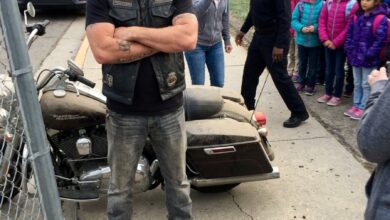
Twenty-two minutes later, thirty motorcycles came down Ringgold Road in the rain. The Scenic City Riders parked along the curb, cut their engines, and lined up behind a card table in the downpour. Each one paid twenty dollars for a paper cup of lemonade that was mostly rainwater.
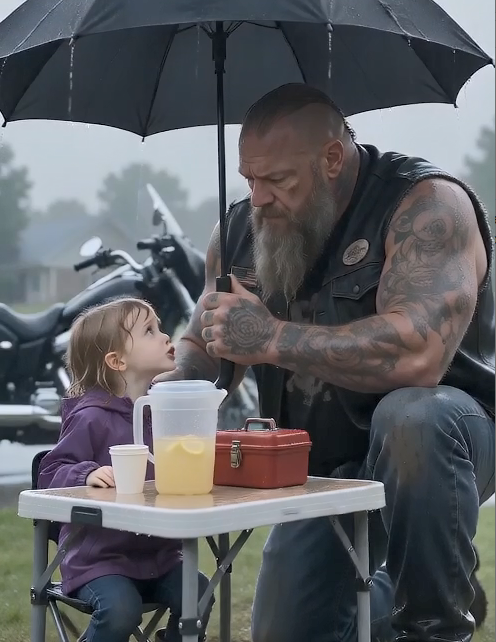
Josie poured and cried and poured.
By the time the last biker drank his cup, the pickle jar held six hundred and forty dollars. Josie kept counting it over and over, her lips moving.
“That’s more than the sun necklace,” she whispered. “That’s more than four sun necklaces.”
Then the front door opened.
Trevor Gaines came down the driveway under a golf umbrella. He was forty-one, with neat brown hair and khakis. He was the assistant principal at East Ridge High School and a deacon at Ridgecrest Baptist, and he had the friendly, careful face of a man who knew the name of every kid in his building.
He looked at the thirty bikers. He looked at the jar. Then he looked at Silas.
And for one half-second, his face went completely blank.
Then the smile arrived.
“Wow. Y’all. This is incredible. Thank you so much.” He put a hand on Josie’s head. “Jo-Jo, honey, let’s get you inside before you catch pneumonia. I’ll make sure every penny gets to your mom.”
He picked up the pickle jar.
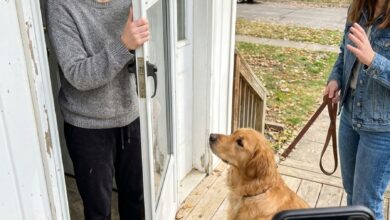
Under the table, Biscuit made a low sound in her chest. It wasn’t quite a growl. Trevor glanced down at her, and the dog went quiet and backed against Silas’s leg.
“Biscuit,” Trevor said. “Inside.”
She didn’t move.
“Biscuit.”
She went, slowly, her head low, looking back the whole way.
Josie stopped at the porch steps and looked back too. She lifted her left hand and waved with her crooked little pinky.
Then the door shut.
The bikers stood in the rain without saying anything. Tank Holloway, the club president, put a wet hand on Silas’s shoulder.
“Brother. You okay?”
Silas wasn’t okay.
He sat on his bike at the curb long after the others left, rain running down his neck, doing the same math over and over. Sentenced May 2017. The letter came in September. I lost the baby. Josie was born in January 2018.
It added up one way.
But there was another way it could add up, and that was the one that kept him sitting there. Maybe there never had been a lost baby. Maybe Hannah had already been seeing somebody else, and Josie was that man’s, and the letter was just the kindest way to cut him loose. Maybe the crooked pinky was a coincidence.
Maybe a man who’d put somebody in the hospital with his fists didn’t get to show up in the rain nine years later and call a little girl his.
He’d made his peace with that a long time ago. Or he’d thought he had.
At four o’clock, he rode downtown to Erlanger Medical Center anyway. He told himself he’d just ask how she was doing.
At the nephrology floor, a nurse checked her screen. Then she looked up at him with a strange expression.
“Sir, what’s your name?”
“Silas Rourke.”
She read the screen again and lowered her voice.
“The patient’s healthcare representative has restricted visitors to immediate family.” She hesitated. “And there’s a note on her chart, added three weeks ago. Do not admit Silas Rourke under any circumstances.”
Three weeks ago, nobody in Hannah’s life had known Silas Rourke still existed.
So how did Trevor Gaines know his name?
Part 3 — Where’s Your Truck?
In the spring of 2016, Silas Rourke drove a tow truck for Lookout Valley Towing and lived above a bait shop on Signal Mountain Road with a pediatric nurse named Hannah Kincaid and a Golden Retriever puppy named Biscuit.
Biscuit hated the tow truck. Specifically, she hated the winch, the high whining scream of the cable reeling in. Every time she heard it, she’d lie down and cover her nose with one paw, as if hiding her face made the noise go away.
So Silas turned it into a trick.
“Biscuit,” he’d say. “Where’s your truck?”
Paw over nose. Every time. Hannah laughed so hard she cried.
Silas had a red metal tackle box from his granddad. He’d built a false bottom into it with a piece of sheet metal, so he could hide bait money from his roommates back in high school. He kept it on the kitchen counter, and Hannah used it as her “rainy day box.” She hid her tips in the secret compartment and swore he’d never find them.
He always found them. He always put a little more in.
Every other Saturday, he went to the Blood Assurance center on Fourth Street and gave blood. He was O-negative, the universal donor. They called him the second he became eligible every time. He had a little plastic donor card with his blood type on it and a sticker for every hundred donations.
“Mister Universal,” Hannah called him. She’d poke the card in his wallet. “If I ever need a spare part, I know exactly where to go.”
“Anything you need,” he said. “Anytime.”
He meant it.
That was the summer before the bar fight. Before the man at the Brass Register grabbed Hannah by the wrist in the parking lot, and Silas hit him once, too hard, and the man’s head hit the curb.
Before four years in the Bledsoe County Correctional Complex.
Before the letter.
Part 4 — The Brother
Trevor found him first.
At nine the next morning, Silas was hooking a broken-down minivan to his tow truck on Brainerd Road when a silver Acura pulled into the lot behind him. Trevor got out alone. He was in a church polo, holding two coffees, and he looked tired and sincere.
“Mr. Rourke. Can I have five minutes?”
Silas didn’t take the coffee. Trevor set it on the bumper.
“I know who you are,” Trevor said quietly. “Hannah told me about you, back when we first got together. I put that note on her chart. I’ll be honest about that.” He held up his hands. “Can you blame me? She’s fighting for her life, and her ex-boyfriend, who did four years for aggravated assault, shows up out of nowhere with a motorcycle gang in front of my little girl.”
“Your little girl.”
“I’ve raised her since she was one, Mr. Rourke. I’ve been to every recital and every ear infection.” He pulled a folder from under his arm. “And I know what you’re thinking about the kidney. Josie told me what she said. Kids hear half a phone call and fill in the rest.”
He opened the folder. It was a letter on Erlanger Transplant Center letterhead, addressed to Hannah’s family.
Living donor candidate Wesley Kincaid has been withdrawn from evaluation.
“Hannah’s brother Wes was disqualified,” Trevor said. “High blood pressure. He was embarrassed. He told Josie he backed out because he didn’t want her thinking her uncle was sick.”
Then he slid over a second document. It was a trust agreement from Hannah’s late father, Roy Kincaid, who had sold his trucking company in Dalton, Georgia, for nearly two million dollars before he died.
In the event of my daughter Hannah’s death, her share of this trust shall pass to my son, Wesley Kincaid.
“Not to me,” Trevor said softly. “Not to her husband. To Wes. Wes, who owes forty thousand dollars to a man in Rossville he’s very afraid of. Wes, who suddenly ‘changed his mind’ about giving his sister a kidney.”
He picked up his coffee.
“I’m not saying Wes wants Hannah gone. I’m saying I’d ask him some questions before I came after the man who’s been holding her hand in that ICU every night for six weeks.”
He drove off.
Silas stood in the parking lot with rain dripping off the tow hook.
It made sense. A brother in debt, an inheritance, and a kidney that never came. It made more sense than a school principal and church deacon blocking his own wife’s transplant.
That evening, Silas found Wes Kincaid at a bar in Rossville, Georgia, called the Tired Mule. He was thirty-six, with paint-flecked hands from the body shop where he worked, three empty beer bottles in front of him, and eyes swollen from crying.
He knew Silas from nine years ago. He didn’t look surprised to see him.
“Josie told me you held an umbrella over her,” Wes said hoarsely. “Thank you.”
“Did you back out of the transplant, Wes?”
Wes laughed, a broken, ugly sound.
“Back out? Man, I passed every test. I was a match. Blood pressure and all.” He wiped his face. “Then, two weeks before the surgery, I got a call from the transplant office. A woman said Hannah had a better donor lined up, a perfect match, and they didn’t need me anymore. She said thank you for your generosity, and she hung up.”
He stared at his bottle.
“I called back the next day to ask who the other donor was. The coordinator didn’t know what I was talking about. She said the hospital’s records show I withdrew. By phone.”
“Who called you, Wes?”
“That’s the thing.” His hands were shaking. “It came from the hospital’s main number. It said Erlanger right there on my phone.”
If the hospital had never made that call, who had?
Part 5 — The Call Log
Danielle Okafor had been a living donor coordinator at the Erlanger Transplant Center for fourteen years. She’d seen families fight, cry and pray in her little office on the fourth floor, but she had never seen a man the size of Silas Rourke sit in her guest chair and ask to be tested.
“I’m O-negative,” he said. He set his Blood Assurance donor card on her desk. 112 donations. “I want to give Hannah Gaines a kidney. Today, if you’ll let me.”
Danielle looked at the card, then at him, for a long time.
Then she got up and shut her door.
“Mr. Rourke,” she said quietly, “you’re the fourth person to sit in that chair for Hannah in two months.”
She turned her monitor toward him.
Wesley Kincaid, brother. Match. Withdrew by phone, Aug. 14.
Tasha Greene, coworker. Compatible. Withdrew by phone, Aug. 29.
Pastor Dale Hutchins, Ridgecrest Baptist. Compatible. Withdrew by phone, Sept. 9.
“Three living donors,” Danielle said. “All compatible. Every one of them called and withdrew at the last minute. And every one of them told me later they never made that call.”
She clicked again. It was the center’s incoming call log.
All three withdrawal calls had come from the same cell phone number.
Silas didn’t recognize it. Danielle did. She pulled up Hannah’s chart and pointed to the healthcare representative’s contact information.
Trevor Gaines, spouse.
The numbers matched.
“He called pretending to be them,” Danielle said. “And then, when they followed up, he used a spoofing app to call them from what looked like our main line. I reported it to compliance a week ago.” Her jaw tightened. “Compliance said it was a misunderstanding between grieving family members.”
Silas sat very still.
Wes came by Danielle’s office that afternoon with the folder from his father’s estate. Trevor had shown Silas a page from it. Wes had the whole thing.
“Read the amendment,” Wes said.
It was dated 2020, a year after Hannah married Trevor, and signed by Roy Kincaid six months before he died.
In the event of my daughter’s death while married, her share shall pass to her surviving spouse.
“Dad changed it after the wedding,” Wes said. “He liked Trevor. Everybody likes Trevor. Trevor showed you the old version, from before.”
Then Wes put one more paper on the desk. It was an insurance form from Erlanger’s employee benefits office. Hannah worked as a pediatric nurse at the children’s hospital, so her life insurance went through her job. Last November, the policy had been raised from two hundred and fifty thousand to one point two million dollars. Hannah’s signature was at the bottom, shaky and slanted.
“Last November,” Danielle said quietly, “Hannah was on her second week of dialysis. She was sleeping eighteen hours a day.”
Wes’s last document came from the Tennessee Department of Commerce and Insurance. Trevor’s side business, Gaines Family Financial, had been under investigation since March for client complaints. Three retired teachers from Hixson said their annuity money was gone.
“He’s going under,” Wes said. “And Hannah’s worth more to him dead than alive.”
Danielle looked at Silas.
“Mr. Rourke, I can run your blood tonight myself. But I need to be honest with you.” She hesitated. “Hannah’s kidneys are failing faster than dialysis can keep up with. She has maybe two weeks. And Trevor is her healthcare representative. If he refuses consent for your donation, I can’t do a thing.”
Silas rolled up his sleeve.
“Run it.”
At 11:40 that night, Danielle called him.
“You’re a match,” she said. Her voice was shaking. “Mr. Rourke, you’re a better match than her brother.”
Then she lowered her voice.
“And Trevor called the floor an hour ago. He’s asking the doctors to talk about moving Hannah to hospice.”
Would Silas get to her before Trevor signed the papers?
Part 6 — Hospice
Trevor moved before sunrise.
At 6:00 a.m., a video went up on Facebook. Somebody from Ridgecrest Baptist had filmed the bikers lining up at Josie’s lemonade stand from across the street and edited it. The thirty bikers looked like a mob. Silas’s face was circled in red.
This man is a violent felon who did prison time for nearly killing a man. Now he’s stalking my eight-year-old daughter while her mother is dying. Please pray for our family. Please share.
It had forty thousand shares by lunch.
At 9:15, an East Ridge police officer served Silas with an emergency order of protection at the towing yard. He was not to contact or come within five hundred feet of Josie Gaines or the Ringgold Road residence.
At 11:00, his boss at Lookout Valley Towing called him into the office. Two of their biggest contracts were with Hamilton County Schools, and somebody at the district had called.
“Take a week, Silas,” his boss said, not looking at him. “Paid. Let it settle.”
At 1:30, Trevor took Biscuit to McKamey Animal Center.
Wes found out from Josie, who called him sobbing from a neighbor’s phone. Trevor had signed an owner surrender form. Elderly dog. Behavior problems. Aggressive toward family members.
“Aggressive,” Wes said, when he called Silas. “That dog’s never bitten anything but a tennis ball.”
At 3:00, Danielle called.
“Trevor met with the nephrology team this morning,” she said. Her voice was flat with anger. “He told them Hannah said months ago that she wanted no heroic measures. No transplant from a stranger. He’s the healthcare representative. The doctors have to listen to him. He’s revoked consent for any donor evaluation. Including yours.”
“She’s awake sometimes, isn’t she? Ask her.”
“She’s on sedatives for the pain and the fluid on her lungs. Trevor asked for them to be increased.” Danielle swallowed. “When she’s lucid, he’s in the room. Every single time.”
Silas sat in his truck outside the towing yard as the rain started again.
He had a matching kidney, and nobody would let him give it. He had no job. He had a court order with his name on it. The dog he’d raised from a puppy was in a shelter, and the woman he’d loved was being talked into hospice by the man who had the most to gain if she died.
He did the only thing he could. He drove to McKamey Animal Center and stood at the counter in his wet vest.
“I want to adopt the old Golden. The one surrendered this morning.”
The young woman at the desk checked her screen and winced.
“I’m sorry, sir. She’s on a behavioral hold. The surrendering owner flagged her. She’s not eligible for adoption.” She lowered her voice. “She’s scheduled for evaluation Thursday.”
Everyone in the building knew what evaluation meant for an eleven-year-old dog flagged as aggressive.
That night, Silas sat alone on the tailgate of his tow truck in the rain outside his apartment, with the red tackle box from his granddad open beside him. He’d taken it when he moved out. He couldn’t remember why he still had it, except that it was the last thing that had ever held Hannah’s rainy-day money.
The false bottom was empty.
At 4:50 a.m., his phone rang.
It was Danielle, whispering.
“Hannah’s awake. Really awake. Trevor went home to shower.” A pause. “She’s asking for you, Silas. By name. She says she has to tell you something before he gets back.”
What could Hannah possibly have left to say after nine years of silence?
Part 7 — The Letter She Never Sent
Danielle met him at the employee entrance and walked him up the back stairwell.
Hannah was propped up in bed with a dialysis line in her arm. She was thirty-four, and she looked fifty. Her face was swollen and gray, and her hair was thin. But her eyes were the same.
When she saw him, she started crying.
“You held an umbrella,” she whispered. “Josie told me. On FaceTime, last night, before Trevor took the phone away. She said a giant held an umbrella over her for an hour and got soaked and never complained once.” She tried to laugh. “I knew it was you before she even said Biscuit did the trick.”
Silas pulled a chair up to the bed. He didn’t trust his voice.
“She’s yours, Silas,” Hannah said. “Josie. She’s yours. There never was a lost baby.”
He’d known since the rain. Hearing it still knocked the air out of him.
“Why?”
“Because you were in prison for four years. Because I was twenty-five and terrified, and my father said a baby didn’t need a father who’d put a man in a coma, even if that man had grabbed me first.” She wiped her face with a shaking hand. “I wrote that letter and mailed it, and then I sat on the bathroom floor and threw up. I told myself I was protecting her.”
“From me.”
“From all of it. The visiting room. The record. The way people would look at her.” She shook her head. “Then Trevor came along. Steady. Church on Sundays. A good job. He said he’d raise her as his own, and that it’d be cruel to let a felon back into her life. And I let him convince me, because it was easier than admitting I’d lied to you.”
She was quiet for a long time.
“I kept Biscuit because she was the only piece of you I had left. And I taught Josie you were dead, because if you were dead, I’d never have to explain why I didn’t wait.”
Silas looked at his hands. The crooked pinky on the left.
“You stole eight years of her, Hannah.”
“I know.” She didn’t look away. “I’ll know it every day I have left. However many that is.”
Then she gripped his wrist with surprising strength.
“Listen to me. Last spring, I started noticing things. Papers Trevor brought me to sign when I was half asleep. Calls he took outside. Money moving out of our joint account. I got scared. So in June, when I still had good days, I went to a lawyer in Fort Oglethorpe by myself.”
She took a breath.
“I signed a new advance directive. It made Wes my healthcare agent, not Trevor. It’s notarized and witnessed. And I wrote a letter naming you as Josie’s father, with a DNA kit receipt, and asking that she go to you if I don’t make it.” She closed her eyes. “I was too scared to file it. I was afraid Trevor would find out. So I hid it where nobody would ever look.”
Silas was already shaking his head. “Where?”
Hannah almost smiled.
“Your granddad’s tackle box. The red one. I gave it to Josie last year for her lemonade money.” She opened her eyes. “Under the false bottom. You never could find my tips.”
He stared at her.
“I took it when I moved out,” he said slowly. “I’ve had the tackle box this whole time, Hannah.”
“No,” she whispered. “You had the old one. I bought Josie a new one at the Walmart on Gunbarrel Road, and you built the same false bottom into it when she was a baby. Remember? The Christmas you came by the porch and I wouldn’t let you in? You left it on the steps.”
He remembered. Christmas 2021, a month after he got out. A red tackle box with a bow on it, left on her porch like a coward. He’d never known what happened to it.
“It’s the cash box on her lemonade table,” Hannah said. “Josie keeps her quarters in it.”
Footsteps sounded in the hall.
Danielle opened the door a crack, pale. “Trevor’s in the elevator.”
Silas stood. Hannah grabbed his hand one more time.
“Ridgecrest is having a fundraiser for me Sunday,” she said quickly. “‘Lemonade for Hannah.’ Trevor’s idea. Josie’s going to be there with her stand. The news is coming.”
Silas squeezed her hand and was gone down the back stairwell before the elevator doors opened.
The papers that could save Hannah’s life were sitting in a little girl’s lemonade box, and the man who wanted Hannah dead was planning to stand right next to it.
How would Silas reach it with a court order keeping him five hundred feet away?
Part 8 — Lemonade for Hannah
Ridgecrest Baptist Church sat on a green hill off South Moore Road. On Sunday afternoon, its fellowship lawn was full of white tents, folding chairs, and about three hundred people. There was a bake sale, a bounce house, and a Channel 3 news van parked at the curb.
It was raining again, a light, steady drizzle.
At the center of the lawn, under a canopy, Josie stood behind a brand-new lemonade stand in a yellow raincoat. A hand-painted church banner hung above her. LEMONADE FOR HANNAH. On the table sat a pickle jar and a small red metal tackle box.
Trevor stood at a microphone beside her. He wore a blue Ridgecrest polo, and his eyes were wet.
“Six weeks,” he said. “Six weeks I’ve sat beside my wife’s bed and prayed. We have searched everywhere for a donor. Her own brother backed out. If I could give her my own kidney, I would, today—”
A low rumble rolled up South Moore Road.
Thirty motorcycles turned into the church lot, slow and quiet, and stopped along the far edge of the lawn. Every engine cut at once. The riders stayed beside their bikes. Five hundred feet was a long way, and Silas had measured it twice.
But Wes Kincaid walked across the lawn, and so did Danielle Okafor, in her hospital scrubs, carrying a folder.
And on a leash beside Wes, limping on old hips, came a white-faced Golden Retriever. That morning, Wes had shown up at McKamey Animal Center with his sister’s signed advance directive, a copy faxed from the lawyer in Fort Oglethorpe, and a lawyer’s letter on top of it. The behavioral hold had lasted about eleven minutes after that.
Josie screamed “Biscuit!” and ran out from behind the table.
Trevor’s face went white, then hard.
“Folks,” he said into the microphone, his voice still steady, “I’m sorry. This is my wife’s brother, and that’s a dangerous dog, and that man in the parking lot”—he pointed across the lawn at Silas—”is a violent felon with a protective order against him. He’s been trying to use my wife’s illness to get to my daughter.”
“I came to tell your church something, Trevor,” Danielle said. She didn’t need a microphone. “I’m Hannah’s living donor coordinator at Erlanger. Three compatible donors were withdrawn from her evaluation by phone this summer. All three calls came from your cell phone.”
The crowd murmured.
Trevor smiled thinly. “That’s a records error. Ma’am, I don’t know who’s been feeding you—”
“And this week, a fourth donor came forward. Silas Rourke.”
“I never received any donor inquiry from that man,” Trevor said sharply. “Never. And for the record, it wouldn’t matter. He’s not even a blood match. He’s B-positive. Hannah’s team told me.”
The lawn went quiet.
From five hundred feet away, Silas held something up over his head. It was small and white, and it caught the gray light. Tank, standing beside him, shouted across the lawn in a voice that had called cadence at Fort Benning.
“O-NEGATIVE! ONE HUNDRED AND TWELVE DONATIONS AT BLOOD ASSURANCE!”
Danielle opened her folder and held a page up to the Channel 3 camera.
“Universal donor. His crossmatch with Hannah came back negative Thursday night. That means compatible. He’s the best match she’s had.” She looked at Trevor. “You told me twice this week you’d never heard of him. So how do you know his blood type, Trevor? Or do you only know what you need to say to keep people away from her?”
Trevor opened his mouth.
Nothing came out.
Josie had gone back to her lemonade stand. She was standing very still, holding the red tackle box with both hands. Wes knelt beside her and whispered something. She nodded, lifted out the tray of quarters, and pressed down hard on the bottom.
It clicked.
A thin sheet of metal popped up. Underneath was a folded envelope, sealed with tape.
“Mommy told me on FaceTime,” Josie said in a small, clear voice. “She said, if anything bad happens, the secret’s in my lemonade box.”
Wes took the envelope and opened it in front of the camera. There was a notarized advance directive naming Wesley Kincaid as Hannah’s healthcare agent, dated June. And under it was a letter in Hannah’s handwriting.
Trevor lunged for it.
Biscuit stepped in front of Josie.
The old dog didn’t bark. She planted all four feet, put her head down, and stood there with a low growl rumbling in her white chest, between the little girl with the crooked pinky and the man reaching for the paper.
Three hundred church members watched Trevor Gaines stop with his hand in the air.
Would any of them finally see who he really was?
Part 9 — Keep the Change
Pastor Dale Hutchins answered that.
He was one of the three donors who’d been “withdrawn.” He walked out of the crowd, gray-faced, and stood next to Danielle.
“Trevor,” he said, “I never called that hospital either. I thought it was strange. I didn’t want to believe it.” He looked at the folder, then at Josie with the open tackle box, then at the old dog standing guard. “Son, I think you need to step away from that microphone.”
Trevor did.
Before Monday was over, a Hamilton County chancery judge had removed Trevor Gaines as Hannah’s healthcare representative and recognized Wes as her agent. On Wednesday, the Tennessee Bureau of Investigation opened a case into the spoofed calls, the insurance increase and the missing client money. Trevor was placed on administrative leave by Hamilton County Schools and stepped down as deacon. In the spring, he was indicted on charges of fraud, theft from his clients, and a charge under the state’s vulnerable adult protection law for interfering with Hannah’s medical care.
He took a plea in June. Hannah filed for divorce from a hospital bed.
The order of protection against Silas was dissolved in four minutes.
On a gray Tuesday morning in October, at Erlanger Medical Center, Silas Rourke lay on a gurney in a pre-op bay with an IV in his arm and a paper hat on his head. Two curtains down, Hannah lay on hers.
Danielle walked between them with a clipboard, smiling.
“Last chance to back out, Mr. Universal.”
“Not a chance.”
The surgery took five hours. Hannah’s new kidney started working on the table.
Josie was allowed in two days later. She climbed onto Silas’s bed very carefully, because she’d been warned about his stitches, and looked at him for a long time. A child psychologist had helped Hannah explain. Josie had listened and nodded and asked one question.
Did you know about me?
No, sweetheart. If I’d known, I’d have been holding that umbrella every day of your life.
Now she just held up her left hand and pressed her crooked pinky against his.
They matched.
She didn’t call him Daddy yet. Not that week. That came later, on its own, in a Waffle House on Brainerd Road, in the middle of a sentence about pancakes. Nobody made a big deal about it. Silas went outside for a minute afterward and stood in the parking lot.
Hannah and Silas didn’t get back together. Too much had happened, on both sides. But they found something steadier than what they’d lost. They had Sunday dinners. They shared custody of an old dog. They had a daughter between them who would never again be told that anyone she loved was dead.
Biscuit came home with Silas. Every other weekend, she went back to Ringgold Road with Josie.
And on a warm Saturday the next May, Josie set up her lemonade stand at the end of the driveway again. She used the same card table and the same red tackle box, with the false bottom empty now. Her new sign said LEMONADE 50¢ — FOR THE KIDNEY CENTER, in purple marker.
It started to rain.
A motorcycle pulled up to the curb. A big man with a gray beard got off, unhooked a black umbrella, and held it over the table.
Not over him. Over her.
Biscuit came out from under the table and leaned her white face against his leg.
“Mister,” Josie said, grinning, “you’re getting all wet.”
“Been wet before.” Silas pulled a soggy twenty out of his vest and dropped it in the jar. “One lemonade, please.”
She poured it carefully and held it up to him. Then she pushed the twenty back across the table with one finger.
“Family drinks free,” she said.
Silas looked down at his daughter for a long moment, rain running into his beard.
Then he pushed the twenty back.
“Keep it, kiddo,” he said. “I already got mine.”
Follow this page for more stories about old dogs who never forget, and the families who find their way back to each other.