She Was Turned Away at the Hospital for Having No Money — Until a Biker Stood Silent at the Front Desk
They told her to leave the emergency room because she couldn’t pay, while her hands shook on the counter—and a biker appeared behind her, silent and unmoving.
The hospital lobby hummed with sterile brightness and cold efficiency. Monitors beeped somewhere out of sight. A TV murmured the afternoon news. At the front desk, a woman in her early forties leaned forward, palms flat, knuckles white. Her jacket was thin. Her hair was pulled back wrong, like she’d done it in a rush.
“I just need a doctor,” she said again, voice cracking. “Please.”
The receptionist didn’t look up. She pointed to a laminated sign and repeated policy in a rehearsed, distant tone. Insurance first. Deposit required. Non-emergency cases redirected.
Behind the woman, people shifted. Some pretended to scroll. Others watched with quiet discomfort, grateful it wasn’t them. A security guard glanced over, then away.
The woman swallowed hard. Fear climbed her throat. Her breathing shortened. She tried to explain—no job, no card, no one to call—but the words fell into a space that had already decided.
That’s when the air changed.
Boots stopped behind her. Not rushed. Not heavy. Just there. A man stood close enough that she felt the warmth of another body. Leather creaked softly. Sunglasses indoors. Sleeveless shirt. Ink along both forearms. He didn’t touch her. He didn’t speak.
A biker had arrived. And no one knew why.
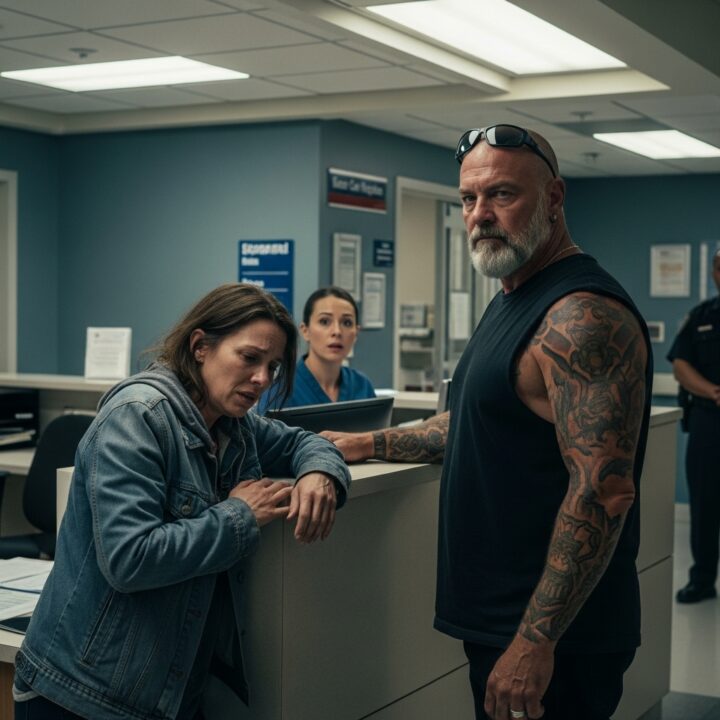
The biker stepped forward and placed one hand on the counter—not aggressive, not polite. Claiming space without force. The receptionist finally looked up and froze.
“This doesn’t involve you,” she said, tight.
The biker shook his head once. “It does now.”
That was enough.
A man in scrubs muttered something about security. The guard straightened and took two steps closer. Phones came out. Assumptions assembled themselves quickly: troublemaker, intimidation, threat.
The biker didn’t argue. He didn’t raise his voice. He stood where the woman had been pushed back from and said, “She needs help.”
The guard reached for his radio. The receptionist’s tone sharpened. “Sir, you need to step away from the desk.”
To everyone watching, it looked like a biker was bullying hospital staff. Like he’d chosen the wrong place to posture. The woman’s stomach dropped. She shook her head, whispering, “Please, it’s okay. I’ll go.”
The biker didn’t move.
Security closed in, forming a loose half-circle of authority. The guard warned him about trespassing. The biker listened, eyes steady behind dark lenses, jaw relaxed. He offered no explanation, no credentials, no backstory.
Silence stretched. Tension learned to breathe.
The woman swayed. Her knees buckled slightly, and she grabbed the edge of the counter. If she went down now, it would get worse—paperwork, liability, blame.
Security was ready. The receptionist’s finger hovered over a call button. A supervisor approached, lips thin, rehearsing control.
The biker sensed the turn. He reached into his pocket and pulled out his phone. One hand. One thumb. One short message. No drama.
“Who are you calling?” the supervisor asked.
The biker answered without looking up. “Someone who should already be here.”
That landed wrong. Authority bristled. The guard tightened his grip on the radio. The woman closed her eyes, ashamed and terrified, certain she’d caused this.
The biker slipped the phone away and said one last thing—short, calm, unyielding: “We’re waiting.”
No one knew for what.
The lobby held its breath.
Sound came first.
Not loud. Not chaotic. Engines easing to silence outside the glass doors. Footsteps. Purposeful. Measured.
Heads turned.
The doors opened, and they entered in order—men and women, American and European accents mixed, removing helmets as they crossed the threshold. Sleeves short. Tattoos visible. Sunglasses coming off. No posturing. No threats.
They didn’t crowd the desk. They lined the wall, leaving space, creating a quiet perimeter of presence. The security guard stopped mid-step. The supervisor swallowed.
An older woman in scrubs pushed through the group and approached the desk. She looked at the biker, then at the woman leaning there, pale and shaking.
“What’s her name?” the doctor asked.
The receptionist faltered. Papers shuffled. Power shifted without a word being raised.
The truth came out not as a speech, but as a sequence of facts.
The biker was a volunteer rider for medical transport—off the books, on-call. Disciplined. Trained. The group behind him? Nurses. EMTs. Former hospital staff who rode on weekends to move patients no system wanted to claim.
The woman at the counter had called a number that morning—an old number she wasn’t sure still worked. It had.
Her condition wasn’t dramatic. It was dangerous. The kind that waits until it’s too late. The biker recognized the signs from a hundred quiet miles on dark roads.
The doctor nodded once and said, “She’s coming back with me.”
No applause. No apologies spoken aloud. Just averted eyes and softened voices.
As the woman was guided away, she turned back, tears finally spilling. The biker dipped his head. Didn’t follow. Didn’t linger.
Outside, engines started again. One by one. Then the sound disappeared.
Inside, the hospital returned to its rhythm—brighter, colder, unchanged.
At the front desk, the laminated sign still stood. But a space had opened around it. A reminder that policy can’t always see what people do.
And somewhere down the hall, a woman was finally being treated—because someone stood still when it mattered most.