She Was Thrown Out at Midnight — The Biker Parked His Bike and Refused to Leave
The door slammed so hard the glass rattled.
“Get out. Now.”
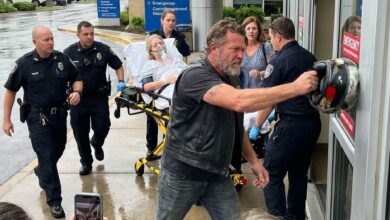
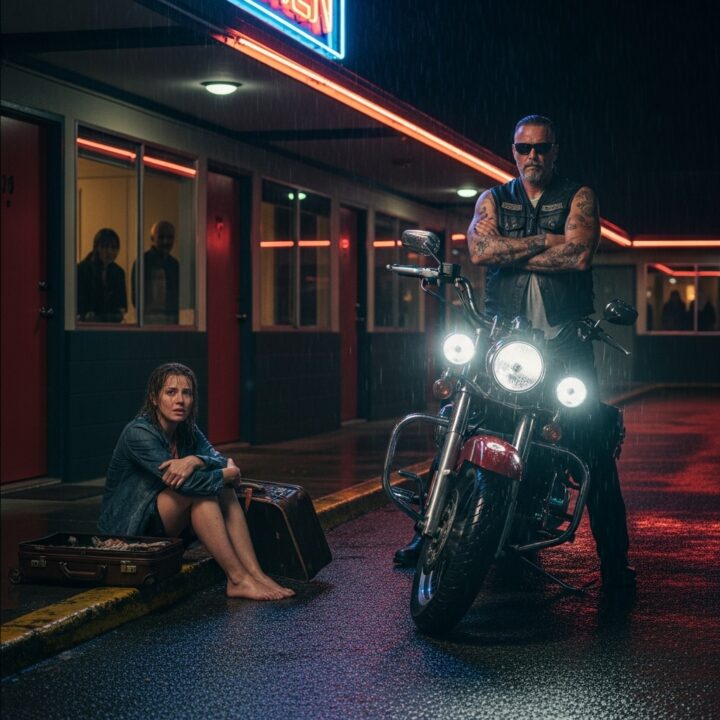
It was past midnight when the woman stumbled onto the wet pavement, a thin jacket clutched around her shoulders. The neon motel sign flickered above her, buzzing like an insect that wouldn’t die. Rain drizzled steadily, soaking her hair, darkening the cuffs of her jeans.
Her suitcase followed her out—thrown, not placed—landing sideways and spilling clothes across the concrete.
She froze.
Cars passed without slowing. Curtains shifted, then stilled. No one opened a door.
She stood there barefoot, shaking, staring at the closed office window where the clerk had already turned away.
That was when the motorcycle rolled in.
The engine cut through the quiet street, deep and heavy. The bike slowed, then stopped across the lot. Headlight on. Engine idling.
The rider didn’t wave.
Didn’t shout.
Didn’t ask anything.
He just stayed there.
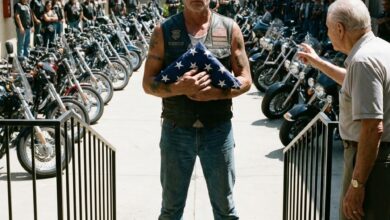
Leather vest. Broad shoulders. Sleeves rolled up, tattoos dark against pale skin. A white man in his late forties, beard streaked with gray, helmet resting on the handlebars.
The woman’s breath caught.
She didn’t know who he was.
Or why he’d stopped.
And neither did anyone else watching from behind glass.
The motel clerk noticed him next.
His face hardened immediately.
“What are you doing here?” he shouted through the cracked office window. “You need to move along.”
The biker didn’t answer.
He leaned back against his bike, arms crossed, rain dripping from his knuckles.
That silence did more damage than words ever could.
A man stepped out of one of the rooms, phone already raised. Another guest whispered something and shook her head. Someone said, “This is how trouble starts.”
From a distance, it looked threatening.
A biker lingering after midnight.
A woman crying on the pavement.
A closed door between them.
The clerk came outside now, chest puffed, voice louder. “You intimidating people? You need to leave before I call the cops.”
Still, the biker said nothing.
He didn’t move closer to the woman.
Didn’t touch her things.
Didn’t even look at the clerk.
He just stayed.
To everyone else, it felt wrong. Suspicious. Dangerous.
Why wasn’t he leaving?
Why was he watching?
Why didn’t he explain himself?
The rain grew heavier. The woman sank onto the edge of the curb, arms wrapped around her knees.
The tension in the lot thickened, heavy and uncomfortable.
Someone finally dialed 911.
Red and blue lights appeared sooner than expected.
A patrol car pulled in, tires hissing on wet asphalt. The officer stepped out slowly, one hand near his belt, eyes moving between the biker and the woman.
“What’s going on here?” he asked.
The clerk spoke first, fast and sharp. “He’s refusing to leave. Standing there like that. Making everyone uncomfortable.”
The officer turned to the biker. “Sir?”
The biker straightened but kept his hands visible. Calm. Measured.
“I’m not bothering anyone,” he said quietly.
The officer frowned. “Then why are you here?”
The biker glanced at the woman. She wouldn’t meet his eyes.
“She doesn’t need to be alone out here,” he said. That was all.
The clerk scoffed. “She was evicted. Not my problem.”
The officer hesitated. People had gathered now, watching from doorways, phones glowing in the rain.
The biker reached into his vest pocket.
The officer stiffened instantly. “Slowly.”
The biker obeyed. Pulled out his phone.
“I’m making a call,” he said evenly.
To whom, he didn’t say.
He dialed, put the phone to his ear, and waited.
No one spoke.
Rain pattered against metal. The motorcycle engine continued its low, steady rumble.
Every second stretched thin.
The sound came before the sight.
Another engine. Then another.
Headlights swept across the motel wall, one after the other, slow and controlled.
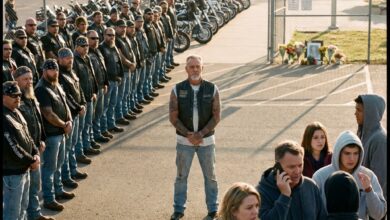
Three motorcycles rolled into the lot. Not fast. Not loud. They parked in a line behind the first bike.
Four riders dismounted in silence.
No shouting.
No posturing.
Just presence.
The crowd went quiet.
The officer’s posture changed—not defensive now, but alert. He recognized the patches on their vests. Not an outlaw club. Something else.
One of the newcomers, a woman with short hair and tired eyes, nodded toward the officer. “Evening.”
They stood together, loose formation, leaving space. Not surrounding anyone. Not blocking exits.
The clerk’s confidence drained from his face.
The biker who’d arrived first stepped aside, revealing the woman on the curb, soaked and shivering.
“That’s her,” he said softly.
The officer looked again—really looked—at the woman. At her bare feet. The suitcase. The time on his watch.
He sighed.
“Sir,” he said to the clerk, “why was she removed?”
The answer came slower this time. Less certain.
The truth unfolded quietly.
The woman had paid for the night.
Her card had declined on a late fee she didn’t know about.
She’d asked for time. She hadn’t been given any.
The officer spoke with the clerk privately. The tone changed. Papers were checked. Policies cited.
No one raised their voice.
A few minutes later, the motel door reopened.
The woman was offered a room.
She didn’t move right away.
The biker crouched down—not too close—and slid a dry towel toward her. “You’re okay,” he said, barely above a whisper.
She nodded, tears streaking through rain.
As people drifted back inside, embarrassed and quiet, the bikers returned to their bikes.
No speeches.
No victory.
The first biker waited until the woman picked up her suitcase and walked back inside.
Then he put on his helmet.
The engines started again, one by one.
As they pulled away, the neon sign flickered once more.
And the lot returned to silence—changed, but pretending it hadn’t been.